
Table of Contents
Table of Contents
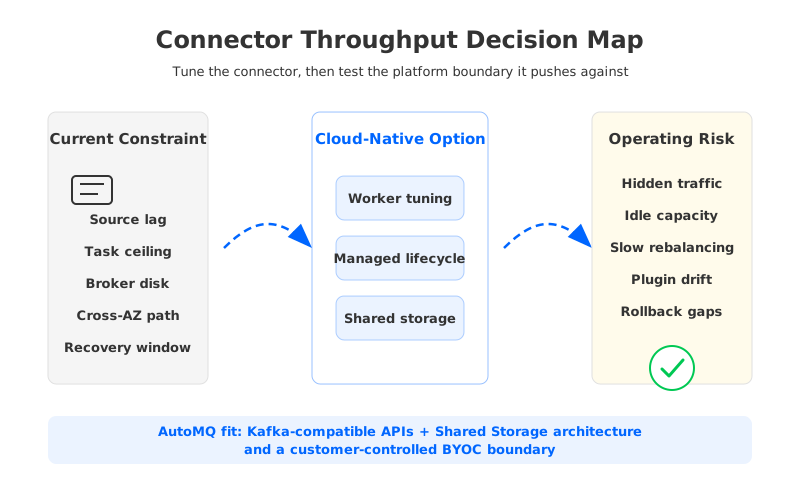
Teams search for connector throughput tuning kafka when a pipeline has stopped being a connector problem and has become a platform problem. The symptom may look narrow: a source connector cannot ingest changes fast enough, a sink connector falls behind during peak hours, or a task restart turns into hours of lag. The first instinct is to raise tasks.max, add workers, and tune batch sizes. Those steps matter, but they do not answer the harder question: where does extra connector throughput become extra Kafka broker load, extra network movement, and extra cloud cost?
That boundary is the real tuning target. Kafka Connect can parallelize work through connectors, tasks, and workers, but every additional record still lands in a Kafka topic, moves through partitions, commits offsets, and waits for downstream consumers. When the Kafka cluster uses broker-local storage, connector growth also means more broker disk planning, more replication traffic, more partition balancing, and more capacity held in reserve for spikes. Good throughput tuning therefore starts with worker settings and ends with an architecture review.
The practical thesis is straightforward: connector throughput is not a single knob. It is a chain of constraints across source systems, Connect workers, Kafka partitions, broker storage, network paths, sinks, and recovery plans. If a team tunes one link while ignoring the others, the bottleneck moves.
1Why Teams Search for connector throughput tuning kafka
Kafka Connect is attractive because it gives data integration teams a common runtime for source and sink connectors. A source connector reads from an external system and writes records into Kafka. A sink connector reads from Kafka and writes to another system. The Connect framework splits connector work into tasks, stores operational state in Kafka topics, and lets workers coordinate distributed execution through the Kafka group protocol. That model is documented in Apache Kafka and remains one reason teams standardize on the Kafka ecosystem.
Throughput pressure appears when the integration estate grows beyond one or two pipelines. A CDC connector may start with a few tables and expand to hundreds. A sink connector may move from hourly analytics to near-real-time operational use. A governance team may require longer retention for replay and audit. A platform team may isolate connectors by domain, which improves ownership but increases the number of workers, internal topics, and network paths to operate.
The visible tuning questions are familiar:
- How many tasks can the connector use? Some connectors can split work across tables, topic partitions, shards, or file partitions. Others have a hard limit because the source system exposes a single ordered stream.
- How large should batches be? Larger batches can improve throughput, but they may increase memory pressure, retry cost, or end-to-end latency.
- How many Kafka partitions are needed? Partitions create parallelism for producers, Connect tasks, and consumers, but each partition also adds metadata, file, and operational overhead.
- Where should workers run? Worker placement determines network distance to the source, Kafka brokers, and destination.
Those questions are incomplete. The team is rarely tuning for raw connector speed alone. They are tuning for sustainable throughput: the ingestion or export level that the platform can hold during peak load, recover after failure, observe during incidents, and pay for every month.
2The Production Constraint Behind the Problem
Connector tuning becomes difficult because the data path crosses ownership boundaries. The database team owns source load and replication slots. The data platform team owns Connect workers and Kafka topics. SRE owns broker health, network cost, and incident response. Application teams own downstream correctness. A setting that helps one team can increase risk for another.
Consider a source connector that is falling behind. Increasing task parallelism may help if the source can be split safely and Kafka has enough partitions. It may also multiply connections to a production database, produce more small batches, and create burstier broker writes. Increasing producer batching may reduce per-record overhead, but it changes memory usage and failure retry behavior. Adding workers may remove CPU pressure from Connect while exposing a broker storage bottleneck that was previously hidden.
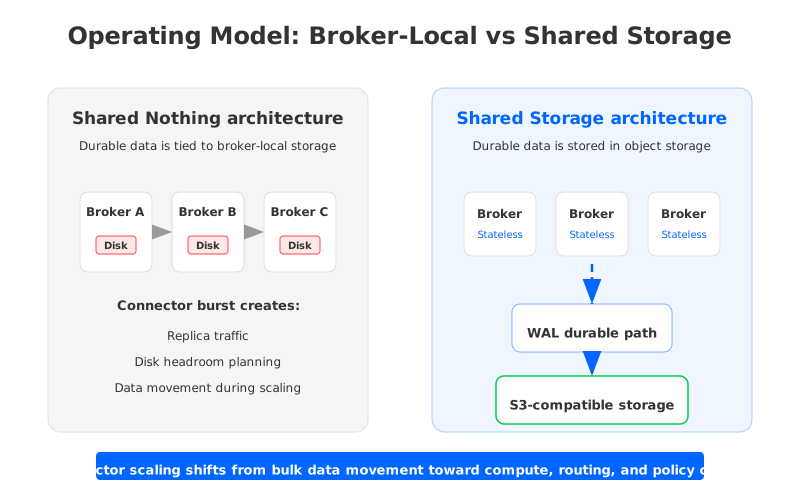
Traditional Kafka clusters make that boundary sharper because durable data is tied to broker-local storage. In a Shared Nothing architecture, each broker owns local log segments for its partition replicas. Reliability comes from replication between brokers through ISR (In-Sync Replicas). When connector traffic grows, the platform team must account for write traffic, replicated traffic, read traffic, catch-up traffic, and operational movement during reassignment or broker replacement.
That is why connector tuning often turns into a spreadsheet. The connector team asks for higher throughput. The Kafka team asks about partitions, retention, replication factor, fan-out, and growth curve. The cloud team asks which Availability Zones the traffic crosses and whether the same data is moving multiple times. The security team asks whether the data stays inside the expected VPC or private network path.
The important point is not that Shared Nothing architecture is flawed. It is a proven design, and it remains appropriate for many environments. The issue is that cloud data integration workloads make its operational costs visible. Storage capacity must be provisioned near brokers. Replication consumes network bandwidth. Scaling out often requires reassignment work. Connector bursts can force teams to reserve capacity that sits idle outside peak windows.
3Architecture Options and Trade-Offs
A platform team evaluating connector throughput has several architecture choices. The right answer depends on whether the main constraint is connector runtime, Kafka broker capacity, cloud networking, governance, or migration risk. A useful evaluation avoids treating "managed" as a complete answer, because managed workers do not automatically remove Kafka storage and network constraints.
| Option | What improves | What still needs attention |
|---|---|---|
| Tune existing Kafka Connect workers | Faster progress when CPU, memory, batching, or task allocation is the bottleneck | Broker storage, partition count, source limits, destination throttling, and network cost |
| Add dedicated Connect clusters | Better isolation between high-volume pipelines and smaller jobs | More worker fleets, more monitoring surfaces, and duplicated operational patterns |
| Use a managed connector service | Less worker lifecycle work and simpler deployment for supported connectors | Service limits, private networking, connector catalog fit, cost units, and Kafka platform capacity |
| Revisit Kafka platform architecture | Better control of storage, scaling, recovery, and network economics | Migration planning, compatibility validation, and team readiness |
This table is intentionally neutral. A team with a stable set of connectors and strong Kafka operations may only need worker-level tuning. A team with many small connector jobs may benefit from managed lifecycle control. A team whose connector throughput creates repeated Kafka broker scaling events should evaluate the broker architecture itself: Connect workers execute connector code, while Kafka brokers store and serve the records those connectors produce or consume. If broker-local storage, replication, or cross-zone traffic is the bottleneck, worker tuning mostly moves pressure downstream.
4Evaluation Checklist for Platform Teams
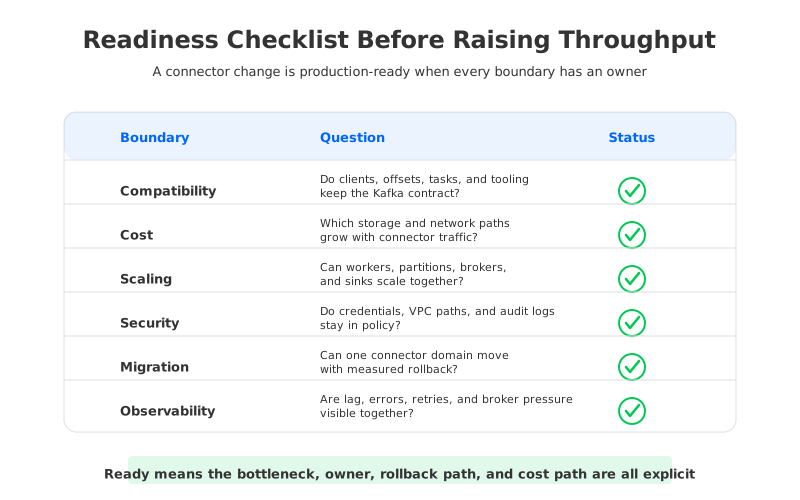
A connector throughput review should start with the pipeline path, not the connector setting page. The goal is to identify which boundary will fail first under load and which team owns the fix.
- Compatibility boundary. List the Kafka APIs and ecosystem components the workload depends on: producers, consumers, consumer groups, transactions, Kafka Connect internal topics, AdminClient automation, ACLs, Schema Registry workflows, and observability tools. A platform change is easier when this contract stays stable.
- Source and sink boundary. Confirm whether the source can be read in parallel and whether the sink can absorb bursts. A connector cannot safely out-tune a database, SaaS API, object store, or warehouse that applies its own limits.
- Partition boundary. Map connector tasks to Kafka partitions. More tasks do not help when all records must preserve one ordering key or when the target topic has too few partitions for downstream parallelism.
- Storage boundary. Estimate retention, replay requirements, compaction, internal topic growth, and catch-up reads. Connector throughput often increases the need for replay, which increases the amount of data Kafka must keep available.
- Network boundary. Trace the source-to-worker, worker-to-broker, broker-to-broker, broker-to-sink, and observability paths. Cloud pricing pages and private connectivity documentation should be part of the design review because data movement is an architectural cost, not an accounting detail.
- Failure boundary. Define what happens when a worker dies, a broker is replaced, a task is retried, a destination throttles writes, or a migration rollback is needed. Throughput that cannot recover is borrowed reliability.
- Governance boundary. Verify where credentials live, where records travel, which accounts own the data plane, and how audit logs are retained. Data integration pipelines often cross regulated systems, so the network boundary is also a compliance boundary.
This checklist tends to reveal one of three patterns. In the first pattern, the connector is the bottleneck, and local tuning is enough. In the second, Kafka has enough headroom, but worker placement or network routing is creating avoidable cost. In the third, connector growth is exposing a deeper mismatch between a dynamic integration workload and a broker architecture that depends on local persistent storage.
5How AutoMQ Changes the Operating Model
The architectural requirement is not "make connectors faster" in isolation. It is more specific: keep the Kafka contract that connectors and applications already use, while reducing broker-local state, data movement, and reserved capacity.
AutoMQ fits that category as a Kafka-compatible, cloud-native streaming platform built around Shared Storage architecture. It keeps the Kafka protocol and ecosystem surface familiar for producers, consumers, and Kafka Connect, while durable stream data is stored in S3-compatible object storage through S3Stream and AutoMQ Brokers handle compute, request processing, caching, and routing as stateless brokers.
That change matters for connector throughput because the broker is no longer the long-term home of partition data. In a traditional cluster, scaling broker capacity can imply moving local partition replicas and planning disk headroom. In AutoMQ, persistent data lives in shared object storage, WAL storage absorbs the immediate durable write path, and broker changes are closer to traffic and ownership changes than bulk data-copy operations.
For connector teams, the benefit is operational rather than magical. A poorly configured connector can still overload a source database. A sink can still throttle writes. A topic with the wrong partitioning strategy can still limit parallelism. What changes is the platform boundary around the connector estate:
- Kafka compatibility stays central. Existing Kafka-oriented pipelines can validate against the same broad contract: records, offsets, consumer groups, topic configuration, Kafka Connect behavior, and operational tooling.
- Storage scaling is less tied to broker disks. Retention and replay planning move toward object-storage-backed capacity rather than broker-local disk expansion.
- Broker replacement and rebalancing become lighter operations. Stateless brokers reduce the amount of data movement associated with changes in compute capacity.
- BYOC keeps network ownership explicit. In AutoMQ BYOC, the control plane and data plane run in the customer's cloud account and VPC, which helps platform teams keep connector traffic inside the intended security and cost boundary.
- Managed Connector narrows the worker operations surface. AutoMQ Managed Connector is built on Apache Kafka Connect and is designed to manage connector deployment and scaling while fitting the same customer-controlled environment model.
The network story is especially relevant for high-throughput connector estates. AutoMQ documents patterns for zero cross-AZ traffic in supported deployments and for managed connector routing that is aware of zone placement. The practical result is not that teams can ignore network design. It is that network design becomes a first-class platform capability instead of a collection of one-off worker placement decisions.
Migration planning should still be deliberate. Start with one connector domain, validate plugin compatibility, replay behavior, task parallelism, internal topics, credentials, and monitoring. Then test worker restart, broker replacement, destination throttling, and rollback. AutoMQ Kafka Linking can help teams migrate Kafka workloads while preserving offsets in supported scenarios, but connector estates deserve their own validation plan.
6FAQ
6.1What is the first setting to check for connector throughput tuning in Kafka?
Start with whether the connector can actually parallelize. tasks.max helps only when the connector and source system can split work safely. After that, check batch settings, worker CPU and memory, target topic partition count, source limits, sink limits, and Kafka broker headroom.
6.2Does adding Kafka Connect workers always increase throughput?
No. More workers help when worker resources or task distribution are the bottleneck. They do not fix a single-threaded source stream, too few Kafka partitions, destination throttling, broker storage saturation, or network cost created by poor placement.
6.3How many Kafka partitions should a connector topic have?
There is no universal partition count. The right number depends on required task parallelism, ordering keys, downstream consumer parallelism, throughput, retention, and operational overhead. Increasing partitions can improve parallelism, but also increases metadata and operational surface area.
6.4When should connector teams evaluate Kafka platform architecture?
Evaluate platform architecture when connector growth repeatedly forces broker disk expansion, partition reassignment, cross-zone traffic reviews, long recovery windows, or large amounts of idle reserved capacity. Those are signs that the connector estate is stressing the storage and network model, not only the worker runtime.
6.5Can AutoMQ run existing Kafka Connect pipelines?
AutoMQ is Kafka-compatible, and AutoMQ Managed Connector is built on Apache Kafka Connect. Teams should still validate each plugin, dependency, credential model, source and sink network path, internal topic behavior, and rollback procedure before moving production pipelines.
7Conclusion
The next time a connector falls behind, the right question is not only which Kafka Connect knob to turn. Ask where the extra throughput will land: on the source, on the worker, on broker storage, on replicated traffic, on the sink, or on the monthly cloud bill. That map turns connector tuning from a local firefight into a platform decision.
If your team is evaluating a Kafka-compatible platform for high-throughput connector workloads, review AutoMQ BYOC and Managed Connector through the same boundaries: compatibility, source and sink behavior, storage, network, failure recovery, governance, and migration. You can start from the AutoMQ technical overview and validate the architecture against one production connector domain before widening the rollout.
8References
- Apache Kafka Documentation: Kafka Connect
- Apache Kafka Documentation: Consumer Groups and Offsets
- Apache Kafka Documentation: Transactions
- AutoMQ Documentation: Shared Storage Architecture
- AutoMQ Documentation: S3Stream Shared Streaming Storage
- AutoMQ Documentation: WAL Storage
- AutoMQ Documentation: Kafka Connect
- AutoMQ Documentation: Inter-Zone Traffic
- AutoMQ Documentation: Kafka Linking
- AWS Documentation: Data Transfer Charges


