
Table of Contents
Table of Contents
Teams usually search for cross account connector networking kafka after a clean whiteboard design hits real cloud boundaries. The connector runs in one account, Kafka sits in another, the source database lives behind a private subnet, and security wants to know which route, identity, key, endpoint, and log stream owns the evidence. The question is no longer "Can the connector reach Kafka?" It is "Can this path survive production governance without turning every pipeline into a custom exception?"
Kafka Connect gives teams a standard way to move data between Kafka and external systems through workers, connectors, and tasks. Cross-account networking adds ownership. A connector task may be healthy while the platform still has unclear responsibility for PrivateLink endpoints, VPC peering, DNS, IAM roles, security groups, TLS certificates, logs, and cloud data transfer charges.
The useful way to evaluate the problem is to separate the connector runtime from the Kafka platform underneath it. Connector teams care about plugin behavior, offsets, retries, snapshots, and task scaling. Platform teams care about broker capacity, storage growth, failure recovery, and network bills. A production design has to satisfy both groups at the same time, because connector traffic is not a side path; for CDC, reverse ETL, and operational analytics, it often becomes one of the heaviest Kafka workloads in the environment.
1Why Teams Search for cross account connector networking kafka
The phrase sounds narrow, but it usually points to a broad platform decision. A data integration team may want a managed connector runtime in a separate account from the database. Security may require that no public endpoint sits between connector and Kafka. A central platform team may run one Kafka service for many application accounts. FinOps may see transfer, endpoint, NAT, and replication charges spread across accounts and ask who owns them.
These searches often appear after a first connector succeeds. The first pipeline uses a small topic, a friendly database, and a permissive network. The fifth pipeline adds a high-volume CDC source. The tenth pipeline adds a regulated sink. Then the original network model becomes the shared constraint for every future integration. If each connector needs a different route, exception, or ownership pattern, the platform loses the main benefit of standardizing on Kafka Connect.
The initial checklist is simple:
- Data path: Which account hosts the connector workers, the Kafka brokers, the source or sink system, and the object storage or log storage behind the platform?
- Control path: Which system creates connector tasks, updates plugins, rotates credentials, and approves runtime changes?
- Failure path: If the connector lags, duplicates records, or loses access to a source, which team can see the offsets, worker logs, broker health, and network telemetry together?
- Cost path: Which account pays for private endpoints, NAT gateways, cross-AZ or cross-region transfer, broker storage, retention, and replay traffic?
If the design cannot name those four paths, adding a managed service may hide the problem rather than solve it.
2The Production Constraint Behind the Problem
Traditional Kafka uses a Shared Nothing architecture. Each broker owns local storage, each partition has a leader, and durability comes from replication across brokers. This model is mature and well understood, but it turns some cloud operations into data movement. Scaling, rebalancing, replacing brokers, and maintaining replicas all interact with broker-local data. When connector traffic grows, the broker layer has to absorb not only produce and fetch requests, but also storage, replication, and reassignment pressure.
Cross-account connector networking makes that pressure more visible. A source connector may write continuously from a database in one VPC to Kafka brokers in another. A sink connector may read retained data during backfill and push it to an analytics system in a third account. If the Kafka cluster is deployed across Availability Zones for resilience, the platform also has to account for where producers, consumers, leaders, followers, and connector workers sit. A private endpoint protects the route, but it does not automatically remove cross-AZ or broker replication traffic.
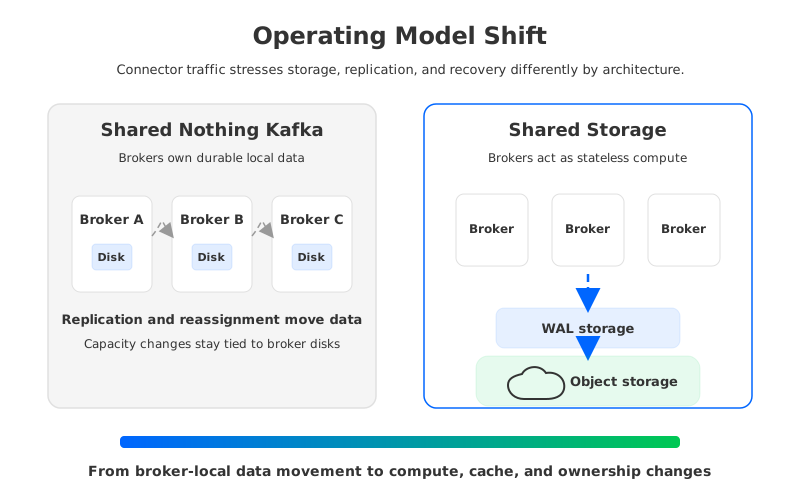
The harder issue is capacity coupling. Connector tasks can scale independently, but their traffic still lands on Kafka partitions. A bursty connector estate can create broker CPU pressure, disk pressure, network pressure, or Consumer group lag. With broker-local storage, retention and replay-heavy connectors can keep old partitions tied to broker disks, so teams reserve capacity early and treat many operational changes as maintenance events.
Shared Nothing Kafka is not wrong. Cross-account connector networking should be evaluated as a system boundary, not a connectivity feature. Low-volume, stable connector estates may prefer self-managed control. Many-account environments with strict governance may need a platform model that reduces moving parts around storage and network placement.
3Architecture Options and Trade-offs
There are four common patterns for cross-account connector networking. The right choice depends on operational control.
| Pattern | What it solves | What still needs review |
|---|---|---|
| Self-managed Kafka Connect near the source | Keeps connector workers close to databases and private services. The data team controls plugins and worker images. | Broker capacity, internal Connect topics, worker upgrades, network routes to Kafka, and incident ownership stay with the platform team. |
| Central connector runtime near Kafka | Simplifies worker governance and may reduce Kafka-side networking complexity. | Source and sink access can become harder across accounts, especially for private databases or tightly scoped IAM roles. |
| Managed connector service with private networking | Reduces worker lifecycle work and can standardize connector creation. | Teams must verify data path ownership, endpoint pricing, supported plugins, credential handling, logs, and failure visibility. |
| Kafka-compatible BYOC platform with managed connectors | Places runtime resources inside a customer-controlled cloud boundary while preserving Kafka client behavior. | Requires review of the vendor's control path, support access, IAM permissions, observability export, and platform-specific migration plan. |
The table is not a ranking. It avoids comparing a worker feature with a platform boundary. A managed connector catalog may be valuable, but it does not answer whether retained Kafka data sits in the customer's account. A BYOC streaming platform may improve data ownership, but connector plugins, offsets, and security settings still need testing.
Cost modeling should follow the same discipline. Map traffic before using a single connector price or broker hourly rate:
- Connector-to-source traffic: CDC snapshots, log reads, batch backfills, and sink writes may have different route and transfer charges.
- Connector-to-Kafka traffic: Produce, fetch, retry, and rebalance behavior can cross VPC, account, AZ, or regional boundaries depending on placement.
- Kafka-internal traffic: Broker replication, partition reassignment, tiered storage movement, or shared-storage writes belong in the platform model.
- Operational traffic: Logs, metrics, plugin artifacts, control APIs, and support access may be small in volume but important for governance.
Cloud pricing pages for data transfer and private endpoints should be checked at design time because rates and included traffic rules vary. The architecture point is stable: private connectivity is a route choice, while storage architecture determines how much Kafka-internal data movement the route must carry.
4Evaluation Checklist for Platform Teams
The evaluation should begin with compatibility, because connector networking is useful only if Kafka behavior remains intact. Test producers, consumers, Consumer groups, offsets, transactions if used, Kafka Connect internal topics, ACLs, TLS, Schema Registry workflows, and admin tooling. A platform can pass a simple produce-consume test and still fail if Connect workers cannot create internal topics, commit offsets reliably, or recover task status.
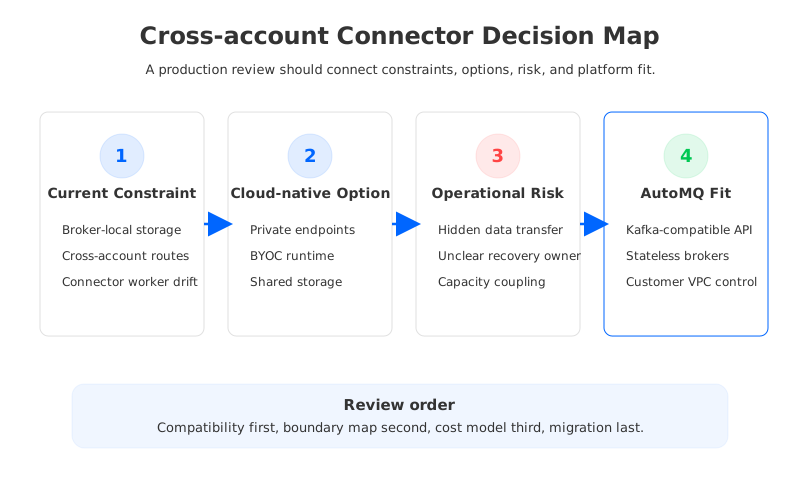
After compatibility, draw the boundary map: where each component runs, which account owns it, which network path it uses, and which team can change it. The useful review question is not "Is the route private?" It is "Can we prove where data, metadata, credentials, and operational evidence move during normal operations and failure recovery?"
The decision matrix should include seven dimensions:
| Dimension | Production question |
|---|---|
| Compatibility | Can existing Kafka clients, Connect workers, plugins, and operational tools keep their expected behavior? |
| Network boundary | Are connector, broker, source, sink, storage, and observability paths explicitly mapped across accounts and VPCs? |
| Cost boundary | Are endpoint, NAT, data transfer, storage, retention, replay, and operational costs assigned to owners? |
| Elasticity | Can connector workers and Kafka capacity scale without long data movement or manual partition planning? |
| Governance | Are IAM roles, ACLs, secrets, plugin approvals, audit logs, and support permissions reviewable? |
| Recovery | Can teams restore connectors, offsets, internal topics, and Kafka availability after worker, broker, network, or source failure? |
| Migration | Is there a reversible path for moving connectors or Kafka workloads without rewriting applications? |
This framework creates a useful separation. If the main risk is connector plugin behavior, focus on Kafka Connect validation and worker operations. If the main risk is account boundary and private access, focus on network ownership. If the main risk is broker scaling, retention, and internal data movement, the Kafka platform architecture deserves equal attention.
5How AutoMQ Changes the Operating Model
Once the evaluation points to Kafka compatibility plus customer-controlled cloud boundaries, AutoMQ becomes relevant as a Kafka-compatible, cloud-native streaming platform built around Shared Storage architecture. Producers, consumers, topics, partitions, offsets, Kafka Connect, and ecosystem tools can be validated against familiar Kafka semantics. Under that contract, AutoMQ moves durable storage away from broker-local disks and into S3-compatible object storage through S3Stream, WAL storage, and data caching.
For connector-heavy environments, that changes the operating model. Brokers are stateless, so scaling and recovery focus more on compute, leadership, cache, and traffic placement than copying retained partition data between disks. Object-storage-backed durability reduces traditional broker-to-broker replica movement. AutoMQ BYOC places the control plane and data plane in the customer's cloud account and VPC, aligning Kafka with the same governance model used for databases, IAM, buckets, logs, and private routes.
AutoMQ managed Kafka Connect extends that boundary to connector operations. In AutoMQ BYOC, Connect Workers run in the user's EKS cluster inside the specified VPC, and connector tasks can be created through AutoMQ Console or Terraform. The connector runtime can sit inside the customer's network environment while the platform still provides managed lifecycle operations. Teams still configure IAM roles, service accounts, plugin versions, ACL credentials, and metrics export, but those controls map to inspectable resources.
Connector networking does not become automatic. Cross-account designs still require route tables, endpoint policies, DNS, security groups, certificates, and access reviews. The difference is narrower: AutoMQ lets teams evaluate connector networking without accepting broker-local storage as a fixed constraint.
6A Readiness Scorecard
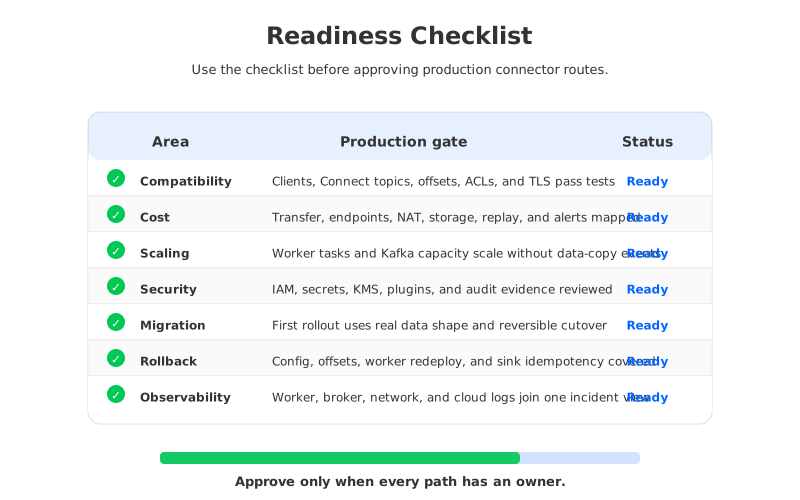
Before approving production, mark each item ready, partial, or blocked.
| Area | Ready means |
|---|---|
| Kafka behavior | Representative producers, consumers, Consumer groups, offsets, transactions if used, and Connect internal topics pass failure tests. |
| Connector runtime | Worker placement, plugin packaging, task scaling, restart behavior, and logging are owned by a named team. |
| Private networking | Every data, control, observability, and support path is drawn with account, VPC, subnet, endpoint, and DNS ownership. |
| Cost model | Data transfer, endpoint, NAT, storage, replay, retention, and operational costs have owners and budget alerts. |
| Security | IAM, ACLs, TLS, secrets, KMS, plugin approvals, and audit evidence are reviewed before production data flows. |
| Recovery | Rollback covers connector config, offsets, worker redeploys, Kafka availability, source resume points, and sink idempotency. |
| Migration | The first rollout uses a low-risk connector but includes real data shape, real credentials, and real network paths. |
The search started with connector networking, but the decision ends at platform boundaries. If your design keeps Kafka semantics, makes the network path visible, and assigns cost ownership before the first backfill, cross-account connectors can become a repeatable platform capability rather than a set of one-off exceptions. If you want to evaluate that model with a Kafka-compatible BYOC architecture, talk to the AutoMQ team with your connector topology, VPC boundaries, and migration constraints.
7FAQ
7.1What is cross account connector networking in Kafka?
It is the network and ownership model for running Kafka Connect or connector workloads across cloud accounts, VPCs, private endpoints, databases, Kafka clusters, and observability systems. The main challenge is not basic connectivity; it is making data paths, control paths, costs, and recovery ownership explicit.
7.2Is PrivateLink enough for Kafka connector networking?
PrivateLink-style connectivity can provide private access to a service endpoint, but it does not by itself define connector worker placement, source access, Kafka storage architecture, cross-AZ traffic behavior, logs, IAM, or incident ownership. Treat it as one part of the boundary map.
7.3Should connectors run near Kafka or near the source system?
Run them near the constraint that is hardest to govern. CDC sources with strict private access often benefit from workers close to the source. High-volume sink workloads or centrally managed plugins may benefit from workers close to Kafka. The final decision should include cost, security, failure recovery, and operational ownership.
7.4How does AutoMQ fit cross-account connector networking?
AutoMQ fits when teams want Kafka-compatible streaming, customer-controlled BYOC deployment boundaries, managed connector operations, and a Shared Storage architecture that reduces broker-local data movement. It should still be validated with the actual connectors, traffic, IAM policies, and failure scenarios.
8References
- Apache Kafka Documentation
- Apache Kafka Documentation: Kafka Connect
- Apache Kafka Documentation: Consumer Groups
- Apache Kafka Documentation: Transactions
- Apache Kafka Documentation: KRaft
- AutoMQ Documentation: Architecture Overview
- AutoMQ Documentation: Managed Kafka Connect
- AutoMQ Documentation: BYOC Environment Overview
- AutoMQ Documentation: Eliminating Cross-AZ Traffic
- AWS PrivateLink Pricing
- AWS EC2 On-Demand Pricing: Data Transfer


