
Table of Contents
Table of Contents
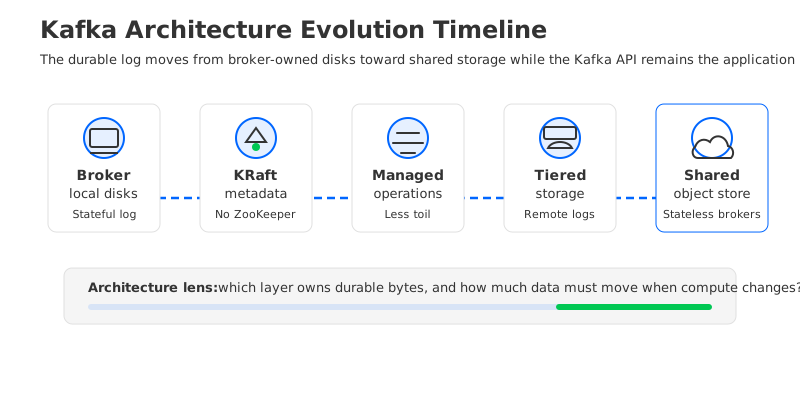
The serious architecture question around Kafka is no longer whether Kafka works. It does. The question is whether the next generation of Kafka architecture should continue around broker-local disks, or whether durable stream storage should move into a shared storage layer while brokers become elastic compute.
That question matters because many Kafka clusters were designed under assumptions that cloud platforms have changed. Traditional Kafka was built around a strong idea: put partitions on brokers, replicate them across brokers, and let each broker own its local log segments. The design succeeded because it matched the infrastructure around it.
Cloud infrastructure changes the pressure points. Storage is no longer only a disk attached to a server. Availability zones introduce explicit failure domains and network cost tradeoffs. Kubernetes encourages replaceable compute. Serverless platforms train application teams to expect capacity that follows workload demand. Kafka can still run in this environment, but broker disks become the hinge point in scaling, recovery, placement, retention, and cost.
1The Architecture Question Behind Cloud-Native Kafka
A useful way to evaluate next-generation Kafka architecture is to ask which layer owns durable bytes. In traditional Apache Kafka, the broker owns them. Each topic partition has replicas, each replica lives on a broker, and each broker stores log segments in local log directories. When brokers are added, removed, or replaced, the architecture must account for where replicas live and how much data needs to move.
This is not a flaw in historical context. It is why Kafka became a reliable distributed log. The local-disk model gives producers and consumers a direct path to broker storage, makes partition leadership concrete, and gives operators familiar levers: disk capacity, replication factor, retention, and reassignment.
The difficulty appears when cloud platform teams expect Kafka to behave like other elastic services. A compute service can add instances and immediately gain capacity. A stateless API can replace a failed pod without restoring a large local dataset. Traditional Kafka does not map cleanly to those expectations because compute and durable storage responsibilities are attached to the same broker.
The evaluation lens is therefore architectural, not ideological. Broker-local disks are a coupling point, and the next-generation Kafka architecture discussion asks whether that coupling still fits the operating model enterprises want.
2Why Broker-Local Disks Are Under Pressure
Most Kafka pain in the cloud has a common root: durable data is tied to broker identity. A broker is not only a process that handles Kafka protocol requests; it is also a storage owner. Once that is true, ordinary platform operations become data operations.
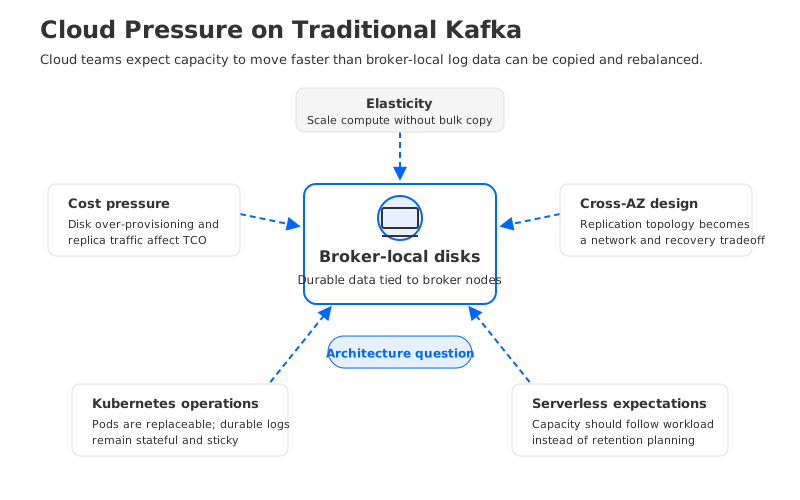
Consider the pressure points architects usually encounter first:
- Cost and over-provisioning. Kafka capacity often sizes brokers for CPU, network, disk throughput, disk capacity, and retention together. When one dimension grows faster, the cluster may need larger brokers or more brokers even if other resources are underused.
- Elasticity. Adding brokers does not automatically move existing partition data to them. Scaling out can require reassignment, throttling, monitoring, and careful leadership movement. Scaling in is even more constrained because replicas must be moved away before brokers can be removed.
- Cross-AZ design. Multi-zone availability improves resilience, but it also makes replica placement and network paths part of the cost and recovery model. Teams need to know where data is copied, where leaders run, and how failure domains interact with broker storage.
- Kubernetes operations. StatefulSets and PersistentVolumes help Kubernetes run stateful workloads, but they do not make Kafka stateless. A pod can be rescheduled, yet the underlying broker identity and log data still need to be preserved, reattached, or rebuilt.
- Serverless expectations. Application teams increasingly expect infrastructure to absorb bursts without long capacity projects. Kafka can be automated, but broker-local durable storage makes true workload-proportional elasticity harder.
None of these pressures imply that every Kafka cluster must be redesigned immediately. They do suggest that a cloud-native Kafka architecture review should start with storage ownership. If scaling delays or cost surprises trace back to broker disks, improving the control plane alone may not be enough.
3Three Evolution Paths
Enterprise Kafka architectures are evolving along three broad paths. They overlap in practice, but they solve different problems. Treating them as interchangeable is where many platform roadmaps become muddled.
| Path | What it changes | What it does not change |
|---|---|---|
| Managed operations | Who operates Kafka and how automation is packaged | Broker-local log ownership may still remain |
| Tiered storage / remote log storage | Where older log segments can be stored | Hot-path storage and broker identity are still important |
| Shared storage with stateless brokers | Which layer owns durable stream storage | Requires validation of the storage engine and migration model |
The first path is operational: let a provider, operator, or platform team automate more of Kafka. The second path is retention-oriented: reduce local disk pressure by moving completed log segments to remote storage. The third path is architectural: move durable stream storage into shared storage so brokers are no longer the permanent home of log data.
3.1Managed Kafka Operations
Managed Kafka services and Kubernetes operators can remove a large amount of toil. They help with provisioning, upgrades, certificates, monitoring, topic workflows, rolling changes, and incident response. For many organizations, that is the highest-return move because the bottleneck is not Kafka architecture; it is the ability to run Kafka consistently.
Managed operations also have a limit. They can hide mechanics from the user, but they do not necessarily change them. If the underlying architecture still stores durable partition replicas on broker-local disks, then scaling, retention, and recovery still have to account for disk ownership somewhere. A provider may automate reassignment, but the bytes still move.
Managed operations should therefore be evaluated as an operating model improvement, not automatically as storage-compute separation. It can be exactly what a team needs when the current pain is staffing, process maturity, or upgrade risk. It is less likely to solve an issue dominated by disk growth, long rebalances, or storage-driven scale decisions.
3.2Tiered Storage and Remote Log Storage
Apache Kafka tiered storage, also described as remote log storage, addresses a real problem: retention can grow far beyond the amount of data that needs to stay on fast local disks. By moving older log segments to a remote tier, teams can reduce local broker disk pressure for long retention workloads while preserving Kafka's log abstraction.
This is an important step in Kafka's cloud evolution. Retention-heavy topics are common in analytics, audit, replay, and event sourcing. Keeping every retained byte on broker-local storage can force teams to scale brokers for data age rather than active throughput. A remote tier changes that equation by separating older data from the hottest local path.
The boundary is equally important. Tiered storage does not necessarily make brokers stateless. The broker still serves as the Kafka data-plane node, handles active segments, participates in leadership and replication, and retains local storage responsibilities. If the primary goal is longer retention at a more appropriate storage tier, tiered storage may be enough. If the goal is replaceable compute nodes, tiering alone may not reach the target.
3.3Shared Storage and Stateless Brokers
The shared-storage path asks a deeper question: what if durable Kafka log data is not permanently owned by individual brokers? In that model, brokers keep the Kafka protocol surface, serve producers and consumers, manage cache and compute responsibilities, and coordinate with metadata. Durable stream storage lives in a shared storage layer, often object storage, with a write path designed to preserve streaming durability and ordering requirements.
This is where terms like Kafka shared storage, stateless Kafka, Kafka object storage, and Kafka storage compute separation become specific. A stateless broker architecture does not mean the system has no state. It means durable stream state is no longer bound to a particular broker disk. That can change the operational contract: broker replacement becomes less about restoring a large local log, scaling can focus on serving capacity, and storage growth follows the shared storage layer.
The tradeoff moves into the storage engine. Object storage has different latency, consistency, request, and throughput characteristics than local SSDs. A serious shared-storage Kafka implementation must handle write-ahead durability, metadata mapping, caching, hot reads, catch-up reads, compaction, and failure recovery. The architecture is credible only if those details are engineered and measured.
4Where AutoMQ Fits in the Shared-Storage Path
AutoMQ is one implementation of the shared object storage path: a Kafka-compatible streaming platform that keeps the Kafka API and ecosystem surface while replacing the traditional broker-local storage architecture with S3Stream, an object-storage-backed shared streaming storage layer. In architectural terms, AutoMQ is not asking teams to replace Kafka clients, Kafka Connect, or Kafka Streams. It is changing where durable log storage lives.
That distinction is the reason AutoMQ belongs later in the evaluation, after the storage ownership question is clear. If the problem is unfamiliar operations, a managed layer may be the right first move. If the problem is long retention on local disks, tiered storage may deserve a pilot. If every scaling, recovery, and cost decision is constrained by broker-local durable data, then a Kafka-compatible shared-storage architecture becomes more relevant.
In AutoMQ's architecture, brokers are designed as a compute layer while S3Stream provides the shared storage layer on object storage. The practical claim to evaluate is whether a Kafka-compatible system can preserve the interfaces your applications depend on while changing the storage model enough to improve elasticity, recovery behavior, and capacity discipline.
An enterprise evaluation should include familiar Kafka tests and storage-specific tests:
- Validate client compatibility, Kafka Connect behavior, Kafka Streams workloads, topic operations, consumer group behavior, and observability integration.
- Test producer latency, consumer replay, catch-up reads, failure recovery, broker replacement, scale-out, scale-in, and object storage dependency behavior.
- Compare migration patterns by workload, not only by cluster. Some topics may be stable and low-risk; others may need more careful sequencing because of retention, ordering, or consumer lag sensitivity.
- Review deployment model, data control, networking, encryption, and compliance requirements.
This framing keeps the evaluation honest. AutoMQ can be a strong candidate when the target architecture is Kafka-compatible storage-compute separation, but it should still be tested against production-shaped workloads and failure modes.
5Roadmap for Architecture Evaluation
The safest roadmap is staged. A next-generation Kafka architecture does not need to begin with a dramatic migration. It should begin with a clear diagnosis of which constraint is hurting the platform.
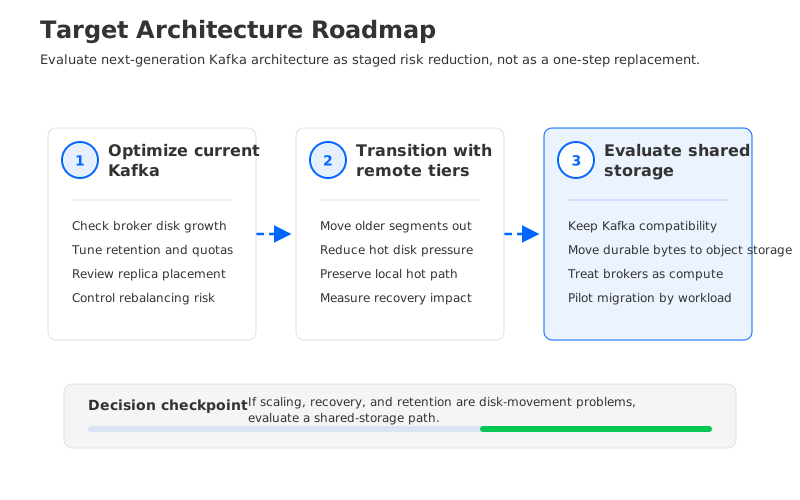
Start with short-term optimization. Measure disk utilization, partition distribution, leader placement, replication traffic, retention settings, latency, consumer lag, and reassignment frequency. Many clusters have immediate improvements available through better partitioning, retention tuning, broker sizing, and operational discipline. These changes create the baseline needed for any architecture decision.
Move next to transition options. Tiered storage can be a practical bridge for retention-heavy workloads because it reduces the need to keep older segments on broker disks. Managed services or operators can reduce operational risk when the platform team is spending too much time on upgrades and lifecycle management. These options may not produce stateless Kafka, but they can reduce pressure while the team defines its target model.
Then evaluate the long-term architecture. If the direction is elastic, cloud-native, Kubernetes-aligned, or serverless-like streaming infrastructure, the target architecture should ask whether brokers should continue to own durable storage. The answer may vary by workload: stable clusters may remain on traditional Kafka, while bursty, retention-heavy, multi-AZ, or fast-growing workloads may be better candidates for shared object storage and stateless brokers.
The decision table should look less like a vendor scorecard and more like an architecture review:
| Evaluation question | Traditional broker disks | Tiered storage | Shared storage / stateless brokers |
|---|---|---|---|
| Who owns durable log data? | Individual brokers | Brokers plus remote tier for older segments | Shared storage layer |
| What improves first? | Familiarity and direct local path | Retention and local disk pressure | Elasticity, recovery model, storage-compute separation |
| What remains hard? | Reassignment, disk growth, broker replacement | Hot-path coupling and broker state | Storage engine validation and migration design |
| Best first pilot | Stable workload with known capacity | Retention-heavy topic | Workload constrained by scaling or recovery |
The most useful architecture conclusion may be modest: do not force one Kafka model onto every workload. Keep traditional Kafka where it is reliable and economically acceptable. Use tiered storage where retention is the core issue. Evaluate shared-storage Kafka where broker-local disks limit the future operating model.
The opening question now has a practical answer. Next-generation Kafka architecture does not have to abandon Kafka's API, ecosystem, or log semantics. It does need to re-examine whether broker disks should remain the center of the design. If your roadmap points toward storage-compute separation, review the AutoMQ architecture overview and test the shared-storage model against one workload where elasticity, recovery, or retention pressure is already visible.
6References
- Apache Kafka documentation
- Apache Kafka Tiered Storage documentation
- Apache Kafka basic operations: expanding a cluster
- Kubernetes StatefulSet documentation
- Kubernetes Horizontal Pod Autoscaling documentation
- Knative Serving autoscaling documentation
- AutoMQ architecture overview
- AutoMQ S3Stream shared streaming storage overview
- AutoMQ stateless broker documentation
7FAQ
7.1What is next-generation Kafka architecture?
Next-generation Kafka architecture usually refers to Kafka-compatible systems and deployment models that reduce the coupling between brokers and durable storage. Key themes are shared storage, stateless brokers, storage-compute separation, object storage, cloud-native operations, and compatibility with existing Kafka clients and ecosystem tools.
7.2Is tiered storage the same as stateless Kafka?
No. Tiered storage moves older log segments to a remote tier, reducing local disk pressure for long retention workloads. Stateless Kafka architectures go further by moving durable stream storage away from broker-local disks as a primary design choice, so brokers act more like compute nodes.
7.3Why does Kafka shared storage matter?
Kafka shared storage matters because it changes what happens when brokers are added, removed, or replaced. In a broker-local disk model, scaling and recovery often involve moving durable log replicas between brokers. In a shared-storage model, durable data is owned by the storage layer, so broker lifecycle can be less tied to bulk data movement. The exact benefit depends on the implementation and workload.
7.4Does stateless Kafka mean there is no state?
No. It means durable stream state is not attached to individual broker disks. The system still has state: log data, metadata, offsets, caches, write-ahead durability, and recovery information. The architectural change is where that state lives and how brokers interact with it.
7.5When should an enterprise evaluate AutoMQ?
Evaluate AutoMQ when the team wants Kafka compatibility but broker-local storage is constraining elasticity, recovery, retention, Kubernetes operations, or cost discipline. It is most relevant when the target architecture is shared object storage with stateless brokers rather than only managed operations or retention tiering.


