
Table of Contents
Table of Contents
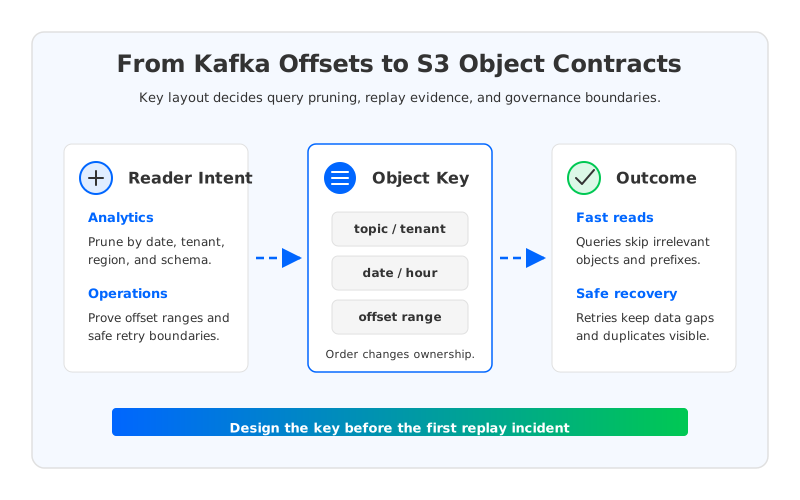
Kafka-to-S3 pipelines fail in surprisingly ordinary places. The connector is running, records are being written, and the bucket is filling up, but downstream teams still complain that queries scan too much data, replay creates duplicate files, late events land in confusing paths, or incident recovery depends on tribal knowledge. The problem is rarely that Kafka cannot send data to S3. The problem is that S3 object keys and partitioning rules become part of the data contract, even when nobody designed them that way.
That contract matters because Kafka and S3 organize data around different assumptions. Kafka gives applications an ordered log inside each partition, with offsets as the durable position. S3 gives applications immutable objects addressed by bucket and key. A key may look like a folder path, but it is still an object name; the apparent hierarchy is a convention used by tools, query engines, and humans. Once Kafka records cross that boundary, your key layout decides how data is discovered, how it is retried, how it is queried, and how it is deleted.
1Why Object Keys Become Architecture
Most teams begin with a practical goal: move Kafka events into S3 so analytics, lakehouse, audit, or machine learning workloads can use them. Kafka Connect and similar frameworks are built for moving data between Kafka and external systems, so the first implementation often feels like a connector configuration exercise. That hides the long-term choice. A Kafka topic is not a table, and an S3 bucket is not a Kafka log with slashes in the name.
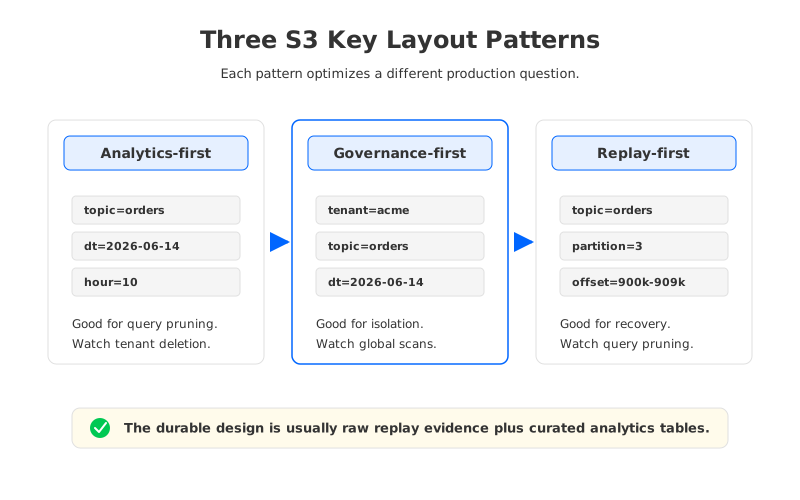
The object key is where this translation becomes visible. A path such as events/topic=orders/dt=2026-06-14/hour=10/partition=3/offset=900000.avro encodes topic boundaries, event time, Kafka partition, and offset range. Change the order of those fields and you change which operations become fast or painful. Put date before tenant and time-window queries are natural, but tenant-level deletion may require broad scans. Put tenant before date and governance tasks improve, but global analytics can touch many prefixes.
The first trap is treating object key design as a naming preference. It is really an access-pattern decision. Who reads the data, at what time granularity, with which filters, under which recovery rules? If the main reader is Athena, Trino, Spark, Snowflake, or a lakehouse table format, the layout has to serve query pruning and table maintenance. If the main user is an incident responder replaying raw events, the layout has to make offset ranges and export commits provable. Those two goals can coexist, but they should not be mixed by accident.
AWS also makes prefixes operationally relevant. Amazon S3 documents at least 3,500 write-type requests and 5,500 read-type requests per second per partitioned prefix, with higher performance available by parallelizing across prefixes. That does not mean every Kafka export needs clever randomization. It means a high-throughput pipeline should avoid funneling all writers and readers through a single hot prefix.
2The Four Questions Behind a Key Layout
A useful key design starts with four questions. They are not connector-specific, and they apply whether the exporter is Kafka Connect, Flink, a custom consumer, or a managed integration.
- What is the commit boundary? The pipeline needs a durable way to say that a Kafka offset range is represented in S3. Without that boundary, retry behavior can produce duplicate files, missing windows, or objects that look complete but do not cover the expected offsets.
- What is the dominant read pattern? Analytics workloads usually want partition pruning by date, hour, tenant, region, product, or schema. Operational replay often wants topic, Kafka partition, and offset range. The key should favor the pattern that will be used under pressure.
- How will late and corrected data behave? Event-time partitioning is attractive for queries, but late records can reopen old paths. Ingestion-time partitioning is operationally stable, but readers need another way to reason about event time.
- Who owns lifecycle and deletion? Retention, legal hold, tenant deletion, and backfill cleanup all follow the object layout. A design that saves minutes in the exporter can cost days during a governance request.
These questions force the team to decide what correctness means before choosing object formats, batch sizes, or connector tasks. Once correctness is clear, implementation choices become easier to defend.
3Key Patterns That Work in Production
The most common safe layout starts with a stable data-domain prefix, adds partitions that match the primary query boundary, and embeds Kafka provenance near the file name. For example, a raw zone might use raw/topic=orders/dt=2026-06-14/hour=10/kafka_partition=3/start_offset=900000-end_offset=909999.parquet. This gives table engines a predictable partition path while preserving enough Kafka lineage to audit and replay export ranges.
That structure is not universal. Some platforms put tenant_id before dt because tenant isolation and deletion matter more than global time-window scans. Some keep one bucket or prefix per environment because IAM and lifecycle policy boundaries are easier to reason about that way. Others separate raw immutable exports from curated table outputs, so the raw path optimizes replay while the curated path optimizes analytics.
| Layout choice | Good fit | Tradeoff to watch |
|---|---|---|
topic/date/hour/file | Shared analytics over a small number of high-volume topics | Tenant or business-domain deletion may require scanning many paths |
tenant/topic/date/file | Strong tenant isolation, per-tenant lifecycle, chargeback | Global time-window analytics fans out across many tenant prefixes |
topic/partition/offset-range | Replay, audit, raw export validation | Query engines get less natural event-time pruning |
| Raw zone plus curated table | Teams need both replay evidence and analytics performance | More pipeline stages, catalog maintenance, and ownership boundaries |
The table shows why key design is not a style guide. Every path makes one class of work easier and another class more expensive. Platform teams should test the tradeoff against the first incident they expect: export task crash, schema rollback, late event backfill, tenant deletion, regional failover, or cost attribution review.
4Partitioning Is Not the Same as Kafka Partitions
The word "partition" causes confusion because Kafka partitions and S3 data partitions serve different purposes. A Kafka partition is part of the streaming contract: it affects ordering, parallelism, offsets, leader placement, and consumer group behavior. An S3 partition in a lake-style layout is usually a directory-like key segment such as dt=2026-06-14 or region=us-east-1; it helps readers prune files and operators manage data by category.
Exporting one Kafka partition to one S3 partition can be useful for raw replay, but it is often poor for analytics. Kafka partition counts are chosen for throughput and consumer parallelism, not for human query filters. A topic with 96 Kafka partitions might generate many small files per hour if each task flushes independently. Collapsing all Kafka partitions into a single hourly object can improve file size but make offset-level recovery harder.
This is where file size and flush policy enter the design. Larger objects reduce small-file pressure and improve many analytical reads, but they increase the delay before records are visible in S3. Smaller objects improve freshness and recovery granularity, but they create more requests, metadata, and compaction work.
The same tension appears in event-time partitioning. If records are written by event time, queries over business windows become efficient. If records arrive late, exporters must decide whether to write into old partitions, route late records into a correction area, or rely on table formats to manage updates. If records are written by ingestion time, the pipeline is easier to operate, but readers need event-time columns and table-level optimizations.
5Recovery Starts With Idempotency
The production test for a Kafka S3 pipeline is not whether it writes files during a demo. The test is whether a team can answer, after a crash, which Kafka offsets are safely represented in S3 and which ones must be retried. S3 writes create durable objects, but a durable object is not automatically a committed data window.
Good pipelines make retries idempotent. One common pattern is to write objects using deterministic names that include topic, Kafka partition, and offset range. Another is to write temporary objects first, then publish a manifest, table commit, or marker that declares the batch visible. Table formats such as Apache Iceberg solve part of this problem at the table metadata layer, but the exporter still has to coordinate Kafka offsets, object writes, and commit state. A raw object without a corresponding commit record may be useful for debugging, but it should not be silently treated as complete data.
Operational observability should follow the same structure. Lag in Kafka is not enough. The platform needs export lag by topic and partition, object write failures by prefix, commit latency, duplicate-object detection, and downstream table freshness. If query users see missing data, SREs need to know whether the issue is upstream production, exporter progress, S3 write health, catalog commit, or reader cache.
6A Production Evaluation Framework
The strongest Kafka-to-S3 design is the one that makes each ownership boundary explicit. Before selecting a connector or declaring the pipeline finished, platform teams should score the design against the dimensions below.
| Decision area | What to verify | Failure mode if ignored |
|---|---|---|
| Key hierarchy | The first key segments match the most important read, deletion, or chargeback pattern | High-volume scans, awkward deletion, unclear ownership |
| Kafka provenance | File names or metadata preserve topic, Kafka partition, and offset range where recovery needs them | Duplicate or missing records become hard to prove |
| Prefix distribution | High-throughput writers and readers are spread across enough natural prefixes | Hot prefixes, uneven task throughput, slow replay |
| Commit protocol | Object creation is separated from visible data commit | Partial writes look like valid data |
| Late data policy | Event-time and ingestion-time behavior is documented and tested | Old partitions change without downstream awareness |
| Governance | IAM, encryption, lifecycle, schema, and retention match the data owners' expectations | A technical export becomes a compliance gap |
This framework also separates two architecture questions that are often blended together. A Kafka-to-S3 export pipeline answers, "How do we make Kafka data available as objects or tables?" A shared-storage Kafka-compatible system answers, "Should object storage be part of the streaming platform's own durability model?" Both can use S3, but they move different boundaries.
7How AutoMQ Fits the Evaluation
Once the evaluation shifts from export layout to Kafka storage architecture, AutoMQ becomes relevant as a Kafka-compatible streaming system built around shared storage. AutoMQ separates broker compute from durable stream storage through its S3Stream architecture, where object storage and a write-ahead path replace the traditional broker-local log storage model. That is a different category from a sink pipeline: the goal is to change how the streaming platform stores and serves its log while preserving Kafka-compatible client behavior.
The distinction matters because user-managed export keys and internal stream-storage organization serve different audiences. In a sink pipeline, platform teams design S3 keys for query engines, governance, and recovery. In a shared-storage Kafka-compatible engine, the storage layer is part of the system implementation, and applications continue to speak Kafka APIs. Teams still may export data to S3 tables for analytics, but that export is no longer a workaround for broker-local disk growth.
AutoMQ is most relevant when the hard problem behind "Kafka on S3" is not file layout, but the cost and operation of traditional Kafka storage in the cloud. Shared storage can reduce the coupling between brokers and retained data, make compute scaling less dependent on partition data movement, and support architectures that avoid cross-AZ replication traffic in supported deployments. Validate those claims with your workload: client compatibility, replay behavior, failure recovery, observability, security controls, and cost attribution.
If your team is designing Kafka-to-S3 object keys, start with the access pattern and recovery contract. If the design conversation keeps returning to broker disks, replication traffic, and long-retention scaling, broaden the evaluation to Kafka-compatible shared storage. You can start with the AutoMQ technical documentation and use the scorecard above as a proof-of-concept checklist.
8References
- Apache Kafka documentation: https://kafka.apache.org/documentation/
- Apache Kafka Connect overview: https://kafka.apache.org/31/kafka-connect/overview/
- Amazon S3 object key naming guidelines: https://docs.aws.amazon.com/AmazonS3/latest/userguide/object-keys.html
- Amazon S3 performance design patterns: https://docs.aws.amazon.com/AmazonS3/latest/userguide/optimizing-performance.html
- Amazon S3 pricing: https://aws.amazon.com/s3/pricing/
- AWS data transfer pricing: https://aws.amazon.com/ec2/pricing/on-demand/#Data_Transfer
- Apache Iceberg partitioning documentation: https://iceberg.apache.org/docs/latest/partitioning/
- AutoMQ architecture overview: https://docs.automq.com/automq/architecture/overview?utm_source=blog&utm_medium=reference&utm_campaign=gs100-0045
- AutoMQ S3Stream shared storage overview: https://docs.automq.com/automq/architecture/s3stream-shared-streaming-storage/overview?utm_source=blog&utm_medium=reference&utm_campaign=gs100-0045
- AutoMQ S3 storage architecture: https://docs.automq.com/automq/architecture/s3stream-shared-streaming-storage/s3-storage?utm_source=blog&utm_medium=reference&utm_campaign=gs100-0045
9FAQ
9.1What is the difference between an S3 object key and an S3 partition?
An object key is the full name of an object inside a bucket. A data partition is a convention encoded into that key, such as dt=2026-06-14 or tenant_id=acme, so tools can prune, discover, and manage files. S3 stores objects by key; query engines and platform teams interpret parts of the key as partitions.
9.2Should Kafka S3 exports partition by event time or ingestion time?
Event-time partitioning is usually better for business queries, while ingestion-time partitioning is easier for exporter operations and incident recovery. Many teams keep raw immutable exports by ingestion time and build curated tables by event time, especially when late events and corrections are common.
9.3Should object keys include Kafka offsets?
Raw exports should usually preserve Kafka provenance somewhere, either in the file name, object metadata, manifest, or table commit record. Offsets help prove what was exported after retries or crashes. Curated analytics tables may hide offsets from users, but the recovery layer still benefits from offset-level evidence.
9.4Do more S3 prefixes always improve performance?
More prefixes can increase parallelism, but prefix design should follow real read and write patterns. Randomizing paths without considering queries, lifecycle, and recovery can make operations harder. High-throughput pipelines should distribute load across natural prefixes such as topic, tenant, date, or shard while keeping the layout understandable.
9.5Is Kafka on S3 the same as writing Kafka records into S3 files?
No. Writing Kafka records into S3 files is an export pattern. Kafka on S3 can also refer to tiered storage or to Kafka-compatible shared-storage systems where object storage participates in the streaming platform's durability model. The phrase is useful for search, but architecture work needs the more precise category.
9.6Where does AutoMQ fit in a Kafka S3 architecture?
AutoMQ fits when the team wants Kafka-compatible streaming with object storage as part of the core storage architecture, rather than only a downstream export destination. It is most relevant when broker-local disks, data movement during scaling, and cloud replication traffic are the main pressure points.


