
Table of Contents
Table of Contents
Teams do not search for diskless kafka because they dislike disks as physical objects. They search for it because broker-local storage has become the part of Kafka that resists cloud economics. A Kafka broker can be restarted, rescheduled, replaced, or scaled, but the log segments attached to that broker still carry ownership, placement, recovery, and cost consequences. Once the retained log is measured in many terabytes and the cluster runs across availability zones, the storage model becomes a production decision rather than an implementation detail.
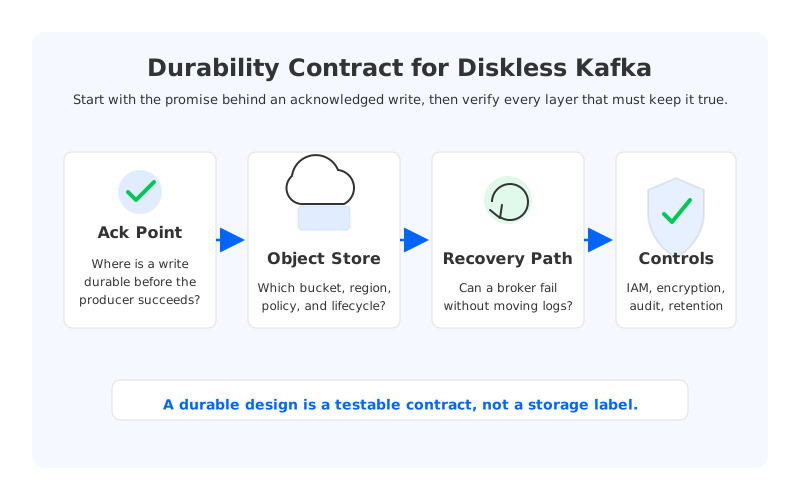
Object storage changes the conversation, but it does not remove the need for a durability review. Amazon S3 documents durability as a service property, and that is valuable, yet Kafka durability is an end-to-end contract: producer acknowledgments, metadata, write-ahead logging, object placement, recovery, consumer visibility, and operational controls all have to line up. A diskless Kafka design is credible only when it can explain where an acknowledged write becomes durable and how that write is recovered when a broker, zone, cache, or storage path fails.
1Why diskless Kafka Is a Durability Question
Traditional Apache Kafka makes a clear promise through replication. A producer writes to a partition leader, followers replicate the record, and the broker can acknowledge based on the configured durability policy. This model is familiar and battle-tested, but it keeps durable log ownership close to broker placement. That is acceptable when brokers are long-lived storage nodes. It becomes harder to defend when platform teams want elastic compute, faster replacement, Kubernetes scheduling, long retention, and tighter cloud cost control.
Diskless Kafka shifts the primary durable storage path away from broker-local disks. That shift can take several forms: upstream design work around diskless topics, Kafka-compatible systems built around shared storage, or managed platforms that expose object-storage-first behavior behind Kafka APIs. The important distinction is not the label. The important distinction is whether object storage sits on the active durability path or only stores older segments after the local log has already accepted the write.
That is also where tiered storage gets confused with diskless design. Apache Kafka tiered storage and remote log storage are useful for reducing pressure from retained data. They let older log segments move to remote storage while brokers keep serving the active log path. Diskless designs ask a sharper question: can brokers become closer to stateless compute while durable stream data lives in shared storage from the beginning of the write path?
The answer can be yes, but not by slogan. Object storage has different latency, request, consistency, identity, and lifecycle characteristics than local SSDs or attached block volumes. A serious evaluation has to preserve Kafka semantics while changing the durability substrate underneath them.
2The Durability Contract to Inspect
The first check is the acknowledged-write boundary. When a producer receives success, which durable components already contain enough information to recover the record? In local-disk Kafka, the answer involves broker logs and replica state. In a diskless design, the answer may involve a WAL layer, object storage, metadata, and cache state. If the design cannot describe that boundary without hand-waving, it is not ready for a production pilot.
Use these questions before comparing product names:
- What is the durable ack point? Identify whether the write is protected by a WAL, direct object-store write, quorum service, or another mechanism before the producer sees success.
- What survives broker loss? Kill the broker that accepted the write and prove that a replacement can serve the data without copying a large local log from the failed node.
- What metadata makes recovery safe? Validate partition ownership, epochs, offsets, object indexes, and idempotent producer behavior during failover.
- What happens when object storage slows down? A good design should state which path absorbs latency, which queues grow, and which metrics warn SREs before applications see errors.
- Which cloud boundary owns the data? Region, bucket, account, encryption key, IAM policy, and lifecycle rules are part of the durability contract, not deployment paperwork.
These checks are intentionally mechanical. They force the discussion away from "object storage is durable" and toward "this Kafka write is recoverable under this failure." The second claim is the one application teams actually depend on.
3Object Storage Durability Is Necessary, Not Sufficient
Object storage gives diskless Kafka designs a strong foundation because the storage service already handles replication, media failure, capacity expansion, and durability engineering at cloud scale. Amazon S3, for example, publicly documents high object durability and stores data redundantly across multiple Availability Zones in a Region for S3 Standard. That helps explain why object storage is attractive for stream retention and shared storage.
But Kafka is not an object archive. It is a low-latency log abstraction with ordering, offsets, consumer groups, compaction, idempotence, transactions in some workloads, ACLs, quotas, and operational tooling built around broker behavior. Moving bytes to object storage is the easy part of the argument. Preserving the behavioral contract around those bytes is the hard part.
The review should separate three layers that are often blended together:
| Layer | What to verify | Why it matters |
|---|---|---|
| Kafka semantics | Producer acknowledgments, ordering, offsets, idempotence, transactions, ACLs, admin APIs | Existing applications should not have to rediscover platform behavior during migration. |
| Storage durability | WAL protection, object-store persistence, metadata integrity, encryption, lifecycle policy | The system must recover acknowledged data after compute or storage-path failures. |
| Operations | Metrics, alerts, throttling behavior, cost visibility, runbooks, rollback | SREs need to operate the design when cloud services degrade or traffic spikes. |
The table also exposes a common evaluation mistake. A benchmark that produces and consumes a few records does not prove Kafka compatibility. A storage durability statement does not prove recovery safety. A lower storage bill does not prove that cross-zone traffic, request fees, cache misses, and migration risk have been priced correctly.
4Failure Drills That Reveal the Real Architecture
Diskless Kafka evaluations should include failure drills early because failure drills reveal the real architecture faster than diagrams do. A design that looks stateless on a whiteboard may still depend on sticky broker caches, slow metadata repair, or local spill files that become operationally significant during recovery. That does not automatically disqualify the design, but it changes the runbook.
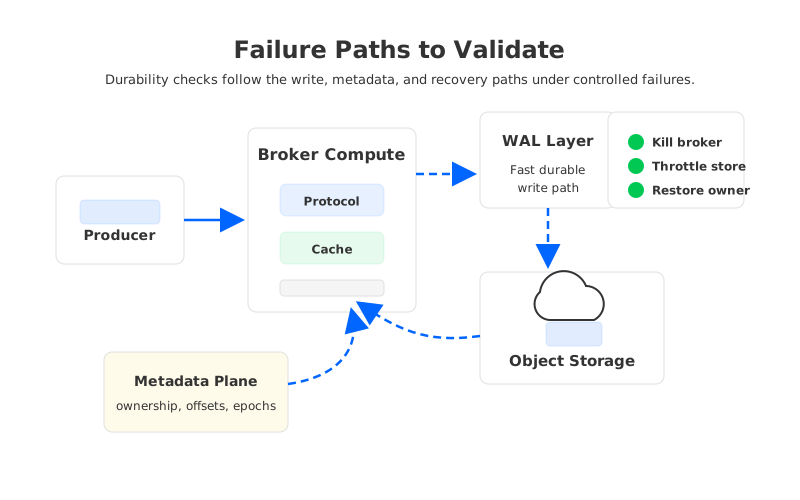
Start with the write path. Produce with acks=all, idempotence enabled if your applications use it, and realistic batching. Terminate the accepting broker during sustained writes. The validation target is not only "the cluster recovered." It is whether acknowledged records remain readable in order, producer retries behave as expected, consumer offsets remain coherent, and the replacement broker does not need a long local-log restoration before it can serve traffic.
Then test the storage path. Throttle or impair object-store access in a controlled environment and watch which metrics move first: producer latency, WAL backlog, cache hit ratio, object request errors, metadata update latency, or consumer fetch latency. This test matters because object storage failure rarely looks like a clean binary outage. It often appears as latency, throttling, partial API errors, or account-policy mistakes.
Finally, test administrative behavior. Reassign partitions, scale brokers, change topic settings, rotate credentials, validate encryption policy, and run restore procedures. A diskless design should make some of these actions lighter because durable data is no longer tied to broker-local disks. It still needs guardrails. Faster reassignment is useful only when the metadata plane, observability, and rollback story are disciplined enough for production.
5Cost Checks Belong in the Same Review
Durability and cost are linked in cloud Kafka because the old replication model and the new storage model create different bills. Traditional multi-AZ Kafka spends money on broker instances, attached storage, replica traffic, and operational headroom. Diskless Kafka shifts more durable storage responsibility to object storage and may reduce broker-local overprovisioning, but it introduces a different mix of storage capacity, requests, WAL resources, cache resources, and network paths.
AWS makes this worth checking carefully. EC2 data transfer pricing has explicit rules for traffic across Availability Zones, and Amazon MSK pricing separates broker, storage, and related service dimensions. A team evaluating diskless Kafka should model at least three traffic categories: producer write path, consumer read path, and internal durability or recovery path. If the design reduces replica movement across zones, that can be material. If it increases object-store requests or cold reads, that also needs to be visible.
The goal is not to force every workload into the same answer. A short-retention, steady, single-region workload may get limited economic benefit from diskless architecture. A bursty, multi-AZ, retention-heavy platform with frequent scaling, consumer replay, or expensive broker replacement has a stronger reason to evaluate shared storage. Cost modeling should follow the workload rather than the category name.
6A Production Readiness Scorecard
A useful scorecard has to be strict enough for SREs and understandable enough for finance and architecture reviewers. The six gates below work well because each one produces evidence rather than opinions.
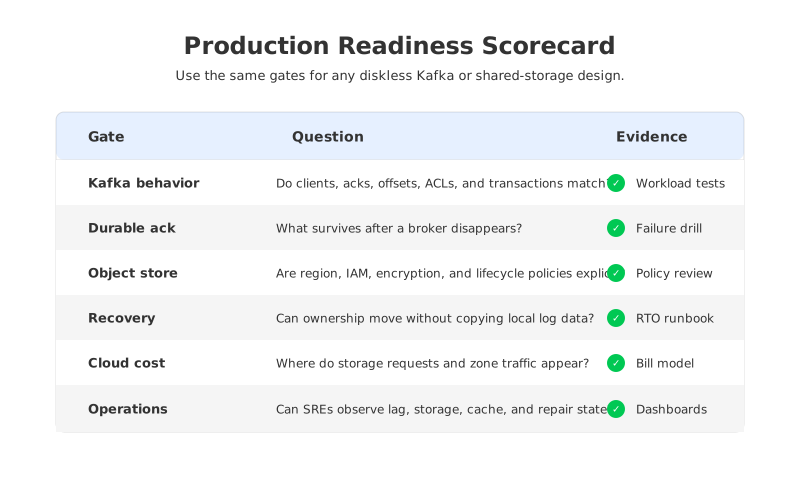
| Gate | Pass condition | Typical evidence |
|---|---|---|
| Kafka behavior | Your real clients, configs, and operational tools behave as expected. | Compatibility matrix, integration tests, client-version inventory. |
| Durable ack | Acknowledged writes survive broker failure and storage-path stress. | Failure-drill logs, record-count checks, offset validation. |
| Object-store control | Data location, IAM, encryption, lifecycle, and deletion policy are explicit. | Bucket policy review, key policy review, audit events. |
| Recovery | Broker replacement and ownership movement do not require large local-log copying. | Recovery-time drills, reassignment tests, restore runbooks. |
| Cloud cost | Storage, request, compute, cache, WAL, and network paths are modeled. | Pricing worksheet, bill simulation, sensitivity analysis. |
| Operations | SREs can observe and act on degraded storage, cache, metadata, and client symptoms. | Dashboards, alerts, escalation paths, rollback plan. |
The scorecard prevents a subtle but expensive failure mode: treating diskless Kafka as one architectural change. It is several contracts changing at once. Storage ownership changes. Broker lifecycle changes. Recovery mechanics change. Cost boundaries change. Operational signals change. Each contract needs a test before the platform team can call the migration safe.
7Where AutoMQ Fits This Evaluation
After the neutral checks are in place, AutoMQ is relevant as a Kafka-compatible shared-storage architecture built for this exact set of questions. AutoMQ keeps the Kafka protocol surface for existing clients and ecosystem tools while moving durable stream storage away from broker-local disks into S3-compatible object storage through S3Stream, with WAL storage used on the write path. Its documentation also describes stateless brokers and a storage-compute separated architecture, which is the operating model many teams are trying to validate when they search for diskless Kafka.
The right way to evaluate AutoMQ is not to accept "diskless" as a conclusion. Use the same scorecard. Verify the Kafka APIs your applications use, the WAL option for your target cloud or private environment, the object-store permissions and encryption model, recovery behavior under broker loss, and the cost impact of your producer and consumer traffic. AutoMQ becomes compelling when the workload is constrained by broker-local storage, long retention, cross-zone data movement, slow scaling, or operational friction from stateful brokers.
This is also why a proof of concept should be workload-shaped. Test one latency-sensitive topic, one retention-heavy topic, one replay-heavy consumer group, and one administrative workflow such as scaling or reassignment. If those paths pass, the architecture conversation becomes concrete: not "should we trust object storage for Kafka," but "which durability contract did our workload prove?"
If your team is evaluating diskless Kafka for a production platform, use the scorecard above as the review agenda. To explore how AutoMQ implements Kafka-compatible shared storage in a customer-controlled deployment, start with the AutoMQ BYOC product page.
8References
- Apache Kafka KIP-1150: Diskless Topics
- Apache Kafka documentation: Tiered Storage
- Amazon S3 data durability documentation
- AWS EC2 data transfer pricing
- Amazon MSK pricing
- AutoMQ Shared Storage architecture
- AutoMQ S3Stream shared streaming storage
- AutoMQ WAL storage
- AutoMQ compatibility with Apache Kafka
9FAQ
9.1Is diskless Kafka the same as Kafka tiered storage?
No. Tiered storage usually keeps the active write path on broker-local storage and moves older log segments to remote storage. Diskless Kafka designs try to remove broker-local disks from the primary durable data ownership model, often by using shared storage or object storage as part of the active durability path.
9.2Does object storage durability prove Kafka durability?
No. Object storage durability is a foundation, not the whole contract. Kafka durability also depends on acknowledgments, metadata, ordering, offsets, WAL behavior, recovery logic, and operational controls.
9.3What should a diskless Kafka proof of concept test first?
Start with the acknowledged-write path under broker failure. Then test object-store latency or throttling, consumer replay, partition ownership movement, ACLs, transactions if used, and cost visibility under production-shaped traffic.
9.4When does AutoMQ belong on the shortlist?
AutoMQ belongs on the shortlist when the team wants Kafka-compatible APIs while reducing the operational coupling between brokers and durable storage. It is most relevant for workloads where long retention, multi-AZ traffic, elastic scaling, broker replacement, or customer-controlled deployment boundaries are material to the decision.


