
Table of Contents
Table of Contents
Teams usually search for object storage read path kafka after retention has stopped being a storage-only question. The cluster still accepts writes, consumer groups still track offsets, and dashboards may look healthy during steady-state traffic. Then an audit replay, delayed connector, lakehouse backfill, model training job, or regional recovery drill asks the platform to read old data at scale, and the cost model changes shape.
That moment is uncomfortable because Kafka made reusable streams feel operationally clean. A producer writes an event once, and many consumers can process it independently through separate consumer groups. The architecture is powerful, but every independent read path has to be served by brokers, storage, cache, network, and metadata. Long retention turns that read path into a durable product requirement rather than a side effect of disk sizing.
The core decision is not whether object storage appears somewhere in the diagram. The real question is where object storage sits in the read path, what the platform caches, how it maps offsets to stored segments, and whether catch-up reads interfere with tailing consumers. A platform that treats object storage as a cold extension of broker-local logs has different cost signals from a platform that treats shared object storage as the durable storage foundation.
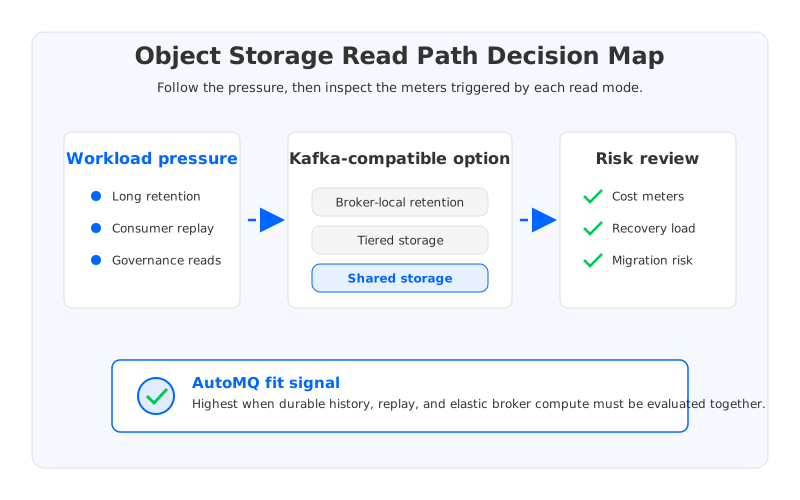
1Why teams search for object storage read path kafka
The search phrase often comes from a mixed workload. One team wants raw events for incident replay. Another wants longer retention for governance. Analytics teams want derived-table backfills, SREs want recovery inside a freshness SLO, and FinOps wants to know why a steady-write cluster creates unpredictable storage, network, and request charges.
Kafka's consumer group model is the reason this pressure accumulates. Consumer groups let independent applications consume the same topic while managing their own offsets, which is exactly what makes Kafka useful as a shared event backbone. The cost side follows the same logic: each group can become another read path, and a delayed group can turn retained history into active infrastructure load.
For long-retention streams, platform teams should separate two modes of reading:
- Tailing reads follow the live log and usually benefit from memory, page cache, local cache, or a hot read path. They are latency-sensitive and often business-critical.
- Catch-up reads scan older offsets after consumer lag, deployment pauses, analytics reprocessing, or recovery. They are throughput-sensitive and can be bursty.
- Governance reads are less frequent but less negotiable. When audit, lineage, or incident review needs historical data, the organization cares more about completeness and access control than average latency.
Those modes have different cost signals. Tailing reads are often constrained by broker CPU, socket capacity, and tail latency. Catch-up reads stress storage layout, cache miss behavior, object requests, and network movement. Governance reads stress retention policy, encryption, access boundaries, and proof that the data can be recovered without disturbing production consumers.
2The cloud cost drivers behind the workload
Traditional Kafka was designed around broker-owned logs. Brokers persist partition data locally, replicate it for durability, and serve consumers from that broker-local layout. That model is coherent in a data center where disks and east-west network are part of the same capacity planning exercise. In the cloud, the same behavior is priced through separate meters: compute instances, block storage, object storage, cross-zone data movement, private connectivity, requests, and operational labor.
Long retention widens the gap between logical Kafka usage and cloud cost accounting. A topic may receive each record once, but the platform may store replicas, move partitions during reassignment, serve many consumer groups, refill caches, and recover brokers after failures. The bill does not know that these actions belong to one business event. It sees bytes stored, bytes copied, and operations executed.
The read path is where many teams under-model cost:
| Cost signal | What to inspect | Why it matters |
|---|---|---|
| Retained bytes | Retention period, compaction, topic growth, replica policy | Storage cost follows data kept, not data read this hour. |
| Read fan-out | Consumer group count, connector count, analytics jobs | One event can be read by many applications. |
| Cache behavior | Hit ratio, hot window, prefetch policy, eviction | Cache misses can move historical reads into object storage or remote segments. |
| Network locality | Consumer placement, zone awareness, endpoint design | Reads across zones or regions may become recurring data-transfer cost. |
| Object operations | GET/LIST/PUT patterns, segment size, index lookups | Object storage can be cost-effective, but request shape still matters. |
| Recovery traffic | Broker replacement, partition reassignment, cache warmup | Recovery can look like an unplanned replay workload. |
This table is not a pricing calculator. It is a way to stop treating "object storage" as a single cost answer. Object storage pricing pages from AWS, Azure, and Google Cloud all expose capacity, operations, retrieval, and transfer dimensions. A Kafka-compatible platform must convert Kafka offsets and fetches into those cloud meters in a controlled way.
3Storage, network, and compute trade-offs
There are three broad architecture patterns to evaluate. The first is broker-local Kafka with retention on local or attached disks. This path is familiar, compatible, and operationally well understood. Its weakness appears when storage growth forces broker growth, or when recovery requires moving large retained logs before replacement capacity is useful.
The second pattern is tiered storage or remote log storage. Apache Kafka's Tiered Storage work separates older log segments from the local broker tier so clusters can retain more history without keeping every segment on local disks. This can reduce local storage pressure and support historical reads from remote storage. It does not automatically make brokers stateless, because the active log, leadership, caching, and hot read behavior still need careful evaluation.
The third pattern is shared-storage Kafka-compatible architecture. In this model, durable stream history is placed in shared object storage, while brokers act more like compute nodes that handle Kafka protocol requests, scheduling, cache, metadata coordination, and WAL-backed write durability. That shift changes the read-path question from "which broker owns the old bytes?" to "how does the platform locate, cache, and serve the requested offset range?"
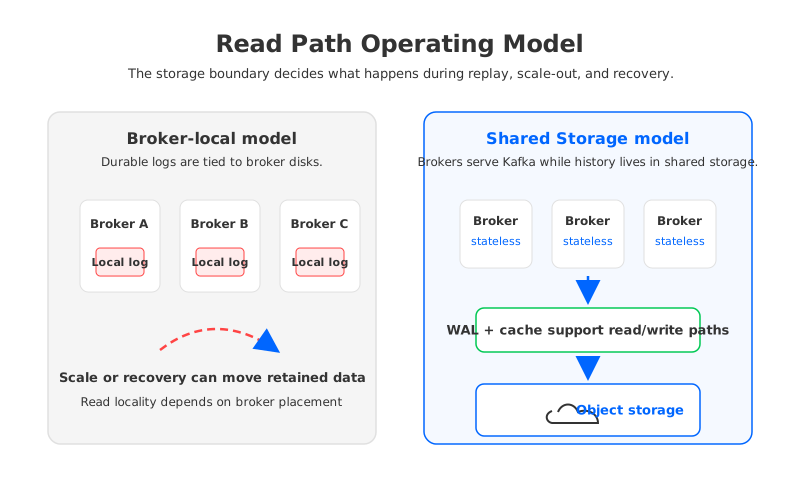
The practical trade-off is not local disk versus object storage in isolation. Local disks can serve hot reads with low latency, but they bind durable history to broker placement. Object storage can hold long-lived history with elastic capacity, but raw object APIs are not a Kafka read path. The platform still needs segment layout, offset indexes, prefetching, cache admission rules, and failure semantics that preserve Kafka expectations.
A useful architecture review asks the same questions for every option:
- How does the platform serve a tailing consumer during steady writes?
- How does it serve a lagged consumer reading hours or days behind the head?
- Does a catch-up read compete with producer acknowledgments, follower replication, or hot consumers?
- What happens when the broker that last served a partition is removed?
- Which cloud meters move when the read path misses cache?
These questions keep the discussion grounded. A long-retention platform can look inexpensive when the team models only capacity and expensive when it models replay, recovery, and fan-out. The opposite can also happen: a higher hourly compute footprint may be rational if it reduces partition movement, operator toil, or repeated cross-zone reads during the workloads that matter.
4Evaluation checklist for FinOps and platform teams
A strong review starts with workload shape, then maps that shape onto architecture. FinOps needs enough technical detail to know which meters are triggered. Platform teams need enough cost detail to know which design choices are worth changing. Procurement needs enough migration detail to know whether the savings model survives production cutover.
Use this checklist before treating any Kafka-compatible object-storage design as production-ready:
| Area | Review question | Evidence to request |
|---|---|---|
| Compatibility | Will existing producers, consumers, Kafka Connect jobs, security settings, and offset workflows keep working? | Client compatibility matrix, migration test plan, failure drill results |
| Read-path design | Are tailing reads and catch-up reads handled as distinct paths? | Cache policy, prefetch behavior, historical-read test results |
| Cost model | Are storage, requests, data transfer, compute, support, and operations modeled together? | Workload-based TCO sheet with sensitivity ranges |
| Governance | Can retention, encryption, access, audit, and data location rules be enforced? | IAM model, deployment boundary, compliance mapping |
| Scaling | Does adding compute require copying retained partition data? | Scale-out test, broker replacement test, partition movement metrics |
| Recovery | Can a failed broker or zone be handled without a long data-copy step? | Recovery time evidence and rollback procedure |
| Observability | Can teams see read-path latency, cache hit rate, object requests, and consumer lag together? | Dashboard and alert samples tied to SLOs |
The evidence column matters because diagrams tend to compress operational risk. "Kafka-compatible" should mean the client-facing behavior your applications depend on, not only a bootstrap endpoint. "Object-storage backed" should mean the read path has been engineered around object storage behavior, not only that old bytes eventually land in a bucket.
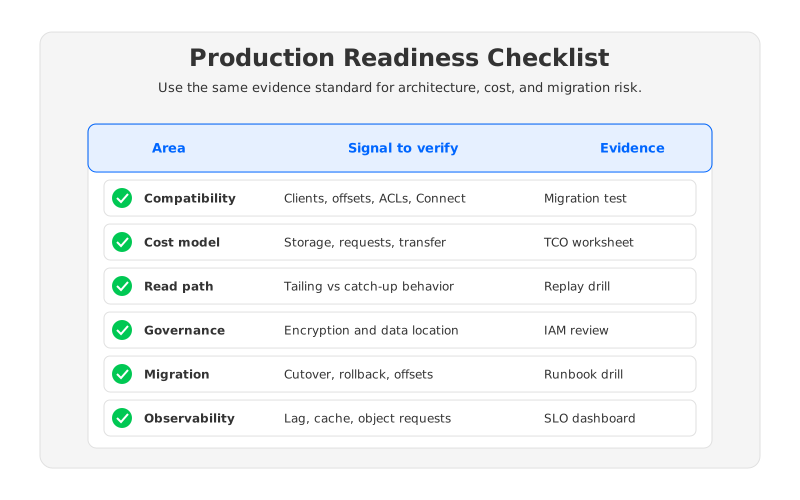
The scorecard becomes more useful when the team adds workload thresholds. A governance-heavy stream may rate compatibility and data-location control above peak replay speed. A fraud or observability stream may rate tailing-read latency and catch-up isolation above retention cost. A lakehouse ingestion stream may care most about sustained backfill throughput and connector recovery.
5How AutoMQ changes the operating model
Once the evaluation framework is clear, AutoMQ belongs in the conversation as one implementation of the shared-storage Kafka-compatible pattern. AutoMQ keeps Kafka protocol compatibility while using Shared Storage architecture: brokers are designed to be stateless, durable stream data is stored in object storage, and WAL storage plus cache support the write and read paths. That design targets the specific coupling that long-retention workloads expose in broker-local Kafka.
The operating-model change is concrete. In a broker-local design, adding or replacing brokers can become a storage movement problem because partition data is tied to broker disks. In a shared-storage design, durable history is not owned by one broker's local disk. Brokers can be scaled or replaced with less dependence on copying retained bytes across the cluster, while cache and metadata determine how reads are served.
For read paths, AutoMQ's documentation distinguishes the storage foundation from the hot access path. Object storage provides durable shared storage, while WAL storage and data caching are used so Kafka clients do not interact with raw object APIs directly. The important review question is not whether every read is faster by default. It is whether the platform gives tailing reads, catch-up reads, and recovery reads a designed path with measurable behavior.
AutoMQ also changes the cloud-network discussion. Its Zero Cross-AZ Traffic materials focus on reducing inter-zone traffic generated by traditional Kafka replication patterns. For FinOps teams, that matters because cross-zone transfer can become a recurring cost source when replication, reads, and recovery traffic span availability zones. The exact benefit still depends on workload placement, cloud provider, and deployment topology, so it should be tested with the same read-path scorecard rather than assumed from a diagram.
This is where a neutral review becomes useful for both engineering and commercial teams. If the workload is short-retention, steady, and already well governed, the migration case may be weak. If the workload combines high retention, frequent replay, elastic compute needs, and recurring broker-local data movement, shared storage deserves a serious test. AutoMQ's fit is strongest when the pain comes from durable history being tied too tightly to broker-local state.
6Migration and readiness scorecard
Migration risk is the part of the decision that rarely appears in storage-cost discussions. Moving a Kafka estate changes client bootstrap endpoints, authentication, ACLs, topic configuration, consumer offsets, connector behavior, monitoring, incident runbooks, and rollback boundaries. A lower storage curve is not useful if the cutover creates opaque application risk.
Score each dimension before committing to a platform:
| Dimension | Low readiness | Higher readiness |
|---|---|---|
| Application inventory | Unknown producers and consumers | Owners, client versions, auth, and SLAs mapped |
| Offset handling | No plan for consumer position | Offset migration or replay policy tested |
| Read-path testing | Only steady tailing reads tested | Tailing, catch-up, and governance reads tested separately |
| Cost validation | Generic per-GB estimate | Workload replay using real message size and fan-out |
| Rollback | DNS-only hope | Rehearsed rollback with data consistency boundaries |
| Operations | Existing dashboards copied | Read latency, cache, object requests, lag, and recovery visible |
The word "readiness" is deliberate. The goal is not to declare one architecture correct for every Kafka workload. The goal is to know which costs and risks move when long-retention streams shift from broker-local storage toward object storage. That evidence lets teams choose with fewer surprises.
If your question started with object storage read path kafka, map tailing, catch-up, and governance reads. Then compare how each platform serves those reads, what meters trigger, and what happens when capacity or failure changes topology. To evaluate shared storage, review the AutoMQ architecture overview or start from go.automq.com with your retention and replay workload.
7References
- Apache Kafka Documentation
- Apache Kafka Tiered Storage documentation
- AutoMQ architecture overview
- AutoMQ compatibility with Apache Kafka
- AutoMQ Zero Cross-AZ Traffic overview
- AWS S3 pricing
- Azure Blob Storage pricing
- Google Cloud Storage pricing
8FAQ
8.1Is object storage always a lower-cost read path for Kafka?
No. Object storage can improve long-retention economics, but the result depends on segment layout, cache hit rate, request volume, data transfer, and replay frequency. A platform that sends too many small reads to object storage can create request and latency pressure. Test tailing reads and catch-up reads separately.
8.2How is tiered storage different from shared-storage Kafka?
Tiered storage usually keeps the active Kafka log and hot read path on broker-local storage while moving older segments to remote storage. Shared-storage Kafka-compatible architecture treats object storage as the primary durable storage foundation and uses WAL, cache, and metadata to support Kafka semantics. Both can use object storage, but their operating models differ.
8.3What should FinOps teams ask before approving long Kafka retention?
Ask for retained bytes, consumer fan-out, cache behavior, cross-zone or cross-region traffic, object operation patterns, recovery traffic, and operational ownership. The cost model should include replay and recovery, not only steady ingest.
8.4Where does AutoMQ fit in this evaluation?
AutoMQ fits when teams want Kafka compatibility with a shared-storage operating model. Its architecture separates broker compute from durable stream storage, uses object storage as the shared storage layer, and uses WAL plus cache for write and read paths. The right validation is workload-based: run the same retention, replay, and recovery tests you expect in production.


