
Table of Contents
Table of Contents
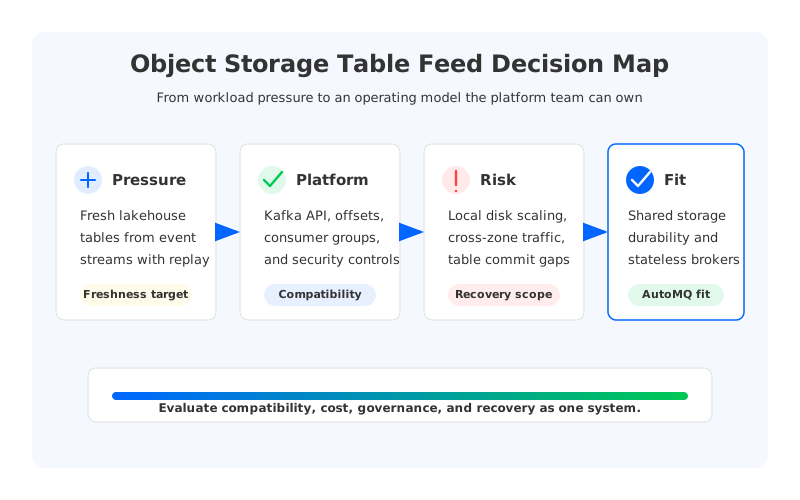
Searches for object storage table feeds kafka usually come from teams that already run a serious event streaming estate. They are not asking whether Kafka can move bytes from producers to consumers. They are asking how a Kafka-compatible platform should feed table formats in object storage without turning freshness, cost, and governance into three separate operating problems. That question matters because the lakehouse has made object storage the system of record for more analytical workloads, while product systems still expect events to arrive with Kafka semantics, offsets, replay, and client compatibility.
The hard part is the boundary between a log and a table. A Kafka topic is optimized for ordered append, retention, replay, and consumer coordination. A table feed has to land records into files, snapshots, partitions, schemas, and catalog state that query engines can read without guessing what is committed. If the pipeline is treated as a connector afterthought, the streaming team owns Kafka health, the data platform team owns table correctness, and the SRE team gets paged when either side discovers that object storage is durable but not a magic transaction coordinator.
1Why Teams Search For Object Storage Table Feeds Kafka
The search phrase sounds narrow, but the intent behind it is broad. Teams want Kafka-style ingestion for transactional systems, clickstreams, IoT telemetry, fraud signals, and AI feature updates, then they want the same flow to become queryable in a lakehouse. They may use Apache Iceberg, Delta Lake, or another table format, but the operational question is similar: how do records become table commits in object storage while preserving enough ordering, compatibility, and observability to trust the feed in production?
The first answer many teams reach for is Kafka Connect. That is a reasonable starting point because Kafka Connect is part of the Kafka ecosystem and gives teams a standard framework for source and sink connectors. The problem is that the connector is not the whole architecture. The platform still has to decide where durable data lives, how much local broker storage to provision, how consumer lag affects file generation, how schema changes are reviewed, and how to recover from partial writes to the table layer.
That is why object storage table feeds become an architecture conversation instead of a connector selection exercise. The feed is a contract between operational data and analytical data. It needs a log with stable offsets, a table writer with commit semantics, a catalog with governance controls, and an infrastructure model that does not punish the team every time write volume or retention changes.
2The Lakehouse Freshness Constraint Behind The Workload
Freshness is the constraint that exposes weak designs. A daily batch export can hide many sins because the platform has hours to compact files, retry failures, and reconcile schema drift. A near-real-time table feed has less room to maneuver. Every minute of delay becomes visible to dashboards, fraud models, personalization services, and downstream data products that promised users a fresher view of the business.
The tension is that object storage is excellent at durable, elastic storage, while table feeds need careful write discipline. Small files can damage query performance. Out-of-order updates can complicate downstream semantics. Compaction and clustering jobs compete with ingestion for compute. If every feed owns its own retry logic, schema handling, and rollback story, the platform becomes a collection of pipelines that happen to share a bucket.
Kafka adds another layer of constraints. Consumer groups, offsets, and replay are strengths when the platform uses them deliberately, but they can also hide table writer problems until lag and commit failures accumulate. Exactly-once processing helps in specific designs, yet teams still need to reason about the table format, the catalog, and the object storage write path. The decision is where each responsibility belongs.
3Stream-To-Table Architecture Options
Most teams land on one of three patterns. Each can work, but each puts pressure in a different place. The right choice depends on throughput, freshness, operational ownership, schema governance, and how much Kafka compatibility the organization needs for existing producers and consumers.
| Pattern | Where It Fits | Main Risk |
|---|---|---|
| Kafka topic to sink connector | Teams with established Kafka operations and clear table ownership. | Connector health and table correctness can become separate incident domains. |
| Stream processor writes table files | Teams that already use Flink, Spark Structured Streaming, or similar engines. | Processing state, checkpointing, and table commits must be operated as one system. |
| Kafka-compatible storage with object storage integration | Teams that want the log and object storage durability model to align. | The platform must prove Kafka API compatibility and production recovery behavior. |
The table makes the choice look clean, but production rarely stays inside one row. A team may ingest through Kafka, transform in Flink, write Iceberg tables, and keep Kafka topics for replay and operational consumers. That mixed design is normal. What matters is whether the underlying streaming platform makes that design easier to operate or turns every retention change into a broker storage project.
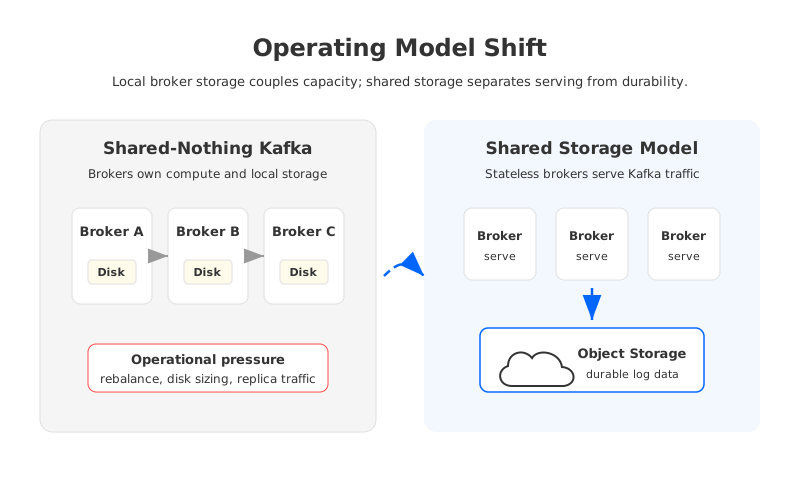
This is where traditional shared-nothing Kafka deployments start to feel awkward in lakehouse architectures. The broker stores partitions on local or attached disks, replicates data across brokers, and uses partition movement to rebalance capacity. That model is battle-tested, but it couples compute, storage, and placement. When a table feed needs longer retention for replay, the Kafka cluster needs more disk. When write volume spikes, the cluster may need more brokers even if CPU is not the bottleneck. When brokers are replaced or rebalanced, data movement becomes part of the operational plan.
4The Shared-Nothing Cost Of Feeding Object Storage
Object storage table feeds expose a duplication that cloud teams increasingly dislike. Data lands in Kafka storage first, then flows into object storage as table files. During that journey, the platform pays for Kafka replicas, broker disk, network movement, connector or stream processing compute, and the table storage itself. Some of that cost is unavoidable because logs and tables serve different access patterns. The avoidable part is making broker-local storage the scaling bottleneck for a workload whose analytical destination is already object storage.
The operational cost is often more important than the infrastructure bill. Local broker storage forces teams to estimate retention and peak write rate ahead of time. Underestimate it, and partitions run hot or disks fill. Overestimate it, and the cluster carries idle capacity because storage and broker compute were purchased together. For table feeds, those estimates are volatile because the business may change freshness targets, add downstream consumers, or extend replay windows after an incident review.
Network topology adds another practical issue. High-availability Kafka deployments commonly replicate across failure domains. In cloud environments, cross-zone traffic can become a visible line item and a design constraint. A lakehouse feed that writes to object storage still has to move records through the Kafka replication path before the table writer sees them. The more the architecture treats Kafka as a disk-bound cluster, the more the cloud bill reflects physical data movement rather than logical event flow.
5Evaluation Checklist For Platform Teams
A useful evaluation starts by separating compatibility requirements from storage requirements. Kafka compatibility is about whether existing clients, producers, consumers, security controls, and operational tooling continue to work. Storage architecture is about where durable data lives, how the system scales, and how failure recovery behaves. Lakehouse teams need both, but they should not accept a vague promise that object storage support automatically solves production operations.
Use these questions before choosing a design:
- Can existing Kafka clients, consumer groups, offset behavior, and security expectations continue without application rewrites?
- Does the platform separate compute scaling from durable storage growth, or does every retention change require broker storage planning?
- Where is the authoritative copy of the log during broker failure, zone failure, and cluster recovery?
- How are table commits, schema changes, retries, and rollback paths observed by both streaming and data platform teams?
- Does the design reduce unnecessary cross-zone traffic, or does replication still dominate the cost model?
- Can the team rehearse migration and rollback without pausing producers or breaking downstream consumers?
The answers should become a scorecard, not a vendor checkbox list. A platform may pass compatibility tests but fail operational recovery. Another platform may write object storage efficiently but require too much change in producer and consumer behavior. For CTOs and architects, the question is whether the architecture reduces the systems that must be rescaled, rebalanced, and debugged when the workload changes.
6How AutoMQ Changes The Operating Model
If the root pressure is the coupling of broker compute, broker-local storage, and object storage feeds, the architecture needs a cleaner split. AutoMQ is a Kafka-compatible streaming system that moves Kafka's durable storage model onto shared object storage while keeping stateless brokers in the serving layer. That matters for lakehouse feeds because the log no longer has to be operated as a fleet of disk-bound brokers before data can become object storage tables.
In this model, brokers serve Kafka-compatible traffic while durable data is backed by shared storage. Compute can scale with connection count, request rate, and partition serving needs. Storage can grow with retention and replay needs. The point is not that a table feed disappears. The point is that the streaming layer stops making local broker disks the first capacity gate for data that is already headed toward object storage.
AutoMQ's Table Topic direction fits naturally into this architecture because it treats table-oriented output as part of the streaming platform discussion rather than a disconnected sink script. A production design still needs schema governance, catalog integration, compaction strategy, and clear ownership for the table layer. The difference is that the Kafka-compatible log and the object-storage-backed durability model can be evaluated together, which gives platform teams a more coherent operating boundary.
The practical benefits show up in ordinary operations. Adding retention does not have to mean attaching more broker disks. Replacing brokers does not have to trigger the same class of partition data movement. Cross-zone traffic can be addressed at the architecture layer instead of accepted as an unavoidable side effect of replication. For a table feed, those details decide whether freshness targets remain stable when traffic grows.
7Migration And Governance Considerations
No serious team should migrate a Kafka-to-table pipeline by swapping infrastructure under production traffic and hoping the contract holds. The safer path starts with compatibility. Inventory producer configs, consumer group behavior, ACLs, authentication, topic naming, partition counts, and offset reset policies. Then test controlled replay, where schema assumptions, idempotency, and table commit behavior tend to break.
Governance deserves the same attention as throughput. Table feeds create data products, not temporary files. Schema evolution, personally identifiable information controls, catalog permissions, retention rules, lineage, and deletion workflows need an owner. Kafka can preserve event order and replay; it cannot decide whether a column is allowed in a governed table. Object storage can hold data durably; it cannot tell query engines which snapshot represents business truth without table metadata and catalog discipline.
A migration plan also needs a rollback path boring enough to run under pressure. Keep the original Kafka feed available during validation. Compare record counts, lag, table snapshots, and query outputs across both paths. Rehearse producer cutover and consumer fallback separately. The team should know what happens if the table writer fails, object storage throttles, schema validation blocks a deploy, or the streaming cluster must be replaced.
8Production Readiness Scorecard
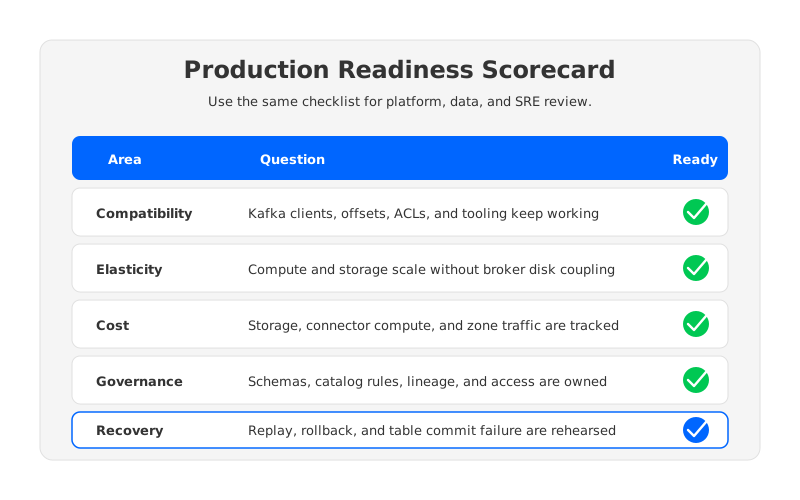
The final decision should look less like "Can this write to object storage?" and more like "Can we operate this feed for years?" A lakehouse feed becomes a dependency for analytics, AI features, regulatory reports, and customer-facing metrics. That changes the bar. A file-writing proof of concept is useful, but production needs predictable recovery, bounded cost, and shared observability across streaming and table layers.
Score each candidate architecture against five dimensions. Compatibility covers the Kafka API surface, client behavior, security, and operational tooling. Elasticity covers compute and storage scaling under retention changes and traffic spikes. Cost covers broker storage, cross-zone traffic, connector compute, and object storage lifecycle policy. Governance covers schemas, catalogs, lineage, and access controls. Recovery covers replay, rollback, broker replacement, table commit failure, and disaster scenarios.
When one dimension is weak, the weakness usually spreads. Poor governance creates recovery ambiguity because nobody knows which table snapshot is correct. Tight compute-storage coupling creates cost instability because scaling for one resource buys the other. Weak compatibility creates migration risk because application teams have to change code during an infrastructure project. A good architecture does not remove trade-offs, but it makes them explicit enough for platform teams to own.
9Closing Thought
The phrase object storage table feeds kafka hides a large design choice. You are deciding whether Kafka remains a disk-bound buffer in front of the lakehouse, or whether streaming and object storage become one cloud operating model. The teams that decide well do not start with a connector. They start with the contract: Kafka-compatible ingestion, object-storage-backed durability, governed table output, and a rehearsable recovery path.
For teams evaluating that operating model, AutoMQ's documentation on shared storage architecture and Table Topic is a practical next step. Start with the architecture and table feed concepts, then map them against your own compatibility, governance, and recovery scorecard: explore AutoMQ for Kafka-compatible lakehouse feeds.
10References
- Apache Kafka documentation: consumers
- Apache Kafka documentation: Kafka Connect
- Apache Kafka documentation: tiered storage
- Apache Iceberg documentation
- Amazon S3 User Guide
- AutoMQ architecture overview
- AutoMQ Table Topic configuration
11FAQ
11.1Is a Kafka-to-object-storage table feed the same as Kafka tiered storage?
No. Tiered storage extends how Kafka stores log segments, while a table feed writes data into a table format that query engines can read through table metadata and snapshots. The two ideas can complement each other, but they solve different problems.
11.2Do object storage table feeds replace Kafka Connect?
Not necessarily. Kafka Connect can remain the connector framework for many teams, especially when they already operate source and sink connectors. The architecture question is broader: whether the streaming storage layer, connector runtime, and table governance model can be operated together.
11.3Why does Kafka compatibility matter for lakehouse feeds?
Compatibility protects existing producers, consumers, security policies, and operational tools during the shift toward object-storage-backed tables. Without it, the lakehouse project can become an application migration project, which raises risk and slows adoption.
11.4Where should AutoMQ appear in the evaluation?
AutoMQ fits after the team has defined the required operating model: Kafka-compatible APIs, shared object-storage-backed durability, stateless brokers, and clear production recovery behavior. It should be evaluated as an architecture option, not as a shortcut around table governance or schema discipline.


