
Table of Contents
Table of Contents
Teams do not usually search for kafka storage request budget because they enjoy cloud billing taxonomy. They search for it when a retention decision has turned into an architecture decision. A product team wants 30 days of replay instead of 72 hours. A fraud team wants to reprocess historical events after a model change. The first estimate is storage capacity. The second, more painful estimate is request volume.
That second estimate matters because object storage pricing is not a single meter. A Kafka-compatible platform that uses object storage for historical data has to account for stored bytes, write requests, range reads, copy operations, deletes, cache misses, and network paths. Some costs stay quiet until replay, backfill, migration, or incident recovery.
The right question is whether your Kafka architecture turns retention into predictable object operations or into a noisy mix of small objects, cold reads, replica traffic, and emergency data movement.
1Why teams search for kafka storage request budget
Kafka retention used to be planned mostly around local disk. You chose log.retention.ms or retention.bytes, estimated ingestion volume, multiplied by the replication factor, and added operational headroom. That model was understandable because the storage and serving node were the same thing.
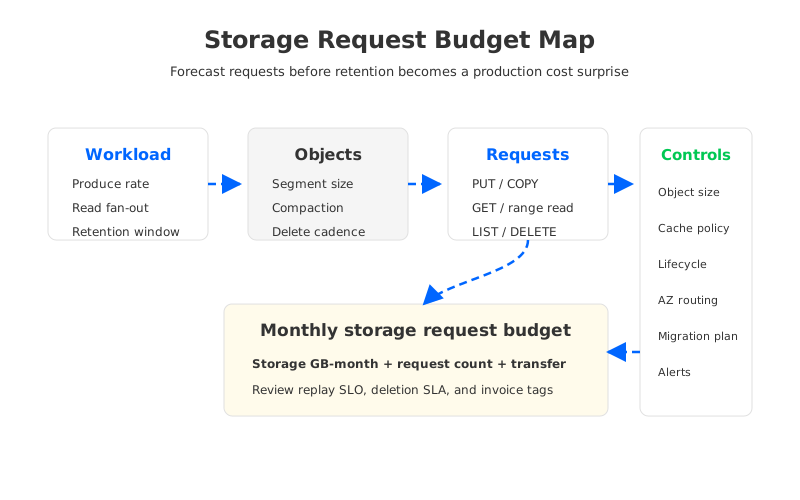
Object storage changes the shape of the estimate. It reduces broker-local disk pressure, but it introduces a different operating surface. Retention creates objects; producers and uploaders create write requests; consumers and replays create GET or range-read behavior.
A practical request forecast has four inputs:
- Ingest rate and segmenting behavior. The same byte volume can produce very different request counts depending on whether data is uploaded as many tiny objects or fewer larger objects.
- Read pattern. A hot tailing consumer, an hourly batch replay, and a disaster recovery catch-up job create different cache and object-read profiles.
- Retention and deletion cadence. Longer retention increases stored bytes, while short retention with many topics can increase delete and metadata operations.
- Architecture boundary. Tiered storage, shared storage, and diskless Kafka designs expose object storage to different parts of the Kafka lifecycle.
The trap is treating these inputs as a pure FinOps exercise. They also determine replay latency, broker replacement speed, consumer lag recovery, and post-incident cost explainability.
2The production constraint behind the problem
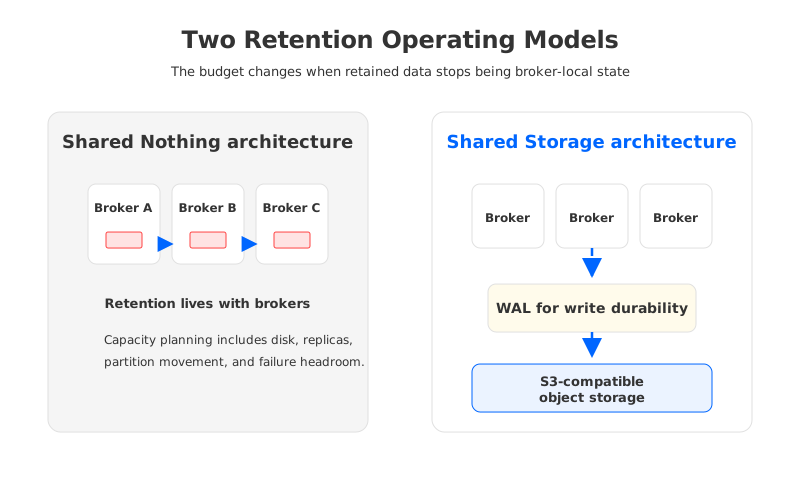
Traditional Apache Kafka follows a Shared Nothing architecture. Each broker manages local log segments, and reliability comes from replication across brokers. This mature design couples compute for current traffic, storage for retained history, and data movement during failures or scaling.
That coupling becomes expensive when retention grows. A 7-day retention policy does not merely require more disk than a 24-hour policy. It increases broker-owned state. Even if Tiered Storage moves older log segments to remote storage, the hot tier still depends on local disk.
Kafka can retain data. The constraint is that broker-local retention forces teams to reserve disk, network, spare broker capacity, and rebalancing time at the same time. Object storage can relieve disk pressure only if the architecture controls the request pattern created by moving data there.
This is where request forecasting becomes a production design exercise. A naive remote-log design can create small uploads, fragmented metadata, and cold-read amplification. A disciplined design batches writes, compacts objects, caches hot reads, prefetches cold reads, and keeps Kafka-facing semantics stable.
3Architecture options and trade-offs
There are three broad ways to think about Kafka retention on object storage. The names matter less than the control points each option exposes to operators.
| Option | Retention model | Request budget concern | Operational risk |
|---|---|---|---|
| Broker-local Kafka | Data remains on broker disks with replication | Object requests are not central, but disk and cross-AZ replication dominate | Scaling and recovery require data movement |
| Kafka Tiered Storage | Older log segments move to remote object storage | Remote segment size, fetch path, and delete behavior affect request volume | Hot tier remains broker-local state |
| Shared Storage architecture | Persistent data is stored in shared object storage with brokers acting as compute | WAL, object compaction, cache, and metadata design determine request efficiency | Requires confidence in the storage engine, not only Kafka APIs |
Broker-local Kafka has the simplest mental model, but it is often the least elastic. If retention grows, the cluster grows with it. The request budget is hidden because object storage is not in the path, but the bill shows up as disks, replicas, cross-Availability Zone traffic, and reserved capacity.
Kafka Tiered Storage recognizes that historical data does not need to live entirely on broker-local disks. KIP-405 introduced the foundation for moving completed log segments to remote storage while Kafka serves the active log locally. Object storage becomes a second tier rather than the primary storage model, so teams still reason about hot-tier sizing, remote fetch behavior, and recovery across both tiers.
Shared Storage architecture goes further. The broker is no longer the long-term owner of retained data. Persistent data lives in shared object storage, while brokers focus on Kafka protocol handling, partition leadership, caching, and routing. Storage operations become part of the core storage engine.
That design still needs validation for low-latency workloads, long replays, compacted topics, high partition counts, and strict residency policies. The evaluation should move from “Does it use object storage?” to “Does it make object storage predictable under Kafka semantics?”
4A forecasting model platform teams can use
Start with the workload before touching a vendor calculator. The minimum model is write throughput, partition count, retention window, read fan-out, replay frequency, and recovery objectives. Estimate stored bytes and request classes separately.
A useful first-pass model looks like this:
retained_bytes = write_bytes_per_second × retention_seconds
object_write_requests = retained_bytes ÷ effective_object_size
steady_read_requests = cache_miss_bytes ÷ effective_read_range_size
replay_read_requests = replay_bytes ÷ effective_read_range_size
delete_requests = expired_objects_per_period
The formulas vary by implementation, but the separation is the point. effective_object_size is the unit produced after batching, upload, and compaction. effective_read_range_size is the access pattern after cache, prefetch, and fetch planning.
For example, a workload that writes 500 MiB/s for 7 days retains roughly 295 TiB before compression and replication assumptions. That number is not enough to forecast request cost. The byte count tells you scale. The object shape tells you operational behavior.
Forecasting should include event-driven scenarios, not only steady state:
- Backfill day. A downstream system reprocesses 3 days of data, creating cold reads absent from the daily profile.
- Consumer outage. A critical consumer group falls behind and has to catch up without starving tailing reads.
- Broker replacement. A node disappears, and the platform has to recover ownership without copying retained history across brokers.
- Retention reduction. A policy changes from 30 days to 7 days, creating delete or lifecycle activity.
- Migration rehearsal. Producers and consumers are cut over while offsets, replay windows, and rollback paths are tested.
These scenarios turn a spreadsheet into an operating plan. FinOps may care about request-line variance. SREs care whether that variance coincides with an incident. Architects care whether it is inherent to the design or tunable through object sizing, cache, and routing.
5Evaluation checklist for platform teams
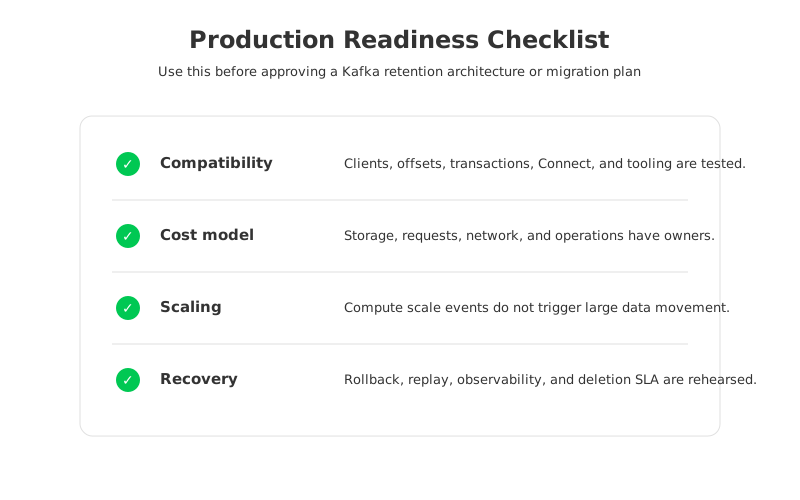
A storage request budget is useful only if it is tied to acceptance criteria. Otherwise it becomes another forecast that no one trusts after the first unexpected replay.
| Area | Question to answer | Evidence to collect |
|---|---|---|
| Kafka compatibility | Will existing clients, consumer groups, offsets, transactions, ACLs, and tooling behave as expected? | Compatibility tests using representative applications |
| Object shape | What effective object size is produced under your partition count and write rate? | Upload, compaction, and metadata metrics |
| Read path | What happens during catch-up reads, replays, and cache misses? | Cold-read latency, range-read size, cache hit ratio |
| Delete behavior | How are expired records removed or made unreachable? | Retention tests, delete request volume, lifecycle audit |
| Network path | Does the design create cross-AZ traffic during produce, replication, or consume? | Cloud network metrics and invoice tags |
| Scaling | Does adding or removing brokers move retained data? | Scale test with partition ownership changes |
| Recovery | What is the recovery path after broker loss, object-store impairment, or bad rollout? | Runbook rehearsal and rollback timing |
The checklist is intentionally implementation-neutral. A platform can pass it with traditional Kafka if retention is short and the team accepts the capacity reserve. It can pass it with Tiered Storage if remote reads and hot-tier sizing are understood. It can pass it with Shared Storage architecture if Kafka semantics, request efficiency, and recovery work together.
What should not pass is a design that answers every question with “object storage is low cost.” The storage engine has to decide durability, write batching, read prefetch, small-object merging, metadata bounds, and broker recovery.
6How AutoMQ changes the operating model
After the neutral evaluation, AutoMQ is relevant because it treats object storage as the primary storage foundation for Kafka-compatible streaming rather than as a remote archive bolted onto broker-local logs. AutoMQ is a cloud-native streaming platform fully compatible with Apache Kafka. Its core architectural change is S3Stream, a storage layer that moves Kafka log persistence into S3-compatible object storage while preserving Kafka semantics.
The important detail for a request budget is the WAL (Write-Ahead Log). Ordinary object APIs are not designed for every small Kafka append to become an independent object request. AutoMQ writes data durably to WAL storage first, returns the client acknowledgment after the durable write, and then uploads data to S3 storage. Data from many partitions can be mixed into the WAL before upload.
S3 storage then becomes the primary retained data layer. AutoMQ uses Stream Set Objects and Stream Objects to organize data, and compaction reduces fragmented object metadata and improves Catch-up Read efficiency.
The operating model changes in three practical ways:
- Compute and retained storage scale independently. Brokers can be added, removed, or replaced without treating retained Kafka data as broker-local cargo that must be copied around.
- Cross-AZ replication traffic is reduced by design. AutoMQ uses S3-based shared storage and routing patterns, so brokers do not replicate full partition data to peer brokers.
- The budget shifts from provisioned disk headroom to measured storage operations. Teams still forecast object requests, storage bytes, reads, and lifecycle activity.
This does not remove the need for testing. It makes the test more targeted: Kafka compatibility, WAL choice, read latency, request shape, cross-AZ traffic metrics, retention deletion behavior, and rollback procedure.
AutoMQ BYOC also keeps an important governance boundary: control plane and data plane run in the customer's own cloud account and Virtual Private Cloud. For regulated teams, the request budget is also about data location, bucket ownership, IAM, and cost allocation.
7Migration and governance considerations
Migration risk is where request budgets get stress-tested. A steady-state model can fail if cutover creates a replay storm, consumers restart from older offsets, or rollback doubles reads across two clusters.
The migration plan should define validation, cutover, and rollback windows. Each window changes request volume differently, so each needs its own budget.
Governance should be equally explicit. Object storage makes retention easier to extend, which also makes it easier to retain data longer than intended. Platform teams need ownership for bucket policy, encryption, lifecycle rules, deletion SLAs, residency, and cost allocation tags.
For procurement and architecture review, the final decision usually comes down to these questions:
- Can the platform preserve Kafka semantics that applications depend on?
- Can the team explain the request budget under steady state, replay, failure, and migration?
- Can compute scale without moving retained data?
- Can network traffic stay within the expected Availability Zone and VPC boundaries?
- Can governance teams audit where retained data lives and how it expires?
When those answers are concrete, storage architecture becomes an engineering choice with measurable acceptance criteria.
8Closing thought
The search phrase kafka storage request budget sounds narrow, but it points to a broader shift in Kafka operations. Retention is no longer only a disk-sizing problem. It is a storage-engine, network, recovery, and governance problem. Object storage helps when the platform turns object operations into a predictable part of the Kafka lifecycle.
If your team is evaluating that shift, run your own workload through the AutoMQ Pricing Calculator and compare the result with your current Kafka retention, replay, and cross-AZ traffic assumptions.
9References
- Apache Kafka documentation: broker retention configuration
- Apache Kafka documentation: Tiered Storage
- Apache Kafka KIP-405: Kafka Tiered Storage
- AWS: Amazon S3 pricing
- AutoMQ docs: S3Stream Shared Streaming Storage
- AutoMQ docs: WAL Storage
- AutoMQ docs: eliminate cross-AZ traffic
10FAQ
10.1What is a Kafka storage request budget?
A Kafka storage request budget estimates the object storage operations created by Kafka retention: writes, range reads, deletes, metadata operations, stored bytes, and network transfer assumptions. The goal is to forecast cost and operational behavior under steady state, replay, failure, and migration.
10.2Is object storage always lower cost for Kafka retention?
Object storage is often cost-effective for long retention because it avoids provisioning every retained byte on broker-local disks, but architecture decides the result. Small objects, poor cache behavior, cold reads, or unmanaged cross-AZ traffic can reduce expected savings.
10.3How is Tiered Storage different from Shared Storage architecture?
Kafka Tiered Storage offloads older log segments to remote storage while the hot log remains broker-local. Shared Storage architecture makes shared object storage the primary durable layer and treats brokers more like stateless compute.
10.4Which metrics should SREs monitor for object-storage-backed Kafka?
Monitor object write requests, range-read size, cache hit ratio, compaction backlog, object count, delete latency, cold-read latency, broker recovery time, cross-AZ traffic, and storage cost by bucket or tag.
10.5Where does AutoMQ fit in this evaluation?
AutoMQ fits when a team wants Kafka compatibility with a Shared Storage architecture. Its S3Stream layer uses WAL storage, S3 storage, caching, and object compaction to make object storage part of the core storage engine.


