
Table of Contents
Table of Contents
Teams searching for load testing event streams kafka are rarely looking for another generic benchmark harness. They usually have a production question behind it: can the streaming platform survive a launch, replay, migration, incident, or seasonal spike without turning every application team into a Kafka operator? A load test that only reports throughput misses the harder part. Event streams fail when ownership is unclear, lag has no accountable owner, recovery depends on broker-local data movement, or the bill explains more than the dashboard did.
The useful question is not "How fast can Kafka go?" Apache Kafka can handle large workloads when it is sized, partitioned, and operated well. The better question is: "What does the load test reveal about the operating model we are about to depend on?" That framing changes the test from a one-time performance exercise into an architecture review for compatibility, cost, elasticity, governance, recovery, and team boundaries.
1Why teams search for load testing event streams kafka
The search usually starts after the easy checks are done. Producers write records. Consumers join a Consumer group. Offsets move. Dashboards show broker request rates, lag, disk usage, and network throughput. Then the test becomes realistic: producers write at uneven rates, one downstream service falls behind, Kafka Connect tasks restart, a schema change lands during traffic, and a team asks whether it can replay 24 hours without affecting online consumers.
That is when a simple load test becomes an ownership test. The platform team may own broker capacity, but not every producer retry policy. SRE may own alerts, but not every consumer group's processing time. The application team may own business logic, but may not know whether reassignment, retention, or cross-zone paths are the hidden constraint.
A practical load test should therefore answer four questions at the same time:
- Can the Kafka API contract hold under pressure? Producers, consumers, transactions, offsets, and admin operations should behave the way existing applications expect.
- Can the team explain the cost curve? Storage, compute, network, and private connectivity costs should be visible as separate drivers, not one blended infrastructure number.
- Can the platform recover without heroic coordination? Broker loss, consumer lag, connector restarts, and replay should have owners and rehearsed actions.
- Can the migration path be rolled back? A test that proves only the forward path is incomplete when offsets, schemas, ACLs, and clients must move together.
The right output is not a single pass/fail number. It is a map of which team owns which bottleneck, which metric proves that ownership, and which action follows when the metric crosses a threshold.
2The production constraint behind the problem
Traditional Kafka uses a Shared Nothing architecture: each broker manages its own local storage, and partitions are replicated across brokers for durability. That design is robust, well understood, and deeply integrated with Kafka's semantics. It also means that capacity planning is not only about CPU and memory. A broker's role as both compute node and local persistence node makes storage placement, replication, and reassignment part of the production constraint.
During a load test, this coupling shows up in ways that average throughput hides. If one topic becomes hot, the platform may need to rebalance partitions. If retention grows, disks or volumes become the limiting resource. If a broker fails, recovery depends on the state of replicas and the time needed for followers, leaders, and clients to converge. If the cluster spans Availability Zones, the test may create a network pattern that is not obvious from Kafka metrics alone. The broker can look healthy while the cost model or recovery plan is becoming fragile.
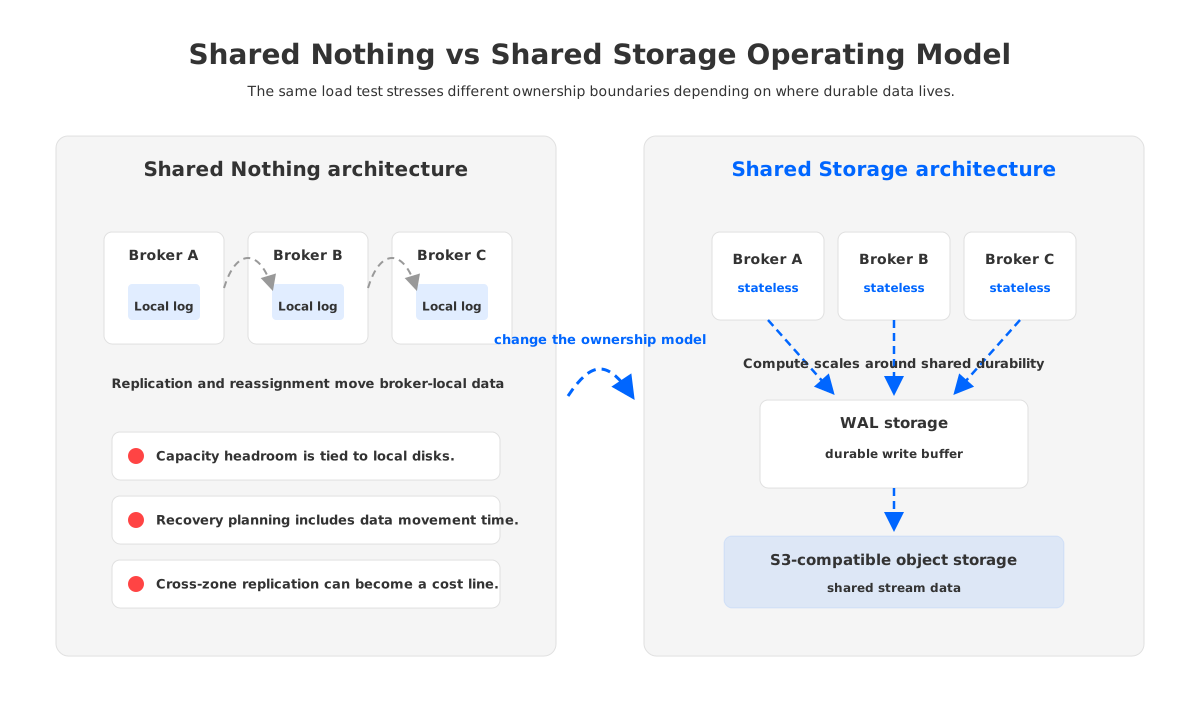
Tiered Storage changes part of this picture by moving older log segments to remote storage, and it can be valuable for long retention. It does not remove the need to reason about the hot path, local broker responsibility, and recent-data behavior. A load test with replay should distinguish tailing reads, catch-up reads, and long-retention access.
This is also why observability must include more than broker dashboards. Kafka's own documentation gives operators a rich model of producers, consumers, offsets, transactions, KRaft metadata, and Connect workers. A production load test needs to connect those concepts to service ownership. Consumer lag is not only a number; it is a question about whether the consumer is slow, the partitioning model is wrong, the downstream dependency is saturated, or the platform is doing work the application team cannot see.
3Architecture options and trade-offs
The first architecture option is to keep the existing Kafka operating model and make the test more disciplined. That is a valid choice when the team has strong Kafka expertise, predictable traffic, clear runbooks, and enough budget for reserved headroom. The test should include broker failure, partition reassignment, consumer group rebalance, producer retry storms, connector restarts, and at least one replay path. It should also tag infrastructure cost so storage growth and cross-zone data movement do not disappear into a monthly cloud line item.
The second option is to use managed infrastructure while retaining the same mental model. This reduces some lifecycle work, but it does not automatically answer ownership questions. Someone still owns topic design, client behavior, schema evolution, lag interpretation, private connectivity, access control, and migration risk. Managed operations can remove toil, yet the load test still needs to prove that the platform's control plane and the application's data plane boundaries are clear enough for incident response.
The third option is a cloud-native Kafka-compatible architecture that separates compute from storage. This is a bigger architectural choice, not a tuning parameter. The goal is to keep the Kafka protocol and ecosystem while changing the place where durable stream data lives. If persistent data is no longer bound to a broker's local disk, then scaling, failure recovery, and partition ownership can be treated differently. That does not remove the need for load testing; it changes what the test should measure.
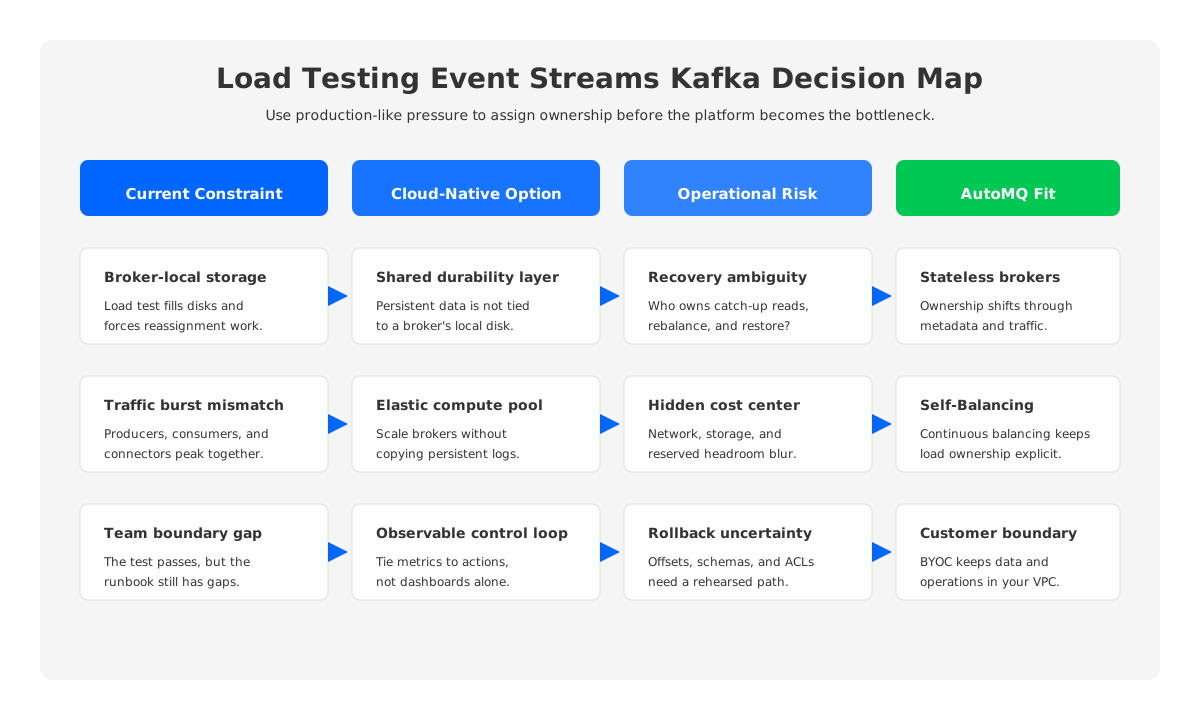
The decision map above is intentionally operational. A platform team should not pick an architecture because one synthetic benchmark looks clean. It should ask which architecture makes the production burden explicit. For Shared Nothing architecture, the key questions are about disk headroom, replica movement, and network paths. For a Shared Storage architecture, the key questions move toward WAL behavior, object storage access, cache effectiveness, metadata ownership, and the control loops that move traffic across stateless brokers.
| Evaluation area | What the load test should prove | Common blind spot |
|---|---|---|
| Compatibility | Existing clients, Consumer groups, offsets, transactions, and Kafka Connect jobs behave as expected. | Testing only producer throughput and ignoring client edge cases. |
| Cost | Compute, storage, network, and private connectivity are measured separately. | Treating a successful high-throughput run as cost-neutral. |
| Elasticity | Scale-out and scale-in happen without disruptive data movement or long ownership confusion. | Adding brokers but not measuring rebalance impact. |
| Governance | IAM, VPC, encryption, ACLs, audit, and data residency boundaries are clear. | Load testing in an environment that does not match production controls. |
| Recovery | Broker loss, consumer lag, connector restart, and replay have timed runbooks. | Watching dashboards without assigning action owners. |
| Migration | Forward and rollback paths preserve offsets, schemas, and access intent. | Testing only the cutover moment, not the return path. |
This table is more useful than a vendor scorecard because it forces the team to name what would break in its own environment. A payment event stream, observability pipeline, and clickstream replay job may all use Kafka, but their failure modes are not interchangeable.
4Evaluation checklist for platform teams
A good load test starts before the first record is produced. Write down the scenario in terms application owners understand: expected write rate, read fanout, retention, replay window, schema-change behavior, connector dependencies, acceptable lag, failure events, and rollback target. If those items are vague, the graphs will be hard to interpret.
The second step is to define metric ownership. Broker request latency belongs to the platform, but producer retry rate may belong to the application. Consumer lag may belong to the consumer team until the platform proves a broker or partition-level cause. Connector task failures may belong to the data integration team, while endpoint or routing issues may belong to networking.
The third step is to test negative paths, not only peak load. A test that never kills a broker, pauses a consumer, restarts a connector, changes a schema, or triggers a replay is a capacity demo. Production load tests need controlled disruption because event streams are designed to retain and replay data.
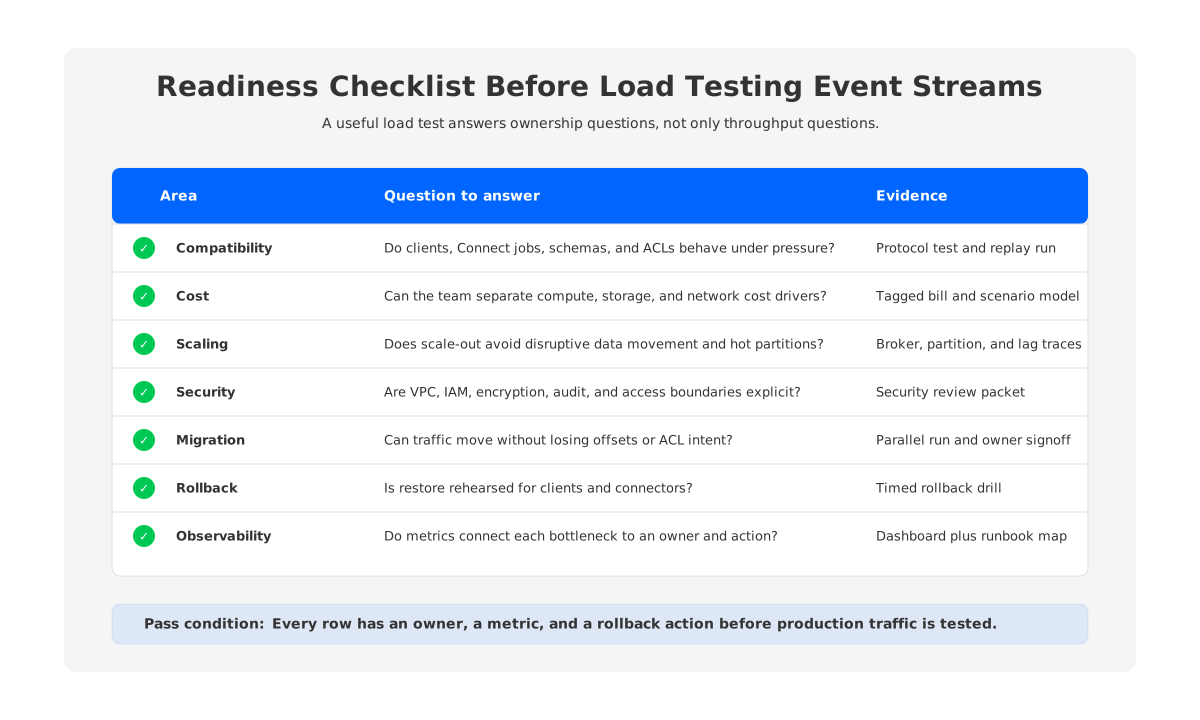
The checklist should produce evidence, not opinions. A platform review should include test configuration, topic and partition layout, client versions, broker versions, deployment topology, region, networking path, access model, and retention assumptions. It should also include decisions made after the test: changed alerts, updated runbooks, added quotas, accepted ownership, and deferred risks.
Teams often treat the load test environment as a smaller copy of production, then assume conclusions scale linearly. Event streaming does not always behave that way. Partition count, message size, compression, batching, read fanout, cross-zone placement, and object storage access patterns can change the bottleneck. Treat the test as evidence about a specific workload shape.
5How AutoMQ changes the operating model
Once the team has an evaluation framework, AutoMQ becomes easier to reason about because it is not merely another place to run Kafka workloads. It is a Kafka-compatible streaming platform built around Shared Storage architecture: AutoMQ keeps Kafka protocol compatibility while moving persistent stream storage to S3-compatible object storage through S3Stream, WAL storage, and data caching. The important shift for load testing is that AutoMQ Brokers are stateless with respect to persistent stream data.
That shift changes ownership questions. In Shared Nothing architecture, a broker is both request-processing node and local persistence boundary. In AutoMQ, brokers handle Kafka protocol work, leadership, routing, caching, and scheduling, while durable data is backed by shared object storage and WAL. During a load test, adding or replacing broker capacity is less about moving large local logs and more about moving ownership, metadata, and traffic.
AutoMQ does not remove the need to test client behavior. A Kafka-compatible API still means the platform team should validate producers, consumers, Consumer groups, offsets, transactions, Kafka Connect jobs, Schema Registry integrations, and operational tools against the versions used in production. The difference is that the test can focus more sharply on workload behavior and less on whether local broker disks are becoming the hidden center of gravity. That distinction matters when teams are evaluating replay-heavy workloads or variable traffic that forces frequent capacity changes.
The deployment boundary is also part of the test. AutoMQ BYOC runs the control plane and data plane in the customer's cloud account and VPC, while AutoMQ Software is designed for customer-managed private environments. For regulated teams, this means a load test can include the same network, IAM, encryption, private connectivity, and observability boundaries that will exist in production. The test should prove not only that the stream can carry load, but also that the organization can operate it inside its own control model.
AutoMQ Console, Terraform workflows, observability integrations, Self-Balancing, Self-healing, and Kafka Linking then become practical operating tools rather than marketing labels. Console and Terraform standardize cluster lifecycle and configuration ownership. Observability connects broker, WAL, object storage, cache, and balancing signals to the runbook. Kafka Linking supports controlled cutover by synchronizing messages and offsets.
The conclusion is not that every Kafka workload must move to Shared Storage architecture. The conclusion is that load testing should expose the operating model. If the test keeps turning into disk headroom debates, reassignment windows, cross-zone cost analysis, unclear rollback paths, and manual balancing, the architecture itself has become part of the bottleneck.
6FAQ
6.1What should a Kafka event stream load test measure beyond throughput?
Measure producer latency, broker request latency, consumer lag, rebalance time, connector restart behavior, offset continuity, replay impact, storage growth, network paths, and cloud cost drivers. More importantly, attach each metric to an owner and a runbook action.
6.2How long should a load test run?
Run it long enough to include the workload phases you expect in production: warm-up, steady write load, peak write load, consumer slowdown, replay, connector restart, and recovery. A short spike test is useful, but it cannot validate retention, catch-up reads, rollback, or cost behavior.
6.3Does Tiered Storage solve the load testing problem?
Tiered Storage can help with long retention by offloading older data, but it does not eliminate the need to test the hot path, local broker responsibility, consumer lag, and operational recovery. Treat it as one architecture option and test the full workload shape.
6.4When should a team evaluate a Shared Storage architecture?
Evaluate it when broker-local storage, data movement, reserved capacity, or cross-zone traffic repeatedly dominate operational planning. The signal is not only high cost; it is the amount of coordination required to scale, recover, and migrate safely.
6.5How should migration be included in the test?
Include a parallel run, offset validation, schema and ACL checks, producer cutover, consumer cutover, and a timed rollback drill. Migration testing is incomplete when it proves only the forward path.
7Closing the loop
The search that started with load testing event streams kafka should end with a clearer ownership model. A useful result is not a graph that says the cluster survived. It is a decision record that says which architecture constraints appeared, which team owns them, which metrics prove they are under control, and which recovery actions were rehearsed.
If you are evaluating a Kafka-compatible platform with Shared Storage architecture and customer-controlled deployment boundaries, start with the AutoMQ Cloud Console and run the checklist against one production-like event stream before expanding the test.


