
Table of Contents
Table of Contents
When teams search for python kafka client backpressure, the problem is rarely that they do not know how to call send() or poll(). The harder question is why a Python service that looked stable at ordinary traffic suddenly starts growing memory, delaying requests, timing out writes, or hiding consumer lag behind a friendly retry loop. Backpressure is where application code, Apache Kafka client behavior, broker capacity, network latency, and team ownership meet.
A Python Kafka client can apply pressure in both directions. A producer may enqueue records faster than the client can deliver them to the cluster. A consumer may fetch records faster than the application can process, write to a database, or call an external API. In both cases, the local symptom is visible in the Python process, but the cause may sit several layers away from Python. That is why useful backpressure work starts with observability and ownership, not with another round of random client tuning.
1Why Teams Search For python kafka client backpressure
Backpressure becomes visible when a service crosses from demo throughput into shared infrastructure. A Python API handler may publish an event for every user action. A batch worker may consume from Kafka, transform payloads, and write into a warehouse. A machine learning feature pipeline may read high-volume topics, enrich records, and emit derived features. Each service has a queue somewhere, even when the queue is not named: the web server request backlog, the Python executor, the producer buffer, the broker request queue, the consumer fetch buffer, or the downstream sink.
The danger is not the existence of a queue. Queues are how streaming systems absorb normal rate differences. The danger is an unowned queue with no clear bound, no alert, and no decision about what happens when it fills. If the producer buffer grows until max_block_ms is hit, the application team sees a timeout. If the consumer keeps fetching while processing stalls, the platform team sees lag after the damage is already underway. If retries mask broker pressure, the incident arrives as an apparently unrelated latency spike.
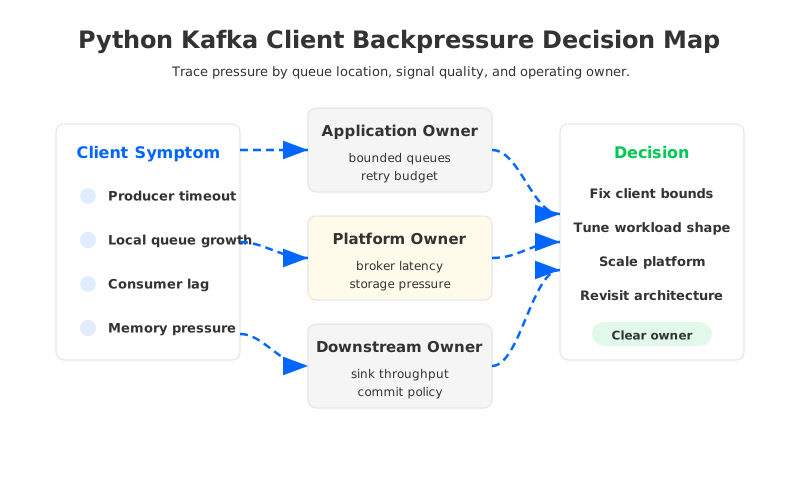
The first useful split is between symptoms and control points:
| Symptom | Likely control point | Owner who must act |
|---|---|---|
| Producer calls block or time out | Client buffer, broker acknowledgments, network path | Application and platform teams |
| Consumer lag grows while processing is slow | Worker concurrency, downstream sink, commit policy | Application and SRE teams |
| Broker latency rises for many clients | Partition load, storage path, request queues | Platform team |
| Memory grows inside one Python process | Local queue design, serialization, batch size | Application team |
This table is deliberately organizational. Many incidents stay unresolved because every team sees the part they own and treats the rest as somebody else's queue. A backpressure design should make that split visible before traffic makes it expensive.
2The Production Constraint Behind The Problem
Kafka client tuning often starts with local settings: batch_size, linger_ms, acks, delivery_timeout_ms, fetch_max_bytes, max_poll_records, and commit behavior. Those settings matter. The kafka-python producer documentation describes an asynchronous producer with pending record buffers and a background sender thread, while its consumer API exposes pause, resume, poll, position, and metrics interfaces. Those are real control surfaces, and Python services should use them deliberately.
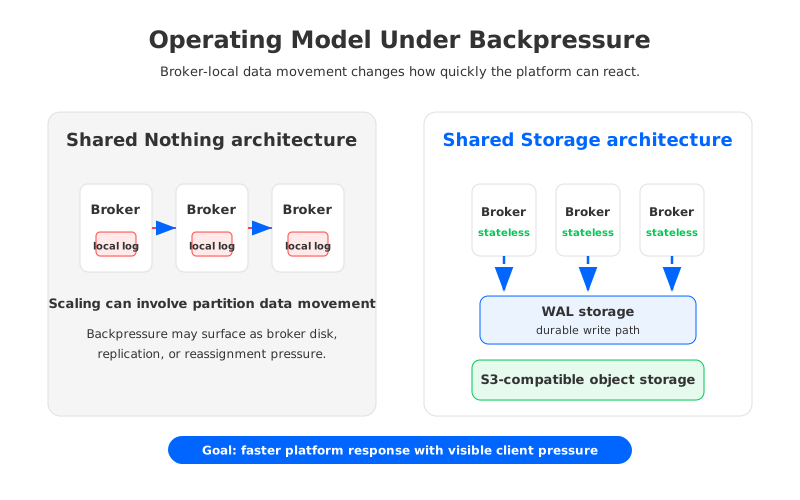
But local tuning cannot answer the platform question: what happens when every client behaves reasonably and the cluster still becomes the bottleneck? Traditional Kafka uses a Shared Nothing architecture. Each broker owns local log data for its partitions, and durability depends on replication across brokers. This model works, but it couples capacity, recovery, and data placement. When a hot topic, broker failure, or scaling event appears, the platform team may need to move partition data, reserve extra disk, rebalance leaders, and protect live traffic from the operational work.
That coupling matters for Python client backpressure because client pressure is often a signal that the platform has run out of elasticity in the wrong layer. A producer retry storm might be caused by broker-side latency. A consumer lag spike might be caused by cold reads, a hot partition, or storage pressure. A Python worker can slow down politely, but it cannot make a broker-local storage model scale without data movement. At that point, the client's backpressure behavior becomes a way of exposing platform constraints.
There is also a cost and governance angle. Over-provisioning brokers to protect clients from bursts may keep dashboards green, but it shifts the cost into idle compute and disk. Aggressive right-sizing may lower steady-state spend, but it leaves less room for retry storms, consumer catch-up, and rolling maintenance. Teams need a model that distinguishes application mistakes from platform constraints, because the remediation paths are different.
3Architecture Options And Trade-Offs
There are three common ways to respond when Python Kafka clients keep hitting backpressure. The first is client-local discipline: bounded queues, explicit timeouts, measured retries, controlled concurrency, and pause/resume for consumers. This is mandatory because no streaming platform can compensate for an application that accepts infinite work into memory. It also gives the application team the fastest feedback loop.
The second response is platform-side capacity management. Add brokers, increase partitions where ordering allows it, tune quotas, isolate noisy tenants, improve broker monitoring, and revisit retention. This is often the correct move when the current cluster is underbuilt or when topic design creates unnecessary hot spots. It becomes less satisfying when every scaling action also creates storage movement, maintenance windows, or a long tail of rebalancing work.
The third response is an architecture change. That does not mean replacing every client or rewriting the application protocol. It means asking whether the streaming layer should still bind durable data to broker-local storage when the rest of the workload is elastic. The answer depends on the pressure pattern, not on a vendor label.
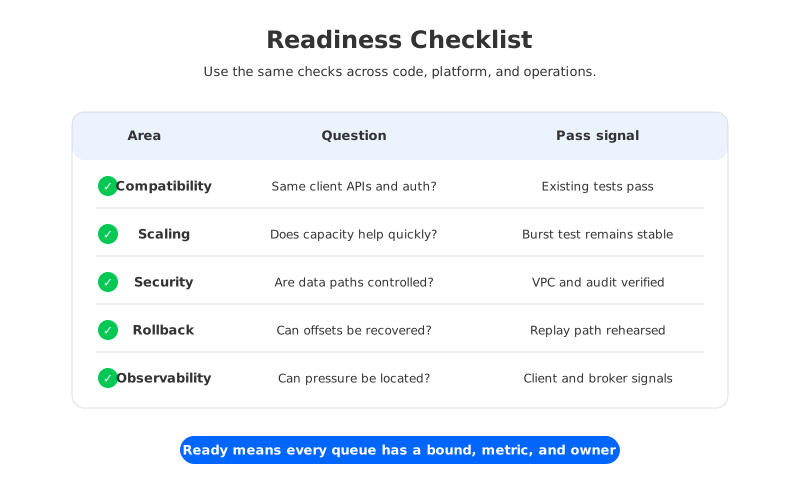
| Evaluation question | Why it matters for backpressure | What to verify |
|---|---|---|
| Client compatibility | Python services should keep existing Kafka APIs, serializers, auth, and delivery semantics. | Run the same producer, consumer, transaction, and error-path tests. |
| Elasticity boundary | Scaling should help live traffic quickly instead of waiting for large data movement. | Measure capacity add/remove behavior during burst and catch-up tests. |
| Storage ownership | Broker-local storage turns client bursts into disk and reassignment work. | Check how durability, recovery, and cold reads are handled. |
| Observability | Teams need to know whether pressure is client-side, broker-side, or downstream. | Correlate client metrics, broker latency, lag, and sink health. |
| Governance | Production fixes must preserve security, deployment boundaries, and rollback paths. | Validate IAM, network paths, audit logs, and operational permissions. |
This framework keeps the conversation honest. If the issue is a Python service with an unbounded in-memory queue, solve that first. If the issue is recurring broker-side pressure during normal bursts, a client-only fix becomes a way of hiding a platform limit.
4Evaluation Checklist For Platform Teams
A useful readiness review should force the application team and platform team to agree on what each layer promises. Start with the producer path. Define the maximum local queue size, the acceptable time a request may wait for Kafka, the retry budget, the behavior when a record cannot be delivered, and whether the upstream caller should receive a throttling response. Then tie those decisions to metrics: queue depth, request latency, delivery errors, timeout counts, and broker acknowledgment latency.
Consumer backpressure needs the same treatment. A consumer may pause partitions while downstream work catches up, reduce concurrency, increase worker capacity, or shed low-priority work. Those choices depend on whether freshness, ordering, cost, or downstream protection is the primary goal. A consumer group that commits offsets before durable processing has a different risk profile from a service that commits only after a sink write succeeds. Neither is universally correct; both need to be explicit.
The platform team should then test the cluster under the same failure modes that application teams actually experience:
- Burst ingestion: Does producer latency rise gradually with clear alerts, or does it jump from healthy to timeout?
- Slow downstream sink: Can consumers pause or slow fetches without losing group stability or hiding lag?
- Broker replacement: Does client pressure spike while the cluster repairs itself?
- Catch-up read: Can consumers recover after an outage without starving tailing traffic?
- Governed rollback: Can teams disable a release, drain queues, and replay from known offsets?
These tests are more useful than a single peak-throughput benchmark. Backpressure is about the system's shape under constraint. A benchmark can say a path is fast when everything is healthy; an ownership test says who gets paged when it is not.
5How AutoMQ Changes The Operating Model
Once the evaluation makes the pressure boundaries visible, AutoMQ becomes relevant as a Kafka-compatible streaming platform built around Separation of compute and storage. It keeps Kafka protocol and API compatibility for existing clients while replacing broker-local persistent storage with a Shared Storage architecture backed by object storage, WAL storage, and S3Stream.
This changes the operating model behind Python client backpressure. AutoMQ Brokers are stateless brokers, so durable data is not tied to the lifetime or disk of a single broker. The broker handles protocol, request routing, caching, leadership, and scheduling work, while the persistent storage layer sits in shared object storage with a WAL path for durable writes. Scaling broker compute is therefore closer to scaling an application tier than copying local log segments between machines.
The result is not that Python clients stop needing backpressure. They still need bounded queues, measured retries, pause/resume behavior, and downstream-aware processing. What changes is the platform side of the incident. If a traffic burst requires more broker compute, the architecture can add or replace brokers without turning partition reassignment into a large storage migration. If a broker fails, recovery focuses on ownership and metadata rather than rebuilding local disk state. If platform teams operate through AutoMQ Console, Terraform, monitoring, Self-Balancing, and Self-healing capabilities, the boundary between application response and platform response becomes easier to encode in runbooks.
AutoMQ BYOC and AutoMQ Software also matter for governance. In BYOC deployments, control plane and data plane components run inside the customer's cloud account or VPC, and customer business data remains in the customer's environment. For teams investigating backpressure in regulated workloads, that boundary is part of the architecture decision: observability and operations should improve without moving business records into a third-party data path.
The practical takeaway is modest and important. Fix the Python client first when the queue is local. Revisit topic design when partitions, keys, or consumer group behavior create avoidable hot spots. Revisit the streaming platform when healthy clients keep surfacing the same broker-local storage and elasticity constraints. Backpressure is not a Python problem or a Kafka problem in isolation; it is a contract between the application and the platform.
If your team is turning repeated Python Kafka backpressure incidents into an architecture review, use the checklist above to separate local code issues from platform limits. To evaluate a Kafka-compatible Shared Storage architecture in your own environment, start with AutoMQ BYOC.
6FAQ
6.1What is Python Kafka client backpressure?
Python Kafka client backpressure is the condition where a Python producer, consumer, or processing worker cannot move records at the same rate as the systems around it. The pressure may appear as producer timeouts, growing local queues, consumer lag, slow commits, rising memory, or downstream throttling.
6.2Should I fix backpressure in the Python code or the Kafka platform?
Start by proving where the queue is growing. If the queue is inside the Python service, fix local bounds, concurrency, retry behavior, and pause/resume logic. If many healthy clients see the same broker-side latency or lag pattern, treat it as a platform capacity or architecture issue.
6.3Do async Python Kafka clients remove backpressure?
No. Async I/O can make concurrency easier to manage, but it does not remove the need for bounded queues, delivery timeouts, retry budgets, and downstream-aware flow control. Async code can hide pressure if every coroutine keeps accepting work without a limit.
6.4How does Shared Storage architecture affect client backpressure?
Shared Storage architecture does not replace client-side flow control. It changes the platform response by separating broker compute from durable storage, which can reduce the amount of broker-local data movement involved in scaling, replacement, and recovery.


