
Table of Contents
Table of Contents
Searching for terraform drift detection kafka usually means something has already gone wrong enough to feel dangerous, but not wrong enough to have a clean incident name. A Terraform plan shows a change nobody expected. A broker group has a different instance type than the module says it should. A security group rule appears in the cloud console but not in Git. A disk was expanded during an incident, and nobody is sure whether Terraform should preserve it, revert it, or turn it into a permanent change.
That ambiguity is the real problem. Terraform can show that the actual infrastructure no longer matches the desired state, but a Kafka platform is not a static collection of cloud resources. It is a running data system with partition leadership, consumer groups, offsets, replication, storage placement, network paths, and client compatibility constraints. A drift signal is only useful when the platform team can connect it to runtime behavior and to a clear owner.
The useful question is not “Can we detect drift?” Most teams can. The useful question is: when drift touches Kafka infrastructure, can you tell whether it is harmless configuration noise, a hidden reliability risk, a cost leak, or an intentional emergency change that must be codified?
1Why Teams Search for terraform drift detection kafka
Kafka infrastructure tends to accumulate manual changes for understandable reasons. An SRE adds broker capacity during a traffic spike. A platform engineer adjusts a load balancer attribute because a client team is blocked. A security team tightens an endpoint policy. A cloud operations team modifies an auto scaling group outside the Kafka module because the generic fleet policy changed first and the streaming module will be updated later.
Each change may be reasonable in isolation. The trouble starts when Terraform sees all of them as the same kind of difference: desired state and real state no longer match. A plain drift report rarely knows whether a disk change affects only future brokers or also changes recovery, cross-Availability Zone traffic, cost allocation, or Kafka Connect access.
For Kafka, drift detection has to answer four ownership questions:
- Who owns the resource? Some resources belong to the platform team, some to cloud networking, some to security, and some to the application team that owns a connector or topic.
- Who owns the runtime effect? The team that owns an instance group may not own consumer lag, partition reassignment, or a failed transactional producer.
- Who can approve remediation? Reverting a tag and resizing a broker volume are not the same kind of action, even if both appear in a Terraform plan.
- Who sees the signal first? A plan diff, a Grafana alert, a cloud cost anomaly, and an application error may all point to the same change from different angles.
That is why Terraform drift detection for Kafka should be treated as an observability and ownership workflow, not only an infrastructure hygiene workflow. Terraform supplies the desired-state lens. Kafka metrics, client behavior, cloud billing dimensions, and deployment history supply the operational lens.
2The Production Constraint Behind the Problem
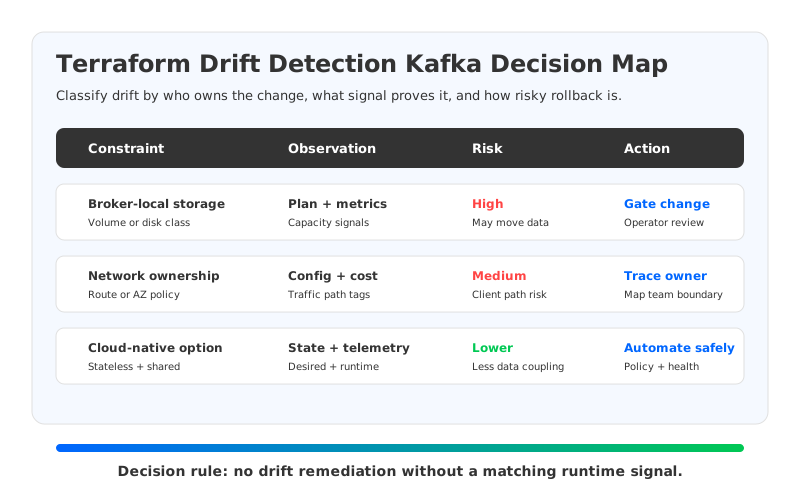
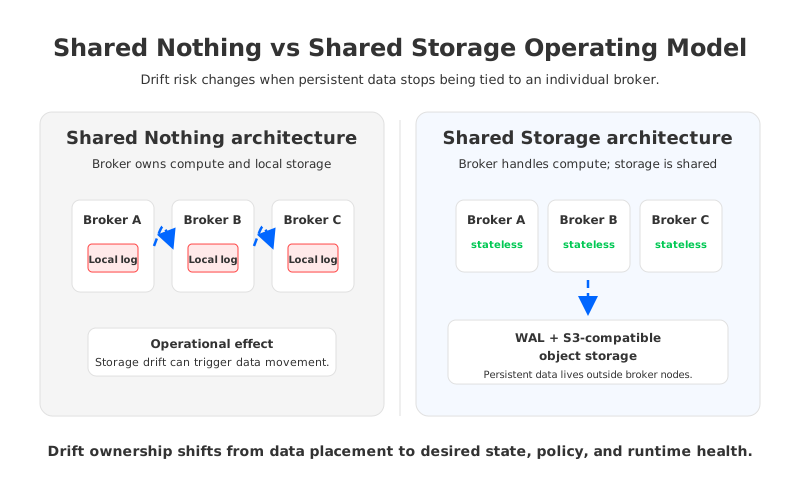
Traditional Kafka operations are hard to automate because the broker is not merely compute. In the classic Shared Nothing architecture, each broker owns local storage for partitions, and durability comes from replication across brokers. That design is mature and proven, but it means a resource-level change can be tied to data placement. When the platform changes broker capacity, disk layout, or node membership, the system may need partition reassignment, replica movement, leader changes, or a controlled rollout.
Terraform sees a broker node group. Kafka sees leaders, followers, ISR, offsets, fetch paths, produce acknowledgments, and consumer group progress. This difference matters during drift remediation. If an instance type was changed manually, reverting it might be straightforward for stateless services. For Kafka, the same revert can interact with broker storage, partition balance, request latency, and recovery time. The cloud resource is the object Terraform manages; the data system is what users experience.
There is also a cost dimension. Kafka clusters on cloud infrastructure often include compute, block storage, object storage when Tiered Storage is enabled, inter-AZ data transfer, load balancers, service endpoints, monitoring, and backup or migration tooling. A drifted network path can look minor in Git while changing traffic flow. A drifted retention policy can look like a topic-level setting while changing storage growth. A drifted broker count can look like capacity while changing replication traffic and operational headroom.
This is why “auto-remediate all drift” is a poor default for Kafka. A better default is “classify before remediation.” The plan diff should open a short investigation path: what changed, what runtime signal moved, what team owns the intent, and what rollback would touch. Automation is still valuable, but the automation should encode these questions instead of skipping them.
3Architecture Options and Trade-Offs
Platform teams usually have three broad options when they build a drift detection process around Kafka. None is universally correct. The right answer depends on how much operational risk the team is willing to encode into policy and how much Kafka-specific context the automation can read.
| Approach | What it does well | Where it becomes risky |
|---|---|---|
| Terraform-only detection | Finds cloud resource drift early and creates a clear Git-based review path. | Treats Kafka-sensitive and low-risk resources similarly unless policy adds context. |
| Runtime-only monitoring | Catches what users feel: lag, under-replicated partitions, failed requests, or latency. | Detects symptoms after the infrastructure change has already affected the system. |
| Combined drift and observability workflow | Connects desired state, actual state, metrics, ownership, and approval. | Requires teams to model resources, owners, and safe remediation rules deliberately. |
The combined model is strongest because it accepts that Terraform and Kafka answer different questions. Terraform declares what the platform should look like. Kafka observability shows how it behaves. Cloud billing and network telemetry show whether the infrastructure path still matches the cost and governance model.
This model also prevents false positives. Some drift is expected: auto scaling may change capacity within approved bounds, an emergency change may be accepted until review, and a provider may add computed attributes. The process should separate expected, tolerated, and unsafe change. Treating every diff as broken trains engineers to ignore the report.
The harder false negative is more dangerous: infrastructure appears consistent enough, but Kafka behavior has moved. A Terraform plan may be clean while a manual topic change, client configuration update, or connector deployment shifts load in a way that changes consumer lag or storage pressure. That is why the drift workflow needs Kafka-level signals such as broker metrics, consumer group lag, partition reassignment activity, request latency, and connector health.
4Evaluation Checklist for Platform Teams
Before choosing a Kafka-compatible streaming platform or automating drift remediation, put the operating model on paper. The checklist should be short enough for incident review and specific enough to reject unsafe automation.
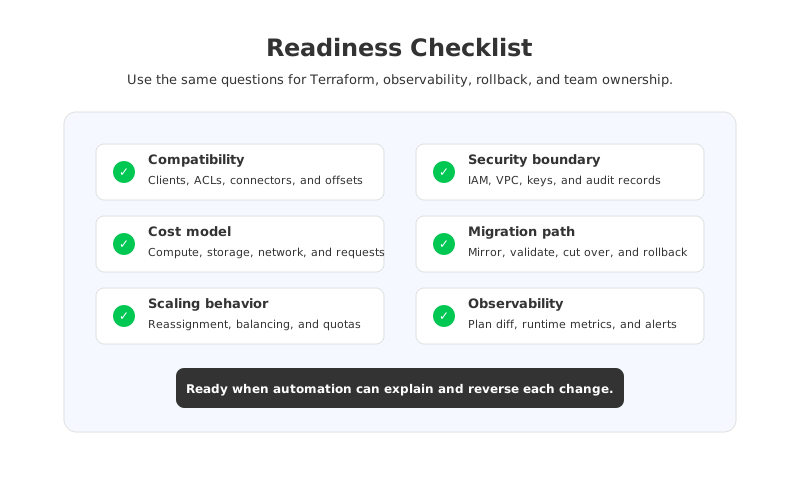
Start with compatibility. A platform that claims Kafka compatibility should preserve the client behavior your applications depend on: producer and consumer APIs, consumer groups, offsets, transactions where used, Kafka Connect integrations, Schema Registry patterns, ACLs, and existing monitoring conventions. Drift remediation becomes much safer when platform changes do not force application teams to rewrite clients or change operational dashboards at the same time.
Then examine cost and elasticity together. A Kafka cluster can be over-provisioned because the team fears traffic spikes, slow reassignment, or recovery risk. A drift process that only says “the broker count changed” misses the deeper question: was the change compensating for an architecture that cannot scale cleanly? The same logic applies to storage. If local disks must be sized for peak retention and recovery, manual expansion may be a symptom of capacity planning friction rather than careless operations.
Governance needs the same rigor. Drift detection should know which changes are security-sensitive, cost-sensitive, and application-facing. A security group rule, an endpoint policy, a broker instance type, and a retention setting all deserve different review paths. The platform team should define what can be remediated automatically, what requires approval, and what should only create an investigation ticket.
A practical readiness scorecard can use five levels:
- Observed: Terraform detects the diff, but ownership and runtime effect are manual.
- Classified: Resources are mapped to owners, risk classes, and service boundaries.
- Correlated: Drift is linked to Kafka metrics, cloud cost dimensions, and deployment events.
- Guarded: Policy decides whether to alert, ignore, open a pull request, or block remediation.
- Automated: Low-risk remediation is automatic, while Kafka-sensitive changes require health checks and approval.
The goal is not to turn every Kafka operation into a policy engine. The goal is to avoid a situation where the safest engineer in the room is the one who refuses to click “apply” because the automation cannot explain what it is about to touch.
5How AutoMQ Changes the Operating Model
Once the evaluation framework is clear, the architecture choice becomes easier to reason about. If drift remediation is difficult because broker-local storage couples infrastructure changes to data movement, then a Kafka-compatible platform with stateless brokers and shared storage changes the risk profile.
AutoMQ is a Kafka-compatible cloud-native streaming platform built around a Shared Storage architecture. It keeps the Kafka protocol and ecosystem surface while replacing broker-local persistent storage with S3Stream, which uses WAL storage and S3-compatible object storage. Persistent data is no longer tied to a specific broker node in the same way it is in a Shared Nothing architecture.
That distinction matters for Terraform drift detection. If brokers are stateless, a drifted compute resource is more likely to be treated as a capacity and scheduling issue instead of a data-placement issue. If object storage is the primary durable layer, the platform team can reason about storage ownership separately from broker replacement. If partition reassignment does not require large broker-local data copies, scaling and balancing fit better with policy-driven operations.
AutoMQ Console, Terraform-driven workflows, monitoring integrations, Self-Balancing, and Self-healing sit on top of that shift. They do not remove governance; they make it easier to express. Application teams keep Kafka-compatible clients and semantics. Platform teams manage desired state, capacity, observability, and deployment guardrails. Security teams review cloud account, VPC, IAM, and key boundaries in customer-controlled deployment models such as AutoMQ BYOC.
This is also where observability becomes more than dashboards. AutoMQ exposes Kafka-compatible metrics and adds S3Stream-related signals, so drift analysis can include broker health, storage behavior, WAL pressure, balancing activity, and cloud resource state. A Terraform plan can say “capacity changed.” The runtime layer can say whether that change correlates with lag, rebalance activity, write latency, or storage pressure.
Migration should still be staged. A team evaluating AutoMQ for drift-sensitive Kafka operations should validate client compatibility, mirror representative workloads, compare runbooks, and define rollback criteria before changing production traffic. Kafka Linking and other migration paths can reduce application disruption, but the readiness bar stays the same: no automation without a runtime signal, an owner, and a rollback path.
6A Practical Operating Model
The most reliable drift process is boring in the right places: low-risk changes become routine, and high-risk changes become explicit. For Kafka-compatible streaming, build a small control loop around four inputs:
- Desired state from Terraform modules, variables, provider state, and approved pull requests.
- Actual infrastructure state from the cloud provider, Kubernetes API, endpoint configuration, and storage resources.
- Runtime health from Kafka metrics, consumer group lag, broker health, connector readiness, and platform-specific storage metrics.
- Ownership state from service catalogs, tags, team mappings, on-call rotations, and change records.
Remediation should be the last step, not the first. Low-risk drift, such as a missing non-critical tag, can open a pull request or apply a predefined correction. Drift in broker capacity, storage, network routing, encryption, or client access should require a health check and an owner. If runtime signals are degraded, hand off to incident response instead of pretending it is a routine apply.
This model improves post-incident learning. After an emergency change, the team can codify it, revert it, or change the module so the same intervention is no longer manual. Over time, the Terraform drift report becomes a map of where the Kafka operating model is still too fragile.
The search that started with terraform drift detection kafka is really a search for confidence: confidence that the plan reflects the system, the system reflects the workload, and the team knows who owns the next action. If you are evaluating whether a cloud-native Kafka-compatible architecture can reduce that operational friction, explore AutoMQ through the technical documentation or start from the AutoMQ deployment path.
7FAQ
7.1What does Terraform drift detection mean for Kafka?
It means comparing declared infrastructure with actual cloud or Kubernetes resources, then interpreting the difference through Kafka runtime behavior: brokers, storage, networking, consumer groups, offsets, connectors, security, and cost.
7.2Should Kafka drift remediation be automatic?
Only for low-risk changes covered by policy. Broker capacity, storage, network routing, encryption, and client access changes need runtime health checks and approval unless the remediation path is already proven.
7.3Which metrics should be correlated with drift?
Useful signals include broker health, request latency, consumer group lag, partition reassignment activity, connector readiness, storage growth, WAL pressure, and cloud network or storage cost dimensions.
7.4How does Shared Storage architecture help?
Shared Storage architecture separates persistent data from broker-local storage. Broker replacement, scaling, and balancing become less dependent on moving data between broker disks, which can simplify drift response.
7.5Does AutoMQ require application rewrites?
AutoMQ is designed to be Kafka-compatible, so existing clients and ecosystem tools can usually keep the same API surface. Teams should still validate versions, security settings, connector behavior, and rollback plans before production migration.


