
Table of Contents
Table of Contents
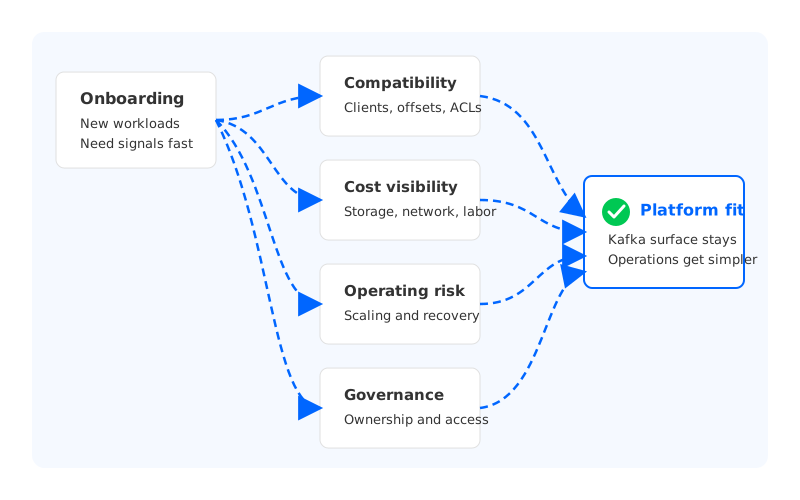
Teams usually search for kafka observability onboarding after Kafka has already become shared infrastructure. A few application teams may have started with basic producer and consumer dashboards, but the platform team now has to onboard more users, topics, connectors, and incident responders. The question is no longer "Can we see broker CPU?" It is whether a first-time user can understand what they own, what they may change, and what signals prove the streaming platform is healthy before the first production incident.
That is a harder problem than a dashboard rollout. Streaming observability sits across client behavior, broker saturation, storage durability, consumer lag, topic governance, network paths, and migration state. A developer experience team wants a self-service workflow. SRE wants alerts that do not wake the wrong team. Security wants auditability and least privilege. Finance wants the cost of retained data and cross-zone traffic to stop hiding inside a generic platform bill. All of those demands land on the same Kafka-compatible infrastructure.
The right starting point is not a tool list. It is an operating model: what must a streaming platform expose so first-time users can operate safely without becoming Kafka specialists?
1Why teams search for kafka observability onboarding
Observability onboarding becomes urgent when Kafka stops being a narrow messaging system and starts acting like a platform dependency. The first wave of users can ask the Kafka team for help directly. The next wave expects paved roads: topic creation, client templates, dashboards, alert routing, access reviews, cost allocation, and migration support. If those workflows stay manual, the platform team becomes a ticket queue with a cluster behind it.
The onboarding workflow has to teach the right mental model. For application teams, the useful signals are often consumer lag, produce error rate, request latency, throughput, partition skew, offset commits, and dead-letter behavior. For platform teams, the useful signals include broker saturation, controller health, partition leadership, storage growth, reassignment activity, network transfer, connector worker health, and recovery posture. Those two views overlap, but they are not the same product.
This is where many onboarding programs drift. They publish a Grafana folder, a few alert rules, and a runbook that says "contact platform." That may be enough for a small estate, but it does not scale into self-service. A good onboarding design answers three questions before a user ships a workload:
- What does this team own: topics, producers, consumers, connectors, schemas, service accounts, or all of them?
- Which signals are application SLOs, and which signals are platform SLOs?
- What changes are safe for the team to make without triggering broker-level side effects?
The third question connects observability onboarding to architecture. If every topic change, retention change, broker replacement, or capacity adjustment can turn into data movement, self-service needs conservative guardrails. If the architecture separates durable stream data from broker lifecycle, onboarding can be more elastic because fewer routine operations move retained logs between broker disks.
2The production constraint behind the problem
Traditional Kafka is a shared-nothing system at the broker layer. Each broker owns local log segments for the partitions it hosts, and replication keeps copies across brokers for durability and availability. That design has served Kafka well, and Apache Kafka documentation still describes core concepts such as consumer groups, offsets, replication, transactions, and broker configuration around this model. The operational consequence is direct: storage, compute, network traffic, and recovery work are closely coupled.
Observability onboarding exposes that coupling quickly. An application team may think it is asking for a topic with 30 days of retention. The platform team sees broker-local disk growth, replication traffic, compaction behavior, backup or tiering policy, quota changes, alert routing, and future reassignment work. A connector may look like a data integration request. The platform team sees worker capacity, source pressure, schema evolution, retry behavior, and dead-letter ownership.
None of this means traditional Kafka is wrong. It means the onboarding system has to surface the real cost of each abstraction. A topic is not only a name. A consumer group is not only an identifier. An offset reset is not only a button. Each of these objects participates in a distributed system where a small permission change can affect recovery, cost, or data correctness.
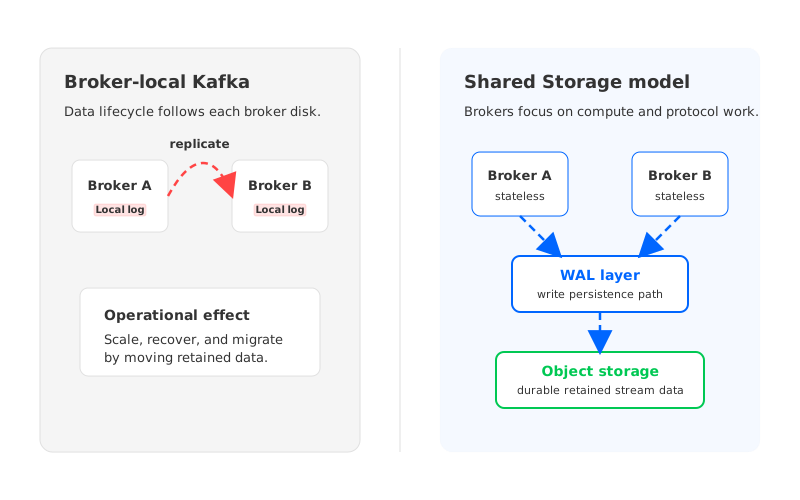
The most common production failure in observability onboarding is treating all signals as equal. Broker CPU and consumer lag do not have the same owner. Cross-zone network transfer and produce latency do not have the same remediation path. Connector restart count and transaction abort rate do not belong in the same escalation channel. When those signals merge into one "Kafka health" dashboard, users ignore it because it cannot tell them what action to take.
A better model separates telemetry into ownership layers. Application teams need workload health. Platform teams need infrastructure health. Security teams need access and audit health. Finance teams need cost attribution. Migration teams need source-to-target parity, offset progress, and rollback readiness. Observability onboarding succeeds when each layer has enough context to make decisions without stealing context from the other layers.
3Architecture options and trade-offs
Kafka-compatible streaming platforms usually fall into three operating patterns. The first is traditional Kafka with broker-local storage, where Kafka semantics are familiar but capacity changes often interact with local data placement. The second is Kafka with remote or tiered storage, where older log segments can move to remote storage while the hot path remains broker-centered. The third is shared storage architecture, where durable stream data moves into a shared storage layer and brokers become less stateful relative to retained data.
Those patterns are not interchangeable. They change what observability must measure and what onboarding must teach.
| Evaluation area | Broker-local Kafka | Tiered storage pattern | Shared storage architecture |
|---|---|---|---|
| User-facing compatibility | Native Kafka behavior when running Apache Kafka. | Usually preserves Kafka APIs while changing retention economics. | Must be verified against clients, consumer groups, transactions, ACLs, Connect, and tooling. |
| Scaling signal | Watch broker disk, partition placement, reassignment, and network replication. | Watch local hot set plus remote tier behavior. | Watch broker compute, cache, WAL, object storage, and metadata health. |
| Cost signal | Compute, attached storage, replication, and inter-zone network transfer can be tightly linked. | Remote storage may reduce local retention pressure. | Storage and compute can be modeled more independently, but object storage and WAL paths must be observed. |
| Onboarding impact | Guardrails often need to be conservative because routine changes can move data. | Retention onboarding improves, but hot path operations still need broker awareness. | Self-service can focus more on workload intent once storage and broker lifecycle are decoupled. |
This table is not a ranking. It prevents category mistakes. A team that cares mainly about operational familiarity may prefer a broker-local model. A team that mainly needs longer retention may look first at tiered storage. A team struggling with elastic scaling, retained-data movement, and cloud cost attribution should evaluate shared storage more seriously.
The architectural choice also affects the alert strategy. In a broker-local model, partition reassignment and broker replacement are heavy observability events because data movement is part of the operation. In a tiered model, remote storage metrics join the alert surface, especially for fetch paths and retention. In a shared storage model, WAL health, object storage availability, cache behavior, and stateless broker scheduling become first-class signals. Onboarding has to describe those differences plainly, because the same word, "storage," means different things in each architecture.
4Evaluation checklist for platform teams
A practical onboarding checklist starts before dashboards. Platform teams should first decide which promises they can make to incoming users: API compatibility, operating boundaries, alert ownership, change permissions, cost visibility, and rollback behavior. Without those promises, observability becomes an archive of symptoms rather than a decision system.
Use this evaluation checklist when comparing Kafka-compatible infrastructure for observability onboarding:
- Compatibility proof: Test producer and consumer behavior, consumer group rebalances, offset reset workflows, transactions if used, Kafka Connect integrations, ACLs, and existing observability exporters. A familiar bootstrap protocol is not enough.
- Cost attribution: Separate compute, retained storage, object storage operations where relevant, cross-zone or inter-region traffic, private connectivity, connector workers, and operational labor. Cloud bills rarely align with Kafka ownership boundaries by default.
- Elasticity model: Document what happens when brokers are added, removed, replaced, or upgraded. The onboarding runbook should say whether the operation moves retained data, warms caches, changes leadership, or touches client routing.
- Governance boundary: Tie topics, consumer groups, service accounts, ACLs, schemas, and connector configs to team ownership. If ownership is vague, alert routing will also be vague.
- Migration safety: Require dual-run evidence, offset progress, cutover criteria, and rollback steps for workloads moving from an existing Kafka cluster or managed service.
- Observability ownership: Classify metrics by action owner. A signal that no team can act on should not page anyone.
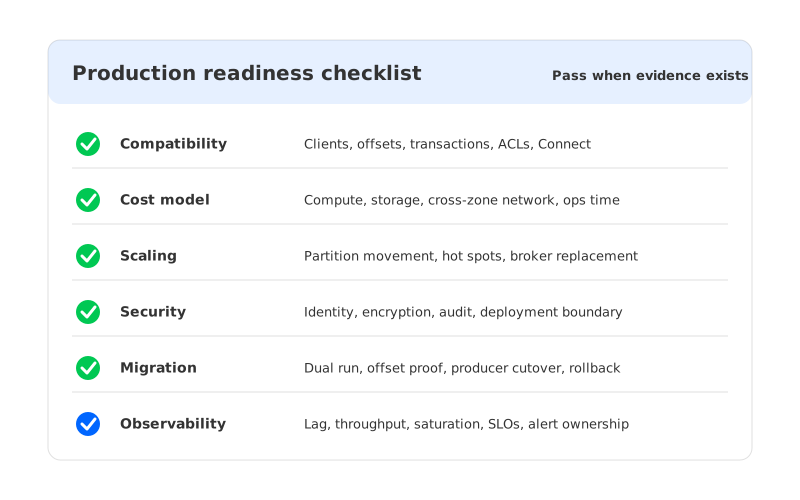
The checklist becomes more valuable when it is enforced in the onboarding path. A self-service portal can require service owner, data classification, retention, throughput, consumer SLO, cost center, and rollback owner before creating production topics. Terraform modules can encode naming, tags, ACL defaults, quotas, and dashboard links.
That is the DevEx version of Kafka observability onboarding: the platform does not wait for users to learn cluster topology by accident. It gives each team enough context to operate within its boundary while giving the platform team deeper signals for capacity, resilience, and cost governance.
5How AutoMQ changes the operating model
Once the evaluation frame is explicit, AutoMQ fits into the discussion as an architectural option rather than a product shortcut. AutoMQ is a Kafka-compatible cloud-native streaming platform built around shared storage architecture. It keeps the Kafka protocol surface while moving durable stream storage into an object-storage-backed design, with a WAL layer for write persistence and recovery. Brokers become largely stateless relative to retained stream data.
That design changes what onboarding needs to explain. In traditional Kafka, many user-facing requests eventually map to broker-local disk and replica movement. In AutoMQ's shared storage model, the durable data layer is not bound to a specific broker's local disk in the same way. Platform teams still need to observe brokers, leaders, clients, WAL, metadata, object storage, and network paths, but routine scaling and replacement are less dominated by retained-data movement.
For observability onboarding, this matters in four ways. First, Kafka compatibility keeps the application surface familiar, so onboarding can reuse producer, consumer, offset, ACL, and connector concepts. Second, storage-compute separation gives platform teams a cleaner cost model: compute capacity, WAL behavior, and object storage are different dimensions rather than one broker-sized bundle. Third, stateless brokers make scaling and replacement easier to reason about because durable data ownership is not trapped on individual disks. Fourth, customer-controlled deployment models such as BYOC help security and platform teams align streaming infrastructure with existing cloud account, VPC, IAM, logging, and network boundaries.
There is still engineering work. Shared storage does not remove the need for capacity tests, failure drills, alert design, or migration discipline. It changes the shape of those tests. Instead of asking only whether a broker has enough disk for a retention policy, the platform team asks whether the WAL path, object storage path, cache behavior, broker compute, and client routing meet the workload's SLO. That is a better set of questions for cloud infrastructure, but it is still a set of questions.
The migration path deserves the same realism. A Kafka-compatible target lowers application change risk, but it does not make cutover automatic. Good onboarding requires a readiness scorecard for topics, producers, consumers, offsets, ACLs, schemas, connector state, lag tolerance, replay plan, rollback owner, and acceptance tests. AutoMQ provides migration documentation and Kafka-compatible operations, but each team still needs to prove behavior with its own clients and traffic.
If your Kafka estate is becoming difficult to onboard because each user increases broker-local storage pressure, reassignment work, or cost ambiguity, evaluate shared storage as part of the platform architecture. Start with the verified AutoMQ overview, then map your onboarding checklist to real workloads rather than a synthetic demo.
6References
- Apache Kafka documentation: Kafka design and implementation and broker, producer, and consumer configuration
- Apache Kafka documentation: Tiered Storage configuration and Kafka documentation index
- AutoMQ documentation: architecture overview, WAL storage, and S3 storage
- AutoMQ documentation: Kafka compatibility, observability overview, and Prometheus integration
- Cloud provider documentation: Amazon S3 user guide, AWS PrivateLink pricing, Azure bandwidth pricing, and Google Cloud VPC network pricing
7FAQ
7.1What is Kafka observability onboarding?
Kafka observability onboarding is the process of giving streaming platform users the dashboards, alerts, ownership metadata, runbooks, and platform context they need to operate safely. It should cover application signals such as lag and error rates, platform signals such as broker and storage health, and governance signals such as ACLs, service accounts, retention, and cost ownership.
7.2Which metrics should a first-time Kafka user see first?
Start with workload-level metrics: produce error rate, produce latency, consumer lag, consume rate, offset commits, dead-letter volume, and client retries. Broker CPU, disk, controller health, partition leadership, and storage metrics still matter, but those are usually platform-owner signals. Mixing both views into one dashboard makes incident ownership harder.
7.3How is observability onboarding different for shared storage Kafka-compatible platforms?
Shared storage changes the operating model because durable stream data is less tied to broker-local disks. Onboarding should still teach Kafka concepts such as topics, partitions, consumer groups, offsets, and ACLs, but it should also add WAL health, object storage behavior, cache behavior, and stateless broker capacity. The goal is not fewer signals; it is clearer ownership for the signals that matter.
7.4Does Kafka compatibility remove migration risk?
No. Kafka compatibility can reduce application change risk, but migration still depends on topic configuration, ACL parity, consumer offsets, connector state, schema behavior, client settings, and rollback planning. Treat migration observability as its own onboarding track with dual-run evidence, lag checks, offset progress, and explicit cutover criteria.
7.5Where does AutoMQ fit in an observability onboarding program?
AutoMQ fits as the Kafka-compatible shared storage platform underneath the onboarding workflow. Teams can keep familiar Kafka clients, consumer groups, ACLs, Connect patterns, and observability integrations while evaluating shared storage, stateless brokers, WAL behavior, object storage, and customer-controlled boundaries as part of production readiness.


