
Table of Contents
Table of Contents
Observability data has an awkward shape. Logs arrive as heavy, uneven bursts. Metrics are small but constant. Traces can be sparse until a bad deploy, a latency spike, or a customer-facing incident makes them explode. Many platform teams reach for Kafka because it already gives them durable ingestion, replay, consumer isolation, and a familiar operational model, but an observability pipeline is not a normal business-event stream with a predictable payload and a tidy retention policy.
The pressure shows up when the telemetry platform becomes part of the incident path. If the logging backend is slow, engineers want to replay raw logs into another index. If the metrics backend changes, SREs want dual writes without changing every service. If trace sampling policy turns out to be too aggressive, the platform team wants to adjust the decision point without redeploying hundreds of applications. Kafka can be a strong backbone for that work, but only when the architecture treats observability data as a production workload rather than a side channel.
That distinction matters because "observability pipelines kafka" is not a search for a connector recipe. It is usually a search for a control plane: where to route data, how to keep noisy teams from overwhelming shared infrastructure, how much raw telemetry to retain, and how to preserve enough history for debugging without turning brokers into a storage budget sink.
1Why Observability Pipelines Stress Kafka Differently
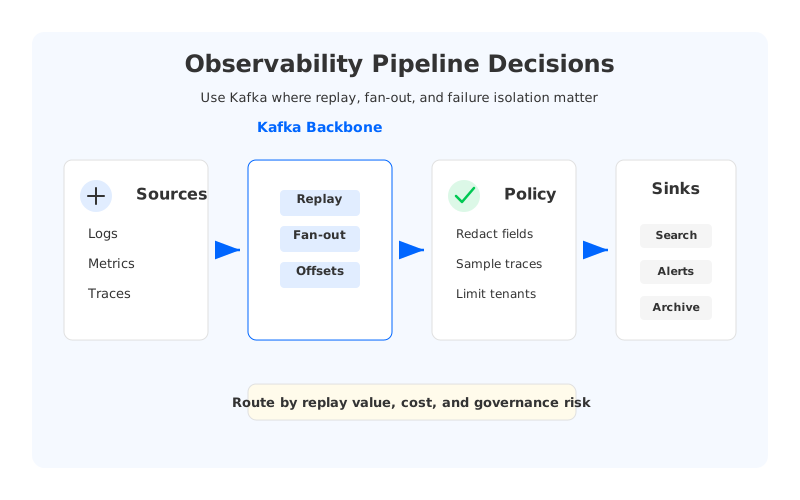
Kafka was built around ordered, durable logs, and that makes it attractive for telemetry. Producers can write to topics, consumers can process independently, and offsets let downstream systems recover without asking every application to resend data. The same properties that make Kafka useful for payments, inventory, and CDC also help with telemetry fan-out: one stream can feed alerting, security analytics, long-term storage, and ad hoc replay.
The challenge is that logs, metrics, and traces behave differently enough that a single topic strategy rarely survives production. Logs usually need volume controls, parsing, redaction, and routing before they hit an expensive search backend. Metrics often need aggregation and cardinality protection because one bad label can create operational noise. Traces need sampling decisions that preserve rare failure paths without keeping every span forever.
Platform teams therefore end up managing several concerns at once:
- Ingestion durability: telemetry should survive backend maintenance, regional issues, or indexer throttling.
- Cost containment: raw logs and high-cardinality labels can grow faster than business events.
- Tenant isolation: one service team should not starve shared consumers or fill shared broker disks.
- Governance: sensitive fields must be removed or controlled before data spreads into many sinks.
- Replay: incident review often needs the exact data that was dropped, delayed, or transformed earlier.
This is where Kafka helps, but it also exposes a hard boundary. Kafka gives the pipeline a durable log and a consumer model. It does not automatically decide what to store, what to drop, which tenants deserve separate capacity, or how much local broker storage to reserve for telemetry bursts.
2The Production Constraints Behind the Architecture
An observability pipeline has two jobs that pull against each other. It must absorb unpredictable write bursts, and it must make downstream systems more selective. Those are different workloads. The first rewards durable buffering and elastic ingest capacity. The second rewards transformation, filtering, enrichment, and policy enforcement before data reaches a destination.
A common first version looks straightforward: applications send telemetry to collectors, collectors publish to Kafka, and multiple consumers deliver to log search, metrics storage, trace analysis, object storage, and security tools. That design is reasonable. It lets applications decouple from downstream vendors and gives platform teams a replayable source of truth.
The second version is where the real architecture begins. Teams add dead-letter topics for malformed records, separate topics for raw and normalized telemetry, policy processors for PII redaction, and retention tiers for different classes of data. They also add rate limits, quotas, and tenant-level naming conventions because a pipeline without ownership boundaries becomes a shared mystery during incidents.
| Pipeline concern | Kafka capability that helps | Architecture decision still required |
|---|---|---|
| Backend outage | Durable topics and consumer offsets | How long raw telemetry should remain replayable |
| Multiple destinations | Independent consumer groups | Which transformations happen before fan-out |
| Noisy services | Topic partitioning and quotas | Whether tenants share brokers, topics, or pipelines |
| Sensitive fields | Stream processors and policy consumers | Where redaction becomes irreversible |
| Migration | Dual consumers and offset tracking | How to cut over without losing debugging history |
The table is intentionally conservative. Kafka is a backbone, not a policy engine by itself. The platform team still has to decide whether a log record is worth retaining, whether a trace should be sampled before or after enrichment, and whether metrics with dangerous cardinality should be accepted, rewritten, or rejected.
3Patterns Teams Usually Compare
Most production designs land in one of three patterns. The first is a direct collector-to-backend path with Kafka used only for selected streams. It is operationally light, but it gives up replay for any data that bypasses Kafka. The second is a Kafka-first telemetry bus where collectors write raw or lightly normalized data into Kafka before downstream processing. It gives the platform team more control, but it also moves cost and capacity pressure into the Kafka layer. The third is a split path: high-value telemetry enters Kafka for replay and governance, while short-lived or low-value signals go directly to specialized backends.
The right choice depends less on ideology than on failure mode. If your biggest risk is losing data during backend outages, Kafka-first is compelling. If your biggest risk is runaway broker storage, direct paths and aggressive pre-filtering may be safer. If your biggest risk is governance, Kafka-first can help because policy processors can create a controlled boundary before data reaches many tools.
There is a trap here: teams often evaluate the pipeline only by ingestion throughput. Throughput matters, but observability pipelines usually fail at the edges. A consumer falls behind because a search backend throttles writes. A topic grows because a parser deploy rejects new log formats. A tenant adds labels that multiply metrics series. A trace consumer needs replay from two days ago, but the raw topic retained only six hours because broker disks were sized for average load.
That is why the core design question is not "Can Kafka ingest telemetry?" It is "What operating model do we want when telemetry volume, retention, and routing policy change faster than the applications that produce it?"
4Where Traditional Broker Storage Becomes the Bottleneck
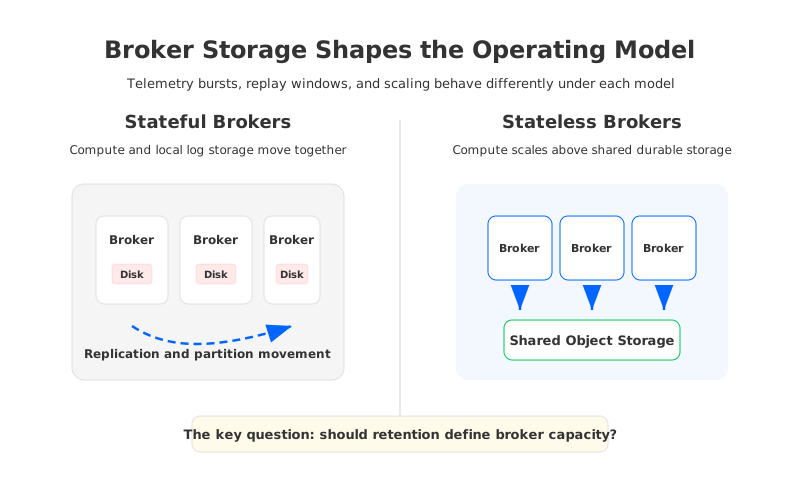
Traditional Kafka deployments are often described as shared-nothing: brokers own partitions, store log segments on local or attached disks, and replicate data across brokers for durability. That model is proven and widely understood. It also means storage, compute, network replication, and partition ownership are tightly coupled at the broker layer.
For observability pipelines, the coupling becomes visible in three places. First, retention consumes broker disk even when old telemetry is mostly used for emergency replay. Second, scaling brokers to absorb bursts may also add storage and rebalance work that the pipeline did not actually need. Third, moving partitions during expansion, maintenance, or recovery can compete with the same network and disk resources that are needed for ingestion.
Tiered storage can reduce some long-retention pressure by moving older log segments to remote storage. It does not make brokers stateless, and it does not remove the need to reason carefully about hot data, local capacity, replica placement, and recovery behavior. For a telemetry platform, that distinction matters because the hot path and the replay path have very different economics.
The practical implication is simple: do not design observability topics as if they are ordinary application topics with bigger messages. Treat them as a storage and routing product. Define hot retention, replay retention, tenant limits, and downstream recovery objectives before you pick partition counts or broker sizes.
5A Vendor-Neutral Evaluation Checklist
A useful observability pipeline review should make uncomfortable trade-offs explicit. If every answer is "keep more data for longer," the architecture is not finished; it is postponing the budget conversation. If every answer is "drop earlier," the architecture may look efficient until the next severe incident needs raw evidence that no longer exists.
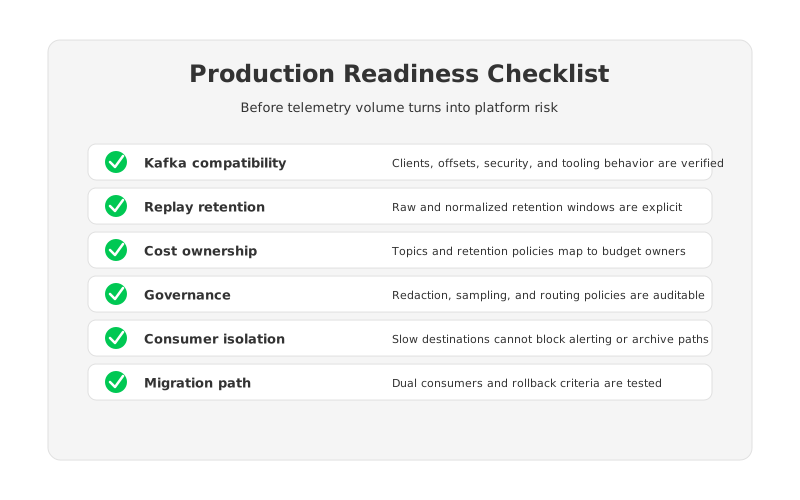
Use the checklist below as a decision tool rather than a compliance artifact:
- Data classification: separate raw logs, normalized logs, metrics, traces, audit events, and security findings. They do not need the same retention or routing path.
- Replay objective: define how far back each data class must be replayable and which teams can trigger replay.
- Transformation boundary: decide which parsing, redaction, enrichment, and sampling steps are reversible.
- Consumer isolation: identify downstream systems that can fall behind without blocking other destinations.
- Cost allocation: map topics, tenants, and retention policies to owners so platform cost is not treated as an anonymous shared pool.
- Migration path: keep old and new destinations running in parallel until offsets, schemas, dashboards, and alert semantics are verified.
The strongest teams write these decisions down before the first large onboarded service. That sounds bureaucratic, but it prevents a worse bureaucracy later: emergency meetings where nobody knows whether a topic is allowed to drop debug logs, whether a trace sink is authoritative, or whether a consumer lag spike is a platform incident or a tenant problem.
6Where AutoMQ Changes the Operating Model
After the neutral evaluation, the architecture question becomes sharper. If the pipeline needs Kafka protocol compatibility, durable replay, and elastic capacity, but the team does not want broker-local disks to define the storage budget, then shared-storage Kafka-compatible systems are worth evaluating. AutoMQ is one option in that category: it keeps Kafka client compatibility while using a cloud-native shared-storage architecture with stateless brokers and object storage as the durable data layer.
That change does not remove the need for telemetry governance. You still need topic design, quotas, retention policy, schema discipline, and downstream ownership. What changes is the operating model around capacity. Brokers can focus more on compute and request handling, while durable data sits in shared storage rather than being bound primarily to each broker's local disk. For observability pipelines, that separation is useful because burst absorption, replay retention, and broker scaling no longer have to be treated as one indivisible capacity problem.
This is also where Kafka compatibility matters in a practical way. Observability stacks already depend on producers, collectors, stream processors, connectors, and consumers that speak Kafka APIs. A platform team can evaluate an architecture like AutoMQ without starting from an application rewrite. The evaluation should still be serious: test producer behavior, consumer groups, offset management, security configuration, failure recovery, and the exact operational boundary of your deployment model.
The most credible AutoMQ use case in observability is not "replace every telemetry tool." It is narrower and stronger: use a Kafka-compatible shared-storage layer when telemetry replay, cost control, and elastic operations are constrained by broker-local storage. That framing keeps the decision architectural, where it belongs.
7Decision Table for Platform Teams
The choice is rarely binary. Many teams should optimize their current Kafka deployment first, especially if telemetry volume is modest and retention windows are short. Others should redesign the pipeline topology before changing the Kafka layer, because bad topic ownership and uncontrolled transformations will follow them into any platform. A smaller set should evaluate a shared-storage Kafka-compatible architecture because the bottleneck is now structural.
| Situation | Better first move | Why |
|---|---|---|
| Short retention, stable volume, few destinations | Tune existing Kafka and consumers | The current model may be sufficient with clearer quotas and lag alerts |
| Many destinations, unclear transformations | Redesign pipeline stages | Routing and governance are the immediate risks |
| Long replay windows, bursty logs, broker disk pressure | Evaluate shared-storage Kafka-compatible architecture | Storage and compute coupling is shaping the operating model |
| Regulated telemetry with strict data boundaries | Strengthen governance before migration | Platform choice does not replace policy enforcement |
| Backend migration or vendor exit | Run dual consumers with offset tracking | Kafka can make migration reversible if replay policy is sound |
Back to the original pressure: logs, metrics, and traces are only useful when they are available during the moments nobody planned for. Kafka can be the durable coordination point for that reality, but the design has to respect telemetry's uneven volume, mixed value, and governance risk. If broker storage has become the limiting factor, evaluate whether a Kafka-compatible shared-storage model such as AutoMQ fits your control, replay, and cost requirements. The next useful step is not a brand comparison; it is a pipeline review with real retention windows, consumer failure drills, and migration rollback criteria.
8References
- Apache Kafka Documentation
- Apache Kafka 3.9 Documentation
- OpenTelemetry Documentation
- OpenTelemetry Specification Overview
- AutoMQ Architecture Overview
9FAQ
9.1Is Kafka a good fit for observability pipelines?
Kafka is a good fit when the pipeline needs durable buffering, replay, fan-out, and consumer isolation. It is less useful as a substitute for policy design. Teams still need to decide what to retain, what to transform, which tenants own which topics, and how downstream failures should be handled.
9.2Should logs, metrics, and traces share the same Kafka topics?
Usually no. They have different volume patterns, retention needs, transformation rules, and consumer expectations. A shared Kafka platform can carry all three, but the topic model should separate data classes and ownership boundaries.
9.3How long should raw telemetry stay in Kafka?
The retention window should follow replay needs, not habit. Security investigations, severe incidents, and backend migrations may require longer raw retention than everyday debugging. High-volume debug logs may need shorter hot retention plus a separate long-term storage path.
9.4Does tiered storage make Kafka brokers stateless?
No. Tiered storage can move older segments to remote storage and reduce pressure from long retention, but brokers still manage hot data and partition ownership. Stateless broker designs go further by separating broker compute from the durable storage layer.
9.5Where does AutoMQ fit in an observability architecture?
AutoMQ fits when a team wants Kafka-compatible ingestion and replay but wants to evaluate a shared-storage, cloud-native operating model. It should be assessed after topic governance, retention requirements, and migration constraints are clear.


