
Table of Contents
Table of Contents
Kafka platform cutovers rarely fail because a team forgets to copy a topic name. They fail because the team cannot prove, at the moment of switching traffic, that every important consumer group can resume from the right place on the target platform. The phrase offset confidence checks kafka appears when an SRE or migration lead is close to a production decision. The question is no longer whether the target cluster can speak the Kafka protocol. The question is whether a payments service, CDC pipeline, fraud model, or operational dashboard will continue from the correct committed position when bootstrap servers change.
That pressure is reasonable. Apache Kafka stores consumer progress as offsets tied to topics, partitions, group identifiers, commit behavior, retention, rebalances, client configuration, and sometimes transactional semantics. A platform cutover changes enough of that environment that offset correctness becomes a system property rather than a single metric. You can compare offset numbers, but the comparison is useful only if topic identity, partition counts, records, group state, and application behavior are aligned.
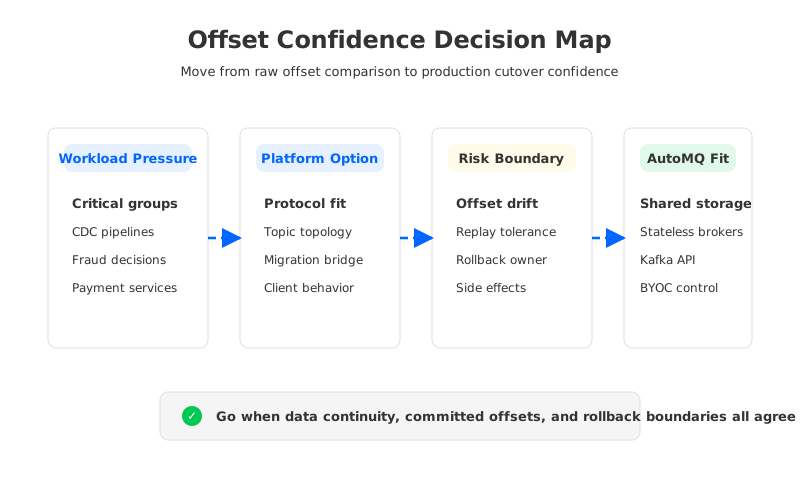
The practical goal is not to prove that two clusters are identical in every byte at every instant. The goal is to build enough confidence that the cutover can proceed, rollback has a known boundary, and the team knows which consumers need manual handling. Replication answers, "Is data arriving?" Offset confidence answers, "Can production safely continue from here?"
1Why Teams Search for offset confidence checks kafka
The search usually comes from one of four production situations. A team may be moving from self-managed Kafka to a managed or Kafka-compatible platform. They may be consolidating clusters after a cloud migration. They may be replacing a regional deployment as part of a disaster recovery program. Or they may be changing the storage and operating model behind Kafka while trying to preserve application contracts. Each case has a different business driver, but the technical anxiety is the same: a small offset mistake can create duplicate processing, skipped records, stalled consumers, or a rollback that is no longer clean.
Offset checks become more complicated when applications commit progress differently. Some consumers commit automatically. Some commit only after an external side effect has succeeded. Some use Kafka transactions to coordinate consumed offsets and produced records. Kafka's documentation treats consumer configuration and processing semantics as first-class concerns because offset behavior is part of the application's reliability contract, not only a broker-side detail. During a cutover, that contract must be tested under realistic behavior.
There are organizational reasons to make the checks explicit. Platform engineers own clusters and replication, application teams own processing semantics, SREs own rollback, and security teams own network boundaries. An offset confidence process gives these groups a shared artifact: consumer groups, validation states, risk owners, and rollback rules.
2The Production Constraint Behind the Problem
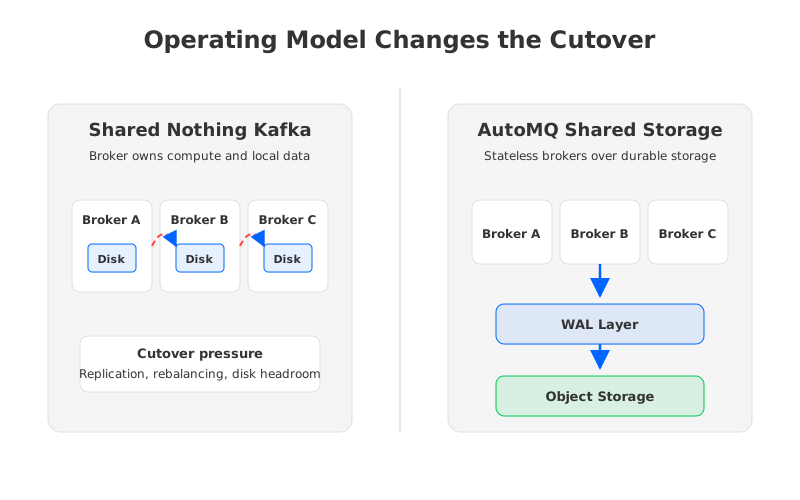
Traditional Kafka deployments use a shared-nothing model: brokers own local storage, partitions have leaders, replicas are distributed across brokers, and recovery depends on moving or catching up data between machines. This model has served Kafka well because it keeps the write path close to local disks and gives operators direct control over placement. The same model makes cutovers operationally tense. When the source and target clusters both have broker-local state, the team has to reason about replication lag, partition leadership, consumer offset commits, disk capacity, and rebalance behavior at the same time.
The difficulty is not that local storage is unreliable. The difficulty is that local ownership creates migration coupling. A platform team cannot treat storage, compute, and network placement as independent levers. If the target cluster needs more headroom, it may need more brokers with attached disks. If the source cluster is under load, replication competes with production traffic. A cutover window then becomes a coordination problem across capacity, topology, and client state.
Cloud networking adds another constraint. Multi-AZ Kafka designs often replicate data across availability zones for durability and availability. Cloud providers meter many forms of data transfer, and private connectivity services have configuration and cost boundaries. A migration that looks safe in a functional test can still become hard to approve if it requires extended dual writes, cross-zone replication, or unplanned network paths. Offset confidence checks therefore belong in the same review as capacity and network design.
3Architecture Options and Trade-Offs
There are several ways to approach a Kafka platform cutover, and each one changes what "offset confidence" means. A mirrored-topic replacement asks whether replicated records and committed offsets are aligned. A dual-write migration asks whether application-produced data is consistent across both platforms and whether consumers have a deterministic switch point. A connector-based migration asks whether source and sink connectors preserve ordering and failure behavior. A disaster recovery promotion asks whether the target has enough data, metadata, and a safe consumer starting point.
The right validation plan starts with workload classification. Not every consumer group deserves the same ceremony. A dashboard that can replay several hours of data has different risk from a debit ledger. A stateless enrichment job has different risk from a transactional service that writes back to Kafka. Treating all groups equally creates noise; treating them as risk tiers gives the migration team a tractable plan.
| Cutover area | What to verify | Why it matters |
|---|---|---|
| Topic and partition shape | Topic names, partition counts, replication expectations, retention settings | Offset values are partition-scoped; topology drift invalidates direct comparison. |
| Consumer group state | Committed offsets, lag trend, assignment stability, reset policy | A group that silently falls back to auto.offset.reset can skip or replay more than intended. |
| Record continuity | Source and target high-water marks, sampled keys, timestamp ranges | Offset equality alone does not prove that the target has the same logical data. |
| Application side effects | Idempotency, external writes, transaction boundaries, dedupe keys | The business impact comes from processing behavior, not offset numbers by themselves. |
| Rollback rule | Last source commit, target promotion time, replay tolerance | Rollback is credible only when the team knows where each group can resume. |
This table also explains why a single "offset sync complete" signal is weak. The signal can be useful, but it is not enough for a production cutover. A stronger plan combines broker metrics, consumer-group observations, application-level probes, and a written go/no-go decision.
4Evaluation Checklist for Platform Teams
A useful offset confidence checklist should be short enough to run during a migration rehearsal and precise enough to stop a risky cutover. Start with inventory: partition count, retention policy, cleanup policy, producers, consumer groups, and owners. Then classify each consumer group by replay tolerance: no replay allowed, small duplicate window acceptable, replay required for safety, or manual restart acceptable. This prevents a low-risk analytics consumer from consuming the same review time as a revenue-critical service.
The second step is to separate data-plane confidence from application confidence. Data-plane checks look at replication progress, target end offsets, source end offsets, timestamp continuity, and sampled record identity. Application checks look at committed offsets, lag after resume, error rates, external side effects, and user-visible behavior. Both are required because either side can pass while the other fails. A target can contain all records while a consumer group resumes from the wrong offset; a consumer can resume cleanly while a connector is behind on a low-volume partition.
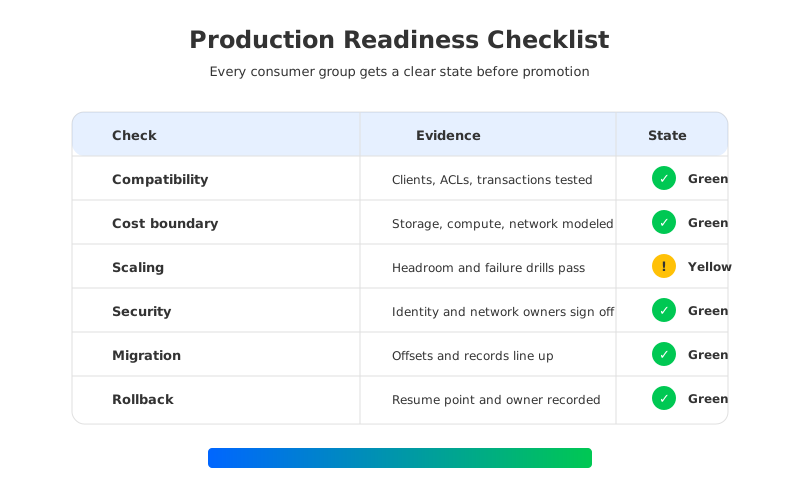
The third step is to rehearse rollback as a first-class path. Rollback is not the act of pointing clients back to the old bootstrap servers. It also means knowing whether source consumers kept committing, whether producers dual-wrote, whether target-only records exist, and whether downstream systems can tolerate another replay. A rollback plan that has not been tested with offset state is a hope, not an operating procedure.
One compact scorecard works well in practice:
- Green means the group has matching topology, target data is current within the agreed lag window, the application has resumed in staging or shadow mode, and rollback has an owner.
- Yellow means the group can cut over with a known manual step, such as resetting to a timestamp or replaying from a checkpoint, and the owner has accepted the risk.
- Red means the group has unknown commit behavior, missing target data, incompatible topology, or an untested rollback path.
The scorecard should be attached to the change record. During the cutover, the team should update states rather than debate them from memory. That gives the migration room a single source of truth.
5How AutoMQ Changes the Operating Model
Once a team has defined the validation framework, the next platform question is architectural: can the target reduce the amount of operational state that must be moved, rebalanced, and protected during the cutover? This is where cloud-native Kafka-compatible systems become relevant. The point is not that offset checks disappear. They do not. The point is that a shared-storage design can remove some of the broker-local coupling that makes cutovers harder to reason about.
AutoMQ is a Kafka-compatible streaming platform that uses Shared Storage architecture with stateless brokers and object-storage-backed durability. Its documentation describes a model where broker compute is separated from the persistent storage layer, and write-ahead log storage absorbs the low-latency write path before data is organized in shared object storage. In practical terms, the broker is less of a permanent owner of local partition data and more of a compute layer over durable cloud storage.
That distinction matters during migration and recovery planning. In a shared-nothing design, expanding capacity or recovering from broker pressure can involve moving partition data between broker-local disks. In a shared-storage design, compute and storage can be scaled more independently, so the migration plan can focus more on client behavior, topic compatibility, offset validation, and governance boundaries. AutoMQ also documents zero cross-AZ traffic capabilities for deployments that are designed around zone-aware access, which is relevant when teams are trying to avoid migration approaches that amplify cloud network cost.
AutoMQ should still be evaluated with the same scorecard as any other Kafka-compatible target. Compatibility claims need to be tested against real clients, serializers, transactions, connectors, ACLs, monitoring, and runbooks. The advantage is that the target architecture changes the shape of several checks:
- Capacity rehearsal can focus on broker compute headroom without treating every scale event as a data relocation event.
- Failure rehearsal can test stateless broker replacement and storage-layer durability separately from consumer resume behavior.
- Cost review can separate storage growth from compute sizing and include object storage, WAL, private connectivity, and data transfer assumptions.
- Governance review can preserve customer-controlled deployment boundaries when using BYOC or software deployment models.
For teams running a staged migration, AutoMQ Linking can also be considered as part of the bridge strategy. The important review question is not "Does the tool replicate data?" but "Does the bridge give us observable progress, a clear promotion point, and a rollback boundary for each consumer group?" That is the same offset confidence discipline applied to a different operating model.
6Decision Matrix for Technical Buyers
Platform buyers sometimes evaluate Kafka-compatible infrastructure with a feature checklist: protocol support, managed operations, pricing model, security, and monitoring. Those categories are necessary, but they miss the cutover question. A stronger decision matrix asks how each platform changes the operational work required to reach offset confidence.
| Evaluation dimension | Question to ask before cutover | Strong signal |
|---|---|---|
| Kafka compatibility | Do existing clients, transactions, consumer groups, and tooling behave as expected? | Production-like tests pass without code rewrites. |
| Storage architecture | Does scaling or recovery require moving broker-local partition data? | Compute changes do not trigger large data relocation. |
| Migration bridge | Can progress, lag, topic coverage, and failure states be observed? | The team can name the promotion point for each group. |
| Cost boundary | Are storage, compute, cross-zone traffic, and private connectivity modeled separately? | Cost review survives a change in workload volume. |
| Governance | Who controls networking, identity, encryption, and region placement? | Security owners can map the target to existing controls. |
| Operations | Can SREs rehearse failure, rollback, and observability before production? | Runbooks are tested, not inferred from docs. |
This matrix keeps the discussion grounded. A platform that looks attractive in a benchmark but forces a fragile cutover may be a poor fit. A platform that reduces local data movement, preserves Kafka semantics, and gives clear observability deserves deeper evaluation.
If your team is already building an offset confidence scorecard for a Kafka migration, the next useful step is to test the architecture against a realistic workload rather than a toy topic. AutoMQ's documentation is a good starting point for understanding its shared-storage model and Kafka-compatible operating assumptions: review the AutoMQ architecture overview.
7References
- Apache Kafka Documentation: Consumers, configuration, and semantics
- Apache Kafka Documentation: Tiered Storage
- Apache Kafka Documentation: Kafka Connect
- AutoMQ Documentation: Architecture overview
- AutoMQ Documentation: WAL storage
- AutoMQ Documentation: Eliminate inter-zone traffic
- AWS Documentation: Amazon S3 data durability
- AWS: Amazon S3 pricing
- AWS Documentation: AWS PrivateLink
8FAQ
8.1Are offset confidence checks the same as consumer lag monitoring?
No. Consumer lag is one signal inside the process, but it does not prove that a target cluster has the right records, that a consumer group will resume from the intended position, or that application side effects are safe. Offset confidence combines lag, committed offsets, record continuity, topic topology, application behavior, and rollback readiness.
8.2Can I compare source and target offsets directly?
Only after verifying that topic names, partition counts, record order, and replication behavior are aligned. Offsets are partition-scoped positions, not universal identifiers. If the target topic was rewritten, repartitioned, compacted differently, or loaded through a connector with different ordering, direct offset equality may mislead.
8.3Should every consumer group block the cutover?
No. Consumer groups should be classified by business risk and replay tolerance. A critical payment processor may require a strict promotion point and application-owner signoff. A dashboard consumer may be safe with replay from a timestamp. The classification should be explicit before the cutover window begins.
8.4How does shared storage affect Kafka migration risk?
Shared storage does not remove offset validation. It changes the operating model around broker recovery, scaling, and data ownership. When brokers are more stateless and durable data is held in shared storage, the migration team can spend less effort on broker-local data movement and more effort validating client behavior, rollback, and governance.
8.5What should be in a minimum cutover readiness checklist?
At minimum, include topic topology, target data continuity, committed offsets, lag trend, application health checks, external side-effect safety, rollback owner, and a go/no-go state for every important consumer group. The checklist should be rehearsed before production and stored with the change record.


