
Table of Contents
Table of Contents
Searches for consumer offset validation kafka migration tend to happen late in a migration plan, which is exactly why they matter. The source cluster is still serving production traffic, replication has started, dashboards show data moving, and the project plan says "cut over consumers" as if the hard part is behind the team. Then an application owner asks the question that can stop the room: when this consumer starts on the target cluster, will it continue from the same business position?
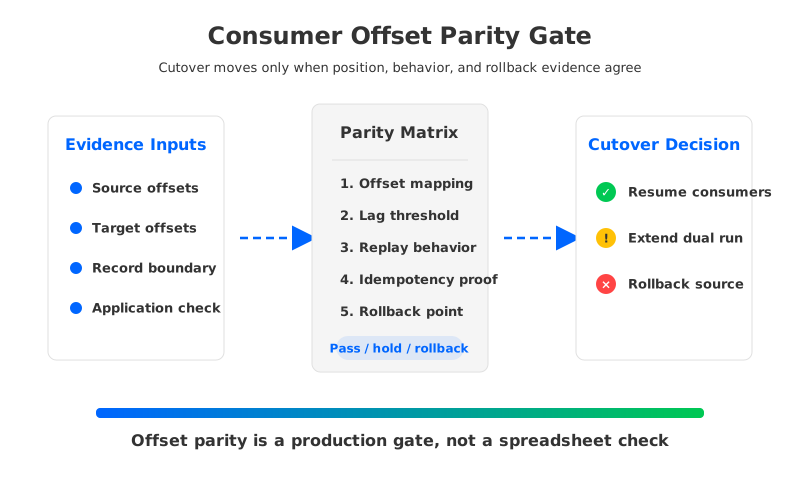
That question is sharper than "were offsets copied?" Kafka offsets are positions within partitions, but applications experience them as payments charged once, orders fulfilled once, risk decisions replayed safely, or telemetry not dropped during a platform change. A cutover can look successful at the broker level while still creating duplicate side effects, skipped records, or a consumer group that resumes from a technically valid but operationally wrong point. Offset parity is the gate that connects Kafka mechanics to application continuity.
1Why teams search for consumer offset validation kafka migration
The phrase usually comes from teams that are not doing a toy migration. They may be moving from self-managed Kafka to a managed or cloud-native Kafka-compatible platform, retiring ZooKeeper-era infrastructure, changing regions, consolidating clusters, or separating platform ownership from application ownership. In those projects, the target cluster is not a byte bucket. It is a different operating boundary with different networking, identity, storage, observability, and rollback behavior.
Kafka gives the migration team useful primitives. Consumer groups commit offsets, Kafka Connect can run replication flows, MirrorMaker 2 builds on Connect for cross-cluster mirroring, and admin tooling can inspect topic and group state. Those pieces are necessary, but they do not prove the final cutover condition by themselves. The migration team still has to answer whether the target group should resume from a mapped source offset, a replicated checkpoint, a timestamp, or an application-owned reconciliation point.
The hidden risk is that offset parity is often treated as a single field comparison. In production, it is a layered test:
- Partition position: The source and target partitions must refer to equivalent record boundaries, not merely similar numbers.
- Consumer group intent: The group should resume according to the business workflow, including paused partitions, manual commits, retry topics, and dead-letter behavior.
- Lag envelope: The team needs a threshold for how far behind the target may be at the moment producers and consumers move.
- Application side effects: The application must tolerate the replay window chosen by the migration team, or the window must be narrowed.
- Rollback anchor: The source cluster must remain a credible recovery baseline until the team deliberately retires it.
Each item is boring when written down. It becomes difficult when the migration window is open, the target cluster is under catch-up load, and multiple application teams are waiting for permission to restart.
2The migration risk behind the workload
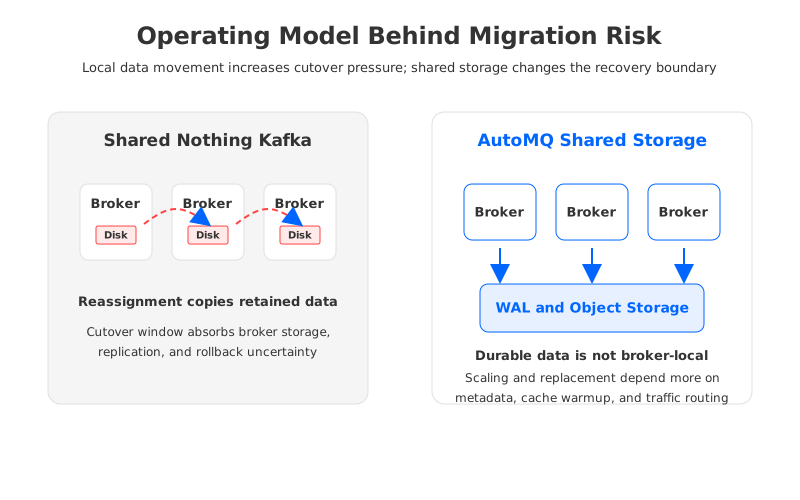
Traditional Kafka clusters run with a Shared Nothing architecture. Each broker owns local log segments for the partitions it hosts, and durability comes from replication among brokers. That model is mature and well understood, but it makes migration and cutover planning sensitive to broker-local storage. The platform team has to budget for retained data, reassignment time, replication traffic, extra validation reads, and capacity headroom for source and target systems during the dual-run period.
The storage model does not break offset validation, but it raises the cost of getting a quiet validation window. If a target cluster needs extra brokers to absorb replication catch-up, those brokers may trigger partition movement. If the source cluster is already near disk, network, or request saturation, validation reads compete with production traffic. If multi-AZ replication is part of the design, the team also has to watch cross-zone traffic and follower lag while proving consumer position. The offset gate becomes a pressure test of the whole operating model.
This is why platform migrations should separate two questions. The first is "can we copy or mirror the data?" The second is "can we prove the business resume point under production constraints?" The first question belongs to replication tooling. The second belongs to the cutover owner, because it spans data position, client behavior, security rules, observability, and rollback authority.
A practical parity check starts with the migration unit. Do not validate "the cluster" as one object. Validate an application slice, topic family, or consumer group set with a named owner. For each unit, record source topics, target topics, partition counts, group IDs, commit strategy, retry flows, schema dependencies, ACLs, and the expected recovery behavior if the switch is reversed. When the team cannot name the rollback unit, it is not ready to move the traffic unit.
3Compatibility, replication, rollback, and observability trade-offs
Offset parity depends on compatibility more than teams expect. A Kafka-compatible target should support the client versions, authentication mechanisms, producer guarantees, consumer group behavior, transaction semantics, and admin operations used by the workload. Even when the public API is compatible, the migration plan should test the exact combinations in production-like conditions. A consumer that commits asynchronously, a sink connector that stores offsets outside Kafka, and a stream processor with state checkpoints all create different parity evidence.
Replication choices also change the proof. Mirror-based migration can preserve enough data continuity for many workloads, but the migration team still has to understand how topic configuration, timestamps, headers, ACLs, schemas, consumer group metadata, and offset syncs are handled. Dual writing can reduce dependence on a replication tool, but it moves risk into application idempotency and partial-write behavior. A timestamp-based resume can be useful when exact offset mapping is unavailable, but it needs a replay policy and application-level deduplication plan.
The following matrix keeps the decision concrete:
| Cutover concern | Evidence to collect | Failure signal |
|---|---|---|
| Client compatibility | Real producer and consumer tests against the target cluster | Client restart requires code changes or unsupported configs |
| Offset parity | Sampled partition mappings, checkpoint records, and consumer lag | Target resumes before or after the accepted business boundary |
| Replication health | Throughput, lag, error rate, and topic coverage | Catch-up cannot converge during the planned window |
| Security and governance | ACL, credential, network, and audit parity | A workload can read or write differently after the switch |
| Rollback | Written trigger, source resume point, and owner signoff | Rollback depends on live debate during the incident |
The table is intentionally operational. Offset validation is not a mathematical exercise performed after the migration tool finishes. It is the point where the team decides whether the target platform is compatible enough, observable enough, and reversible enough for this workload.
4Evaluation checklist for migration teams
A good parity gate produces evidence before the cutover call. The migration team should run at least one rehearsal with a representative workload, not a synthetic topic that avoids the hard parts. That rehearsal should include steady writes, replication catch-up, target-side consumer startup, application-level reconciliation, source rollback, and post-rollback observation. The test should also define what is out of scope. Changing retention, repartitioning topics, renaming business events, and rewriting consumer logic during a platform cutover expands the failure surface.
Use this checklist as a working gate:
- Inventory the migration unit, including topics, partitions, groups, connectors, schemas, ACLs, owners, and recovery expectations.
- Freeze incompatible changes during the validation window, especially partition-count changes and consumer group rewrites.
- Establish the source-of-truth position for each group: committed offset, checkpoint, timestamp, or application reconciliation marker.
- Compare source and target record boundaries with sampled reads, not only metadata.
- Define acceptable lag and replay windows in business terms.
- Validate target-side observability for lag, errors, producer latency, broker health, and replication status.
- Write rollback criteria before the cutover starts, including who can call rollback and which cluster becomes authoritative after it.
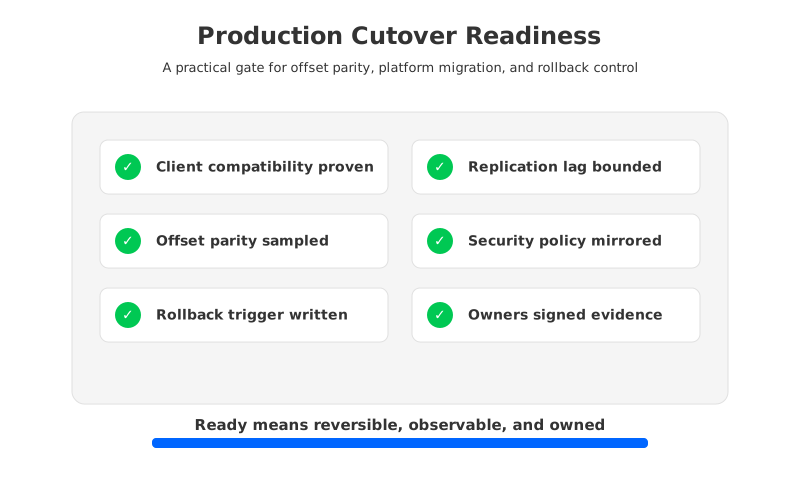
The important discipline is to move from "we think it is close" to "we know what happens if it is wrong." A migration plan that cannot explain duplicate handling, skipped records, and rollback ownership is not ready, even if every topic exists on the target cluster.
5How AutoMQ changes the operating model
After the parity gate is clear, the target architecture deserves its own review. Many teams use a migration window to evaluate whether the next platform should keep the same broker-local storage assumptions or move toward a cloud-native Kafka-compatible architecture. The API compatibility goal is stable: producers, consumers, Kafka Connect jobs, and operational tooling should keep Kafka semantics. The operating model behind those APIs is where the choice becomes meaningful.
AutoMQ is a Kafka-compatible streaming platform that uses Shared Storage architecture with stateless brokers and object-storage-backed durability. Instead of treating each broker's local disk as the long-lived home of partition data, AutoMQ places durable stream data in shared object storage and uses a WAL layer for write acceleration and recovery. Brokers still serve Kafka protocol traffic, leadership, caching, and request processing, but retained data is no longer tied to one broker's local disk.
That difference does not remove the need for consumer offset validation. It changes the post-migration pressure points that often make validation hard to schedule and repeat. Broker replacement and scaling are less dominated by copying retained partition data between machines. Compute and storage can be planned more independently. Multi-AZ cost reviews can include designs that reduce cross-AZ replication traffic. For customer-controlled deployments such as AutoMQ BYOC and AutoMQ Software, governance teams can also review where the data plane, control plane, credentials, logs, metrics, WAL storage, and object storage live.
The most relevant AutoMQ evaluation questions are practical:
- Will existing Kafka clients, Connect jobs, stream processors, and admin workflows run without application rewrites?
- Which WAL option fits the latency, durability, and cloud boundary of the workload?
- Can the team observe WAL, object storage, broker, consumer, and replication behavior during the cutover window?
- Does the deployment model match the organization's data residency, IAM, network, and procurement requirements?
- Can migration or linking workflows preserve the offset behavior required by the business unit?
For some teams, open-source MirrorMaker 2 is enough for staged movement, provided they can tolerate its operational boundary and validate offsets manually. For teams that require offset-consistent migration with lower disruption, AutoMQ commercial editions provide Kafka Linking capabilities that should be evaluated against the same parity gate. The decision should not be framed as "tool versus tool." It should be framed as whether the target platform makes the next validation, rollback, and scaling event less fragile than the last one.
6Cutover scorecard
Before approving a production switch, give each migration unit a simple score. Green means the evidence exists and the owner accepts it. Yellow means the evidence exists but the team needs a narrower window, smaller wave, or stronger rollback guard. Red means the migration is still a forward-only bet.
| Dimension | Green | Yellow | Red |
|---|---|---|---|
| Offset parity | Record boundary and group resume behavior are proven | Metadata matches, but application behavior needs more sampling | The team has not tested target-side resume |
| Platform compatibility | Real clients and tools pass | Long-tail clients need exemptions | Client behavior is assumed from API claims |
| Operations | Dashboards and alerts cover source, target, and replication | Some signals require manual queries | The team cannot see failure fast enough |
| Governance | Network, IAM, ACL, audit, and ownership are reviewed | Exceptions are documented | Security parity is checked after cutover |
| Rollback | Trigger, owner, and source recovery point are written | Rollback depends on a narrow time window | Rollback is a meeting, not a runbook |
The scorecard is useful because it makes migration risk visible before the production clock starts. It also helps platform owners compare targets fairly. A Kafka-compatible platform that reduces long-term storage movement, capacity over-provisioning, or cross-AZ traffic may still be a poor fit if the migration evidence is weak. Conversely, a careful parity gate can make a larger architecture change safer because the team knows what must be true before each wave moves.
If your team is using offset parity checks to evaluate a broader Kafka migration or cloud-native streaming architecture, start with one real consumer group and make the gate executable. You can review AutoMQ's Kafka-compatible architecture and deployment materials through AutoMQ on GitHub, then test the checklist against your own client, replication, observability, and rollback requirements.
7References
- Apache Kafka documentation
- Apache Kafka consumer configuration
- Apache Kafka Connect documentation
- AutoMQ compatibility with Apache Kafka
- AutoMQ Shared Storage architecture
- AutoMQ migration from Apache Kafka
- AWS Amazon S3 storage classes
8FAQ
8.1What is consumer offset validation in Kafka migration?
Consumer offset validation is the process of proving that a consumer group will resume from the intended business position after moving from a source Kafka cluster to a target Kafka-compatible cluster. It should compare offsets, record boundaries, lag, application behavior, and rollback paths.
8.2Is matching committed offsets enough before cutover?
No. Matching committed offsets can be useful, but it does not prove that the target partition contains the equivalent record boundary or that the application can tolerate the replay window. Production validation should include sampled reads and application-level checks.
8.3How does MirrorMaker 2 fit into offset parity checks?
MirrorMaker 2 can be part of a Kafka migration and replication workflow, but it does not replace the need for a cutover gate. Teams still need to verify topic coverage, lag, offset mapping behavior, consumer resume behavior, and rollback criteria for each migration unit.
8.4Where does AutoMQ fit in a Kafka migration plan?
AutoMQ fits as a Kafka-compatible target when teams want to preserve Kafka APIs while changing the operating model toward Shared Storage architecture, stateless brokers, and object-storage-backed durability. Offset parity checks still matter; AutoMQ changes the architecture the team operates after the workload moves.


