
Table of Contents
Table of Contents
Teams rarely search for oidc access model kafka because they want a different login screen. They search for it after a Kafka platform has become important enough that informal access patterns stop working. Application teams want self-service topics, connectors, consumer group visibility, and promotion paths from test to production. Security teams want identity federation, least privilege, auditability, and clean offboarding. Platform teams sit between those expectations while still owning the operational consequences of every topic, ACL, connector, and broker change.
The uncomfortable part is that Kafka access is not one access problem. It is several access problems stacked on top of each other: human access to a console, machine access from producers and consumers, infrastructure access inside the cloud account, operational access for support, and administrative access for topic lifecycle management. OIDC can solve part of that stack, especially for human identity federation and token-based authentication flows. It does not define who can create topics, reset offsets, rotate service accounts, or handle emergency broker maintenance.
That distinction matters for self-service platforms. A self-service Kafka program succeeds when teams can move faster without turning the central platform group into an approval queue. It fails when "self-service" means every team can create risk faster than the governance model can observe it. The access model is the place where those two outcomes diverge.
1Why teams search for oidc access model kafka
OIDC is attractive because it maps Kafka platform access back to the identity systems enterprises already trust. Engineers can authenticate through an identity provider, groups can map to roles, and offboarding can follow the same process used for other internal systems. For browser-based consoles and platform APIs, this is usually the right direction because it reduces local user sprawl and gives security teams a familiar control plane.
Kafka workloads complicate the picture. Producers, consumers, stream processors, and connectors are not people behind an interactive login. They often run in Kubernetes, virtual machines, serverless jobs, or managed integration services. Their access model must survive token expiry, deployment automation, secret rotation, failover, and network policy. A clean OIDC login for the console is useful, but it is not the same as a production-ready Kafka authorization model.
The practical question is not "does Kafka support OIDC?" A better question is "which identities use OIDC, which identities use Kafka-native or cloud-native credentials, and how are those identities translated into authorization decisions?" Apache Kafka supports multiple security mechanisms, including SASL and authorization through ACLs. OIDC enters the architecture through OAuth/OIDC-capable authentication layers, platform consoles, gateways, operators, or managed service control planes. The implementation detail varies, but the design pressure is consistent: identity must become an operational boundary.
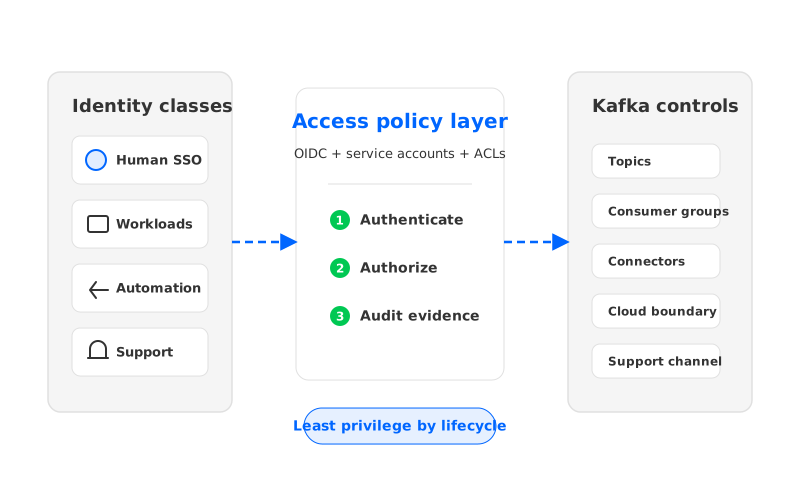
A useful access model separates five identity classes:
- Platform administrators need privileged access tied to enterprise identity, approval workflows, and audit logs.
- Application developers need scoped self-service for topics, credentials, and non-production experimentation.
- Workload identities need durable credentials for producers, consumers, connectors, and stream processors.
- Automation identities need predictable permissions for Terraform, CI/CD, policy-as-code, and environment provisioning.
- Vendor or support identities need explicit time bounds, visibility, and audited operational channels.
Once those classes are visible, OIDC becomes one component in a larger access model. It is strongest where human identity, group membership, and SSO matter. Kafka ACLs, service accounts, mTLS, SASL credentials, cloud IAM, private networking, and audit pipelines carry the rest.
2The production constraint behind the problem
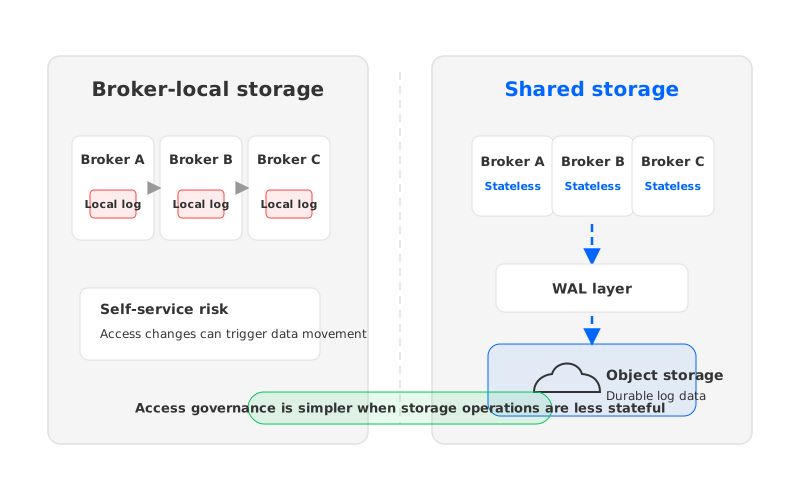
Traditional Kafka was designed around stateful brokers with broker-local storage. That design is not a security flaw; it is a storage and operations model that predates many cloud-native platform patterns. Brokers own local log segments, replication moves data between brokers, and capacity decisions are tied to disks attached to individual nodes. When access becomes self-service, that storage model changes the shape of governance because operational risk is local, stateful, and expensive to unwind.
Consider a developer team that creates a high-retention topic through a self-service portal. In a broker-local model, that decision consumes disk on specific brokers, affects future rebalance behavior, and can increase replication traffic across zones. If the team later asks for more partitions, the platform may need to move data and watch for hot brokers. The permission to create a topic is no longer an isolated control-plane action; it is a capacity and failure-domain decision.
The same pattern appears with connectors. A sink connector may need credentials to a data warehouse, read access to several topics, write access to internal status topics, and operational visibility into task failures. If every connector request is treated as generic "Kafka access," the platform loses the boundary between application data, infrastructure credentials, and operational recovery. The result is either too much manual review or too much standing privilege.
Security teams often see the problem as governance drift, while platform teams see it as an operations queue. Both are right. Governance drift happens when topic ownership, group membership, ACLs, and service credentials are not reconciled. The operations queue appears because every access decision can become a scaling, retention, networking, or incident response decision. That is why the access model must include architecture, not only identity.
3Architecture options and trade-offs
There are several ways to build OIDC into a self-service Kafka platform, and none of them is universally correct. The right model depends on whether the platform is mostly developer self-service, regulated production infrastructure, or a shared enterprise data backbone.
| Access layer | Common pattern | What it solves | What still needs design |
|---|---|---|---|
| Human console access | OIDC or SAML SSO mapped to roles | Centralized login, group-based access, offboarding | Role granularity, environment isolation, audit coverage |
| Kafka client access | SASL, mTLS, OAuth-capable flows, or service credentials | Producer and consumer authentication | Credential rotation, workload ownership, ACL lifecycle |
| Kafka authorization | Kafka ACLs, RBAC, policy engine, or control-plane roles | Topic, group, transactional ID, and cluster permissions | Self-service guardrails and exception handling |
| Cloud infrastructure access | Cloud IAM, Kubernetes RBAC, private networking | Deployment and operational boundaries | Support access, blast radius, cross-account permissions |
| Automation access | Terraform/API service accounts | Repeatable provisioning and policy-as-code | Change approval, drift detection, rollback |
Access layers interact. If developers can create topics but cannot create ACLs, the platform team becomes a bottleneck. If developers can create ACLs without ownership rules, permissions accumulate. If automation can create everything but audit logs are not tied back to human approvals, compliance teams have a traceability problem. A mature model assigns each layer a clear job and then tests the handoffs.
A good OIDC-centered design follows three principles. Use enterprise identity for humans and short-lived administrative sessions wherever possible. Use workload identities or service accounts for running applications rather than tying production producers and consumers to individual users. Treat Kafka authorization as a resource policy problem: topics, consumer groups, transactional IDs, connectors, and admin APIs need explicit ownership, not a generic developer role.
Network boundaries deserve the same attention. In BYOC or private deployments, data plane resources often run inside the customer's cloud account or VPC. That can support stronger data sovereignty and network control, but only when the access model is explicit about who can reach brokers, who can reach control-plane APIs, and which operational channels can be opened for troubleshooting.
4Evaluation checklist for platform teams
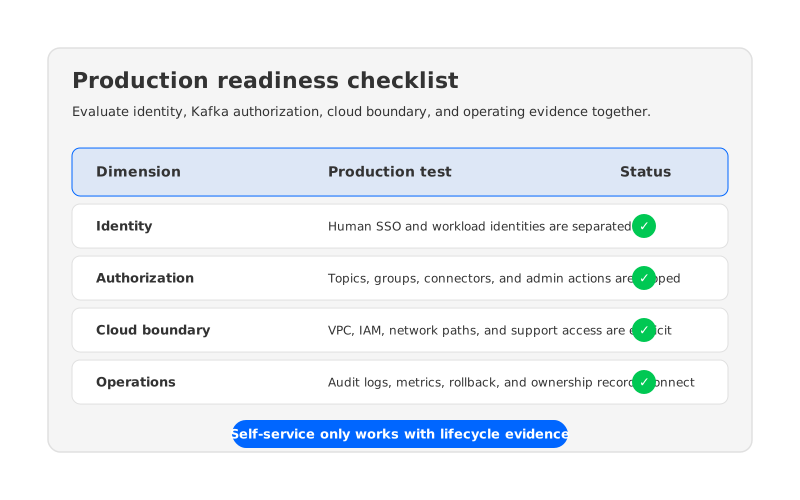
An OIDC access model should be evaluated through production workflows, not architecture diagrams alone. Walk through a complete lifecycle: a team requests a namespace, creates topics, deploys producers and consumers, adds a connector, rotates credentials, responds to an incident, and decommissions the service. Every unclear step becomes a future ticket or a future audit exception.
Use this checklist before standardizing the platform:
- Identity source and mapping: Which identity provider owns human access, and how are groups mapped to platform roles?
- Environment isolation: Can the same user have different permissions in development, staging, and production?
- Workload credential lifecycle: How are producer, consumer, connector, and CI/CD credentials issued, rotated, revoked, and audited?
- Kafka authorization scope: Are permissions expressed at the right Kafka resource level: topic, consumer group, cluster operation, transactional ID, and connector-related internal topics?
- Operational access: Can support or platform operators get temporary access without creating permanent privileged accounts?
- Observability and evidence: Can the team answer who changed a topic, who created credentials, which workload used them, and whether the change affected traffic, lag, or error rates?
The strongest access models make the safe path the normal path. Developers should not need to understand every Kafka ACL primitive to ship an application, but the platform should still translate their request into precise permissions. Security teams should not need to approve every low-risk action, but they should have evidence for the actions that matter.
5How AutoMQ changes the operating model
After the identity and governance model is clear, architecture determines how expensive that model is to operate. Broker-local Kafka makes many self-service actions stateful because storage, replication, and compute are bound together. A topic change can create disk pressure, a partition change can trigger data movement, and a broker replacement can turn into a storage recovery event.
AutoMQ approaches the problem as a Kafka-compatible, cloud-native streaming platform built around shared storage and stateless brokers. The important point for an OIDC access model is not that shared storage replaces identity controls. It does not. The point is that shared storage changes which operational risks are attached to self-service decisions. When durable log data is backed by object storage and brokers are no longer the long-term owners of local disks, scaling and broker replacement become less coupled to data relocation.
That separation has practical consequences for platform governance. Topic ownership can focus more on data access, retention policy, and cost attribution, and less on whether a specific broker has enough local disk headroom. Scaling workflows can be designed around compute elasticity rather than long-running partition reassignment.
AutoMQ's documentation describes shared storage with stateless brokers, Kafka protocol compatibility, WAL options, self-balancing, and deployment choices across cloud environments. For teams designing a Kafka self-service platform, those capabilities reduce the places where access policy and storage operations become entangled. A developer portal can still enforce least privilege, ownership, and approval gates, but the backend platform has fewer broker-local storage constraints to absorb.
There is also a data sovereignty angle. In customer-controlled or BYOC deployment models, the organization can keep streaming data and cloud resources within its own cloud boundary while still using a managed operational model. That makes the access design more concrete: enterprise identity governs human access, Kafka ACLs and service credentials govern workload access, cloud IAM and network policy govern infrastructure access, and audited operational channels govern support. The model is easier to defend when each boundary has a named purpose.
None of this removes the need for careful OIDC integration. A production design still needs to decide which identities are federated, which are service accounts, which actions are self-service, and which require approval. The architectural benefit is that the platform team can spend more of that effort on governance and less of it on compensating for broker-local storage mechanics.
6A practical decision framework
If you are standardizing an OIDC access model for Kafka, start with the resource lifecycle rather than the identity provider configuration. Platform programs fail when a role can do too much, when a credential outlives its owner, when audit logs cannot connect automation back to a team, or when a small self-service action creates a large operational cleanup.
Score each candidate platform across six dimensions:
| Dimension | What good looks like | Risk signal |
|---|---|---|
| Compatibility | Existing Kafka clients, tooling, ACL concepts, and operational practices remain usable | Migration requires rewriting clients or abandoning established Kafka semantics |
| Governance | Human, workload, automation, and support identities are separated | One credential type is reused for too many jobs |
| Cost control | Retention, partitions, scaling, and traffic are visible to owners | Self-service actions create hidden storage or network costs |
| Elasticity | Compute scaling and broker replacement do not require long storage operations | Scaling depends on moving large volumes of broker-local data |
| Migration safety | Cutover, rollback, offsets, and client compatibility are planned | Access changes are bundled with too many application changes |
| Evidence | Audit, metrics, logs, and ownership records can answer incident and compliance questions | The platform can show state but not explain who changed it |
The highest-scoring model is not the most permissive one. It is the one where the platform can automate routine work while preserving clear ownership. A developer should be able to request a topic without learning every broker detail. A security reviewer should be able to inspect the resulting permissions without reverse-engineering tribal knowledge.
That is the standard worth applying to OIDC and Kafka. OIDC gives you a strong foundation for federated human identity. The production platform still has to translate that identity into durable workload credentials, Kafka resource permissions, cloud boundaries, operational access, and evidence.
For teams evaluating cloud-native Kafka-compatible infrastructure, test the access model against a real service lifecycle. AutoMQ's BYOC and shared-storage architecture are designed for teams that need Kafka compatibility, customer-controlled deployment boundaries, and elastic operations. You can review the deployment model on the AutoMQ BYOC page and compare it against the checklist above.
7References
- Apache Kafka documentation: Authentication using SASL
- Apache Kafka documentation: Authorization and ACLs
- Apache Kafka documentation: Consumer groups and offsets
- OpenID Foundation: How OpenID Connect works
- AutoMQ documentation: Shared Storage architecture overview
- AutoMQ documentation: Kafka compatibility
- AutoMQ Cloud documentation: Role-Based Access Control
- AutoMQ Cloud documentation: Manage Kafka ACLs
8FAQ
8.1Does OIDC replace Kafka ACLs?
No. OIDC is an identity and authentication layer. Kafka ACLs or an equivalent authorization model still define what an identity can do to topics, consumer groups, transactional IDs, and cluster operations.
8.2Should producers and consumers use OIDC user identities?
Production workloads should usually avoid credentials tied to individual humans. Service accounts, workload identities, mTLS identities, SASL credentials, or OAuth-capable machine flows are better fits because they can be rotated, audited, and owned by an application team.
8.3Where do BYOC and private deployments fit into the access model?
BYOC and private deployments make the cloud boundary part of the access model. Data, brokers, networking, and supporting resources can remain inside the customer's environment, while the platform defines which human, workload, automation, and support identities can act.
8.4What is the biggest mistake in Kafka self-service access design?
The common mistake is treating self-service as a role assignment problem. The harder issue is lifecycle control: who owns the topic, which workload uses the credential, how permissions are revoked, what happens during incidents, and whether the platform can show evidence.


