
Table of Contents
Table of Contents
Many Kafka teams do not start looking for an on-premise Kafka alternative because Kafka failed them. They start looking because the operating model around Kafka has become too rigid. A platform built for predictable rack capacity, planned hardware refreshes, and careful partition placement can struggle when data volume, retention, and team expectations move faster than the data center lifecycle.
The search is also not limited to SaaS. For regulated industries, private networks, low-latency internal systems, or teams with strict data residency rules, sending every Kafka workload to a vendor-operated public service may be a non-starter. The more useful question is narrower: how can a team keep Kafka protocol compatibility while changing the parts of the platform that make on-prem Kafka expensive, slow to scale, or hard to operate?
Modern private Kafka options include BYOC, private cloud deployment, vendor-supported software, and Kafka-compatible systems that decouple brokers from local disks. The architectural decision is not whether Kafka remains important. It is whether the storage, scaling, and operations model around Kafka still matches the business.
1Why Teams Look for On-Prem Kafka Alternatives
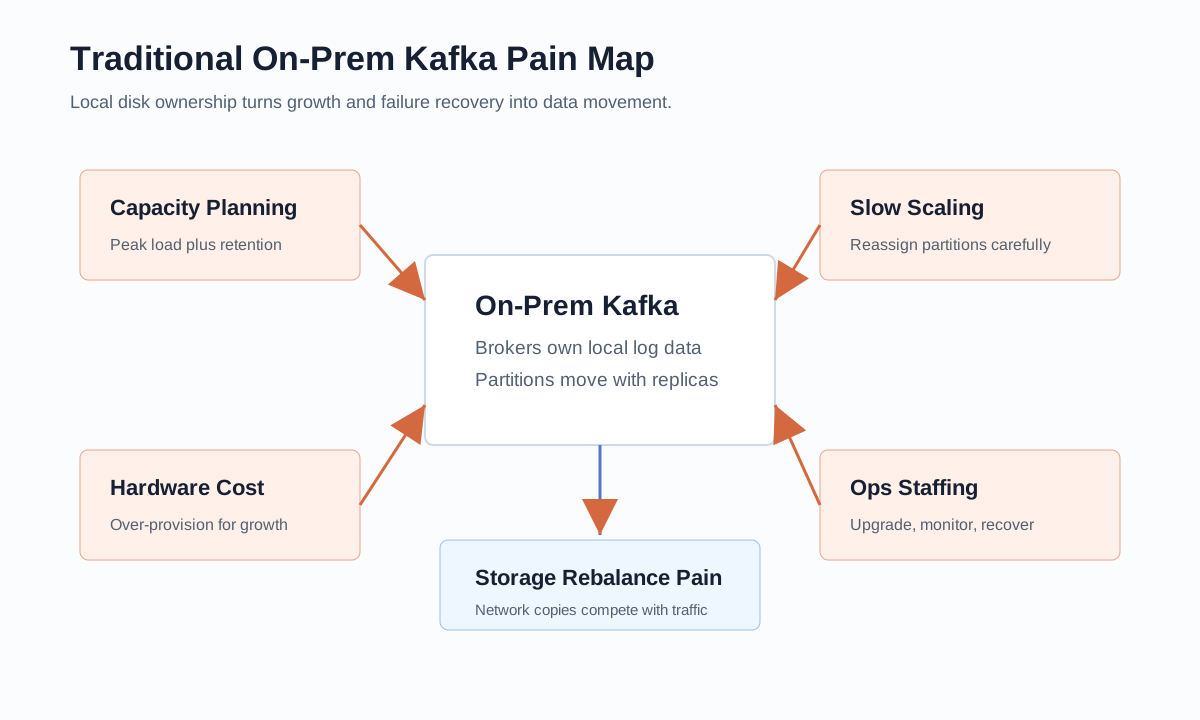
Traditional on-prem Kafka usually starts with a straightforward promise: own the hardware, own the network, own the data. That control is valuable, but it comes with compounding operational commitments. Every new topic, retention increase, replication-factor change, and traffic spike eventually becomes a capacity discussion across brokers, disks, racks, and people.
The pain is most visible in storage. Kafka's classic architecture binds partitions to broker-local storage. When a broker fills up, fails, or needs replacement, the cluster must move partition replicas across the network. Reassignment is not only a metadata operation; it can mean sustained disk reads, network copies, page cache churn, and throttling decisions that affect producers and consumers.
On-prem teams also face procurement latency. A Kafka platform may need more storage this quarter, but hardware ordering, rack space, power, network ports, and change windows may move on a different clock. Over-provisioning becomes the defensive move, and that turns Kafka capacity planning into a capital expense exercise.
The operating burden tends to show up in several places:
- Capacity planning must account for peak throughput, retention growth, replication overhead, disk headroom, rack awareness, and future migrations.
- Scaling often requires broker sizing, partition reassignment, rebalance throttling, client impact review, and long maintenance windows.
- Failure recovery depends on local replica placement, disk replacement procedures, broker rebuilds, and careful observation of under-replicated partitions.
- Platform staffing must cover upgrades, security patching, observability, incident response, tuning, and tenant support.
None of these are unusual for mature Kafka teams. The issue is that they consume time that could otherwise go into application enablement, governance, data product quality, or platform automation.
2Alternative Models: SaaS, BYOC, Private Cloud, Software
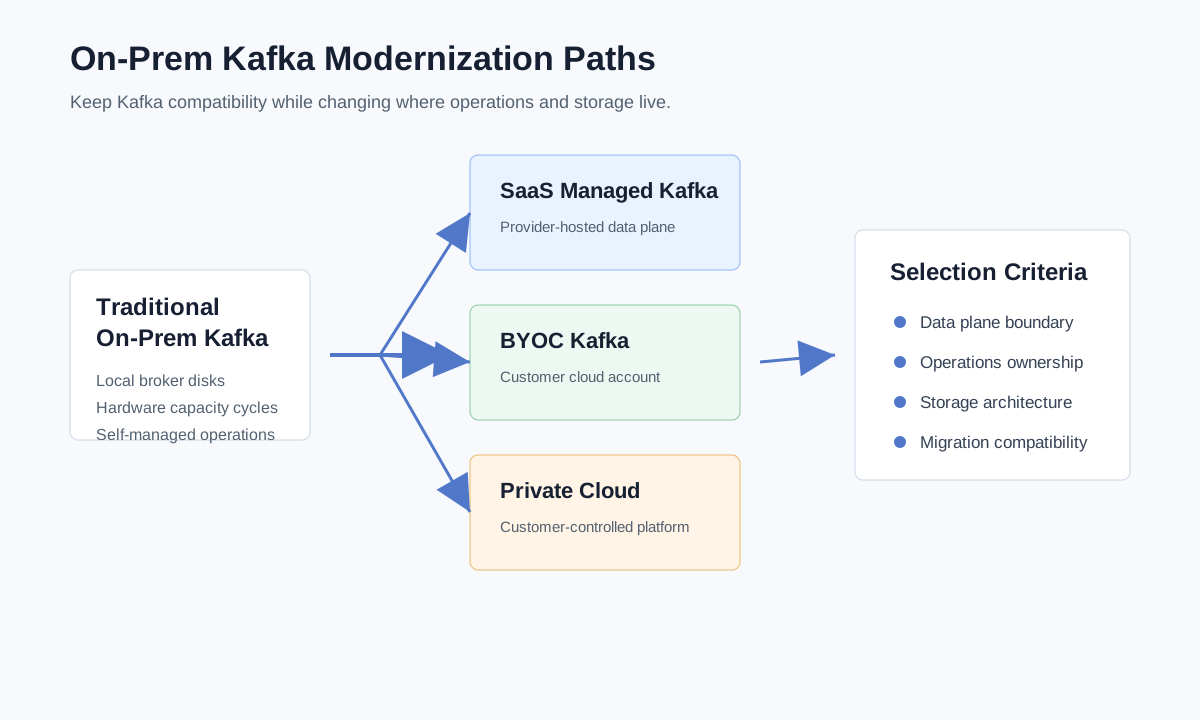
An alternative to on-prem Kafka does not have to mean giving up private deployment. It helps to separate the choices by control boundary and operational responsibility.
| Model | Where Kafka runs | Who operates most of it | Good fit |
|---|---|---|---|
| SaaS managed Kafka | Provider cloud account | Provider | Teams that prioritize fast adoption and can accept provider-hosted data plane boundaries |
| BYOC Kafka | Customer cloud account or VPC | Provider and customer share responsibilities | Enterprises that want managed operations with customer-owned cloud resources |
| Private cloud Kafka | Customer-controlled private cloud | Customer or vendor-supported platform team | Teams standardizing infrastructure on Kubernetes, virtualization, or private object storage |
| Software deployment | Customer data center or private environment | Customer, with vendor support | Regulated or air-gapped teams that need deployable software and local control |
| Self-managed Kafka replacement architecture | Customer environment | Customer platform team | Teams keeping internal operations but changing broker and storage architecture |
SaaS can remove a large amount of operational work, especially for teams that do not need to keep the data plane inside their own account. It is often the fastest way to provision clusters, but the network, compliance, and cost model must match enterprise requirements.
BYOC sits between SaaS and self-managed Kafka. In a BYOC model, the control experience may feel managed, but the data plane runs in the customer's cloud account, VPC, or equivalent private boundary. This can preserve private networking, cloud billing visibility, and security policy alignment while reducing some lifecycle work.
Private cloud and software deployment are different again. They matter when the enterprise wants a deployable Kafka-compatible platform inside its own environment, often with S3-compatible object storage, Kubernetes, existing observability, and internal access controls. For these teams, the question is not "cloud or no cloud." It is whether the new platform can run where governance requires it to run.
3What Must Remain Compatible During Migration
Kafka compatibility is the guardrail that keeps modernization from becoming an application rewrite. If producers, consumers, connectors, stream processors, and operational tools all have to change at once, the migration risk may exceed the operational benefit. A serious Kafka on-premise alternative should therefore be evaluated from the client outward.
Start with the protocol and client behavior. Existing producers and consumers should continue to use Kafka APIs, bootstrap servers, topics, partitions, offsets, consumer groups, transactions where required, idempotent producers, ACLs, and TLS/SASL patterns with minimal code change. Compatibility should include common ecosystem components such as Kafka Connect, Schema Registry integrations, Flink, Spark, and observability exporters when those are part of the current platform.
The migration also has to preserve operational semantics. Topic naming, partition counts, retention policies, compaction behavior, access control models, quota expectations, and lag monitoring are all part of the user contract. Even when a new platform improves the underlying architecture, application teams need predictable behavior during cutover.
A practical migration plan usually checks four layers:
- Client compatibility: APIs, authentication, TLS, advertised listeners, client versions, and retry behavior.
- Data movement: topic inventory, retained history, offsets, dual-write or mirror strategy, and validation windows.
- Operations: metrics, logs, alerts, runbooks, backup expectations, upgrade process, and incident ownership.
- Governance: data residency, key management, audit logs, IAM boundaries, support access, and deletion policy.
The strongest alternative is rarely the one with the most features on paper. It is the one that lets the platform team change the architecture underneath Kafka without forcing every application owner to relearn the streaming platform at the same time.
4Shared Storage as a Modern Kafka Architecture
The core architectural limitation in classic Kafka is not the Kafka protocol. It is the coupling between broker compute and broker-local persistent storage. A broker is both a request-processing node and the owner of local log segments for many partitions. That design is robust and well understood, but it makes scaling and recovery data-heavy operations.
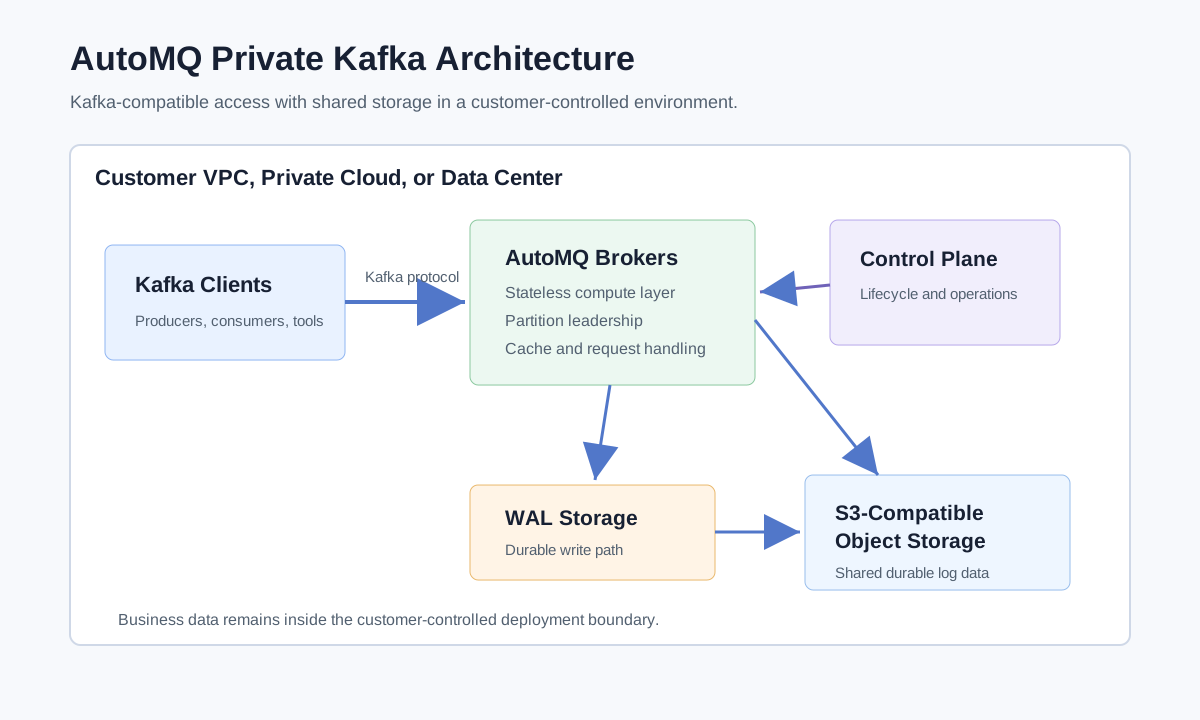
Shared storage changes the shape of the problem. In a shared storage architecture, brokers remain responsible for Kafka protocol handling, partition leadership, caching, and request execution, while durable log data is placed in a shared storage layer such as object storage. Broker replacement and scaling can therefore become more about ownership, metadata, and traffic routing than bulk data copying.
This does not remove distributed systems complexity. The platform still needs a durable write path, metadata consistency, cache design, failure recovery, compaction strategy, and careful handling of object storage latency. But it attacks the part of on-prem Kafka that often hurts most: the assumption that data must live on the broker that currently serves it.
Shared storage also changes capacity planning. Instead of sizing every broker for a fixed blend of compute, disk, and retention, the team can reason about compute and storage as separate pools. Compute can scale with request load, connections, and partition leadership. Storage can scale with retained data and object storage policy. That separation is especially useful for private platforms where storage growth and traffic growth do not always move together.
For on-prem and private cloud teams, S3-compatible object storage is important because it provides a deployment target that can exist outside a public-cloud SaaS boundary. Many enterprises already operate object storage as part of backup, analytics, AI, or data lake infrastructure. A Kafka-compatible streaming platform that can use that layer may fit existing private infrastructure better than broker-local disk expansion.
5How AutoMQ Fits Private Kafka Modernization
AutoMQ is one example of a Kafka-compatible streaming platform built around shared storage. It keeps Kafka protocol and ecosystem compatibility while moving the persistent storage layer away from broker-local disks and toward S3-compatible object storage. In this model, brokers are designed to be stateless with respect to long-term durable data, and the system uses a storage layer built for shared access rather than local replica ownership.
That architecture is relevant to private Kafka modernization because it targets the specific problems that push teams away from on-prem Kafka: storage-heavy rebalancing, slow capacity changes, expensive disk over-provisioning, and operational load around broker replacement. The point is not that every workload should use the same deployment model. The point is that a Kafka-compatible platform can change the storage and scaling model without asking applications to abandon Kafka semantics.
AutoMQ BYOC is designed for customers that want the data plane in their own cloud account or VPC while still using a managed operational model. AutoMQ Software is aimed at private environments where customers run the control plane and data plane in their own infrastructure, including data centers or private clouds. In both cases, the customer boundary matters: business data stays in the customer's environment, and the deployment can align with private networking and governance requirements.
There are still practical questions to validate. Teams should examine supported storage backends, WAL options, Kubernetes requirements, observability integrations, network design, upgrade ownership, and disaster recovery procedures. They should also run workload-specific tests rather than assuming that any architectural model is universally better. Kafka workloads vary widely: high fan-out analytics, low-latency transactional streams, compacted topics, connector-heavy platforms, and bursty telemetry systems stress different parts of the stack.
The natural fit is a team that wants Kafka compatibility and private deployment but no longer wants broker-local disk to define every scaling and recovery decision.
6Migration Readiness Checklist
Before replacing an on-prem Kafka platform, make the current system measurable. Many modernization projects stall because the team discovers undocumented dependencies only after the target platform is selected. A short readiness assessment can prevent that.
Use this checklist before choosing a private cloud Kafka alternative:
- Inventory topics, partition counts, replication factors, retention settings, compaction topics, quotas, ACLs, and client owners.
- Capture producer and consumer client versions, authentication methods, TLS requirements, bootstrap patterns, and retry configurations.
- Measure baseline throughput, p99 latency, consumer lag patterns, storage growth, broker disk utilization, and rebalance history.
- Classify data by residency, sensitivity, encryption requirements, key ownership, audit requirements, and deletion obligations.
- Map operational dependencies such as Connect, Schema Registry, Flink, Spark, MirrorMaker, alerting, dashboards, and incident runbooks.
- Define cutover strategy: phased migration, topic-by-topic move, dual-write, mirroring, offset translation, validation, and rollback.
- Test failure scenarios including broker loss, storage interruption, zone failure, client reconnect behavior, and restore procedures.
The checklist should end with a business decision, not only a technical score. Some teams will choose SaaS because speed matters most. Some will choose BYOC because the data plane boundary is non-negotiable. Some will choose software deployment because the platform must run in a private data center. The right on-premise Kafka alternative is the one whose failure modes, governance model, and operating cost are explicit.
7References
- Apache Kafka Documentation: Tiered Storage
- Apache Kafka Documentation: KRaft
- Confluent Documentation: Replication and partition rebalancing concepts
- AutoMQ Documentation: Architecture Overview
- AutoMQ Documentation: S3Stream Shared Streaming Storage
8FAQ
8.1What is an on-premise Kafka alternative?
An on-premise Kafka alternative is a deployment or architecture that replaces a traditional data-center Kafka cluster while preserving the capabilities the business still needs. It may be SaaS managed Kafka, BYOC Kafka, private cloud Kafka, vendor-supported software, or a Kafka-compatible shared storage platform.
8.2Is SaaS the only alternative to on-prem Kafka?
No. SaaS is one option, but many enterprises evaluate BYOC, private cloud, and software deployments because they need customer-controlled networking, data residency, audit visibility, or private infrastructure. The key is to separate operational responsibility from data plane placement.
8.3Can private cloud Kafka remain Kafka-compatible?
Yes, if the platform supports Kafka protocol behavior, existing clients, topic and partition semantics, consumer groups, offsets, security integration, and ecosystem tools. Compatibility should be tested with real client versions and production-like workloads before migration.
8.4Why does shared storage matter for Kafka modernization?
Shared storage reduces the dependence on broker-local disks. That can make scaling, broker replacement, and partition movement less data-heavy because durable data is stored in a shared layer rather than tied to the current broker. The implementation still needs careful durability, metadata, and cache design.
8.5Where does AutoMQ fit compared with self-managed Kafka?
AutoMQ fits teams that want Kafka compatibility but prefer a shared storage architecture with stateless brokers and object storage. BYOC can place the data plane in the customer's cloud account, while AutoMQ Software supports private deployment patterns for data centers or private clouds.


