
Table of Contents
Table of Contents
Teams searching for confluent alternatives usually have a concrete problem, not a casual curiosity. The platform may be working, but renewal pressure, data residency review, network cost, feature fit, or migration timing has turned "managed Kafka" into a board-level infrastructure decision. At that point, the search is less about finding another logo and more about deciding which parts of the Kafka operating model the company wants to control again.
That distinction matters because Confluent is a serious Kafka platform, and many teams use it precisely because they want managed operations, ecosystem integration, and a mature commercial service. A respectful exit review should credit that value. The mistake is assuming the next platform can be evaluated with the same checklist that justified the current one. A replacement decision changes the control plane, data plane, cost model, migration surface, and recovery plan at the same time.
The useful question is not "which vendor is the alternative?" It is "which control questions must be answered before any alternative deserves production traffic?" A platform team that can answer those questions will make a better Confluent renewal decision, a better migration decision, and a better architecture decision even if it ultimately stays where it is.
1Why teams search for confluent alternatives
The search phrase looks like a vendor comparison, but the underlying work is usually cross-functional. SREs want fewer operational surprises. FinOps wants a model that explains spend before the invoice arrives. Security wants to know where data, metadata, credentials, and support access live. Application teams want Kafka compatibility without rewriting producers, consumers, connectors, schemas, or stream processing jobs.
Those concerns are connected by control. A SaaS streaming platform centralizes many operational decisions inside the provider boundary. That can be attractive when the organization wants speed and does not want to own Kafka internals. It becomes uncomfortable when the organization needs finer control over account boundaries, network paths, cloud primitives, scaling policy, or long-retention economics.
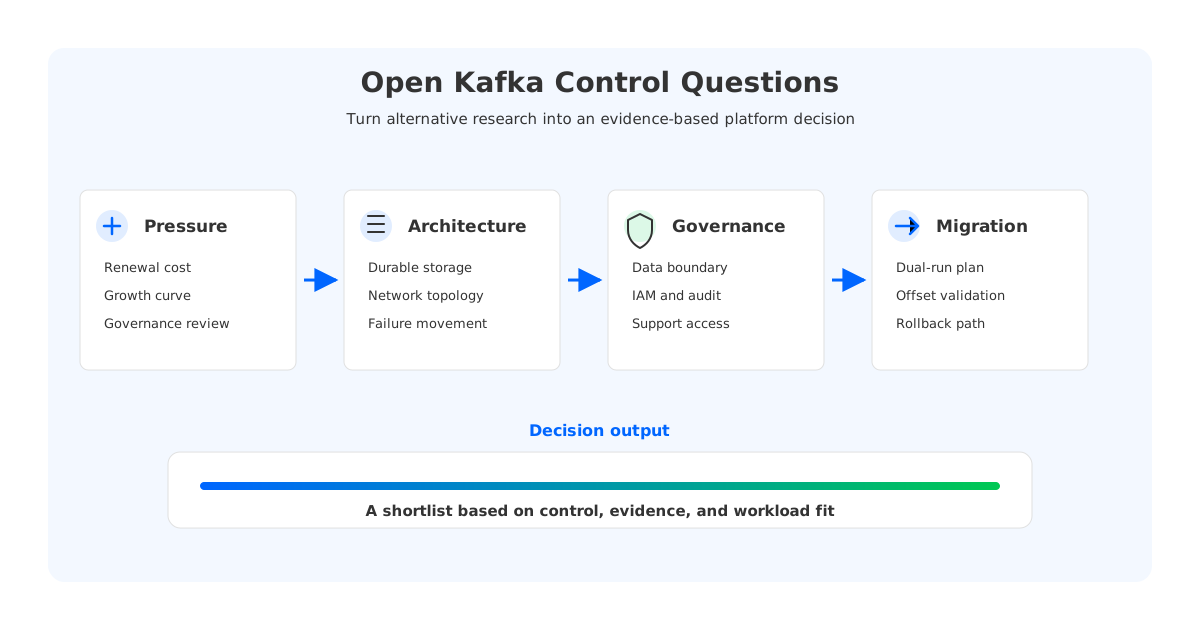
Before a shortlist is built, the team should separate four motives that often get mixed together:
- Commercial pressure. Renewal or growth makes the existing spend curve hard to defend. The team needs a workload-based model, not a brand-based complaint.
- Architecture pressure. Broker-local storage, partition movement, retention, and recovery behavior may no longer match cloud-scale requirements.
- Governance pressure. Data residency, BYOC preference, IAM review, private connectivity, or audit evidence may push the platform boundary closer to the customer account.
- Migration pressure. The organization wants an exit path that preserves Kafka-facing contracts while reducing cutover and rollback risk.
These motives lead to different answers. A team that only has commercial pressure may negotiate, right-size, or change usage patterns. A team with architecture and governance pressure needs a deeper review because changing the platform is also changing who owns durable data, network topology, and operating evidence.
2Where surface comparisons stay shallow
Many alternatives pages organize the market by product category, deployment model, or review score. That helps buyers build a starting list, but it rarely goes far enough for a Kafka platform owner. Kafka is not a standalone application. It is a shared substrate under CDC, stream processing, analytics, fraud detection, feature pipelines, audit trails, operational telemetry, and customer-facing workflows.
A platform replacement therefore cannot be decided by feature parity alone. The real evaluation has to ask whether the candidate preserves the Kafka behaviors that applications rely on while changing the parts of the operating model that created the need to search in the first place. Apache Kafka's own documentation treats producers, consumers, delivery semantics, transactions, security, and operations as part of a broader system contract, not isolated checkboxes.
The shallow version of the evaluation asks whether the candidate has Kafka APIs, connectors, schema support, private networking, and support SLAs. The deeper version asks how those capabilities behave during failures, upgrades, consumer catch-up, region-level incidents, quota changes, and ownership transfers between application teams and the platform team. That is where many shortlists become thinner.
| Question area | Shallow comparison | Production control question |
|---|---|---|
| Compatibility | Does it support Kafka clients? | Which client versions, protocol behaviors, transactions, ACLs, connectors, and tooling paths have been tested for our workload? |
| Cost | Is the list price lower? | Which workload inputs drive spend: throughput, retention, partitions, read fanout, network path, support, and operational labor? |
| Data boundary | Is there private connectivity? | Where do data, metadata, logs, credentials, support access, and cloud resources reside under normal and incident conditions? |
| Migration | Is there a migration tool? | Can we dual-run, validate offsets, cut over topic families, and roll back without corrupting the application contract? |
This is also why review-style marketplace framing can be misleading for Kafka. User sentiment is useful context, but the buyer still has to inspect the architecture. A five-star tool that does not fit the organization's data boundary, latency envelope, or rollback requirements is not a production-ready replacement.
3Architecture criteria behind the shortlist
A Confluent exit review should first define architecture categories, then place vendors inside those categories. The most common options are managed Kafka SaaS, self-managed Apache Kafka, cloud-provider Kafka services such as Amazon MSK, and Kafka-compatible systems that keep the Kafka API while changing the storage or deployment model. None of these categories is universally correct. Each moves responsibility to a different place.
The architecture review should begin with the data plane. Ask where records are written durably, how replicas or shared storage are used, what happens during broker loss, and how much data must move when capacity changes. Traditional Kafka's replication model was designed around broker-owned local logs. That model is well understood, but in multi-AZ cloud deployments it can create a predictable network bill because replication traffic crosses zones. AWS documents common same-Region cross-AZ EC2 data transfer at \$0.01/GB in each direction, which makes architecture-level traffic patterns financially visible.
The next layer is the control plane. Who can create clusters, change quotas, rotate credentials, approve upgrades, inspect logs, and intervene during incidents? A provider-owned SaaS boundary simplifies many operational tasks but may put critical controls outside the customer's cloud account. A self-managed boundary gives maximum control but puts Kafka operations back on the customer. BYOC and software models sit between those poles, but the details matter: BYOC is only meaningful if the account, network, storage, metadata, and support-access model can be audited.
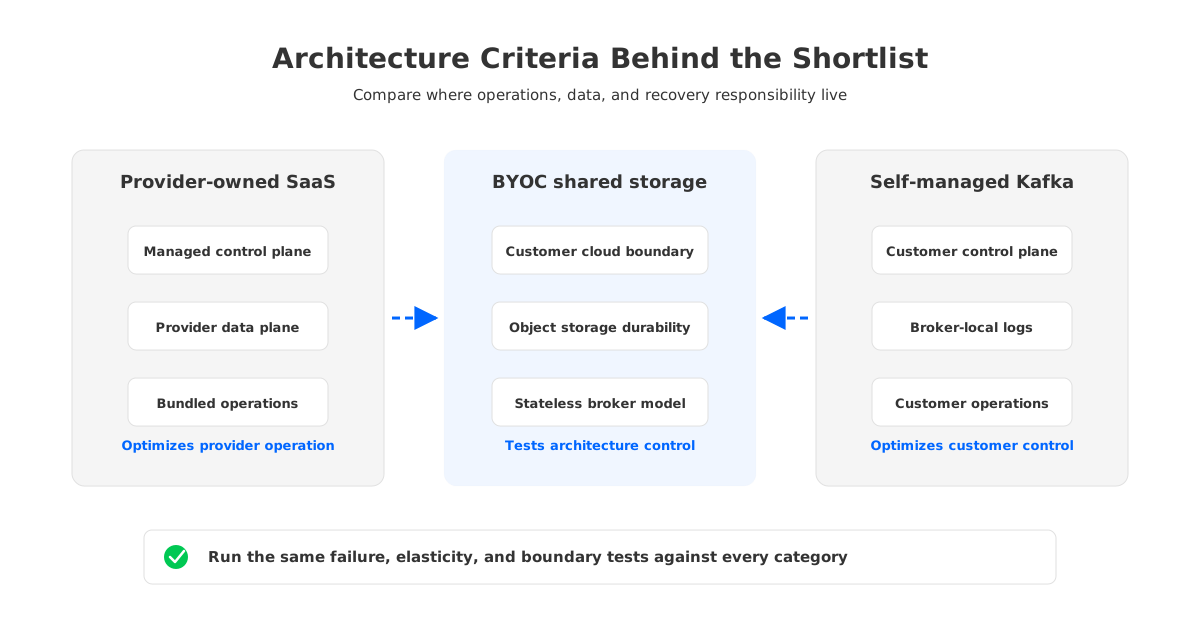
Three architecture tests make the shortlist more honest:
- Failure movement test. Kill a broker, lose an AZ, throttle storage, and restart clients. Measure not only recovery time but also which component became the source of truth.
- Elasticity test. Add and remove capacity under load. Track data movement, partition reassignment, cache warmup, consumer lag, and operational steps.
- Boundary test. Trace data, metadata, credentials, telemetry, and support paths. The result should be a diagram security and platform teams can both sign.
If a candidate cannot explain these tests, it is too early to compare price. Cost only means something after the team knows which architecture it is buying.
4Migration and ownership questions for platform teams
The migration plan should be written before the vendor preference hardens. Kafka migrations fail less often because a target cannot accept bytes and more often because ownership boundaries are vague. Who freezes topic changes? Who validates schema compatibility? Who approves ACL migration? Who watches consumer lag? Who has the authority to roll back when an application team reports a timing bug?
A practical plan starts with topic families rather than clusters. Append-heavy analytics streams, CDC staging topics, compacted changelogs, transactional pipelines, connector control topics, and internal platform topics have different blast radii. Moving them as one unit turns a platform migration into a company-wide application event. Moving them by risk class lets the team prove the target platform gradually.
The ownership worksheet should include:
- Topic inventory with owners, retention, partitions, compaction, transaction usage, and consumer groups.
- Client and connector inventory, including Kafka client versions and framework dependencies.
- Cutover design for dual writes, mirroring, offset translation, DNS or bootstrap changes, and rollback.
- Governance controls for ACLs, secrets, network access, audit logs, Terraform or API ownership, and support escalation.
- SLO changes for latency, availability, consumer lag, recovery time, and incident response.
This may feel heavier than a normal vendor evaluation, but it saves time later. Once a platform owns hundreds or thousands of topics, "Kafka compatibility" is not a single yes-or-no question. It is a set of workload-specific proofs.
5How AutoMQ fits the evaluation
After the neutral evaluation is clear, AutoMQ is relevant as one Kafka-compatible path for teams that want to keep Kafka-facing application contracts while changing the storage and ownership model underneath. AutoMQ is a cloud-native streaming system compatible with Apache Kafka clients and ecosystem tools. Its architecture uses S3Stream shared streaming storage, WAL storage for the write path, stateless brokers, and object storage as the durable storage foundation.
That design addresses a specific control question: what changes if brokers are no longer the long-term home of partition data? In a broker-local architecture, scaling and recovery are tied to where data lives. In a shared-storage architecture, brokers can focus more on protocol processing, leadership, caching, and scheduling while durable data is kept in shared storage. The operational promise is not magic; the promise is that capacity changes and failure recovery can involve less broker-to-broker data relocation because durable data is not anchored to one broker's disk.
AutoMQ also fits the governance side of the review through BYOC and software deployment options. In AutoMQ BYOC, the environment is managed in the customer's cloud context, which can align better with teams that need cloud-account ownership, VPC control, IAM review, and storage transparency. That does not remove security work. It gives the security review a different starting boundary than a pure provider-hosted SaaS data plane.
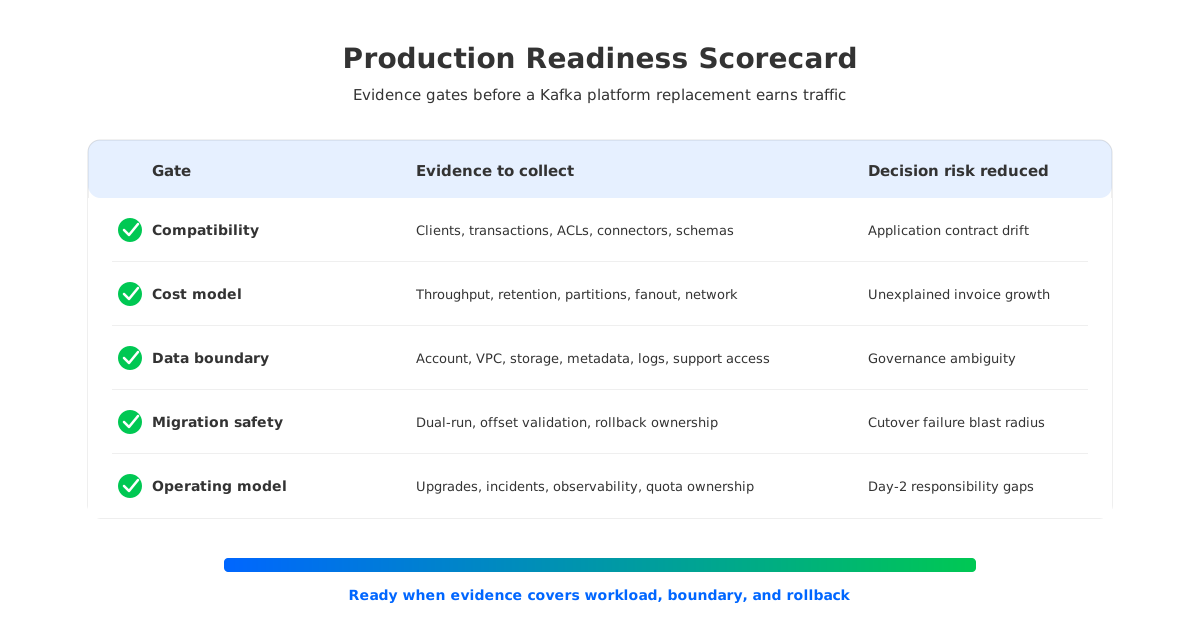
AutoMQ should still be tested with the same scorecard as every other candidate. Validate Kafka client behavior, connector workflows, transaction and compaction assumptions, failover, cold reads, scaling events, observability, and rollback. The point is not to replace one unchecked assumption with another. The point is to compare architecture to architecture: managed SaaS convenience, self-managed control, cloud-provider managed Kafka, and Kafka-compatible shared storage.
If your team is building a Confluent exit worksheet, include an architecture track alongside the commercial track. Start with your current workload inputs, then model how those inputs map to brokers, storage, network paths, operations, and data boundaries in each option. AutoMQ is worth evaluating when the desired end state is Kafka compatibility with more customer-side control over data location, cloud resources, and storage economics. The AutoMQ documentation is a practical next checkpoint for mapping that architecture to your own proof of concept.
6A decision rule for Kafka platform buyers
A Confluent exit is not a declaration that the current platform is bad. It is an admission that the organization's requirements have changed enough to re-open control questions. That is a healthy exercise when it is done with evidence instead of frustration.
Use one decision rule: do not shortlist a replacement until you can say which controls you want back, which controls you still want a provider to operate, and which Kafka-facing contracts cannot change. That rule keeps the discussion grounded. It prevents the team from chasing a lower quote that creates operational risk, and it prevents the team from renewing by inertia when the architecture no longer fits.
The search starts as confluent alternatives. The real work is deciding who should control the Kafka data plane, the cost model, the migration path, and the evidence trail for the next several years.
7References
- Apache Kafka: Documentation
- Apache Kafka: Message delivery semantics
- Confluent documentation: Confluent Platform and Apache Kafka compatibility
- AWS EC2 pricing: Data Transfer within the same AWS Region
- Amazon MSK documentation: What is Amazon Managed Streaming for Apache Kafka?
- AutoMQ documentation: Compatibility with Apache Kafka
- AutoMQ documentation: S3Stream shared streaming storage overview
- AutoMQ documentation: WAL storage
- AutoMQ documentation: BYOC environment
8FAQ
8.1What should teams compare before leaving Confluent?
Compare the operating model, not only feature names. The review should include Kafka compatibility, data-plane boundary, cloud account ownership, network paths, retention economics, migration tooling, rollback plan, support access, and who owns operational changes after production cutover.
8.2Is Confluent always the wrong choice if a team wants more control?
No. Confluent can be a strong fit when a team values a managed service boundary, ecosystem integration, and provider-operated Kafka infrastructure. The question is whether that boundary still matches the organization's cost, governance, data residency, and architecture requirements.
8.3How is BYOC different from self-managed Kafka?
Self-managed Kafka puts cluster operation primarily on the customer. BYOC usually means data-bearing infrastructure runs in the customer's cloud environment while a vendor provides software, automation, lifecycle management, or support. The exact split must be reviewed because BYOC models differ across providers.
8.4Where does AutoMQ fit among Confluent alternatives?
AutoMQ fits when the team wants Kafka compatibility but also wants a shared-storage architecture, stateless brokers, object-storage-backed durability, and deployment options that can keep the data plane closer to the customer's cloud boundary. It should be tested against the same workload, migration, governance, and failure criteria as every other candidate.


