
Table of Contents
Table of Contents
Security data has a strange habit: the more valuable it becomes, the harder it is to move cleanly. CloudTrail logs, endpoint events, identity signals, vulnerability findings, DNS telemetry, audit records, and detection outputs arrive continuously. Security analysts want those events normalized, queryable, retained, and available to multiple engines. Platform teams usually reach for Kafka because it gives them a durable stream between producers and consumers, but the search for open security lake kafka points to a deeper question: how do you turn high-volume security events into governed lakehouse tables without turning every feed into a bespoke pipeline?
The hard part is not choosing between streaming and a security lake. Production teams need both. Kafka is the operational handoff: it absorbs bursty event streams, preserves order within partitions, allows replay, and gives downstream processors a contract. Open table formats such as Apache Iceberg are the analytical contract: they give query engines snapshots, schema evolution, partition metadata, and file-level planning over object storage. If the middle layer is treated as a loose collection of jobs, the security lake inherits every operational weakness of the streaming estate.
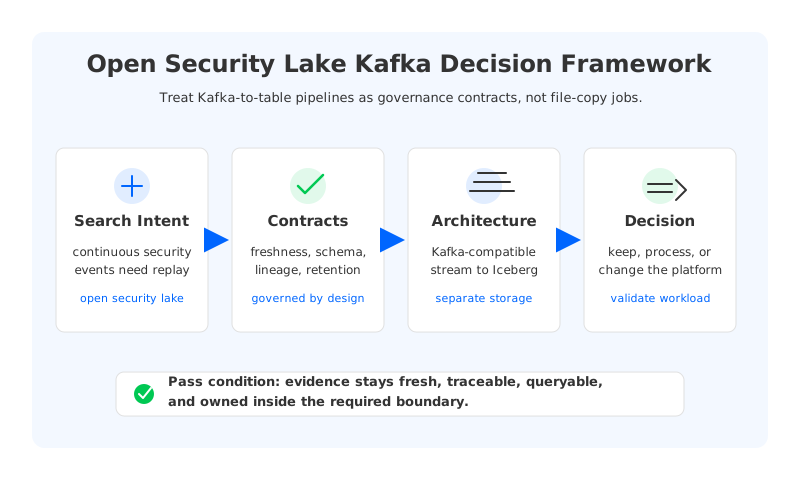
An open security lake pipeline should be evaluated as a control surface, not as a one-way ingestion pipe. Security data carries compliance, investigation, and retention obligations. A delayed batch may weaken detection freshness; bad schema evolution may break triage queries; a missing replay path may make incident reconstruction impossible. The architecture review starts with four contracts: stream freshness, schema governance, table quality, and ownership boundary.
1What Security Teams Actually Need From Kafka
Kafka fits security pipelines because security events are rarely polite. They arrive in spikes during incidents, endpoint rollouts, vulnerability scans, rule deployments, and cloud-account onboarding. A collector may produce millions of records during a short window, while the downstream enrichment or detection system may need to slow down without forcing the source to drop events. Kafka's partitioned log gives that buffer a precise operational meaning: consumers can fall behind, recover, and replay from known offsets.
That does not make Kafka a security lake by itself. Kafka topics are optimized for movement and replay, not for ad hoc investigation across months of retained data. A threat hunter does not want to scan raw topic segments with consumer code. A governance team does not want every query engine to learn a different serialization convention. The lakehouse layer becomes necessary when security data must be searchable, joined, versioned, and retained in object storage under a common table contract.
The production requirements usually look like this:
- Freshness with replay: Detection pipelines need low-latency ingestion, but incident response also needs the ability to replay from a trusted point when a parser, schema, or enrichment rule changes.
- Open schema alignment: Security teams need normalized fields for identities, resources, network flows, findings, and timestamps, especially when events come from many tools and clouds.
- Queryable retention: Long-retention security data belongs in object storage and table formats so engines such as Spark, Trino, Athena, or Flink can query it without a broker-local storage bottleneck.
- Governance at the boundary: Encryption, access control, auditability, and data residency should be defined where data enters the platform, not patched onto each downstream consumer later.
The mistake is to treat these as downstream lake requirements. By the time a record reaches the table writer, the platform has already made decisions about ordering, schema resolution, event time, partitioning, and error handling. If Kafka is the front door of the security lake, its operating model shapes the lake's reliability.
2From Topics to Tables: The Real Translation Layer
Moving security events from Kafka to table formats sounds like a connector problem until you list what must be preserved. A Kafka topic has partitions, offsets, keys, headers, timestamps, and serialized values. An Iceberg table has schemas, snapshots, manifests, partition specs, data files, delete files, and a catalog pointer. The translation layer must map one contract to the other without losing evidence, freshness, or operational control.
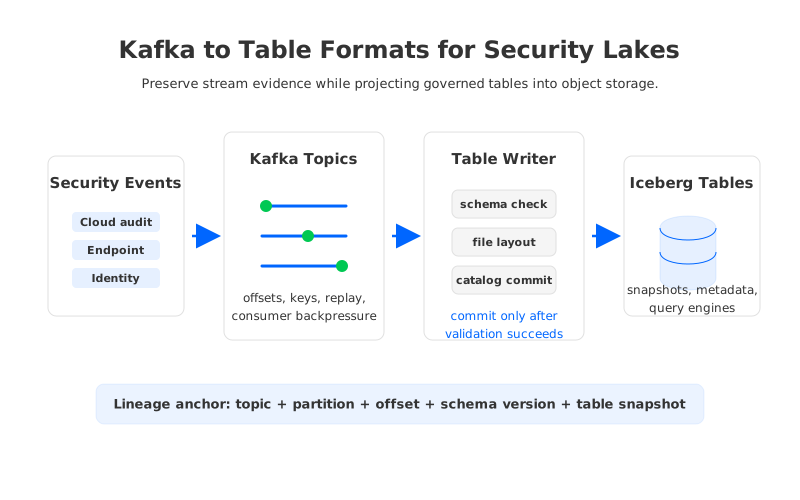
For append-only telemetry such as DNS logs or cloud audit events, the mapping is relatively direct: parse the record, validate the schema, write files, commit table metadata, and expose a snapshot to query engines. For findings, asset inventories, or identity state, updates and deletes may matter. Then the pipeline needs keys, CDC semantics, equality deletes, or merge-on-read behavior. For compliance records, the error path matters as much as the happy path. Skipping malformed records may keep dashboards fresh, but it can create blind spots if skipped records are not quarantined and replayable.
This is why "Kafka to Iceberg" cannot be evaluated by checking whether a connector can write Parquet. The table writer is responsible for several design choices that affect security operations:
| Design choice | Why it matters in a security lake | What to verify |
|---|---|---|
| Schema source | Determines whether field names, types, and evolution are consistent across producers and tables | Schema registry integration, compatibility policy, fallback behavior |
| Event-time handling | Controls partitioning, query pruning, late arrivals, and investigation windows | Timestamp source, time zone normalization, late-event policy |
| Commit cadence | Balances detection freshness against metadata churn and small-file pressure | Commit interval, file sizing, compaction plan |
| Error tolerance | Decides whether bad records block the pipeline, get skipped, or enter a review path | Dead-letter topic, quarantine table, retry and alerting behavior |
| Ownership boundary | Defines who controls object storage, keys, catalog, and query access | IAM model, VPC boundary, audit logs, catalog permissions |
These choices are not abstract. A security lake that commits tiny files every few seconds may feel fresh but become expensive to query. A pipeline that waits too long to commit may hide events from detection queries. A schema policy that allows uncontrolled drift may work during onboarding and fail during incident response.
3Why Broker-Local Kafka Becomes Awkward For Security Lakes
Traditional Kafka is a shared-nothing system. Brokers own local persistent data, partitions are assigned to brokers, and replication keeps multiple copies available. That design is mature and powerful, but it creates friction for lakehouse-oriented security workloads because retention, scaling, and recovery are tied to broker-local storage.
Security data stresses the parts of Kafka that are least elastic. Retention windows grow because investigations, audits, and model training need historical events. Fan-out grows because SIEM, SOAR, detection engineering, threat hunting, data science, and compliance teams all want access to the same streams. Onboarding a log source adds traffic and schema complexity. When durable data lives on broker disks, each change can trigger capacity planning, reassignment, disk pressure, and cross-zone replication work.
The mismatch becomes clearer when the table layer is added. The lake wants object storage as the durable analytical foundation. Broker-local Kafka wants disks and replicas to hold the stream. The result is often duplicated persistence: security events are retained in Kafka long enough for replay, then written again into object storage for analysis. That duplication can be acceptable for modest volumes, but it becomes uncomfortable when security teams want broad retention, many consumers, and repeatable replay.
This does not mean every security pipeline should abandon existing Kafka. A stable cluster with modest retention and a small number of feeds may be fine with Kafka Connect, Flink, or Spark jobs writing tables. The warning sign is when the team cannot change retention, add consumers, backfill a table, or scale brokers without a storage project. At that point, the lakehouse problem is rooted in the streaming platform's persistence model.
4A Cloud-Native Kafka Pattern For Open Security Lakes
The architecture to look for is not "Kafka or lakehouse." It is Kafka-compatible streaming where durable storage, compute capacity, and table output can be reasoned about separately. That pattern keeps the Kafka API for producers and consumers, keeps replay semantics available to operational systems, and moves the persistence foundation closer to object storage and table metadata.
AutoMQ is one implementation of that pattern: a Kafka-compatible, cloud-native streaming platform that uses Shared Storage architecture and stateless brokers while preserving Kafka protocol semantics. The important point for security lake design is not a vendor label. It is the separation of responsibilities. Brokers handle Kafka-facing compute, routing, cache, and leadership. Durable stream data is backed by object storage through the storage layer, and the broker fleet becomes easier to scale or replace because it no longer owns long-lived local partition data in the same way.
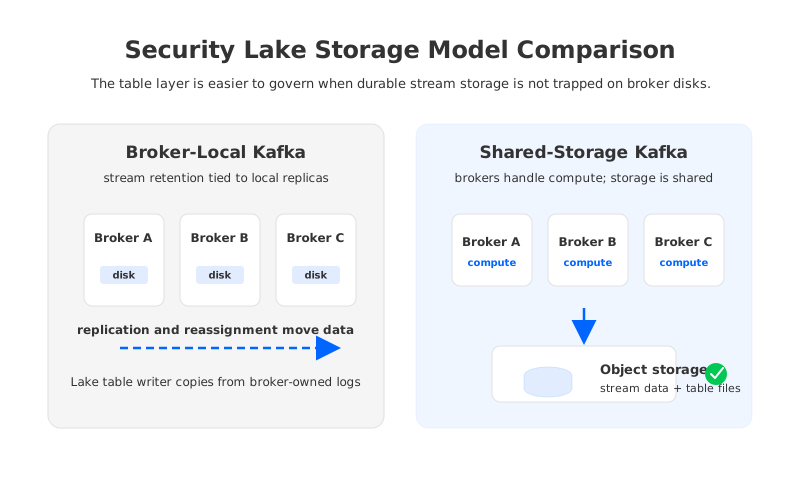
That operating model changes the table-format discussion. If object storage is already the durable foundation for streaming data, the lakehouse handoff becomes less like a copy from one world into another and more like a controlled projection from stream records into analytical tables. AutoMQ's Table Topic capability is relevant here because it can convert Kafka topic data into Apache Iceberg tables using schema, catalog, partition, commit, and error-handling configuration. The public documentation describes support for catalog types such as REST, Glue, Nessie, and Hive, along with topic-level settings for table output, partitioning, commit interval, and upsert or CDC mode.
The same caveat applies to any production security platform: validate the exact workload. Security pipelines should test producer compatibility, consumer offsets, schema registry behavior, ACLs, encryption, catalog permissions, object-storage policies, replay, and rollback. A Kafka-compatible platform reduces application rewrite risk, but it does not remove the need for evidence. The proof of concept should include malformed events, late events, schema changes, traffic spikes, query backfills, and broker replacement under load.
5Governance Questions That Belong In The Architecture Review
Security lake projects often fail quietly. The first dashboard works, the first feed lands, and the first few tables query well. Later, the team has dozens of feeds, several incompatible schema conventions, multiple table writers, and no confident answer to which events were skipped or transformed. Governance should be designed before the feed count grows.
Use the following checklist before choosing a Kafka-to-table architecture:
- Can every table row be traced back to a topic, partition, offset, schema version, and ingestion timestamp? This lineage is essential for investigations and for explaining why a query result changed after a reprocessing job.
- Can schemas evolve without breaking detection and audit queries? Iceberg supports schema and partition evolution, but the pipeline still needs a controlled schema source and compatibility policy.
- Can malformed records be isolated without becoming invisible? A dead-letter topic, quarantine table, or error stream should be queryable and alertable, not hidden in task logs.
- Can object storage, catalog metadata, and encryption keys stay within the required ownership boundary? For regulated teams, the placement of the data plane can matter as much as feature coverage.
- Can the platform replay a selected time window into a corrected table without disrupting live ingestion? This separates a resilient security lake from a pipeline that merely works when every parser is correct.
The checklist is intentionally practical. It does not assume one cloud, one SIEM, or one query engine. It asks whether the architecture preserves the evidence chain from live event to analytical table. If the answer depends on a spreadsheet of job names and tribal knowledge, the system is carrying hidden operational risk.
6Decision Framework For Platform Teams
There are three common paths, and each is reasonable in the right environment. The wrong move is to pick based on a single phrase such as "real-time" or "open lake" without mapping the operational consequences.
| Situation | Reasonable path | Watch the tradeoff |
|---|---|---|
| Few feeds, modest retention, existing Kafka is healthy | Keep current Kafka and use a connector or stream processor to write Iceberg | Operational simplicity may be higher than changing the platform |
| Many feeds, strict normalization, heavy enrichment | Use Kafka plus a managed processing layer and table-maintenance workflow | Job sprawl, schema drift, and small-file maintenance need ownership |
| High volume, long retention, many consumers, strict boundary control | Evaluate Kafka-compatible shared storage with built-in table-format output | Compatibility, catalog governance, and workload-level validation remain mandatory |
For security leaders, the decision should be framed around risk reduction. Does the architecture make evidence fresher, more traceable, and easier to govern? For platform leaders, the decision is operating control. Does adding a feed, extending retention, or replaying a window create proportional work, or does the platform absorb the change?
That is where cloud-native Kafka becomes relevant. A security lake should not force teams to choose between Kafka's operational stream contract and the lakehouse's open table contract. The stronger architecture keeps both visible: Kafka for movement and replay, Iceberg for queryable tables, object storage for durable scale, and governance at each boundary.
7References
- Amazon Security Lake documentation
- AWS announcement: Security Lake support for OCSF 1.1.0 and Apache Iceberg
- Apache Kafka security documentation
- Apache Iceberg table evolution documentation
- Apache Iceberg specification
- AutoMQ architecture overview
- AutoMQ Table Topic configuration
8FAQ
8.1Is Kafka a replacement for a security lake?
No. Kafka is the streaming and replay layer. A security lake usually needs object storage, table metadata, query engines, retention policy, and governance controls. Kafka becomes the front door for continuous events, while table formats such as Iceberg make the retained data queryable and maintainable.
8.2Why use Apache Iceberg for security data?
Iceberg provides table metadata, snapshots, schema evolution, partition evolution, and engine interoperability over object storage. Those features are useful for security data because investigations often need historical queries, schema changes, and selective scans over large event volumes.
8.3When should a team evaluate a Kafka-compatible shared-storage platform?
Evaluate it when broker-local storage starts dominating security-lake operations: long retention, high fan-out, repeated backfills, scaling friction, or cross-zone replication cost. The goal is to keep Kafka-facing behavior while changing the storage and scaling model underneath.
8.4How does AutoMQ fit this architecture?
AutoMQ fits when the team wants Kafka compatibility, stateless brokers, object-storage-backed shared storage, and a customer-controlled deployment boundary. Its Table Topic feature can also be evaluated for Kafka-to-Iceberg output, but production teams should validate schema handling, catalog permissions, replay, error behavior, and table maintenance with their own security feeds.
The next useful step is to draw one sensitive pipeline end to end: source event, Kafka topic, schema version, offset, table commit, catalog, object-storage policy, query engine, and replay path. If broker-local storage or job sprawl makes that map fragile, review AutoMQ's cloud-native Kafka architecture against your own security-lake requirements.


