
Table of Contents
Table of Contents
The phrase "open source Kafka" was once clear. Apache Kafka was an Apache Software Foundation project, the code was available, and the license was Apache 2.0. That clarity is gone. The Kafka ecosystem now includes Apache Kafka itself, open-core platforms, Kafka-compatible engines, source-available products, BYOC services, and managed products that expose Kafka APIs while using different code and control-plane models.
Kafka is not a small library you can swap out during a sprint. It becomes a shared infrastructure layer for payments, logs, observability, AI features, fraud detection, lakehouse ingestion, and internal platform services. Once teams standardize clients, topics, schemas, connectors, Terraform modules, dashboards, and on-call practices around a streaming platform, the license becomes part of the architecture.
This is not legal advice.
1Why License Choice Matters for Kafka Infrastructure
Kafka infrastructure lives in an awkward place inside enterprise governance. It is application infrastructure, but it often serves many internal tenants. It may be self-managed, but it may also be wrapped behind an internal platform API. It may start as a logging cluster, then become a product-facing event backbone. That evolution changes the meaning of "use" in ways a lightweight license checklist can miss.
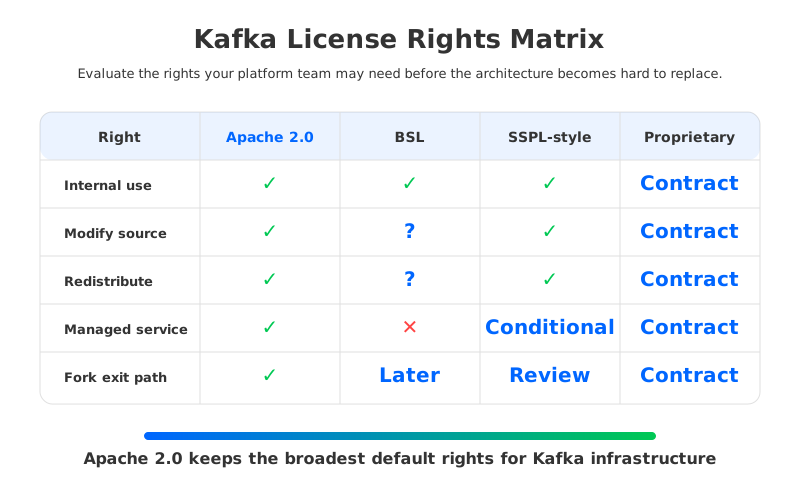
For a platform team, license risk usually shows up in five concrete questions:
- Can we run this in production for our own workloads? Most licenses allow internal use, but the conditions differ. "Free to use" and "open source" are not interchangeable.
- Can we modify the code if production requires it? Kafka operators often need patches for networking, storage, metrics, authentication, or automation. Reading code is less valuable if running modifications is restricted.
- Can we redistribute or package it into our internal platform? Large enterprises wrap software in golden images, Helm charts, Terraform modules, and internal distributions.
- Can we offer it as a managed service to business units, subsidiaries, partners, or customers? This is the line where many source-available licenses become materially different from permissive open source.
- Can we fork or maintain an exit path if the vendor changes direction? Forkability is a procurement hedge for infrastructure with a long operating life.
These questions shape architecture. If a product cannot be offered as a service under the license, your internal platform model may need a separate commercial agreement. If visible code converts to a permissive license only after a delay, your emergency patch strategy differs from an Apache 2.0 project.
2The Baseline: What Apache 2.0 Gives Kafka Teams
Apache Kafka is licensed under Apache 2.0, and that baseline is why Kafka became so widely embedded across vendors, cloud providers, distributions, and internal platforms. Apache 2.0 is a permissive open source license. It grants broad copyright rights to reproduce, prepare derivative works, publicly perform, sublicense, and distribute the work, and it also includes an express patent license from contributors subject to the license terms.
The practical effect is straightforward for most platform teams: you can use Apache Kafka internally, modify it, build distributions around it, and operate it as part of a broader service, provided you comply with obligations such as preserving notices and license text. Apache 2.0 does not remove legal work, but its default permission model is broad and familiar.
That matters when the streaming layer becomes strategic. A permissive license gives your architecture team multiple fallback options:
| Need | Why Apache 2.0 helps |
|---|---|
| Internal distribution | Teams can package builds with standard notice compliance. |
| Emergency patching | Engineers can modify and run code. |
| Managed service | The license is not designed to block service operation as a field of use. |
| Vendor exit | Forking is a technical challenge, not primarily a license prohibition. |
AutoMQ fits this part of the spectrum because AutoMQ Open Source is covered under Apache License 2.0, and the project is published on GitHub under Apache-2.0. Commercial AutoMQ services may have separate contract terms, but the open source engine gives teams a Kafka-compatible, diskless architecture option in the same broad license family that helped Apache Kafka spread through enterprises.
The architectural angle matters. AutoMQ keeps Kafka compatibility while changing the storage layer around shared object storage, stateless brokers, and separation of compute and storage. For buyers, Apache 2.0 helps with commercial control, while Kafka compatibility helps with technical exit planning.
3BSL: Source-Available Is Not the Same as Open Source
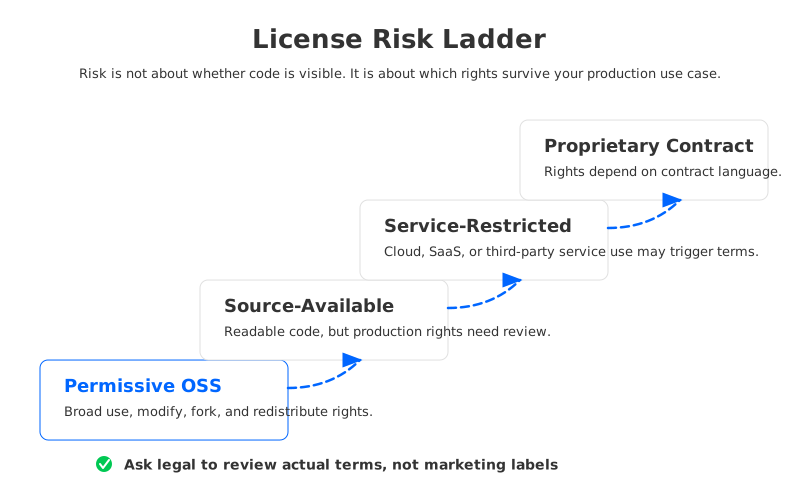
The Business Source License, or BSL, is often described in ways that sound close to open source because the code can be available and because versions can convert to an open source license after a delay. The BSL text published by MariaDB states that it is not an open source license, while also describing a delayed conversion to an open source license through a "Change License." That delayed-conversion design is the main reason BSL deserves a separate review track.
Redpanda's current licensing documentation says Redpanda Community Edition is licensed under the Redpanda BSL, is free and source-available, cannot be provided as a commercial streaming or queuing service to others, and converts to Apache 2.0 four years after each code merge. A team may be comfortable running Redpanda for internal workloads, but the service restriction and delayed Apache 2.0 conversion need to be evaluated against the company's actual operating model.
The hard part is that many enterprises blur the line between internal infrastructure and managed service. A central platform team may expose Kafka as a standardized capability to dozens of product teams. A parent company may operate shared infrastructure for subsidiaries. A software company may embed streaming into a customer-facing product. A cloud marketplace team may package infrastructure for external tenants. These are not edge cases for Kafka; they are common maturity stages.
BSL therefore creates a timing and use-case question:
- If the current version is under BSL, which production uses are allowed?
- If a version converts to Apache 2.0 later, can the business wait for that older version to age into permissive status?
- If the platform team modifies BSL-covered code, what rights apply to those modifications before and after conversion?
- If the company provides an internal or external streaming service, does the license restriction require a commercial agreement?
- If the vendor changes roadmap, is the delayed fork path good enough for your risk model?
None of these questions imply that BSL is bad. BSL is a vendor strategy for making code visible while limiting direct cloud-service competition. For enterprise architects, the issue is precision. If your internal governance says "open source approved" but the product is source-available under BSL, you need a different approval path.
4SSPL-Style Restrictions: The Service Clause Is the Point
SSPL-style restrictions are less common in Kafka engines than in databases and search infrastructure, but review boards often group them into the same discussion because the service clause targets cloud providers or third parties offering software as a service. MongoDB's SSPL FAQ says the license has not been approved by the Open Source Initiative and explains that a company offering MongoDB as a publicly available service must release the software used to offer that service under the SSPL.
That is a very different model from Apache 2.0. Apache 2.0 focuses on broad permission with attribution, notice, and patent-related conditions. SSPL-style models make service operation the central trigger. Whether that trigger matters depends on what your company is doing.
For a Kafka platform decision, the lesson is to map your use case before approving the license. An internal application team consuming a managed database may face a different risk profile from a platform organization offering a Kafka-compatible service to many tenants. A SaaS company embedding a streaming engine into a customer-facing control plane has a different profile again.
The Open Source Initiative definition is a useful checkpoint. Open source does not merely mean access to source code; it includes free redistribution, derived works, and no field-of-use discrimination. When a license blocks specific service-provider uses, it may still be source-available and commercially reasonable, but it should not be treated as conventional open source in procurement.
5Proprietary and Commercial Kafka-Compatible Services
Some Kafka-compatible platforms are primarily consumed as commercial services or binary distributions, even when they use open protocols and publish detailed architecture documentation. WarpStream is a good example of why license review should look beyond API compatibility. Its public documentation describes a diskless, Apache Kafka-compatible platform built on object storage, plus a stateless Agent binary and a vendor-operated cloud metadata store.
That may be a valid architecture. BYOC and vendor-operated control planes can reduce operational burden while keeping data in the customer's cloud account. But the license and exit questions differ from Apache 2.0 software:
- What rights do you have to the Agent binary?
- Is source code available under an OSI-approved license, a source-available license, or not available for the relevant component?
- What happens if the control-plane contract ends?
- Can you continue operating existing clusters?
- Can you migrate metadata, topic configuration, schemas, and operational tooling without vendor assistance?
- Are there restrictions on benchmarking, reverse engineering, redistribution, or internal service wrapping?
These are normal due diligence questions for any proprietary or commercial infrastructure layer. Kafka API compatibility reduces client migration work, but it does not automatically grant source rights, control-plane continuity, or forkability.
Confluent Platform shows a different version of the same theme. Confluent's FAQ says Apache Kafka remains Apache 2.0, while certain Confluent Platform components are under the Confluent Community License. The FAQ also says Confluent does not refer to that license as open source because it is source-available and excludes a competing SaaS use case. That clarity lets architects separate Apache Kafka itself from adjacent platform components such as Schema Registry, REST Proxy, ksqlDB, connectors, enterprise features, and cloud services.
The trap is buying "Kafka" as a bundle without reviewing each layer. The broker, schema registry, stream processing layer, connector catalog, control plane, monitoring stack, and cloud automation may each have different terms. One permissive component does not make the full platform permissive.
6Kafka Ecosystem License Comparison
The following comparison summarizes public, official documentation as of May 22, 2026, and it should not replace legal review of the exact version and contract you plan to use.
| Platform or model | Public license posture | What architects should review |
|---|---|---|
| Apache Kafka | Apache 2.0 open source | Standard notice compliance, patent policy, internal distribution process. |
| AutoMQ Open Source | Apache 2.0 open source | Which deployment uses rely on open source code versus commercial BYOC or support contracts. |
| Redpanda Community Edition | Source-available under Redpanda BSL, with documented service restriction and later Apache 2.0 conversion | Whether internal platform or commercial service use is allowed; how four-year conversion affects fork and patch strategy. |
| Confluent Platform components | Mixed: Apache Kafka under Apache 2.0; certain components under Confluent Community License; enterprise features under commercial terms | Which components are included in the deployment and whether SaaS/service restrictions affect the intended use. |
| WarpStream-style commercial BYOC | Public docs describe Kafka compatibility, Agent binary deployment, and vendor cloud metadata services | Source rights, binary use rights, control-plane dependency, contract termination, data and metadata migration. |
| SSPL-style infrastructure | Source-available but not OSI-approved, with service-source obligations for third-party service use | Whether the use case offers the software's functionality as a service and what source disclosure obligations may follow. |
The point is not to crown one model for every company. A bank may prioritize forkability and private patch rights. A startup may prefer a managed service contract because speed matters more than source control. A platform company exposing streaming to customers may be especially sensitive to service restrictions.
License fit is contextual. The mistake is treating "Kafka-compatible" as if it answered the license question.
7Where AutoMQ Fits
AutoMQ's role in this conversation is specific: it combines Kafka compatibility, diskless cloud-native storage, and an Apache 2.0 open source engine. Kafka compatibility helps teams preserve client and ecosystem investments. Diskless architecture moves persistent data away from broker-local disks and toward object storage, improving elasticity and reducing broker-bound state. Apache 2.0 licensing keeps the core software posture familiar for enterprises that already approve Apache Kafka.
That combination is relevant for teams that like the operational idea behind diskless Kafka but do not want their only path to be a closed service or a source-available engine with service restrictions. AutoMQ gives those teams a way to evaluate a Kafka-compatible shared-storage architecture while preserving a permissive open source option.
AutoMQ should still be reviewed like any serious infrastructure dependency. For AutoMQ Open Source, review the Apache 2.0 obligations and exact repository version. For AutoMQ BYOC or a commercial edition, review service terms, support boundary, telemetry model, data-plane location, control-plane responsibilities, and cloud account permissions. Open source code reduces one class of lock-in; it does not eliminate contract and operational review.
The stronger architectural claim is about optionality. A Kafka-compatible Apache 2.0 engine gives your platform team more ways to respond if cost, latency, compliance, or vendor strategy changes after the first rollout.
8A Practical License Review Checklist
Review license rights before the platform sits behind services. Once schemas, connectors, client libraries, and runbooks depend on a system, exit becomes expensive even if the license technically allows it. A lightweight review at the architecture stage is lower-friction than a legal escalation during renewal.
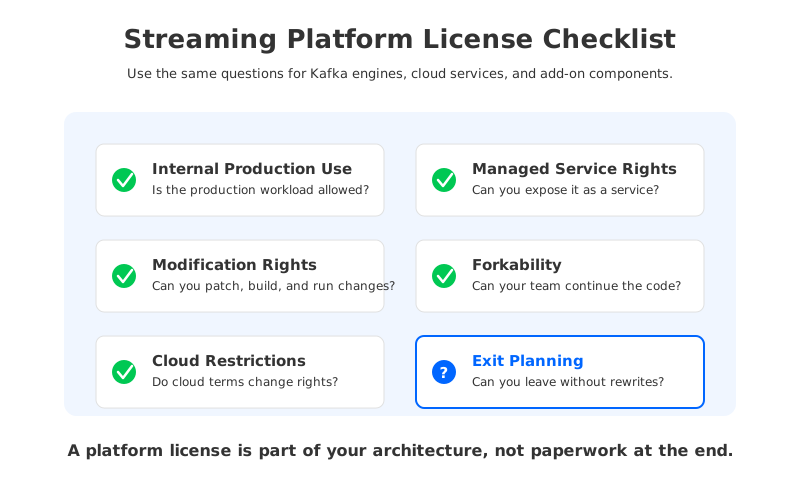
Use this checklist for every Kafka-compatible platform, not only for products that market themselves as open source:
- Identify every component in the deployment. Broker, controller, schema registry, connectors, stream processing, UI, CLI, operator, Terraform provider, and observability integrations may not share the same license.
- Map the actual use case. Internal application use, shared internal platform, subsidiary service, customer-facing SaaS, and public managed service can trigger different license analysis.
- Check modification and build rights. Source visibility is not enough. Confirm whether your team can patch, compile, deploy, and keep operational modifications private.
- Review redistribution and packaging. If your company ships internal distributions, golden images, Helm charts, or appliance-like packages, make sure those flows are allowed.
- Test the exit path. Ask what happens if the vendor is acquired, changes license terms, discontinues a feature, or raises prices at renewal.
- Separate code rights from service rights. A permissive repository license and a commercial cloud contract solve different problems. Review both.
- Document counsel's answer in engineering language. "Approved" is less useful than "Approved for internal production use, not approved for third-party managed service without separate agreement."
This checklist also improves vendor conversations. Instead of asking "Are you open source?" ask "Which components are under OSI-approved licenses, which are source-available, which are commercial, and which rights apply to managed service use?"
9FAQ
9.1Is Apache Kafka open source?
Yes. Apache Kafka is an Apache Software Foundation project licensed under Apache License 2.0. Review normal Apache 2.0 compliance obligations, but the baseline license is permissive and widely approved in enterprise open source programs.
9.2Is AutoMQ open source?
AutoMQ Open Source is licensed under Apache License 2.0, and the public GitHub repository is marked Apache-2.0. Commercial AutoMQ services or editions may also include contract terms, so review the open source license and service agreement separately.
9.3Is Redpanda open source?
Redpanda's current documentation describes Redpanda Community Edition as free and source-available under the Redpanda BSL, not as conventional Apache 2.0 open source at the time of release. The same page says BSL code converts to Apache 2.0 four years after each code merge and includes a restriction on providing Redpanda as a commercial streaming or queuing service to others.
9.4Is source-available the same as open source?
No. Source-available usually means you can see the source code, and sometimes modify or use it under defined conditions. Open source, in the OSI sense, requires broader permissions such as free redistribution, derived works, and no field-of-use discrimination.
9.5Does Kafka API compatibility reduce license risk?
It reduces technical migration friction, but it does not answer the license question. A Kafka-compatible product can be Apache 2.0, source-available, commercially licensed, or delivered as a proprietary service. Review API compatibility and license rights as separate dimensions.
9.6Should architects reject BSL, SSPL-style, or proprietary models automatically?
No. Different companies can make different trade-offs. The key is to avoid treating these models as equivalent to Apache 2.0. If the license restricts service use, delays permissive rights, or depends on a commercial contract, make sure that matches the way your streaming platform will actually be operated.
10Sources
- Apache License, Version 2.0
- Apache Kafka GitHub repository
- Open Source Initiative: The Open Source Definition
- AutoMQ Documentation: Licensing and Enterprise Features
- AutoMQ GitHub repository
- Redpanda Documentation: Licenses and Enterprise Features
- MariaDB: Business Source License 1.1
- MongoDB: Server Side Public License FAQ
- Confluent Community License FAQ
- Confluent Community License
- WarpStream Documentation: Introduction
- WarpStream Documentation: Architecture
- WarpStream Documentation: Install the WarpStream Agent / CLI


