
Table of Contents
Table of Contents
An open table freshness kafka investigation usually starts after the easy architecture diagram has stopped being useful. Kafka is already in the middle. A lakehouse table format such as Apache Iceberg is already on the target side. Somewhere between them sits Flink, Spark Structured Streaming, Kafka Connect, or a custom sink. The hard part is proving that an event written to the stream becomes queryable in the table within a time boundary the business can trust.
That boundary is a service level agreement, even when nobody has given it a formal name. A fraud model may tolerate seconds. A product analytics table may tolerate minutes. A compliance replay table may tolerate longer freshness but needs deterministic recovery. Once the table is part of a user-facing dashboard, feature store, or operational workflow, "Kafka is healthy" is no longer enough. The platform must explain where time is spent from producer append to table commit, what happens during broker recovery, and how much cloud infrastructure has to be kept warm to protect that path.
1Why Teams Search for open table freshness kafka
Kafka became the backbone for lakehouse ingestion because it gives teams a durable offset log between application services and analytical storage. That offset log is useful because it separates producer availability from table write behavior. A downstream table writer can pause, catch up, checkpoint, and replay without asking the source system to resend business events.
The same separation creates the freshness problem. A lakehouse table is not fresh when Kafka accepts a record. It is fresh when downstream work has consumed the record, transformed it if needed, committed data files, updated metadata, and exposed the result to query engines. For Apache Iceberg, that means table snapshots and metadata updates, not only object files landing in storage. The stream and the table have different clocks, and production incidents tend to happen in the gap between them.
Platform teams usually feel the gap through four signals:
- Consumer lag is stable but table age grows. The streaming job is reading, but file commits, compaction, schema handling, or catalog operations are slowing the table-visible path.
- Broker maintenance affects table SLAs. Partition movement, disk replacement, cluster expansion, or recovery competes with sink throughput and catch-up reads.
- Backfill disrupts fresh writes. Historical replay is needed for correctness, but replay traffic consumes the same broker, network, and sink resources as fresh ingestion.
- Ownership is split. The Kafka team measures broker health, the data engineering team measures table commits, and the incident commander has to stitch the timeline together by hand.
These signals matter because open table freshness is not a connector feature. It is an end-to-end property of the streaming backbone, processing runtime, object storage, catalog, and operating model.
2The Lakehouse Freshness Constraint Behind the Workload
A useful freshness target starts with a visible definition: maximum acceptable table age for a specific table and workload. "Five-minute freshness" should mean that a record accepted into the stream is normally queryable through the table within five minutes, with a defined percentile, exception path, and recovery objective. Without that definition, teams argue about isolated metrics. Kafka lag says one thing, the Flink checkpoint says another, and the table catalog says something else.
The stream-to-table path has several time components. Produce latency adds the first boundary. Consumer polling and batching add another. The processing job may wait for watermark progress, checkpoint alignment, file size thresholds, or transactional sink commits. The table layer then writes data files, metadata files, and catalog state. Query engines may also cache metadata, so "committed" and "visible to readers" can diverge.
The platform decision is therefore not whether Kafka can write fast enough in a benchmark. It is whether the full path can preserve freshness during the boring production events: a broker failure, a traffic spike, a schema rollout, a downstream table compaction, a region-level network wobble, or a replay after a bad transform. Those events expose the storage architecture underneath Kafka.
3Stream-to-Table Architecture Options
There are several patterns for feeding open table formats from Kafka-compatible streams. None is universally right. The better question is which operational bottleneck each pattern moves closer to your team.
| Pattern | Where it fits | Freshness risk to test |
|---|---|---|
| Kafka Connect sink to object storage or table format | Standard ingestion where transformation is light and connector operations are already mature. | Task rebalances, file sizing, exactly-once configuration, and how failed commits recover. |
| Flink or Spark streaming writer | Stateful enrichment, event-time processing, deduplication, and custom commit logic. | Checkpoint duration, state growth, replay speed, and how job recovery affects table commits. |
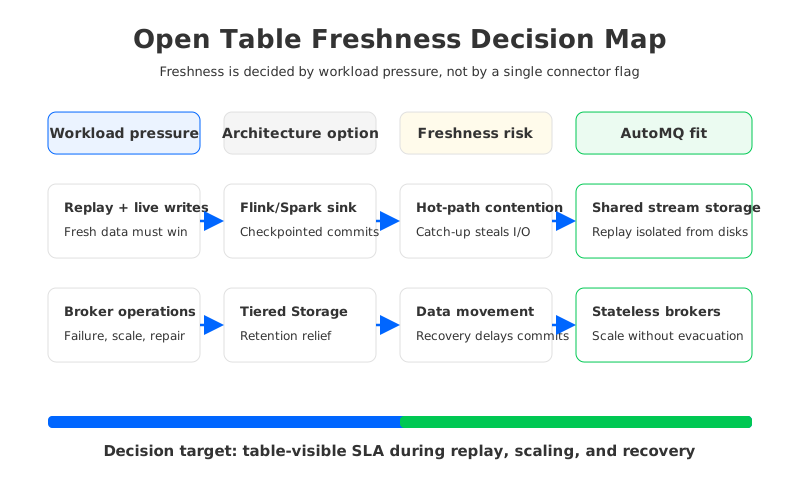
| Kafka with tiered storage plus downstream table writer | Long retention and replay without sizing all broker disks for historical data. | Hot-tier pressure, remote-read behavior, and whether backfill steals resources from fresh ingestion. |
| Kafka-compatible shared storage backbone with table integration | Teams that want Kafka API compatibility while reducing broker-local storage coupling. | WAL choice, object-storage behavior, table commit semantics, and compatibility with existing clients and tools. |
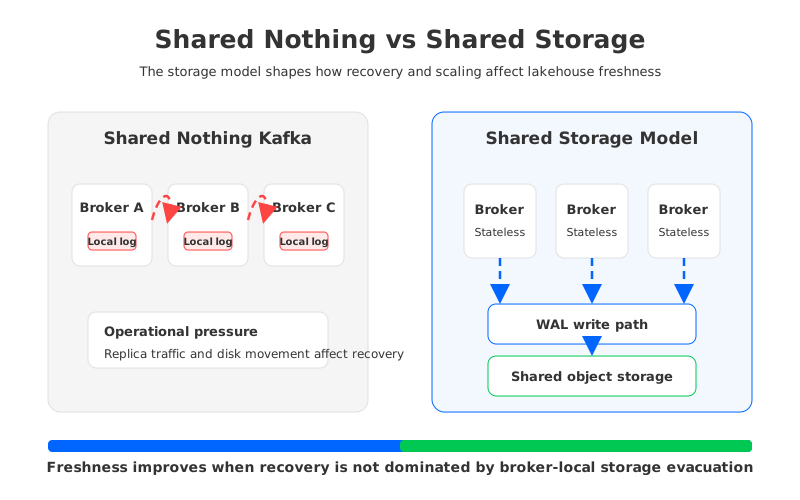
Traditional Kafka's Shared Nothing architecture makes the first three patterns operationally familiar, but it also ties durability to broker-local storage and replica placement. That design is sound for many deployments. The challenge appears when freshness depends on elastic recovery and large replays in cloud environments. Broker-local data movement is not only an internal maintenance detail; it can compete with the same network and disk paths that table writers need to catch up.
Tiered Storage changes the retention economics by moving older segments to remote storage, and it can be a practical step for replay-heavy workloads. It does not make brokers stateless. Hot data, leader placement, partition reassignment, and recovery behavior still matter for freshness because the broker remains the control point for reads and writes.
4Evaluation Checklist for Platform Teams
The cleanest way to evaluate open table freshness is to separate table semantics from streaming infrastructure. Table semantics answer what the reader sees. Streaming infrastructure answers whether the pipeline can keep feeding that table during normal operations and failure recovery.
| Evaluation axis | Question to ask | Evidence to collect |
|---|---|---|
| Compatibility | Can existing Kafka producers, consumers, tools, ACLs, and offset workflows keep working? | Client version inventory, Kafka protocol features used, Connect and processing framework tests. |
| Freshness isolation | Can backfill and catch-up reads run without starving fresh writes? | Replay test with live traffic, p95/p99 table age, consumer lag, and sink commit duration. |
| Cost model | Which resources scale with retained bytes, write rate, read fanout, and cross-zone traffic? | Cloud bill model for compute, block storage, object storage, request volume, and network paths. |
| Elasticity | Can the cluster add or remove capacity without large broker-local data movement? | Scale test under load, reassignment duration, and table freshness during scaling. |
| Governance | Who owns schemas, table commit policy, encryption, IAM, and catalog access? | RACI, audit trail, data retention policy, and rollback procedure. |
| Migration | Can the team preserve offsets and run a reversible cutover? | Dual-run plan, consumer group handling, checkpoint mapping, and rollback threshold. |
| Observability | Can one incident timeline connect Kafka, processing, object storage, catalog, and query freshness? | Unified dashboard for producer latency, consumer lag, checkpoint age, table age, and catalog errors. |
The important column is evidence. Many platform reviews stop at feature comparison, which is comfortable but not decisive. A streaming backbone is part of the SLA when it can be tested under the same failure and replay conditions that the lakehouse will face in production.
5How AutoMQ Changes the Operating Model
Once the evaluation moves from feature names to operating behavior, shared storage becomes a concrete architectural option. AutoMQ is a Kafka-compatible streaming platform that keeps Kafka protocol semantics while moving persistent stream storage out of broker-local disks and into shared object storage, with a WAL layer on the write path. The point is not that every pipeline should use the same storage design. The point is that broker statefulness is often the hidden variable in freshness incidents.
In a Shared Storage architecture, brokers are closer to stateless compute nodes. Durable data is not stranded on a failed broker's local disk, so recovery and capacity changes do not require the same style of broker-to-broker segment movement. For open table freshness, that changes the shape of the incident. A failed compute node should not automatically turn into a long storage evacuation. A scaling event should not have to wait for large partition data moves before the platform can use additional compute.
AutoMQ's fit is strongest when the table freshness SLA is constrained by cloud operations rather than by table format semantics alone:
- Kafka compatibility reduces migration surface area. Existing Kafka clients and common ecosystem tools can be tested against the same protocol expectations instead of forcing an application rewrite.
- Shared storage decouples retained data from broker-local capacity. That matters when replay, retention, and table rebuilds are part of the lakehouse contract.
- Stateless brokers change scaling and recovery behavior. Capacity planning can focus more on active throughput and less on permanent local disk placement.
- Object-storage-backed durability aligns the stream log with the lakehouse storage substrate. The stream and table still have different formats and commit protocols, but both can be operated around elastic cloud storage.
- Inter-zone traffic can be reduced in supported deployments. This matters for teams whose lakehouse ingestion costs are dominated by replica traffic, cross-zone reads, or over-provisioned broker capacity.
Table Topic is the AutoMQ feature most directly related to this discussion because it targets streaming data lake ingestion into table formats such as Iceberg. It should still be evaluated with the same discipline as any sink path: define the table freshness target, test failure recovery, verify schema and governance behavior, and measure the cost of replay. A built-in table path can reduce connector operations, but the SLA still belongs to the whole system.
6Migration Readiness Scorecard
Before changing the streaming backbone underneath a lakehouse, run a readiness review that is specific enough to block risky migrations. The scorecard below is intentionally operational. If a team cannot answer these questions, it is not ready to compare vendor claims.
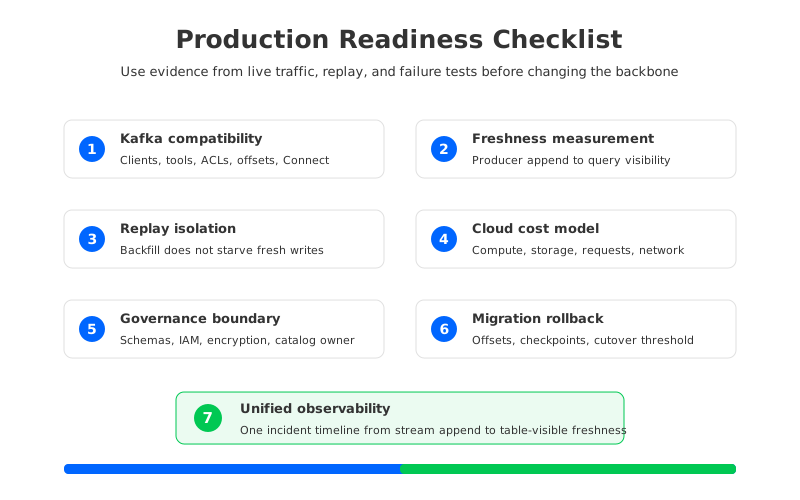
- Define table age per workload. A dashboard table, a feature table, and an audit table may all consume the same stream but require different freshness and recovery targets.
- Measure current end-to-end latency. Capture producer append time, Kafka offset consumption, processing checkpoint, table commit, and query visibility in one timeline.
- Run replay with live traffic. Freshness that passes during idle replay is not enough. The test should include normal writes and a controlled backfill at the same time.
- Model cloud costs from data movement. Include broker storage, object storage, cross-zone traffic, connector compute, catalog requests, and replay fanout.
- Prove rollback. A migration plan that preserves offsets but cannot return consumers to the prior path under a defined threshold is incomplete.
- Assign one owner for the SLA. Multiple teams can own components, but one team must own the lake-visible freshness objective.
The search phrase open table freshness kafka sounds narrow, but the decision is wide. Kafka is not the table, and the table is not the stream. The SLA lives between them. If your current backbone makes freshness fragile during scaling, recovery, or replay, evaluate shared-storage Kafka-compatible systems beside the connector and processing options you already know. For teams exploring that path, the AutoMQ documentation and trial path are available at go.automq.com.
7References
- Apache Kafka Documentation: https://kafka.apache.org/documentation/
- Apache Kafka Connect Documentation: https://kafka.apache.org/documentation/#connect
- Apache Iceberg Documentation: https://iceberg.apache.org/docs/latest/
- Amazon S3 User Guide: https://docs.aws.amazon.com/AmazonS3/latest/userguide/Welcome.html
- AutoMQ Kafka Compatibility: https://docs.automq.com/automq/what-is-automq/compatibility-with-apache-kafka.md
- AutoMQ Shared Storage Architecture: https://docs.automq.com/automq/architecture/overview.md
- AutoMQ Table Topic Overview: https://docs.automq.com/automq/table-topic/overview.md
- AutoMQ Inter-Zone Traffic Overview: https://docs.automq.com/automq/eliminate-inter-zone-traffics/overview.md
8FAQ
8.1What does open table freshness mean in a Kafka pipeline?
Open table freshness is the time between a record becoming durable in the stream and that record becoming visible through an open table format such as Apache Iceberg. It includes Kafka consumption, processing, file writing, metadata commits, catalog behavior, and query engine visibility.
8.2Is Kafka consumer lag enough to measure lakehouse freshness?
Consumer lag is necessary but incomplete. A sink can have low lag while table commits are delayed by checkpointing, small-file handling, catalog errors, schema conflicts, or object storage operations. Track table age beside Kafka lag.
8.3Does Tiered Storage solve open table freshness problems?
Tiered Storage can improve retention and replay economics, but it does not remove all broker-local operational constraints. Test recovery, hot-tier pressure, remote-read behavior, and table commit latency before treating it as a freshness solution.
8.4When should teams evaluate shared-storage Kafka-compatible systems?
Evaluate shared storage when freshness risk is tied to broker-local data movement, over-provisioned capacity, cross-zone traffic, replay contention, or slow recovery. The decision should be based on workload tests, not architecture labels alone.
8.5How does AutoMQ relate to open table freshness?
AutoMQ keeps Kafka compatibility while using shared storage, stateless brokers, object storage, and a WAL layer. For lakehouse workloads, that can reduce the operational coupling between broker storage events and table freshness, especially when paired with a measured sink or Table Topic evaluation.


