
Table of Contents
Table of Contents
A search for data residency architecture kafka rarely starts as a clean architecture exercise. It starts when a security review asks where retained event data lives, when a procurement team asks whether a service boundary fits the contract, or when a platform team realizes that "Kafka-compatible" does not answer who owns the data plane. The hard part is not defining data residency. The hard part is designing an operating model that can keep Kafka semantics, satisfy residency controls, and still survive scaling, recovery, and migration work.
Data residency for Kafka is a production constraint because Kafka is not a passive database backup. It is a live commit log with producers, Consumer groups, offsets, transactions, connectors, schemas, retention policies, and operational metadata. Event records may carry customer identifiers, payments context, device telemetry, audit events, or product behavior. Once that stream is governed, the platform team has to explain more than the Region name. They have to explain the data path, the control path, the support path, and the recovery path.
1Why teams search for data residency architecture kafka
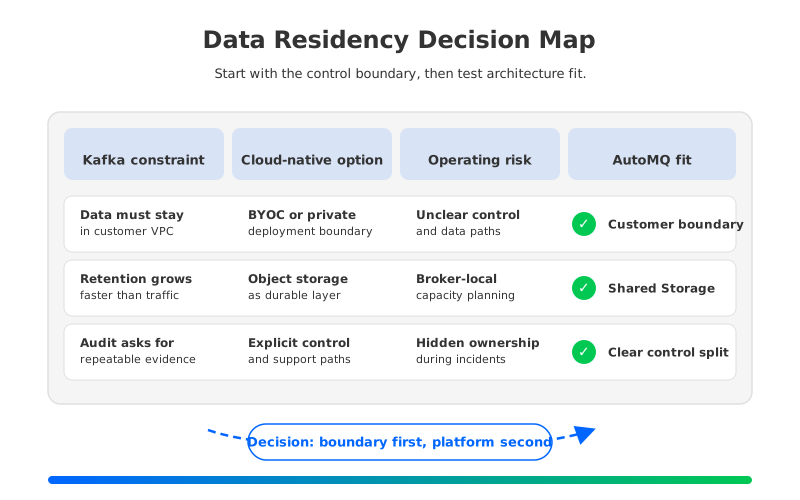
Most Kafka residency discussions get stuck because each stakeholder uses a different vocabulary. Security asks about VPC isolation, encryption keys, identity, and privileged access. Platform engineering asks about broker replacement, partition reassignment, client compatibility, and rollback. Finance asks why retention, private connectivity, and network paths are hard to forecast. Procurement asks whether the service model creates a data processing boundary that legal can approve.
Those questions are connected by one operating-model issue: which team can prove where data is, who can reach it, and what happens during failure. A Kafka service can be secure and still fail this review if its operational boundary is unclear. A self-managed Kafka cluster can satisfy residency and still be risky if every scale-out, disk replacement, or reassignment requires heavy manual work. The useful question is not "managed or self-managed?" It is "which parts of Kafka ownership must remain inside our boundary, and which parts can be delegated?"
That framing changes the evaluation. Instead of starting with a product list, start with four paths:
- The record path covers producers, brokers, retained logs, consumers, and any connector that moves records into another system.
- The metadata path covers topic configuration, ACLs, Consumer group offsets, transaction state, KRaft metadata, schemas, and cluster inventory.
- The management path covers provisioning, upgrades, scaling, observability, support access, and incident response.
- The recovery path covers backup, replay, broker loss, zone impairment, migration, rollback, and disaster recovery drills.
If any of those paths crosses a boundary that the security team cannot approve or audit, the architecture is not ready for governed workloads. The problem is also not limited to regulated industries. Customer analytics, AI feature pipelines, CRM synchronization, telemetry, and operational event streams often contain enough business context to require explicit location, access, and retention controls.
2The production constraint behind the problem
Traditional Apache Kafka was designed around a Shared Nothing architecture. Each broker owns local storage, and partition replicas are distributed across brokers for durability and availability. This model is well understood, and it gives operators direct control over the runtime. It also means that durable data, compute capacity, and failure recovery are tightly coupled at the broker layer.
That coupling matters for data residency because production work changes where data moves. Adding capacity may trigger partition reassignment. Replacing a broker may require replicas to catch up. Increasing retention expands local or attached storage pressure. Multi-zone availability relies on replicas and traffic between failure domains. A platform team can keep the cluster in the approved Region and still spend a lot of operational effort moving governed data inside that Region.
The deepest issue is not that Shared Nothing architecture is wrong. It is that broker-local durability makes residency a broker operations problem. Every capacity decision touches storage placement. Every recovery plan has to account for replica movement. Every migration plan must preserve offsets and client behavior while data is copied somewhere else. The architecture works, but it asks the team to keep residency controls and stateful infrastructure choreography in sync.
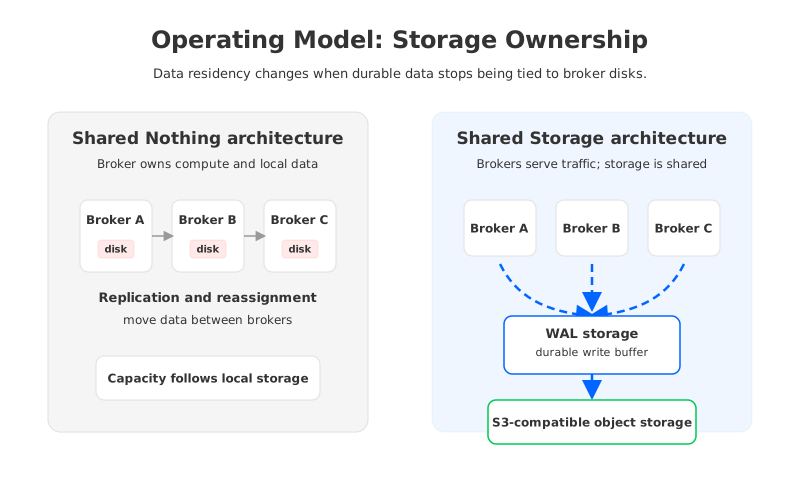
Tiered Storage helps with long retention by moving older segments to remote storage, but it does not make brokers stateless. Hot data, leadership, local disks, and reassignment behavior still matter. For residency-driven architectures, that distinction is important: offloading historical data is not the same as making object storage the durable storage layer for the streaming system.
3Architecture options and trade-offs
A serious evaluation should compare operating models, not labels. Self-managed Kafka, cloud-provider managed Kafka, SaaS Kafka, BYOC Kafka, and software deployed in a private environment can all be valid. They fail in different ways. The right choice depends on which constraint is binding: residency, operational load, recovery speed, cost transparency, ecosystem compatibility, or procurement control.
| Architecture option | Where it tends to fit | Main trade-off to test |
|---|---|---|
| Self-managed Kafka | Teams that need direct infrastructure control and have strong Kafka operations capacity. | The team owns broker sizing, storage growth, upgrades, rebalancing, and incident response. |
| Cloud-provider managed Kafka | Teams that prefer a cloud-native procurement and operations model. | Residency may be clear, but capacity, network, version, and cost controls still need review. |
| SaaS Kafka | Teams that prioritize service abstraction and can accept the provider boundary. | The data plane, support access, private connectivity, and contractual controls need careful review. |
| BYOC Kafka | Teams that need customer-owned cloud boundaries with more managed operations. | The split between customer-owned infrastructure and vendor-managed software must be explicit. |
| Private software deployment | Teams with strict private environment or data center requirements. | The customer keeps strong control but must operate the platform lifecycle. |
This table is deliberately plain. It avoids the trap of treating residency as a single checkbox. A team may choose SaaS for a low-risk internal analytics stream and BYOC for payment events. It may run private software for a business unit with a strict isolation requirement and use cloud-provider managed Kafka elsewhere. The operating model should follow the data classification, not the other way around.
Cost also belongs in the residency discussion. Private networking, cross-zone traffic, retained storage, object storage requests, observability pipelines, support contracts, and migration windows can all become part of the bill. A platform design that hides those drivers may pass a security review and still become hard to govern financially. The most useful Total Cost of Ownership (TCO) model separates compute, storage, network, support, and people so that a residency decision does not become a surprise renewal discussion later.
4Evaluation checklist for platform teams
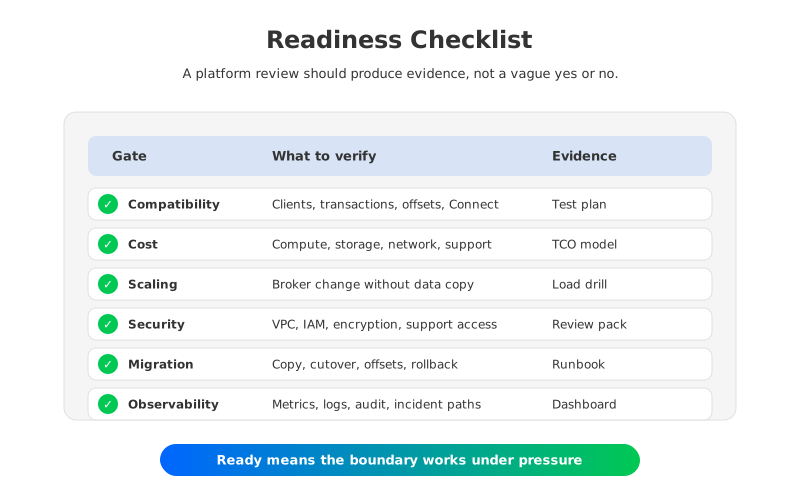
The checklist should produce evidence that an architecture review can use. It should not produce a vague score. Start with compatibility because a residency-safe Kafka platform that breaks client assumptions creates migration risk. Apache Kafka's documentation covers the semantics that application teams depend on: producers, consumers, offsets, transactions, Consumer groups, KRaft, Kafka Connect, and the broader client protocol. Those behaviors are part of the residency decision because they determine how much application change the migration requires.
Use the following questions as gates:
- Compatibility gate: Which Kafka client versions, producer settings, Consumer group behaviors, transactions, idempotent producers, ACLs, and Kafka Connect integrations must remain stable?
- Boundary gate: Where are records, WAL (Write-Ahead Log) data, retained logs, metadata, credentials, metrics, logs, and support artifacts stored?
- Network gate: Which paths use public endpoints, private endpoints, peering, PrivateLink-style connectivity, NAT, or cross-zone traffic?
- Governance gate: Who can approve access, rotate keys, inspect audit logs, change retention, reset offsets, and authorize support access?
- Scaling gate: What happens when throughput doubles, retention expands, a broker fails, or a zone becomes impaired?
- Migration gate: How are records copied, offsets preserved, producers switched, consumers validated, and rollback performed?
- Observability gate: Which metrics and logs prove that the system is healthy without exposing business records outside the approved boundary?
The migration gate is where many evaluations become real. It is not enough to say that the target is Kafka-compatible. The team has to test topic configuration, record ordering assumptions, offsets, consumer lag, schema behavior, authentication, authorization, and rollback timing. For critical streams, the runbook should include a live dual-read or validation phase so application owners can verify behavior before the final cutover.
5How AutoMQ changes the operating model
Once the evaluation framework is clear, the architecture requirement becomes sharper: keep Kafka-compatible behavior while reducing the amount of durable state tied to brokers. AutoMQ is a Kafka-compatible cloud-native streaming platform built around Shared Storage architecture. It keeps the Kafka protocol and ecosystem interface, while moving durable stream storage away from broker-local disks and into S3-compatible object storage.
That change is not cosmetic. In AutoMQ, brokers are stateless for durable data ownership. WAL storage provides the durable write buffer, and S3 storage is the main storage layer. Brokers handle Kafka protocol traffic, leadership, caching, and scheduling, but retained data is not owned by a single broker disk. When a broker is replaced or capacity changes, the operating problem shifts from copying large amounts of local data to moving ownership, metadata, and traffic.
For data residency architecture, that shift creates three practical effects. First, durable records can stay in customer-controlled object storage instead of being scattered across broker-local volumes. Second, scaling and recovery become less tied to data movement, which reduces the operational blast radius of capacity changes. Third, audit conversations can focus on cloud-account boundaries, bucket ownership, IAM, encryption, control-plane access, and observability paths rather than every broker disk lifecycle event.
AutoMQ BYOC is relevant when the approved boundary is the customer's cloud account and VPC. In this model, the control plane and data plane run inside the customer's environment, and customer business data stays on the customer's data path. AutoMQ Software is relevant when the approved boundary is a private environment or data center. These deployment models do not remove the need for security review; they make the review concrete. The team can map which services run where, which identities have access, where records are stored, and how operations are authorized.
Kafka Linking can also reduce migration risk for teams moving governed streams. A production migration should not ask every producer and consumer team to coordinate a fragile pause. It should preserve offsets, validate Consumer group progress, and keep a rollback path until the target has proven itself. The exact migration design still depends on the source cluster, client behavior, and governance requirements, but the platform should make those controls part of the runbook rather than an afterthought.
6A practical operating model scorecard
The scorecard below is useful because it forces teams to write down where responsibility sits. Give each row an owner, evidence, and test date. A blank cell is not a minor documentation problem; it means the team has not proven the boundary under production pressure.
| Review area | What good looks like |
|---|---|
| Residency boundary | Records, storage, metadata, and operational artifacts have named locations and owners. |
| Kafka behavior | Client compatibility, Consumer group behavior, offsets, transactions, and connector assumptions are tested. |
| Storage model | Retention growth does not force disruptive broker-local storage expansion. |
| Failure response | Broker loss, zone impairment, and rollback have practiced runbooks. |
| Access control | IAM, ACLs, key rotation, support access, and audit logs are reviewed together. |
| Cost model | Compute, storage, network, and operational effort are modeled separately. |
| Migration path | Copy, validation, switchover, and rollback are observable and rehearsed. |
This is where the opening search query should end. A team looking for data residency architecture kafka does not need another generic diagram with a Region box around Kafka. It needs an operating model that explains who owns each path, how the system behaves when it changes, and what evidence the team can show when the next audit, outage, or migration arrives. If your next step is to evaluate a customer-controlled Kafka-compatible architecture, start with the AutoMQ BYOC deployment guide or book a technical review with the AutoMQ team.
7FAQ
7.1Is data residency only about choosing the right cloud Region?
No. Region selection is necessary, but Kafka residency also includes retained records, metadata, credentials, metrics, logs, connector paths, support access, backup, replay, and migration behavior. A design that names the Region but cannot explain these paths is incomplete.
7.2Does BYOC automatically solve Kafka data residency?
BYOC can help because it places the runtime in the customer's cloud boundary, but it still needs review. Teams should inspect control-plane placement, data-plane placement, object storage ownership, IAM permissions, support access, telemetry, and incident procedures.
7.3Is Tiered Storage enough for a residency-driven Kafka architecture?
Tiered Storage can reduce pressure from long retention, but brokers still retain important local responsibilities. For teams trying to reduce broker-local data ownership, a Shared Storage architecture is a different operating model.
7.4What should be tested before migrating governed Kafka workloads?
Test client compatibility, authentication, authorization, topic configuration, offsets, Consumer group progress, transactions if used, connector behavior, observability, rollback, and the evidence required by security or compliance reviewers.


