
Table of Contents
Table of Contents
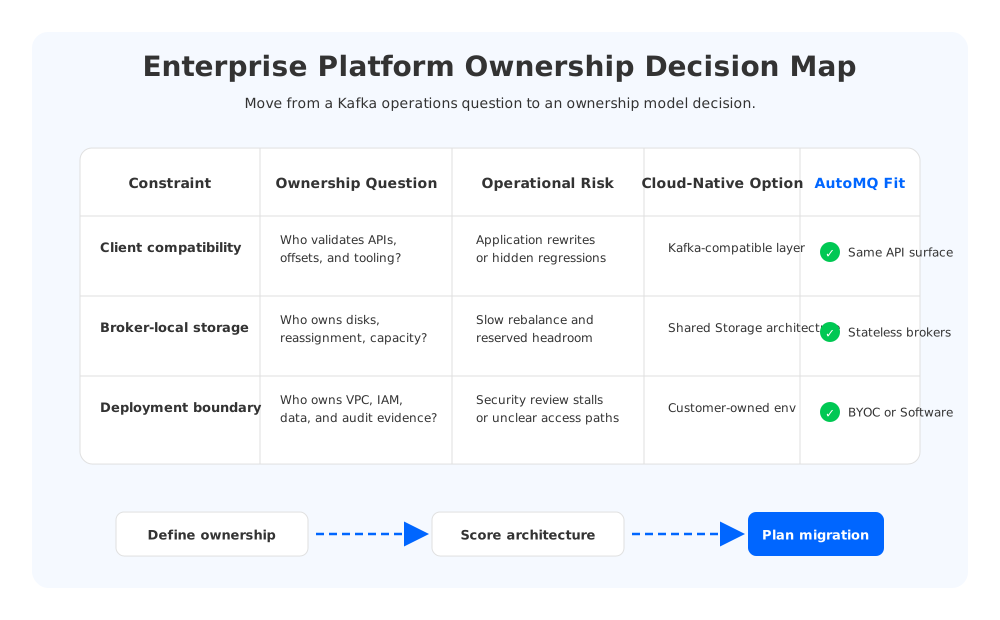
Teams rarely search for enterprise platform ownership kafka because they need another definition of Apache Kafka. They search it when the Kafka estate has crossed an organizational boundary. A small platform team may have started with a few shared clusters, but the same clusters later carry payments, observability, fraud detection, AI feature pipelines, customer activity streams, and operational analytics. At that point the hard question is not whether Kafka can move events. The hard question is who owns the platform contract when cost, security review, incident response, capacity, migration, and application compatibility all collide.
That ownership question is easy to underestimate because Kafka presents a familiar API surface. Producers write to Topics, Consumers read by Offset, Consumer groups distribute work across Partitions, and components such as Kafka Connect expect Kafka behavior to remain stable. The operating model behind that API is less stable: it may be self-managed, cloud-managed, vendor-managed, or customer-controlled, and it may use broker-local disks, Tiered Storage, or Shared Storage architecture.
The practical thesis is simple: enterprise Kafka ownership should be designed around operating boundaries before a team commits to a product boundary. If the architecture makes the wrong team own broker-local storage, cross-zone data movement, reserved capacity, or opaque migration risk, procurement approval will not fix the model. It will only lock in the confusion.
1Why teams search for enterprise platform ownership kafka
The search intent usually comes from one of three moments. The first is scale: a platform that was built for a few teams becomes a shared service with dozens of producers and consumers. The second is governance: security and compliance teams start asking where data, keys, logs, metrics, and administrative access live. The third is cost pressure: storage, compute, and inter-Availability Zone traffic no longer look like small line items. In each case, the team is not only buying Kafka capacity. It is deciding how much operational responsibility stays inside the enterprise.
The mistake is to treat this as a binary choice between "managed" and "self-managed." Managed operations can reduce patching and cluster maintenance, but they may also move data paths, support access, networking, procurement, and audit evidence into a vendor-operated boundary. Self-managed operations preserve control, but they can leave the internal platform team responsible for disk sizing, broker failures, rolling upgrades, Partition reassignment, and workload isolation. BYOC (Bring Your Own Cloud) and software deployment models sit between those poles. They can give enterprises more control over the environment while still changing the day-to-day operating burden.
An ownership design has to answer concrete questions, not slogans:
- Who owns the network path from Kafka clients to brokers and from brokers to storage?
- Who can see payload data, metadata, logs, metrics, and encryption configuration?
- Who approves scaling, upgrades, emergency access, and configuration changes?
- Who pays for storage, compute, inter-zone traffic, private connectivity, and marketplace or support charges?
- Who owns migration rollback if producers, Consumer groups, or stream processors behave differently after cutover?
2The production constraint behind the problem
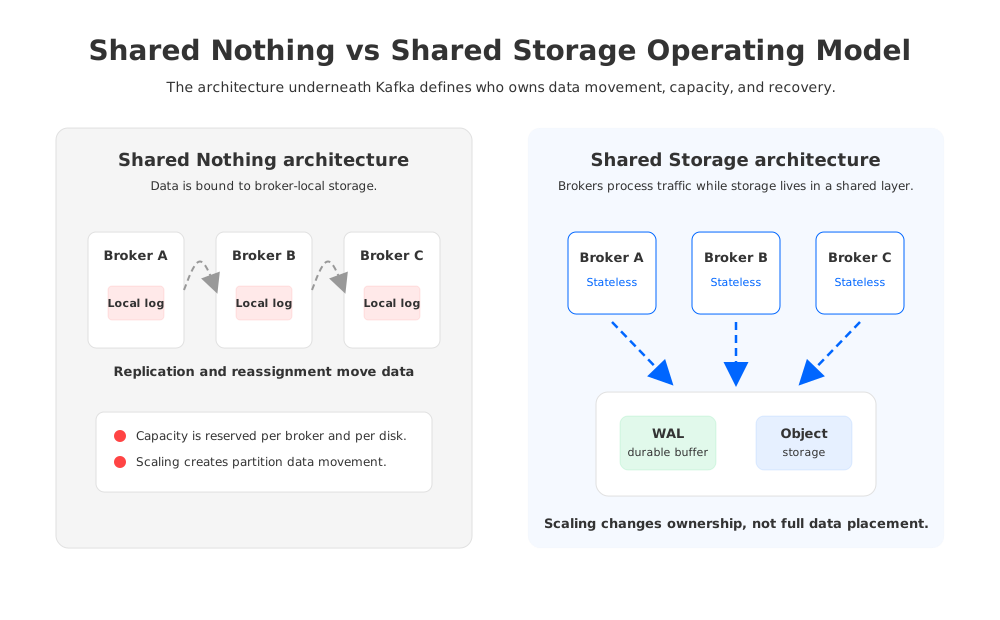
Traditional Kafka was designed as a Shared Nothing architecture. Each Broker owns local storage, and each Partition has replicas across Brokers for durability and availability. This model is well understood and powerful. It also makes the Broker a combined compute, storage, and recovery unit. When a Broker fills up, fails, or needs to be replaced, the platform has to reason about both traffic ownership and data placement.
That coupling turns into production work. Storage capacity is not a pool; it is spread across Brokers and tied to Partition placement. Scaling out does not merely add compute; it requires reassignment planning so hot Partitions and local data move to the new Brokers. Scaling in requires even more caution because data must leave the Brokers being removed. Retention growth, catch-up reads, and uneven Producer traffic can all create local pressure before the cluster has reached its aggregate limit.
In cloud environments, the same coupling also affects cost boundaries. A Kafka cluster with replicas across Availability Zones can generate inter-zone traffic as data is replicated or read across zones. Cloud providers publish separate pricing for data transfer, private connectivity, object storage, block storage, and request operations, so a production cost model needs to include more than Broker instance hours. The exact numbers vary by cloud, region, traffic path, and architecture, but the ownership pattern is stable: if the streaming platform creates network or storage movement, somebody has to own the budget and the runbook.
Enterprise platform ownership cannot start with a feature checklist. First decide whether operations depend on local disk ownership or whether compute and durable storage are separated enough to change the operating model.
3Architecture options and trade-offs
A neutral evaluation should compare operating models by responsibility, not by brand category. Four patterns show up frequently in enterprise reviews.
| Option | What the enterprise owns | What to inspect before approval |
|---|---|---|
| Self-managed Kafka on cloud infrastructure | Brokers, disks, networking, upgrades, security, observability, and incidents | Team capacity, disk operations, reassignment runbooks, cost visibility, and recovery drills |
| Managed Kafka service | Less day-to-day cluster work, but still owns application fit, data governance, networking, and vendor review | Data boundary, service limits, networking charges, migration path, and support model |
| Kafka with Tiered Storage | Broker operations plus a remote retention tier | Hot-tier sizing, cold-read behavior, failure recovery, object storage access, and cost model |
| Kafka-compatible BYOC or software deployment | Customer-controlled environment with vendor-assisted platform lifecycle, depending on product | Control plane and data plane boundary, IAM, VPC, upgrade model, observability, and rollback |
Compatibility is the first technical gate. Kafka is not only a wire protocol; it is an ecosystem contract. Consumer group coordination, committed Offsets, transactional Producer behavior, idempotence, Kafka Connect, Schema Registry, stream processors, monitoring tools, ACLs, and operational scripts all depend on details that application teams may not have documented. A platform review should inventory clients, versions, authentication modes, connectors, stream processors, admin APIs, and any tool that reads or writes cluster metadata.
Cost is the second gate, and it should be modeled by driver. Broker compute, local disks, object storage, request operations, cross-zone traffic, private connectivity, backups, observability, and platform labor do not scale the same way. A good cost model names each driver and explains who owns it.
Governance is the third gate. Enterprises need to know where records live, what logs and metrics contain, who can access operational systems, how encryption keys are controlled, and which account or VPC contains the data plane. The answer does not have to be the same for every organization, but it has to be explicit enough for security, legal, procurement, and platform teams to sign off without inventing assumptions.
Resilience is the fourth gate. Ask how the platform recovers from Broker failure, Availability Zone impairment, storage access problems, bad configuration, client retry storms, and overload caused by catch-up reads. Then ask who is paged. This is where an apparently simple managed-vs-self-managed decision becomes a real operating model design.
4Evaluation checklist for platform teams
The cleanest way to run the review is to score the platform on evidence, not preference. The following checklist works well when architecture, security, FinOps, and application stakeholders are in the same room.
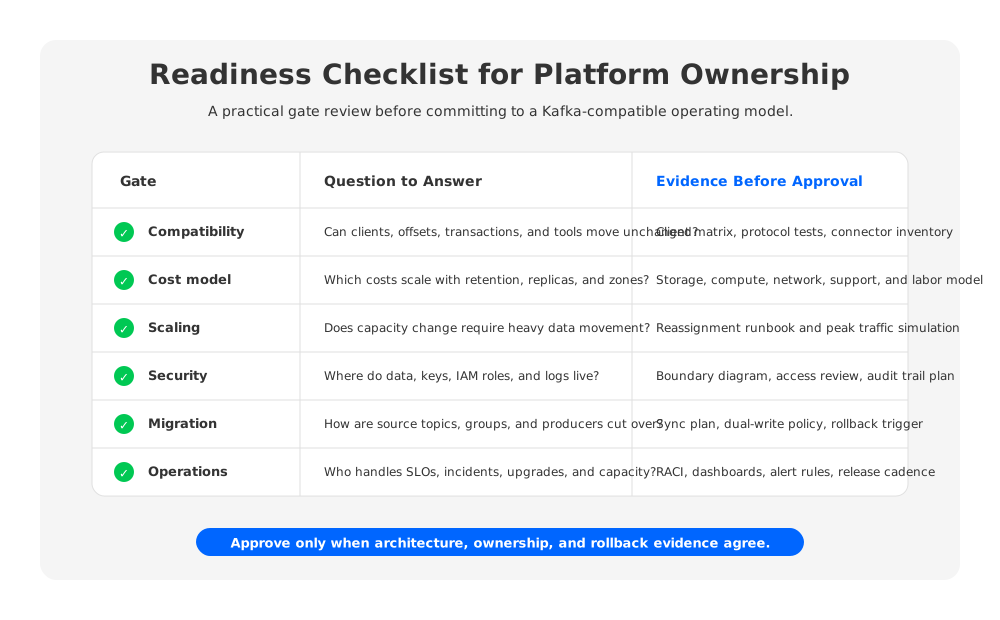
Start with the compatibility score. A "Kafka-compatible" claim is useful only when it is mapped to the workloads that matter: client libraries, Producer settings, Consumer group behavior, transactions, Kafka Connect connectors, monitoring integrations, and admin automation. If the migration requires application rewrites, the ownership model shifts from the platform team to every application team. That may still be acceptable, but it is a different program.
Then score the storage and scaling model. The review should ask whether adding capacity changes only compute placement or whether it also creates a data movement backlog. It should ask whether retention growth consumes expensive local disks, object storage, or both. It should ask whether a failed Broker is replaced like a compute node or restored like a storage node. These distinctions decide whether the platform can behave like cloud infrastructure or like a stateful fleet that must be hand-managed.
Next, score deployment boundaries. For regulated, security-sensitive, or data-residency-sensitive workloads, the most useful diagram is not a product architecture diagram. It is a boundary diagram that shows accounts, VPCs, subnets, IAM roles, storage buckets, key management, control operations, data paths, logs, metrics, and support access. If a team cannot draw that diagram, it is not ready to approve ownership.
Finally, score migration and rollback. The readiness plan should name source Topics, Consumer groups, starting positions, producer cutover mechanics, DNS or bootstrap changes, dual-write policy, validation metrics, and rollback triggers. Many streaming migrations fail not because the target cluster cannot receive data, but because the team cannot prove where every Consumer should resume and what happens if producers must move back.
5How AutoMQ changes the operating model
This is where AutoMQ becomes relevant as an architecture choice rather than an opening pitch. AutoMQ is a Kafka-compatible streaming platform that keeps the Kafka API and ecosystem contract while replacing Kafka's broker-local storage model with a Shared Storage architecture. Brokers process Kafka traffic, but durable data is written through S3Stream into WAL storage and S3-compatible object storage. That separation changes what the platform team has to own.
In a Shared Storage architecture, Brokers are no longer the long-term home of Partition data. WAL storage acts as the durable write buffer for low-latency acknowledgement and recovery, while object storage is the primary durable storage layer. The practical result is that scaling and failure recovery are less tied to bulk data relocation. A Broker can be treated more like replaceable compute because the durable stream is not trapped on that Broker's local disk.
That architectural shift matters for enterprise ownership in three ways. First, capacity planning moves closer to separate compute and storage dimensions. Platform teams can reason about throughput, cache, WAL type, and object storage retention without treating every Broker as a fixed storage island. Second, operational workflows such as Partition reassignment and Self-Balancing can focus on ownership and traffic distribution instead of large local-data movement. Third, cloud cost review becomes more transparent because the architecture is designed around object storage and avoids traditional cross-AZ replication paths in supported deployment patterns.
AutoMQ BYOC is relevant when the enterprise wants the service to run inside its own cloud boundary. In that model, the customer-controlled environment defines where the control plane, data plane, network, IAM, storage, metrics, and operational access live. This can simplify security review because the business data path stays inside the customer environment, while the platform still gets a managed lifecycle surface through AutoMQ tooling. AutoMQ Software serves a similar ownership need for private data centers or environments that cannot rely on a public-cloud managed service boundary.
Due diligence still matters: teams must choose a WAL type, validate clients, test failure modes, review IAM, model charges, and build observability. The difference is that the architecture gives platform owners cloud-native levers: stateless Brokers, object-storage-backed durability, customer-controlled deployment boundaries, and Kafka compatibility in the same decision frame.
6A practical ownership scorecard
Use the following scorecard before selecting a platform or approving a migration. Give each line a score from one to five, where one means "unclear or untested" and five means "documented, tested, and owned."
| Area | Scoring question | Approval evidence |
|---|---|---|
| Compatibility | Can existing clients, tools, and stream processors run without behavior changes? | Client inventory, integration tests, admin API checks, and connector validation |
| Cost | Are compute, storage, network, private connectivity, and labor modeled separately? | Workload-based TCO model with cloud pricing assumptions and sensitivity analysis |
| Governance | Are data, metadata, logs, metrics, keys, and access paths mapped? | Boundary diagram, IAM review, encryption plan, and audit evidence |
| Elasticity | Can the platform change capacity without turning every change into a data relocation project? | Scaling test, reassignment timing, and failure recovery drill |
| Migration | Can producers and Consumer groups move with clear validation and rollback? | Cutover runbook, sync metrics, rollback triggers, and ownership assignments |
| Operations | Does the team know who handles incidents, upgrades, SLOs, and capacity exceptions? | RACI, dashboard, alert rules, release cadence, and escalation path |
A scorecard forces the conversation back to evidence. It also prevents a common procurement trap: choosing the platform with the most attractive management story while leaving the enterprise with unclear data ownership, unclear rollback, or unclear cost drivers.
7FAQ
7.1What does enterprise platform ownership mean for Kafka?
It means the organization has explicitly assigned responsibility for Kafka compatibility, storage, scaling, security boundaries, cost drivers, migration, observability, upgrades, and incidents. It is broader than broker administration because Kafka sits between application teams, data platforms, cloud infrastructure, and governance teams.
7.2Is BYOC Kafka the same as self-managed Kafka?
No. Self-managed Kafka usually means the enterprise operates the full stack directly. BYOC Kafka means the deployment runs in the customer's cloud environment, but the product may still provide lifecycle automation, console workflows, support processes, and managed operational tooling. The exact responsibility split depends on the product and contract, so it should be reviewed explicitly.
7.3Why does storage architecture affect ownership?
Storage architecture decides whether Brokers are stateful storage owners or mostly replaceable compute nodes. Broker-local storage makes capacity, failure recovery, and Partition movement part of daily operations. Shared Storage architecture moves durable data into a common storage layer, which can reduce the amount of data movement tied to scaling and recovery.
7.4What is the first step in an ownership review?
Draw the boundary diagram before comparing products. Include clients, Brokers, control operations, object or block storage, keys, IAM roles, logs, metrics, support access, and network paths. Once the boundary is clear, the team can score compatibility, cost, resilience, migration, and operations with fewer assumptions.
If your team is reviewing Kafka ownership because the platform has outgrown its original operating model, start with architecture evidence rather than vendor category labels. AutoMQ can help you evaluate a Kafka-compatible, customer-controlled, Shared Storage architecture for that review: talk to AutoMQ.


