
Table of Contents
Table of Contents
Teams do not search for secure connector operations kafka because they forgot how Kafka Connect works. They search because connector work has crossed a line from integration convenience into production control. A connector can read from a payment database, write to a warehouse, reshape fields, carry secrets, update offsets, and keep retrying after an external system slows down. Once that connector is part of a regulated data path, the platform question is no longer "can it run?" The better question is who can prove what it did, where it ran, what it touched, and how it can be rolled back.
Kafka Connect is often introduced as the framework for streaming data between Apache Kafka and external systems. That description is accurate, but too small for security and governance reviews. In production, a connector is a stateful operating unit with workers, tasks, offsets, converters, transforms, internal topics, credentials, network paths, and observability requirements.
The operating model has to make those boundaries visible before the first audit. Secure connector operations decide where workers run, how schemas and data contracts are enforced, how Kafka capacity is protected, how recovery is tested, and how much trust the organization places in a managed service versus a customer-controlled runtime.
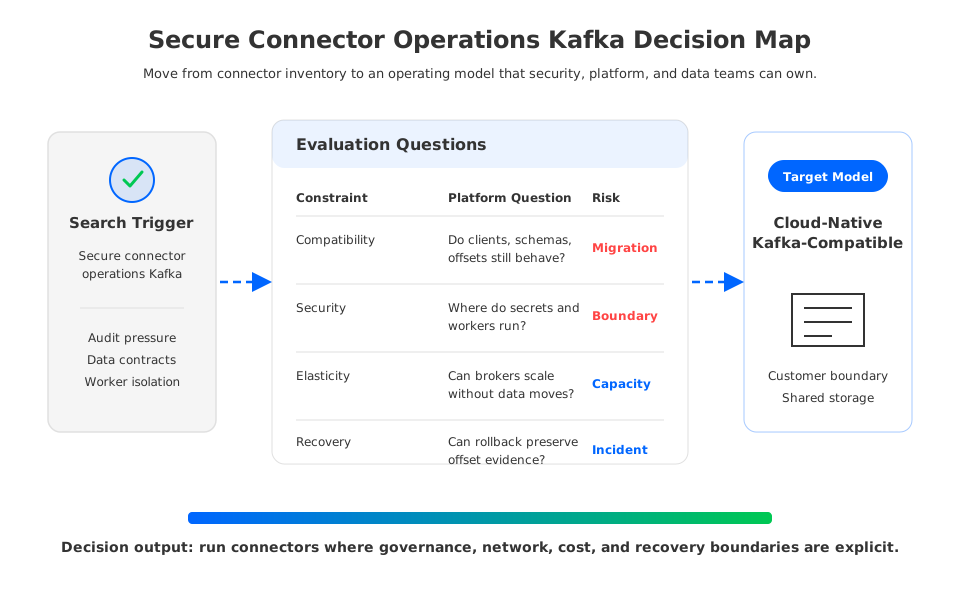
1Why Teams Search for secure connector operations kafka
The search usually begins after a connector estate becomes hard to reason about. One team adds change data capture from a database. Another adds a sink to a lakehouse. A third routes operational events into a search index. Each pipeline looks reasonable on its own, but the shared platform starts carrying sensitive records, operational telemetry, schema versions, and retry traffic.
Security teams then ask questions that Kafka platform teams cannot answer with broker metrics alone:
- Where does the connector runtime execute? A connector running inside a customer VPC (Virtual Private Cloud) has a different risk profile from one running in a provider-operated network, especially when it needs private access to databases, object storage, or internal services.
- Which identity does it use? Connector tasks often need Kafka ACLs, cloud IAM roles, database credentials, and sink-system tokens. Each credential should map to the smallest practical scope.
- What is the evidence trail? Operators need to connect task status, offset movement, schema changes, retries, dead-letter records, and downstream writes into a reviewable timeline.
- What happens when it is wrong? A bad transform or schema mismatch can spread malformed events faster than a human can approve a rollback.
These are not only connector questions. They expose whether the streaming platform underneath can absorb connector pressure without turning every security decision into a capacity or migration project. Kafka Connect supplies the integration framework; the organization still needs a control model for compatibility, cost, elasticity, governance, recovery, migration risk, and ownership.
2The Production Constraint Behind the Problem
Traditional Kafka deployments use a Shared Nothing architecture. Each broker owns local log storage, and partitions are tied to broker-local disks. This gives teams direct control over broker placement and storage configuration, but operational change often involves data movement: partition reassignment, broker replacement, disk expansion, retention changes, and recovery all interact with where the log physically lives.
Connector-heavy workloads make that coupling more visible. A source connector can create a write surge after a database snapshot. A sink connector can fall behind and force longer retention. A replay after a failed transform can turn old data into active read traffic. A migration may require both incumbent and replacement connector paths to run at the same time while offsets and schemas remain auditable. In each case, the connector team asks for flexibility, but the broker team must pay the operational cost.
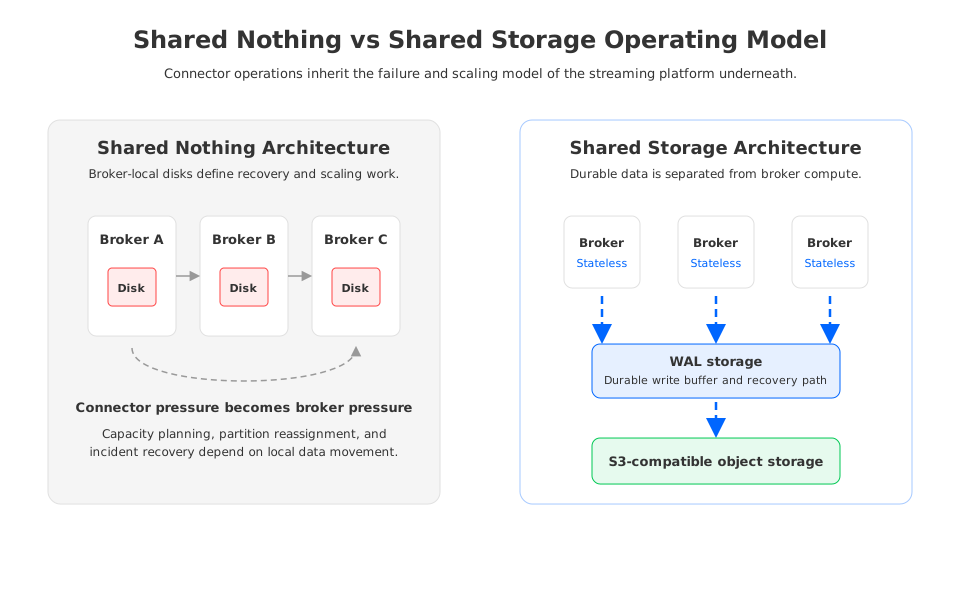
The security angle sharpens the constraint. If every connector needs network isolation, dedicated workers, narrow IAM roles, separate metrics, and tested rollback, the platform needs a repeatable way to say: this connector can run here, with this identity, against these topics, inside this network boundary, with this recovery path.
That does not make Shared Nothing architecture wrong. It makes the trade-off explicit. Broker-local storage gives operators a familiar mental model, but it also keeps storage, compute, and recovery tightly coupled as connector count, replay frequency, and compliance scope grow.
3Architecture Options and Trade-Offs
A neutral evaluation should compare operating models before comparing product names. The right answer depends on how much Kafka expertise the team has, how sensitive the data is, how much control the security team requires, and whether connector growth is predictable or bursty.
| Operating model | Where it fits | Main security question | Operational trade-off |
|---|---|---|---|
| Self-managed Kafka Connect on self-managed Kafka | Teams with strong Kafka and Kubernetes operations | Can the team govern workers, plugins, ACLs, secrets, and offset topics consistently? | Maximum control, but broker storage, scaling, and Connect operations remain internal work. |
| Managed connector service on a managed Kafka platform | Teams that want less worker management | Does the provider runtime match the required network, identity, plugin, and audit boundaries? | Worker operations move out of the team, but service limits and pricing units need review. |
| Customer-controlled managed Connect in BYOC | Teams that want management convenience inside their own cloud boundary | Can the runtime stay in the customer VPC while preserving managed lifecycle controls? | Stronger data residency and network control, with cloud resource preparation still required. |
| Kafka-compatible platform with separated storage and compute | Teams whose connector growth stresses broker-local storage | Can Kafka compatibility be preserved while broker scaling and storage pressure are decoupled? | Changes the platform architecture underneath Connect, so workload validation matters. |
The table is not a ranking. Self-managed Connect fits mature platform teams with strict custom plugin needs. Managed services fit teams that want less worker lifecycle work. BYOC fits when the security boundary matters as much as management convenience. A Kafka-compatible shared-storage platform becomes relevant when connector operations are limited by broker architecture, not by the connector framework itself.
The mistake is choosing on connector catalog alone. A broad catalog does not answer where data flows, how credentials are scoped, what happens during replay, or whether offset state can be inspected during rollback.
4Evaluation Checklist for Platform Teams
A useful checklist should be written as questions the accountable teams can answer, not as generic control names. The goal is to turn "we support Kafka Connect" into a release gate security, data governance, and platform engineering can sign off.
Start with compatibility. Which producer and consumer client versions are in use? Are any workloads using idempotent producers, transactions, compacted topics, Schema Registry-compatible tooling, or Kafka Streams state? Kafka compatibility means little if a migration preserves produce and fetch behavior but breaks assumptions around offsets, schemas, or connector restarts.
Then inspect the security boundary. Where do workers run? Which Kubernetes namespace, service account, IAM role, and network route does each connector use? How are plugin artifacts reviewed before deployment? Runtime isolation reduces the blast radius of secrets, data access, dependency bugs, and operational mistakes.
Governance comes next because connectors are where data contracts meet messy external systems. The platform should define who owns source schemas, who approves transforms, which fields may leave a domain, and how incompatible changes are blocked or quarantined. A schema registry can enforce format compatibility, but policy belongs in the operating model.
Cost and elasticity deserve the same treatment as security. A connector's visible runtime cost may be smaller than the storage, replay, and network cost it creates. Capacity planning should include worker CPU and memory, Kafka broker throughput, retained history for recovery, object storage or disk growth, cross-zone traffic, and downstream API limits. When a connector falls behind, the cost moves around the system rather than disappearing.
Finally, require a recovery story. Every production connector should have a tested answer for pausing, restarting, replaying, skipping poison records, rotating credentials, restoring plugin versions, and rolling back a bad deployment. The key artifact is a runbook another engineer can execute without guessing which offset or schema version is the source of truth.
5How AutoMQ Changes the Operating Model
After the neutral evaluation is complete, AutoMQ becomes relevant as a Kafka-compatible streaming platform with a Shared Storage architecture. It keeps the Kafka protocol and ecosystem surface, including Kafka Connect-oriented workloads, while moving durable log storage away from broker-local disks and into S3-compatible object storage through S3Stream.
That architectural shift matters for connector operations because it changes what platform teams have to coordinate. If brokers are not the long-term home of durable log data, scaling broker compute does not have to mean moving large amounts of partition data between local disks. A connector spike is still a workload event that needs quotas, monitoring, and capacity policy, but it is less likely to turn immediately into a broker-local storage project.
AutoMQ BYOC is also relevant to the security boundary. AutoMQ documentation describes managed Kafka Connect for BYOC environments where Connect Workers run in the user's EKS cluster inside the specified VPC. That model combines managed connector lifecycle controls with customer-owned network placement, cloud IAM design, and access to private resources. Connector tasks still need ACLs, service accounts, IAM roles, plugin review, and metrics export, but the runtime boundary is easier to review.
AutoMQ Software fits a different boundary: private data centers or controlled infrastructure where the customer operates the environment and AutoMQ provides the Kafka-compatible software layer. For governance teams, the important distinction is not a product label. It is where the control plane, data plane, connector runtime, object storage, credentials, logs, and metrics live.
The architecture does not remove the need for connector discipline. Teams still need schema ownership, data contract review, offset management, plugin vulnerability review, and incident runbooks. AutoMQ's contribution is underneath that work: Kafka compatibility, Shared Storage architecture, stateless brokers, and deployment models that can keep data and connector execution inside customer-controlled boundaries.
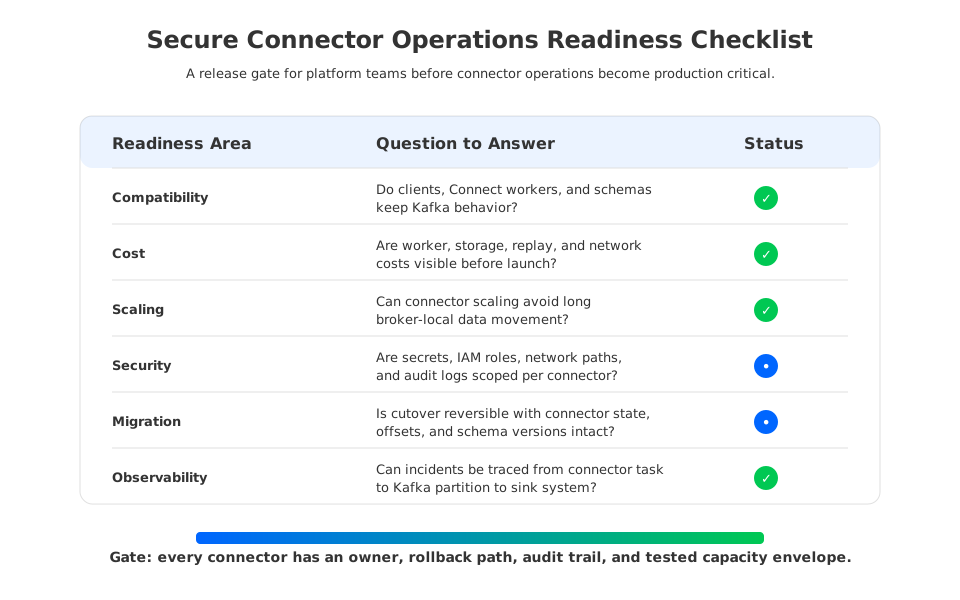
6A Practical Readiness Scorecard
Before approving a connector platform, score the model from 1 to 3 on seven dimensions: 1 means unclear, 2 means partially defined, and 3 means tested in production-like conditions.
| Dimension | Score 1 | Score 2 | Score 3 |
|---|---|---|---|
| Compatibility | Kafka behavior assumed | Key clients and connectors tested | Clients, offsets, schemas, and rollback tested together |
| Security boundary | Shared runtime and broad credentials | Scoped credentials, mixed isolation | Per-connector identity, network path, and worker isolation |
| Governance | Schema checks only | Schema plus manual review | Data contracts, ownership, audit trail, and exception workflow |
| Cost | Worker cost only | Worker plus broker cost | Worker, broker, storage, replay, network, and incident cost |
| Elasticity | Manual capacity changes | Some autoscaling | Tested scale events without long data movement |
| Recovery | Restart documented | Replay path documented | Pause, replay, skip, rollback, and credential rotation rehearsed |
| Observability | Connector status visible | Metrics and logs collected | End-to-end trace from source to Kafka to sink |
The score is not a universal pass mark. It exposes where the operating model is still based on trust. A regulated payment connector with low scores on identity and rollback should not launch because the broker cluster has spare capacity. A low-risk analytics sink may tolerate a smaller control surface if replay is harmless.
Return to the original search phrase. secure connector operations kafka is not a request for a single configuration flag. It is a sign that Kafka has become part of the organization's control plane for data movement. If your connectors are already carrying regulated data, crossing private networks, and driving downstream decisions, evaluate the platform beneath them with the same rigor as the connectors themselves.
For teams that want to keep Kafka compatibility while changing the broker storage and scaling model underneath connector workloads, start with the AutoMQ home path. Use the readiness scorecard as the first conversation, not the last-minute review.
7FAQ
7.1Is Kafka Connect itself enough for secure connector operations?
No. Kafka Connect provides the framework for running connectors, tasks, workers, converters, transforms, and offsets. Secure operations also require identity design, network placement, plugin review, data contracts, observability, recovery plans, and clear team ownership.
7.2Does a managed connector service remove the need for Kafka platform planning?
No. A managed service may reduce worker lifecycle work, but connector behavior still affects Kafka throughput, retention, replay, schema governance, network paths, and downstream systems. The platform team still needs to understand the end-to-end operating model.
7.3Why does Shared Storage architecture matter for connector workloads?
Connector workloads often create bursts, replays, and long retention requirements. Shared Storage architecture separates broker compute from durable log storage, which can reduce the amount of broker-local data movement required when capacity changes.
7.4Can AutoMQ run Kafka Connect workloads?
AutoMQ is Kafka-compatible and is designed to work with the Kafka ecosystem. AutoMQ BYOC also documents a managed Kafka Connect service where Connect Workers run in the user's EKS cluster inside the specified VPC. Teams should still validate their connector plugins, schemas, ACLs, and recovery paths before production cutover.
7.5What should be tested before migrating connector workloads?
Test producer and consumer behavior, connector task restart behavior, offset continuity, schema compatibility, ACLs, plugin versions, private network access, replay speed, dead-letter handling, metrics export, and rollback. The test should include both normal flow and failure paths.
8References
- Apache Kafka documentation, Kafka Connect
- Apache Kafka documentation, Consumer groups and offsets
- AutoMQ documentation, Architecture overview
- AutoMQ documentation, Compatibility with Apache Kafka
- AutoMQ documentation, Managed Kafka Connect overview
- AutoMQ documentation, Manage connectors
- AWS documentation, IAM roles for service accounts


