
Table of Contents
Table of Contents
Teams usually search for streaming privacy by design kafka after Kafka has crossed a boundary it was never meant to cross quietly. A topic that started as an application log becomes a source for fraud detection, customer analytics, machine learning features, and audit evidence. The data still moves as records and offsets, but the questions around it change: who can produce it, who can read it, where it is stored, how long it lives, and how the platform proves those answers during an audit.
Privacy by design in a Kafka environment is not a banner over encryption and access control. It is an operating model. The hard part is keeping privacy rules attached to data while producers, consumers, partitions, connectors, schemas, and infrastructure all change under production pressure. A platform team cannot answer that with a single policy document, because every scaling event, broker replacement, connector deployment, and migration can shift the control boundary.
The practical test is this: privacy-by-design streaming depends less on a single feature checklist and more on whether the streaming platform makes the privacy boundary straightforward to operate. A good review should survive the events that usually create exceptions, including urgent capacity expansion, consumer lag recovery, broker replacement, connector rollout, and a failed migration window.
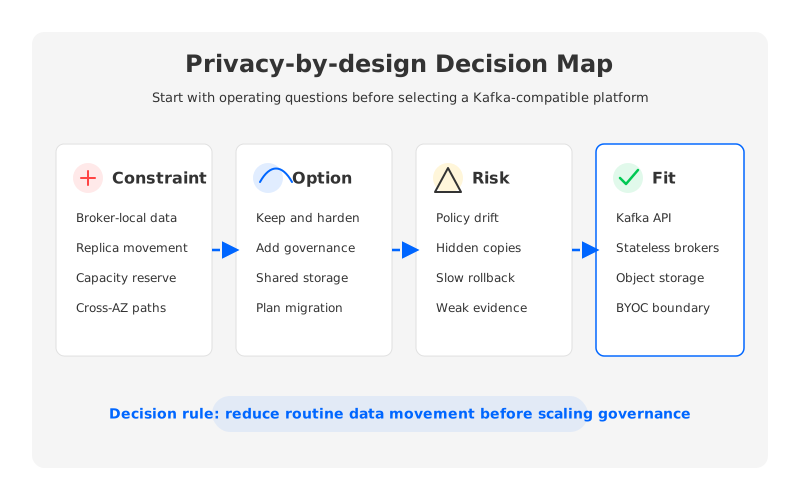
1Why Teams Search for streaming privacy by design kafka
The search intent is practical. A security lead wants to know whether Kafka topics can carry personal data without creating unmanaged copies. A data governance team wants schema changes to be reviewed before downstream systems break or ingest fields they should not see. A Kafka platform owner wants to keep consumer groups, offsets, and connectors stable while moving workloads to a more controlled deployment model.
Those questions usually arrive together because streaming data is copied by design. A producer writes a record once, then multiple consumers read it at different speeds. Kafka tracks progress through offsets, and a consumer group divides partitions across members so processing can scale and recover. That model is powerful, but it also means privacy controls must account for replay, fan-out, retention, dead-letter topics, and connector sinks.
For governance teams, the problem is not that Kafka lacks security primitives. Kafka supports authentication, authorization, encryption, quotas, transactions, and client-side schema patterns through the ecosystem. The deeper issue is operational drift. When storage is local to brokers, capacity, recovery, and data placement decisions become part of the privacy story. A privacy review that ignores broker-local data movement is reviewing only the API surface.
2The Production Constraint Behind the Problem
Traditional Kafka follows a Shared Nothing architecture. Each broker owns local storage, and partitions are replicated across brokers for durability and availability. This design fit the data center era, where disks were attached to servers and replication was the system's responsibility. In the cloud, the same model turns infrastructure operations into data operations.
A privacy-by-design review has to care about that distinction. If adding capacity requires partition reassignment, the platform may move large amounts of data between brokers. If brokers span Availability Zones, replication and client routing can create cross-AZ traffic. If retention grows, the team may add disks or change storage tiers. None of these actions changes the Kafka API, but each one can affect where sensitive data resides, which network paths it crosses, and how quickly the team can isolate a fault.
Kafka's local-storage model also shapes the cost of being conservative. Teams often over-provision brokers because running out of disk is worse than paying for idle capacity. They avoid frequent rebalancing because data movement can take time. They postpone migrations because preserving offsets, consumer progress, and rollback options is difficult. Privacy programs notice this as slow control change: the policy can be written in a day, but the platform change behind it takes weeks.
That is why the operating model matters. A privacy control that requires heroic coordination during every scaling event will decay. A control that aligns with normal platform operations has a better chance of surviving production.
3Architecture Options and Trade-offs
There are three common ways to make Kafka friendlier to privacy-by-design operations. None is universally right. The correct choice depends on how much change the team can accept, how much Kafka compatibility it needs, and where the data boundary must sit.
| Option | What it improves | What still needs scrutiny |
|---|---|---|
| Harden the existing Kafka estate | Keeps current clients, topics, ACL patterns, and operational knowledge. This is often the lowest-risk first step for access review and encryption cleanup. | Broker-local storage, data movement during reassignments, over-provisioned capacity, and connector sprawl still belong to the operating model. |
| Add governance around Kafka | Schema review, data contracts, cataloging, lineage, and connector approval can make data use more explicit. | Governance tools do not remove the need to operate storage, scaling, recovery, and migration safely. |
| Move to Kafka-compatible shared storage | Keeps Kafka protocol semantics while changing how data is stored and how brokers scale. | The team must validate compatibility, WAL storage type, cloud boundaries, migration method, observability, and rollback. |
The important point is sequencing. Start with the neutral questions before choosing the platform. If a team starts with a vendor feature list, it will miss the harder operating questions that decide whether privacy controls hold during production change.
3.1The Evaluation Checklist for Platform Teams
A useful privacy-by-design review should force concrete answers. The following checklist is intentionally operational rather than legal. It helps security, data governance, and Kafka platform teams speak about the same system.
- Compatibility: Which Kafka client versions, producer semantics, consumer group behavior, transactions, compaction, Kafka Connect jobs, and Schema Registry patterns must keep working? A platform that breaks client behavior creates migration risk before governance even starts.
- Data boundary: Where do records, WAL data, object data, logs, metrics, schemas, connector configs, and audit events reside? The answer should distinguish business data from operational telemetry.
- Network path: Which paths can cross Availability Zones, VPC boundaries, private endpoints, or public internet egress? Private connectivity still has cost and routing implications, so it belongs in the platform design.
- Scaling behavior: What happens when brokers are added, removed, replaced, or isolated? If scaling means moving local partition data, privacy operations inherit a data relocation workflow.
- Governance workflow: How are schemas reviewed, how are data contracts enforced, and how are connector sinks approved? Topic-level ACLs are not enough when sensitive fields can appear inside a value payload.
- Migration and rollback: Can the team preserve offsets, keep consumers consistent, and return traffic to the source if validation fails? Privacy-by-design plans need a failed-change path, not only a target architecture.
- Observability and audit: Which events prove that access, configuration, scaling, schema changes, and connector changes followed policy? Metrics without audit context help operations, but they do not satisfy governance on their own.
This is also where cost becomes a privacy topic. Idle disks, cross-AZ replication, and oversized brokers are not only finance concerns. They slow down architectural change, and slow change is where exceptions accumulate.
4Shared Nothing vs Shared Storage Operating Model
The largest architectural fork is whether Kafka storage remains broker-local. Tiered Storage can move historical segments to object storage, which helps retention economics, but the primary write path and broker-local responsibility remain central to the operating model. A Shared Storage architecture changes the premise: persistent data is stored in shared object storage, while brokers handle Kafka protocol work, leadership, caching, and scheduling.
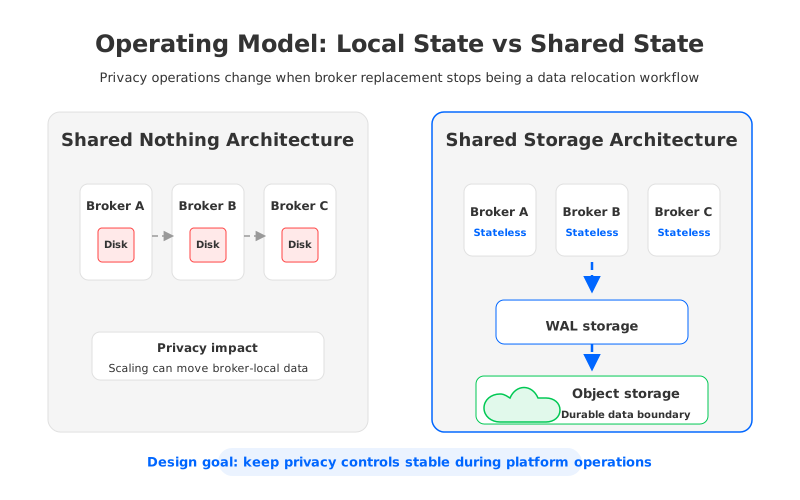
That distinction matters for privacy because the platform no longer treats broker replacement as a data relocation event. Brokers can be more stateless, and the system can shift ownership or leadership without copying the full partition history between local disks. Object storage becomes the durable data boundary, and WAL storage provides the write path needed for low-latency acknowledgement and recovery.
This architecture does not remove privacy work. Teams still need authentication, authorization, encryption, schema governance, connector approval, retention policy, and audit review. It changes where those controls attach. Instead of pairing every control with broker-local disk management, the team can reason about a smaller set of durable storage boundaries, network paths, and compute nodes.
5How AutoMQ Changes the Operating Model
After the neutral evaluation, AutoMQ is one answer in the Kafka-compatible shared-storage category. AutoMQ keeps Kafka protocol compatibility while replacing Kafka's local log storage with a Shared Storage architecture built on S3-compatible object storage. AutoMQ Brokers are stateless brokers, and persistent data is stored through S3Stream, WAL storage, and object storage rather than being bound to broker-local disks.
The practical effect is that platform operations become less data-movement-heavy. Partition reassignment, broker replacement, Self-Balancing, and scaling can operate around metadata, leadership, traffic, and cache rather than copying full local histories between brokers. For a privacy-by-design operating model, that reduces the number of routine events that look like data relocation events.
Deployment boundary is the other reason AutoMQ belongs in this discussion. AutoMQ BYOC runs the control plane and data plane in the customer's cloud account and VPC, while AutoMQ Software is designed for customer-managed private environments. That distinction matters for governance reviews because teams can separate business data paths from management paths and keep Kafka records inside customer-controlled infrastructure.
The platform still has to be evaluated like any critical data system. Review the WAL type, object storage configuration, VPC endpoints, IAM permissions, encryption model, audit integrations, Schema Registry process, connector deployment workflow, and migration plan. The benefit is not that privacy becomes automatic. The benefit is that the architecture gives platform teams a cleaner operating model to review.
6Readiness Scorecard
Use this scorecard before a migration proposal reaches a steering committee. A "no" answer is not a blocker by itself. It is a signal that the team has found work that should be planned rather than discovered during cutover.
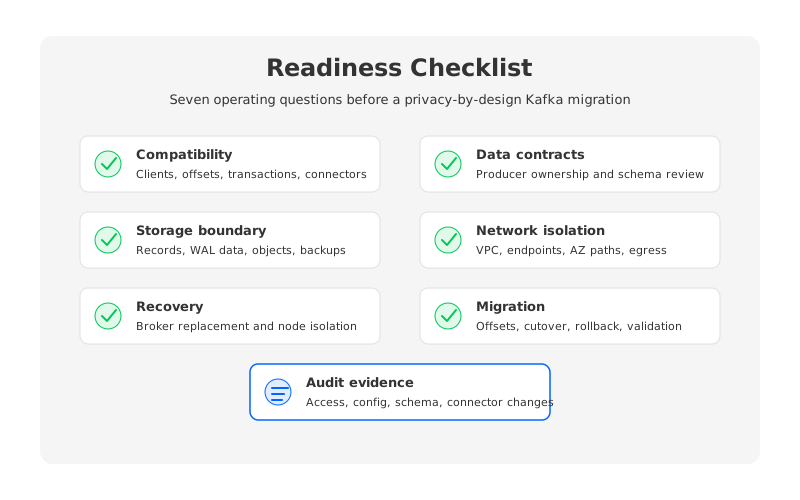
| Area | Question | Ready signal |
|---|---|---|
| Compatibility | Have critical producers, consumers, transactions, compaction patterns, connectors, and admin tools been tested? | Test results map to real applications, not only sample clients. |
| Data contracts | Are sensitive fields classified before they enter shared topics? | Schema review and producer ownership are part of release flow. |
| Storage boundary | Can the team name where records, WAL data, object data, and backups live? | Business data stays inside the approved account, region, and storage boundary. |
| Network isolation | Are client, broker, object storage, connector, and management paths documented? | Private routing and endpoint costs are understood before launch. |
| Recovery | Can the team replace brokers, isolate bad nodes, and restore service without ad hoc data copying? | Recovery procedures are tested under realistic load. |
| Migration | Are offsets, lag, producer cutover, rollback, and validation covered? | A failed migration has a rehearsed return path. |
| Audit | Can access, schema, connector, scaling, and configuration changes be reconstructed? | Evidence can be produced without scraping chat logs or tribal memory. |
The scorecard is deliberately plain. Privacy failures in streaming systems rarely begin with a dramatic breach. They usually begin with a small exception that becomes a workflow, then a workflow that no one can explain six months later.
7FAQ
7.1Is privacy by design possible with Apache Kafka?
Yes, but it requires more than ACLs and TLS. Kafka privacy by design needs topic ownership, schema governance, field classification, connector approval, retention policy, audit evidence, and a clear storage and network boundary. The more the platform depends on broker-local data movement, the more those controls must account for operational events.
7.2Do data contracts replace schema governance?
No. Data contracts make expectations explicit between producers and consumers. Schema governance gives teams a review and enforcement process. In streaming systems that carry sensitive data, the two should work together: contracts describe allowed fields and semantics, while schema workflows prevent unreviewed changes from entering shared topics.
7.3Is Tiered Storage the same as Shared Storage architecture?
No. Tiered Storage moves older Kafka log segments to object storage, while the primary write path still depends on broker-local storage. Shared Storage architecture moves the durable storage responsibility out of broker-local disks, which changes scaling, recovery, reassignment, and data placement operations.
7.4Where should AutoMQ enter a privacy-by-design evaluation?
AutoMQ should enter after the team has defined compatibility, data boundary, network, governance, scaling, recovery, migration, and audit requirements. It is a Kafka-compatible shared-storage option, not a substitute for governance work. Its value is strongest when broker-local storage and data movement are making privacy operations harder than they need to be.
8Closing Thought
The original search, streaming privacy by design kafka, sounds like a policy question. In production it becomes an operating question: can the platform keep privacy boundaries understandable while the system scales, fails, migrates, and evolves? Start with that question, then choose the architecture that makes the answer easier to prove.
If you want to evaluate a Kafka-compatible shared-storage architecture inside your own cloud boundary, start with AutoMQ BYOC and test the checklist against a real workload.


