
Table of Contents
Table of Contents
A search for zero trust kafka networking usually starts after the network diagram has become an audit artifact. Security wants every path named. Platform engineering wants Kafka clients to keep working. Compliance wants data residency, encryption, identity, and evidence. The Kafka team wants to avoid turning every topic, connector, and Consumer group into a custom exception.
The hard part is that Kafka is not a single endpoint. It is a protocol surface, storage system, metadata system, and client ecosystem. Zero trust networking asks whether each moving part has a clear boundary, identity, failure mode, and owner.
The operating-model question is direct: can your Kafka-compatible streaming platform preserve Kafka behavior while making network, storage, and governance boundaries explicit enough for production control?
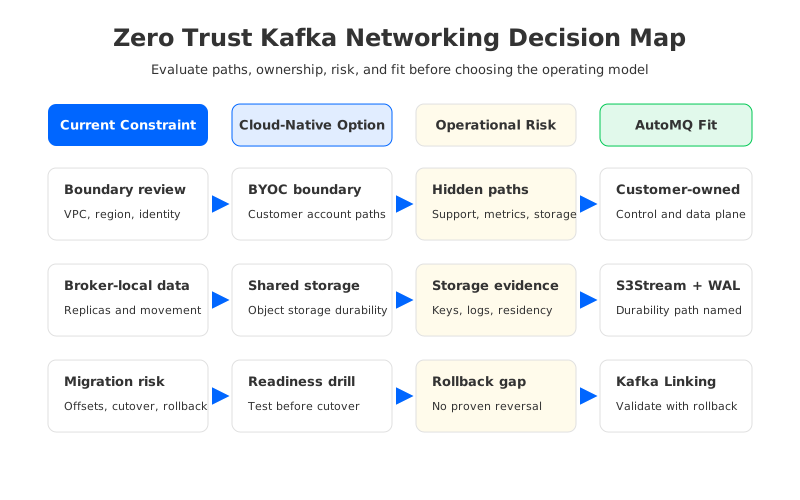
1Why Teams Search for zero trust kafka networking
Zero trust enters the Kafka discussion when teams stop trusting location as proof of safety. A broker in the right subnet is not enough. A connector with a private endpoint is not enough. A topic ACL is not enough if object storage, schema changes, observability exports, and migration traffic sit outside the same review.
Kafka makes this uncomfortable because production usage spreads across many paths. Producers reach bootstrap servers and individual brokers. Consumers join Consumer groups, fetch offsets, and recover from rebalances. Kafka Connect workers read and write through source and sink systems. Schema controls, data contracts, audit logs, and observability pipelines form another evidence layer.
For platform teams, the practical search intent is rarely "What is zero trust?" The real questions are more specific:
- Which Kafka paths must stay inside a VPC (Virtual Private Cloud), private cloud, or approved region?
- Which identities are allowed to produce, consume, administer topics, deploy connectors, or replay retained data?
- Which data leaves the boundary through monitoring, support workflows, object storage access, or migration tooling?
- Which controls remain valid when brokers fail, partitions move, traffic spikes, or teams add additional connectors?
That last question is where many plans get thin. A security design that works only while the cluster is stable is not an operating model. The boundary has to survive normal Kafka operations.
2The Production Constraint Behind the Problem
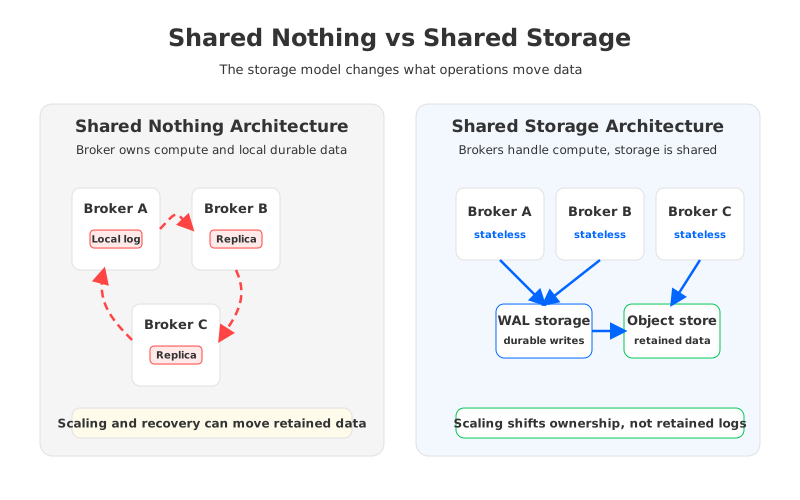
Traditional Kafka uses a Shared Nothing architecture. Each Broker owns local storage, each Partition has leaders and followers, and durability comes from replication across brokers. That model matches the way Apache Kafka has served production workloads for years, and the Apache Kafka documentation remains the baseline for understanding clients, Consumer groups, offsets, transactions, Kafka Connect, KRaft, and related behavior.
The same model also turns a networking review into a storage review. If durable data lives on broker-local disks, then availability, failover, scaling, and recovery often involve broker-to-broker replication or partition data movement. In a multi-AZ cloud design, that movement can cross Availability Zone boundaries. In a regulated design, the same movement can cross ownership boundaries, audit scopes, or firewall paths that security teams expected to remain quiet.
Zero trust does not make broker-local storage wrong. It changes what the platform team must prove. A shared-nothing cluster can be secure when its replication paths, listener configuration, ACLs, encryption, private endpoints, and operational procedures are documented and tested. The risk is that many teams review Kafka as if it were a set of client endpoints, while the heaviest operational behavior happens behind those endpoints.
That gap shows up during incidents. A failed broker can trigger leader movement, recovery reads, replica catch-up, and load redistribution. A scaling event can create partition reassignment work that moves retained data. A migration can require topic mapping, offset continuity, schema alignment, connector validation, and rollback evidence.
Zero trust Kafka networking is less about drawing a tighter box around brokers. It is about deciding whether the platform can explain every data path when Kafka is under stress.
3Architecture Options and Trade-offs
Teams usually compare three patterns. The first is self-managed Kafka in a controlled network. This gives strong ownership of VPCs, subnets, firewalls, keys, placement, and upgrades. It also leaves the team with broker sizing, disk management, partition movement, scaling, security patching, connector operations, and incident response.
The second pattern is a managed Kafka service with private connectivity. This can reduce day-to-day broker work and give teams familiar cloud constructs. The trade-off is boundary precision. Security teams still need to know where the control plane runs, where the data plane runs, who owns storage, how support access works, which telemetry leaves the account, and whether private connectivity changes the bill.
The third pattern is a Kafka-compatible platform that changes the storage model. Instead of treating each Broker as the long-term owner of local log data, this architecture moves durable stream storage into shared storage and keeps brokers closer to compute nodes. That does not remove the need for identity, encryption, private networking, or audit logs. It changes the operational paths that create data movement, failover work, and capacity coupling.
The useful comparison is not "managed versus self-managed." It is the set of operating questions below.
| Question | Why It Matters for Zero Trust | Evidence to Request |
|---|---|---|
| Kafka compatibility | Existing producers, consumers, offsets, transactions, and Connect workloads depend on Kafka behavior. | Client test matrix, protocol compatibility, topic configuration support, and offset behavior. |
| Network boundary | Private endpoints do not cover every data path by default. | VPC paths, subnet placement, listener design, endpoint policy, DNS, and firewall rules. |
| Storage ownership | Retained records, WAL storage, backups, and object storage can carry regulated data. | Storage account, bucket policy, encryption keys, object access logs, and data residency. |
| Scaling and recovery | Failover and scaling are where hidden data movement appears. | Broker failure test, partition movement behavior, recovery path, and scaling procedure. |
| Governance | Data contracts need enforcement points, not only schema files. | ACL model, schema workflow, connector approvals, audit logs, and replay authorization. |
| Migration and rollback | A zero trust design must survive cutover and reversal. | Topic mapping, offset continuity, dual-write policy, rollback gate, and monitoring evidence. |
Architecture diagrams are useful, but zero trust reviews are won or lost in evidence. A team that can show who may replay a topic, where retained bytes live, which private endpoint carries connector traffic, and how rollback works is in a stronger position than a team with a cleaner slide and weaker tests.
4Evaluation Checklist for Platform Teams
Start with compatibility because every later control depends on it. Kafka clients use metadata requests, group coordination, offset commits, idempotent producers, transactions in some workloads, and admin APIs. If a platform claims Kafka compatibility, turn the claim into a test suite before discussing cost or governance.
Then separate network control from data control. Network control answers where packets flow, which endpoints are reachable, and which identities can connect. Data control answers where records, schemas, offsets, WAL data, object storage, logs, and metrics reside. A private endpoint can still point to a service whose storage and support model sits outside the boundary your auditors care about.
Cost needs the same separation. Do not compress compute, storage, inter-AZ traffic, private connectivity, object storage requests, observability export, and migration overhead into one monthly estimate too early. Cloud providers publish separate pricing for services such as AWS PrivateLink. Break the bill into paths first, then decide which paths are acceptable.
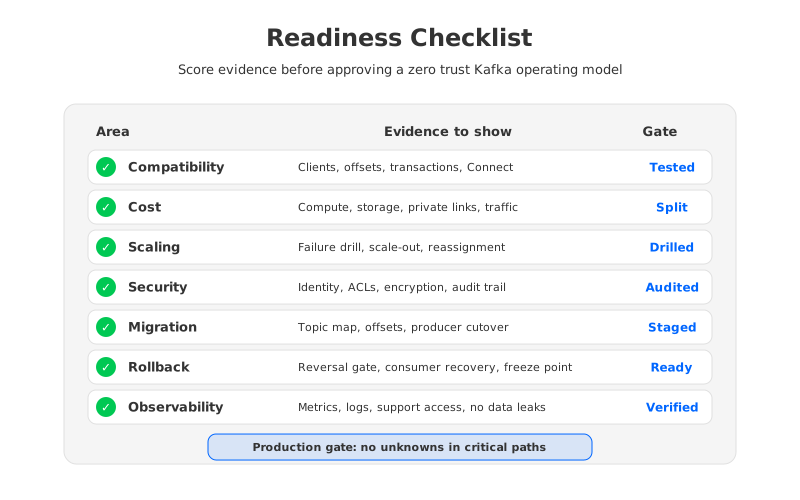
A readiness checklist should cover seven areas:
- Compatibility: Test producers, consumers, Consumer groups, offsets, transactions, Kafka Connect, schema workflows, and admin tooling against representative workloads.
- Network: Map client-to-broker, broker-to-storage, connector-to-system, observability, control, and migration paths. Include DNS, private endpoints, firewall rules, and region placement.
- Storage: Identify who owns retained records, WAL storage, object storage buckets, encryption keys, backups, and access logs.
- Scaling: Rehearse broker failure, traffic bursts, scale-out, scale-in, and partition movement. Record which operations move data and which only move metadata or ownership.
- Governance: Define topic ownership, ACLs, data contracts, schema approval, connector approval, replay authorization, and audit evidence.
- Migration: Validate topic mapping, offset continuity, cutover sequencing, producer behavior, consumer recovery, and rollback checkpoints.
- Observability: Confirm that logs, metrics, traces, and support workflows do not leak business data or bypass the approved control boundary.
The checklist should be scored with evidence, not optimism. A simple scale works: 0 means unknown, 1 means described but untested, 2 means tested in a non-production environment, and 3 means tested with production-like traffic and a rollback path. Any zero in compatibility, storage ownership, migration, or observability should block a production decision.
5How AutoMQ Changes the Operating Model
After the neutral evaluation is complete, AutoMQ becomes relevant when the blocker is not Kafka semantics, but the operating model created by broker-local durable storage. AutoMQ is a Kafka-compatible streaming platform that uses a Shared Storage architecture. It keeps Kafka protocol and ecosystem compatibility while moving durable stream storage into S3-compatible object storage through S3Stream.
That shift matters for zero trust because it changes what a Broker represents. In a traditional shared-nothing cluster, a Broker is both compute and the local owner of retained log data. In AutoMQ, stateless brokers handle Kafka-facing compute, routing, cache, and scheduling, while durable records live in customer-controlled object storage. The WAL storage layer provides the write durability path.
For platform teams, this reduces security exceptions caused by data movement rather than application intent. Broker replacement, scaling, and partition reassignment can be evaluated as ownership, metadata, and traffic-scheduling operations instead of retained-log relocation projects. AutoMQ also documents Self-Balancing, which is relevant when teams need load redistribution without manual data placement work.
The deployment boundary is the other reason AutoMQ belongs in this discussion. AutoMQ BYOC runs the control plane and data plane in the customer's cloud account and VPC. AutoMQ Software targets private data center deployments. In both cases, the zero trust review can focus on the customer's network paths, storage account, object storage bucket, keys, logs, metrics, service accounts, and approvals.
This does not remove the need for governance. A Kafka-compatible platform still needs topic ownership, ACLs, schema controls, connector policies, monitoring, and incident procedures. AutoMQ's value in a zero trust review is narrower and more practical: it helps teams evaluate Kafka compatibility without inheriting the same broker-local storage coupling that makes scaling, recovery, and data movement hard to explain.
Migration deserves its own gate. If a team is moving from an existing Kafka estate, they should test topic-level behavior, offset continuity, Consumer group recovery, and producer cutover. AutoMQ documents Kafka Linking as a migration path for AutoMQ Cloud environments, but production teams should still rehearse rollback and observe migration traffic inside the same network boundary used for steady-state operations.
6Decision Matrix for a Zero Trust Kafka Review
The final decision should give security, platform engineering, data governance, FinOps, and application owners the same evidence. If the conversation stays at "private networking enabled," it is too shallow. If it descends into every Kafka configuration knob, it loses the operating question.
Use this matrix to keep the decision focused:
| Requirement | Traditional Kafka Fit | Managed Service Fit | Shared Storage Kafka-Compatible Fit |
|---|---|---|---|
| Keep full infrastructure ownership | Strong, but high operating load. | Depends on vendor and cloud model. | Strong when deployed as BYOC or private software. |
| Reduce broker-local data movement | Limited by Shared Nothing architecture. | Depends on the service architecture. | Strong when durable data lives in shared object storage. |
| Preserve Kafka clients and tools | Strong when using Apache Kafka. | Strong when service remains Kafka-compatible. | Strong when compatibility is validated with real workloads. |
| Simplify scaling evidence | Requires reassignment and capacity planning evidence. | Depends on service limits and support process. | Strong when stateless brokers and shared storage reduce data relocation. |
| Control retained data residency | Strong if storage is customer-owned. | Depends on provider boundary. | Strong when object storage and WAL storage stay in the customer boundary. |
| Lower migration risk | Depends on tooling and cutover plan. | Depends on ecosystem and migration support. | Depends on compatibility tests, linking path, and rollback evidence. |
No row chooses the platform for you. Zero trust Kafka networking is an evidence problem before it is a vendor problem. The right architecture is the one whose boundaries your team can operate, audit, and repair when Kafka is busy, not only when the diagram is calm.
If your evaluation shows that broker-local storage is the main source of scaling, recovery, and boundary complexity, test AutoMQ with the same checklist. Start with a representative workload, run compatibility and failure drills, inspect the object storage and WAL paths, and verify that the control boundary matches your audit model. For a customer-controlled deployment discussion, use the AutoMQ BYOC entry point as the next step.
7FAQ
7.1What is zero trust Kafka networking?
Zero trust Kafka networking is the practice of treating every Kafka path as explicit and verifiable: client connections, broker communication, storage access, connector traffic, observability export, admin operations, migration paths, and support workflows. The goal is to avoid relying on network location alone as proof of safety.
7.2Is private connectivity enough for Kafka security?
No. Private connectivity helps control packet paths, but Kafka security also needs identity, authorization, encryption, data contract governance, storage ownership, audit logging, and operational evidence for failover, scaling, and migration.
7.3How does Shared Storage architecture affect zero trust reviews?
Shared Storage architecture can reduce the amount of durable data movement tied to broker lifecycle events. That makes scaling, replacement, and partition ownership changes easier to reason about, but teams still need to validate storage access, WAL behavior, encryption, identity, and observability boundaries.
7.4When should AutoMQ enter the evaluation?
AutoMQ should enter after the team has defined compatibility, network, storage, governance, scaling, migration, and observability requirements. It is most relevant when the team wants Kafka compatibility but sees broker-local storage and data movement as the source of operating-model friction.


