
Table of Contents
Table of Contents
When a platform team searches for broker replacement automation kafka, the problem is rarely the script itself. The team already knows how to drain a node, update an instance group, or restart a process under orchestration. The harder question is whether a broker can be treated as replaceable capacity without dragging durable data, partition movement, client behavior, and rollback risk into the same operation.
That distinction matters because Kafka clusters sit behind real production pressure. Hardware ages out. Cloud instances get interrupted. Kubernetes nodes rotate. Security teams ask for faster patch windows. Finance teams ask why spare capacity exists for rare failures. Automated broker replacement helps only when the architecture gives the runbook a clean boundary.
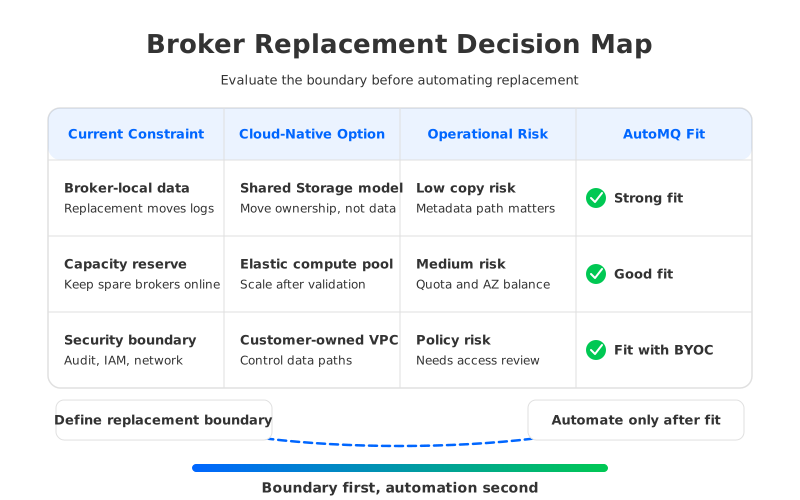
The practical boundary is this: automate broker replacement only after you understand what the broker owns. If it owns local persistent data, replacement is also a data movement event. If durable data lives outside the broker, replacement becomes closer to compute capacity management.
1Why teams search for broker replacement automation kafka
Broker replacement becomes urgent when the operational loop is too slow. A team might want to replace unhealthy brokers before consumer lag compounds, rotate nodes during patching, recover from cloud instance failures, or add capacity before a traffic spike. In each case, the search query sounds like automation, but the root issue is often architectural coupling.
Traditional Apache Kafka gives teams mature operational primitives: partition leaders, follower replicas, Consumer groups, offsets, idempotent producers, transactions, and an ecosystem around Kafka Connect and Kafka Streams. Those primitives are valuable because they let applications depend on stable Kafka semantics while the cluster changes underneath. The complication is that the broker is not only a request-processing process. In the classic model, it is also a storage owner.
That creates a mismatch between what operators want and what the platform can safely do. Operators want a failed or risky broker to be disposable. The cluster often needs that broker's partition data replicated, reassigned, caught up, or validated before replacement is complete. Automation does not remove that work; it schedules it. If the underlying operation is large data movement, the automation boundary must include its time, bandwidth, capacity, and failure cases.
There are legitimate reasons to automate anyway. Mature Kafka operators automate broker decommissioning, rolling restarts, rack-aware placement checks, disk health gates, and reassignment workflows. The point is that the operational boundary has to match the architecture. A script that assumes brokers are stateless will be fragile on a Shared Nothing architecture.
2The production constraint behind the problem
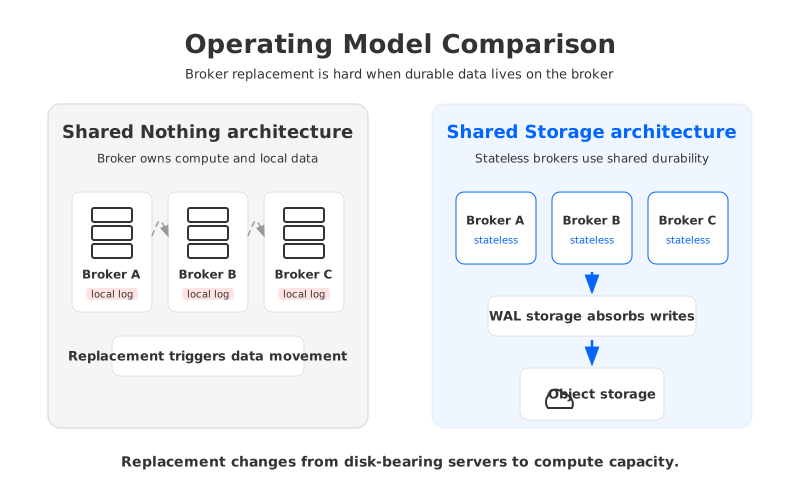
Kafka's traditional Shared Nothing architecture binds each broker to its own local storage. Partitions have leaders and followers, and each broker manages the local log segments for the partitions it hosts. Replication through ISR (In-Sync Replicas) gives durability and availability, but it also means the cluster must maintain enough replicated data on enough brokers before a node can disappear safely.
That model made sense when local disks were predictable and operators could reason about broker ownership. The trade-off appears in elastic cloud environments where compute, network, and storage are billed and scaled as separate resources.
Broker replacement then becomes entangled with several constraints:
- Broker-local storage. Replacing a broker is not only replacing CPU and memory. The cluster must account for the partition data that was local to that broker, even when replicas exist elsewhere.
- Network movement. Partition reassignment, replica catch-up, and rebalancing consume broker network and disk I/O. In multi-AZ deployments, some of that traffic can also cross Availability Zone boundaries depending on placement and client routing.
- Capacity reserve. A cluster needs enough spare headroom to survive replacement while continuing to serve production traffic. That reserve is often idle until failure, maintenance, or scale events happen.
- Long operational tails. The command may start quickly, but the full operation ends only when replicas, leaders, lag, and application behavior are back inside policy.
The dangerous version of broker replacement automation hides these constraints behind a green status. The script finishes and the node group looks healthy, while partition movement may still be reshaping load, consumers may still be catching up, and rollback may no longer be obvious.
3Architecture options and trade-offs
The first decision is not "which tool should replace brokers?" It is "which part of the system should be responsible for durable state?" Three common paths have different automation boundaries.
| Option | What changes | Why it helps | Boundary to watch |
|---|---|---|---|
| Improve traditional Kafka operations | Keep the Shared Nothing model and automate safer broker lifecycle steps | Works with existing clusters and known Kafka behavior | Replacement still depends on local log ownership and replica movement |
| Use Tiered Storage | Keep recent data local while moving older segments to object storage | Reduces local storage pressure for historical data | Hot data and broker-local responsibilities still remain |
| Move to Shared Storage architecture | Put durable stream data in shared storage and make brokers largely stateless | Broker replacement becomes closer to compute replacement | Requires careful compatibility, WAL, governance, and migration validation |
Tiered Storage deserves a fair reading. Apache Kafka's Tiered Storage moves older log segments to remote storage while keeping Kafka semantics intact. That can reduce local disk pressure and improve retention economics, especially when the main problem is historical data growth. It does not automatically make brokers stateless because the broker still participates in local hot data handling, leadership, and replication.
Shared Storage architecture changes the operating model more directly. Instead of treating each broker's disk as the durable home of a partition, it places durable data in a shared storage layer and lets brokers focus on protocol handling, leadership, caching, and scheduling. The replacement unit shifts from "a server carrying data" to "a compute process with recoverable ownership." That does not make operations trivial, but it does remove a major reason replacement workflows become long and unpredictable.
Platform teams should be precise about terminology. "Cloud-native Kafka" can mean managed operations, Kubernetes packaging, object storage, serverless consumption, or Kafka-compatible APIs. For broker replacement automation, the narrower question is: can the platform replace a broker without copying that broker's durable log data to another broker as the main recovery mechanism?
4Evaluation checklist for platform teams
Before adopting or building broker replacement automation, evaluate the platform against operational questions, not only feature names. The right checklist starts with compatibility and ends with rollback, because a replacement workflow that cannot be reversed is not production automation. It is a one-way maintenance event.
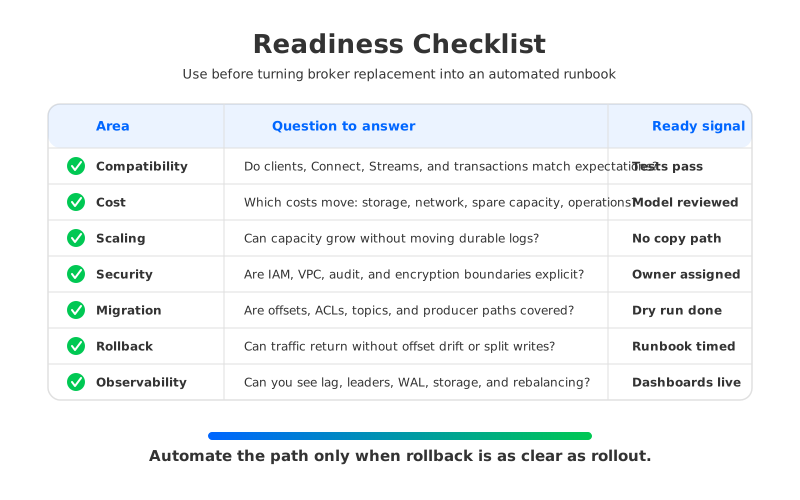
Use these questions as a review gate:
- Compatibility: Do existing producers, consumers, Kafka Connect jobs, Kafka Streams applications, transactions, ACLs, and monitoring tools behave as expected?
- Cost model: Which cost moves when brokers are replaced: compute reserve, block storage, object storage, cross-AZ traffic, PrivateLink, operations, or migration tooling?
- Scaling behavior: Does adding or removing brokers require moving durable logs, or only moving leadership, ownership, and traffic?
- Governance: Which account, VPC, IAM role, encryption key, audit trail, and network path owns the data plane?
- Migration path: Can topics, offsets, ACLs, and producer paths move without forcing a risky all-at-once client cutover?
- Rollback: If the replacement or migration fails, can traffic return without offset drift, split writes, or data ambiguity?
- Observability: Can operators see leadership, Consumer lag, storage health, WAL behavior, object storage errors, and rebalance state in one place?
The checklist should be owned jointly by SRE, platform engineering, security, and application stakeholders. SRE owns the runbook and SLO. Platform engineering owns architecture and cluster lifecycle. Security owns access boundaries. Application teams own client behavior and cutover risk.
5How AutoMQ changes the operating model
After that neutral evaluation, AutoMQ is relevant because it attacks the specific coupling that makes broker replacement hard. AutoMQ is a Kafka-compatible cloud-native streaming platform that keeps Kafka protocol and ecosystem compatibility while replacing Kafka's broker-local storage layer with a Shared Storage architecture built on S3-compatible object storage.
In AutoMQ, brokers are designed as stateless brokers. They still process Kafka requests, own leadership, serve reads, handle caching, and participate in cluster scheduling. The difference is that durable stream data is not tied to broker-local disks as the long-term source of truth. AutoMQ uses S3Stream as the storage layer, with WAL (Write-Ahead Log) storage absorbing writes before data is organized into object storage. The WAL type depends on deployment shape and product edition; for example, AutoMQ Open Source supports S3 WAL, while AutoMQ commercial editions can use additional WAL storage options such as Regional EBS WAL or NFS WAL.
That architecture changes broker replacement in three practical ways.
First, replacement is less dominated by durable data copy. When a broker fails or a compute node is rotated, the platform can focus on ownership, leadership, cache warmup, and traffic routing rather than moving that broker's local log files as the central recovery path. Operators still need health checks and observability, but the long pole changes.
Second, capacity planning becomes less tied to disk placement. Traditional Kafka often forces teams to think about broker count, disk size, partition placement, and replica movement together. With AutoMQ's Separation of compute and storage, compute capacity and storage capacity can be reasoned about more independently. That is useful for scheduled replacement, Auto Scaling, and Self-Balancing because the system can rebalance traffic without treating every compute change as a storage reshuffle.
Third, governance can stay inside customer-controlled boundaries. AutoMQ BYOC deploys the control plane and data plane in the customer's own cloud account and VPC, while AutoMQ Software targets customer-managed private environments. For teams evaluating automation, that matters because broker replacement runbooks often need cloud IAM permissions, Kubernetes or infrastructure access, object storage access, audit evidence, and clear data ownership. The operational boundary is not only technical; it is also a security boundary.
Migration deserves the same discipline. If the team is moving from an existing Kafka cluster to a target Kafka-compatible platform, broker replacement automation may become part of a broader migration program. AutoMQ Kafka Linking is designed for zero-downtime migration scenarios by handling byte-level message synchronization, offset consistency, and producer-path cutover patterns in AutoMQ's documented migration flow. That does not remove the need for dry runs. It gives the migration team a more explicit tool for reducing the risky gap between "data copied" and "applications safely switched."
6A practical decision matrix
The cleanest way to make the decision is to score the platform against failure modes, not promises. A platform is ready for broker replacement automation when the team can explain what happens in each failure path and who owns the response.
| Decision area | Green signal | Red signal |
|---|---|---|
| Broker ownership | Broker replacement changes compute ownership, not durable log ownership | Replacement depends on large, time-sensitive partition copy |
| Client behavior | Existing Kafka clients and tools work without semantic surprises | Client libraries, transactions, or offsets need special-case handling |
| Cost exposure | Storage, network, and reserve capacity are modeled separately | Savings claims hide network or migration costs |
| Security boundary | IAM, VPC, encryption, and audit scopes are reviewed before automation | Automation requires broad permissions that no team owns |
| Rollback | Return path is tested and timed | Rollback is "restore from backup" or "wait for rebalancing" |
| Observability | Operators can see lag, storage, WAL, leadership, and rebalance state | The runbook depends on scattered dashboards and manual inference |
The red signals do not always mean "do not proceed." They mean the automation scope is bigger than broker replacement. For example, if rollback depends on offset consistency, then the runbook must include Consumer group validation. If cost exposure depends on cross-AZ traffic, the runbook must include placement and client routing checks. If the automation requires object storage permissions, security review is part of the engineering work, not an afterthought.
The safest production posture is incremental. Start with replacement in a staging environment that mirrors the production network and authentication model. Measure client-visible impact, not only cluster health. Validate consumer lag behavior. Time rollback. Then repeat with a constrained production maintenance window before handing the workflow to an automatic controller.
Broker replacement automation is worth doing when it reduces human toil without hiding system state. If your current Kafka architecture makes every replacement a data relocation event, the next step is not a larger script. It is a platform evaluation that separates compute replacement from durable data ownership. To test that model in a Kafka-compatible environment, start with the AutoMQ GitHub project or evaluate AutoMQ BYOC with your own network, IAM, and migration constraints.
7FAQ
7.1Is broker replacement automation the same as Kafka partition reassignment?
No. Partition reassignment is one mechanism that may be involved in broker lifecycle work, especially in traditional Kafka clusters. Broker replacement automation is the broader operational workflow around detecting, draining, replacing, validating, and potentially rolling back broker capacity.
7.2Does Tiered Storage make Kafka brokers stateless?
No. Tiered Storage can move older log segments to remote storage and reduce local storage pressure, but it does not by itself remove every broker-local operational responsibility. Hot data, leadership, and local broker behavior still matter.
7.3What makes Shared Storage architecture different for replacement workflows?
Shared Storage architecture puts durable stream data in shared storage rather than treating a broker's local disk as the long-term home of partition data. That changes replacement from a data-copy-heavy operation into a compute, ownership, and traffic-management operation.
7.4Can AutoMQ replace existing Kafka clients?
AutoMQ is designed to be Kafka-compatible, so existing Kafka clients and ecosystem tools can be used without changing application protocol semantics. Teams should still validate their own client versions, authentication setup, transactions, Connect jobs, and operational tooling before production migration.
7.5What should be tested before enabling automatic replacement?
Test client compatibility, Consumer lag behavior, transaction behavior if used, storage and WAL health, observability coverage, IAM permissions, network placement, migration flow, and rollback timing. The automation should not run unattended until rollback has been tested under realistic conditions.


