
Table of Contents
Table of Contents
Searches for hot partition recovery kafka usually happen after the first mitigation has already failed. The team has seen one partition dominate producer latency, one broker absorb an unfair share of leader traffic, or one consumer group keep falling behind on a narrow slice of the topic. Adding capacity may have helped the cluster average while doing little for the overloaded path. That is the moment when the question changes from "How do we detect the hot partition?" to "What is the safe boundary for recovering from it?"
The boundary matters because a hot partition is not only a throughput problem. It is where application ordering, partition ownership, broker placement, storage layout, and recovery time meet. A good plan does not rush into repartitioning, reassignment, or platform migration. It first separates what the application can change from what infrastructure can move without changing semantics.
1Why Teams Search for hot partition recovery kafka
Hot partition incidents have a particular shape. Dashboards show that the Kafka cluster is not uniformly saturated, yet a small number of partitions explain most user-visible pain. Producers retry because one partition leader is slow. Consumers appear well scaled, but lag is concentrated on fewer partitions than active consumers. A broker has spare CPU on paper while disk, network, or request queue behind one leader becomes the bottleneck.
That mismatch is frustrating because many familiar Kafka levers work only after the workload can spread. More consumers do not help a consumer group read one partition in parallel. More brokers do not cool a single leader until leadership or placement changes. More partitions may help future records, but one hot key can still map to one partition and preserve the bottleneck.
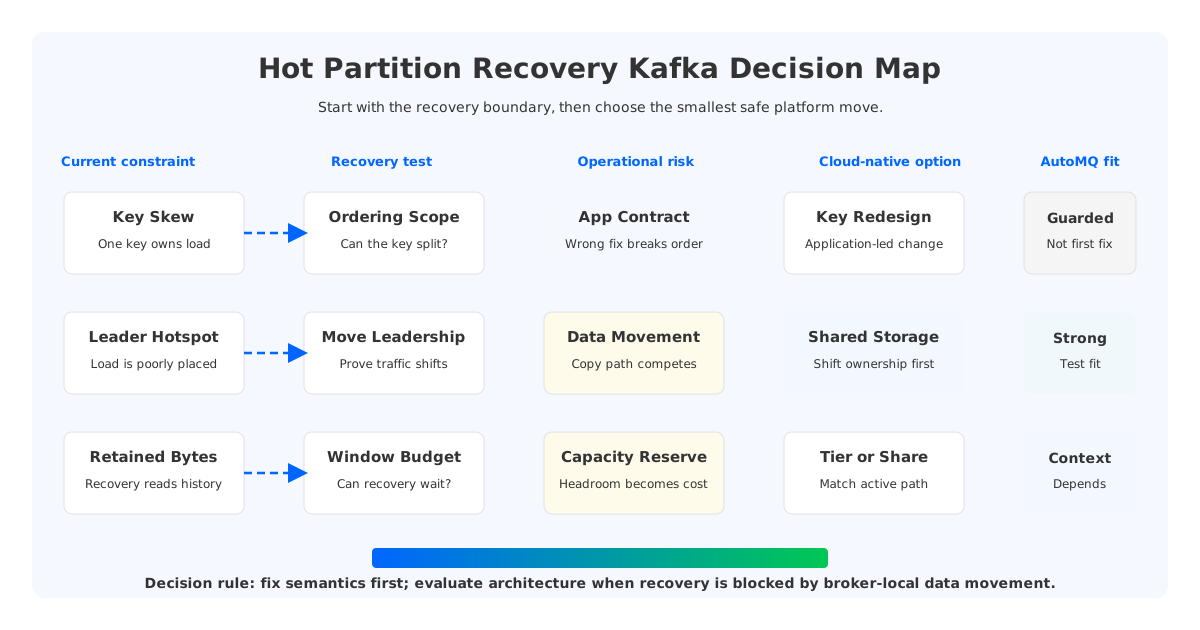
The first recovery boundary is therefore semantic, not infrastructural:
- Can the key be split? If strict per-key order is required, salting or changing keys may move the problem into the application layer.
- Can the topic be expanded safely? Partition expansion can change key-to-partition mapping for future records and may affect downstream state assumptions.
- Can leadership move without moving too much data? If the useful operation is slow because durable data is broker-local, recovery becomes a storage problem.
- Can consumers resume from the expected offsets? A recovery plan that loses offset continuity creates a second incident.
These questions keep the team from treating every hot partition as the same incident. Some are key-design problems. Some are placement problems. Some are capacity-planning problems. The expensive ones are recovery-boundary problems: the team knows what should move, but the system makes that move risky.
2The Production Constraint Behind the Problem
Apache Kafka organizes records by topic partitions, and a Consumer group divides partitions across consumers. That model gives Kafka a clear ordering contract: order is maintained within a partition. The same contract also creates a hard limit during recovery. If one partition carries a large share of traffic, the leader for that partition and the consumer assigned to that partition become the narrow path.
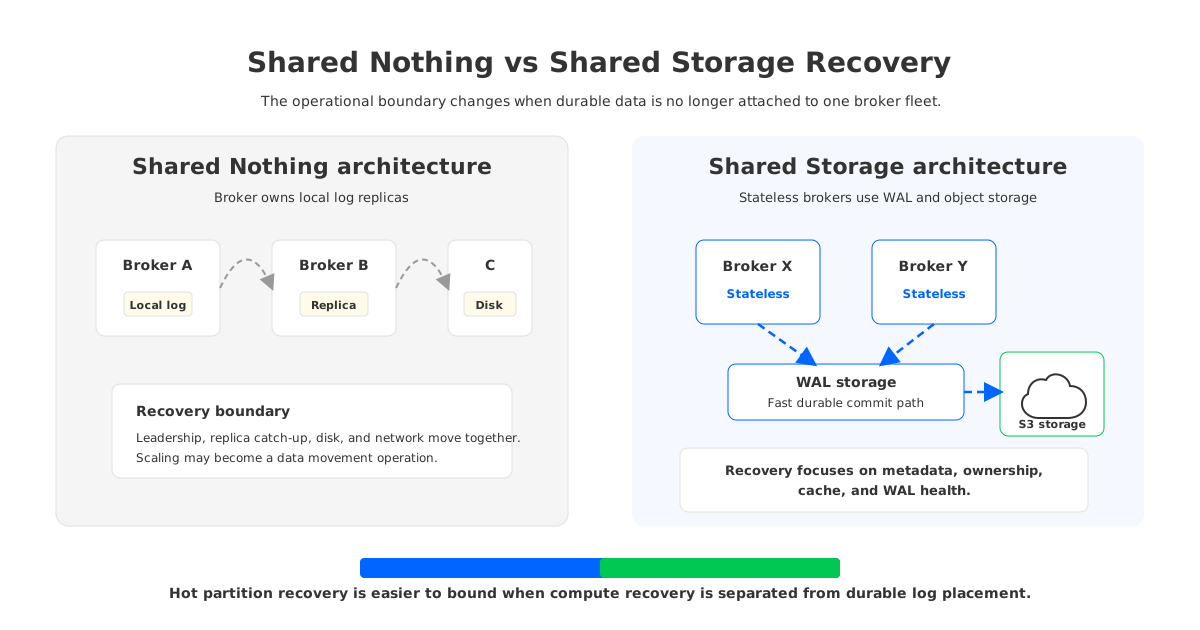
Traditional Kafka runs as a Shared Nothing architecture. Brokers store local log replicas, leaders serve reads and writes, followers replicate data, and partition reassignment coordinates where replicas should live. This design is understandable and battle-tested, but it ties recovery to physical placement. When a hot partition needs to move, the operation can involve leader election, replica catch-up, throttling, network traffic, disk I/O, and observation of under-replicated partitions.
That is why a "simple" recovery action can consume more of the incident window than expected. The team may be reducing one overloaded leader while reassignment reads from the same storage path, writes to another broker, and competes with live traffic. If the cluster runs across Availability Zones (AZs), replication and reassignment traffic may also cross fault-domain and cost boundaries. Production reviews should use current provider pricing pages rather than inherited assumptions.
Tiered Storage changes the retention side of the equation, not every active recovery path. Kafka Tiered Storage moves older log segments to remote storage while the active write path and recent data still involve broker-managed local storage. That helps long retention and historical reads, but it does not make hot partition recovery stateless. During a live event, the current leader, recent records, cache behavior, and consumer fetch path still matter.
The practical constraint is this: if durable partition state is attached to brokers, recovery has to respect where the bytes are. If durable stream state is outside the broker fleet, recovery can focus more on ownership, metadata, cache warm-up, and commit-path health. That does not remove the need for good keys or enough partitions, but it changes the operating model after the team has identified the right move.
3Architecture Options and Trade-Offs
There are three common paths for hot partition recovery, and they solve different problems. The first is application-level redesign: change the key, split the workload, add a routing layer, or isolate a tenant into a separate topic. This is strongest when the hot partition comes from unavoidable business skew, but it has the largest semantic blast radius. Ordering, compaction, deduplication, stateful stream processing, and replay logic all need review.
The second path is Kafka operational tuning: rebalance leaders, add brokers, expand partitions, tune quotas, control backfill jobs, and rehearse reassignment. This is often right when the workload is sound and placement is poor. It keeps the architecture familiar, but works best when reassignment is fast enough, headroom is available, and automation covers throttling and rollback.
The third path is changing the storage architecture behind the Kafka-compatible surface. A Shared Storage architecture keeps Kafka-facing concepts such as topics, partitions, offsets, producers, consumers, and Consumer groups, while moving durable log storage away from broker-local disks. The trade-off is a different allocation of risk: less broker-local data movement during recovery, more attention to object storage, WAL storage, metadata, cache behavior, and cloud boundaries.
Use a comparison like this before choosing the path:
| Recovery question | Traditional Kafka tuning | Workload redesign | Shared Storage architecture |
|---|---|---|---|
| Hot key dominates traffic | Helps only around the edges | Strong fit if semantics allow | Does not remove key skew |
| Leaders are poorly placed | Strong fit | Usually unnecessary | Strong fit if storage movement is the blocker |
| Recovery reads retained data | May need careful throttling | Usually unrelated | Depends on read path and cache design |
| Scaling is blocked by local data | Operationally heavy | Partial help | Strong architectural signal |
| Governance requires customer-owned boundaries | Depends on deployment | Depends on application | Evaluate VPC, IAM, bucket, and support boundaries |
The table is not a product scorecard. A stable Kafka cluster with predictable traffic and well-rehearsed reassignment may not need architectural change. A workload with a broken key model should fix the application contract first. Shared storage becomes interesting when the same pattern repeats: the application can tolerate moving ownership, the cluster can identify target placement, and durable broker-local data movement is the bottleneck.
4Evaluation Checklist for Platform Teams
The strongest hot partition recovery plans are written before the next incident. They define the evidence required to decide whether a recovery action is safe, not only the commands someone might run under pressure. This is where platform teams bring SRE, application owners, security, and FinOps into the same review.
Start with compatibility. Producers, consumers, stream processors, connectors, ACLs, transactions if used, offset management, and monitoring tools all become part of the recovery surface. A Kafka-compatible platform can preserve API and protocol expectations, but the team still has to test production client behaviors. Compatibility is workload-specific proof, not a checkbox.
Then define the cost and capacity boundary. Hot partition recovery often requires temporary headroom, controlled backfill, or additional brokers. In cloud deployments, network path, storage path, and AZ placement can affect the incident budget as much as instance count. The goal is to know whether recovery requires hidden reserve capacity the platform team has not budgeted.
Security and governance deserve the same precision. If recovery depends on object storage, the bucket, encryption keys, lifecycle policies, IAM roles, private connectivity, and audit logs are no longer peripheral details. If recovery depends on migration or dual-run, the control plane, data plane, and support access model must be clear enough for security review.
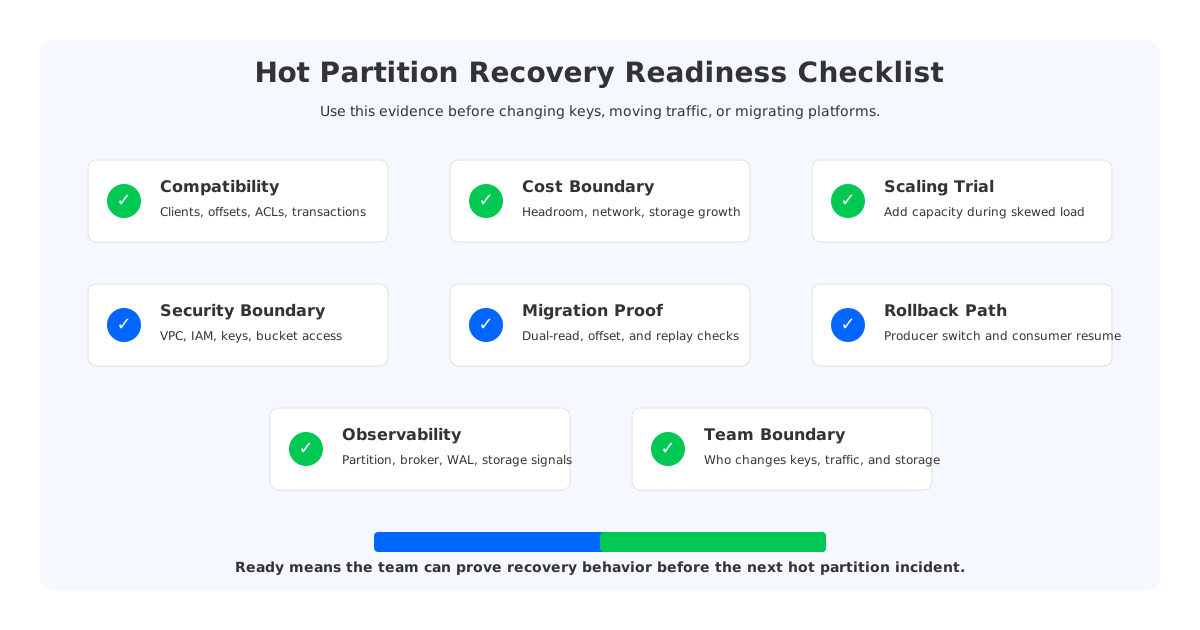
For a practical readiness review, require evidence in seven areas:
- Compatibility proof. Run the actual client versions, serialization formats, offset behavior, security settings, and transaction patterns that production uses.
- Scaling proof. Add and remove capacity under skewed traffic, not only under even synthetic load.
- Recovery proof. Rehearse leader movement, consumer resume, replay, and rollback with retained data present.
- Cost proof. Identify storage, compute, and network paths that grow during mitigation.
- Governance proof. Map customer data, metadata, credentials, keys, logs, metrics, and support access.
- Migration proof. Validate dual-run behavior, topic mapping, consumer progress, and cutover criteria.
- Observability proof. Alert on partition-level load, broker ownership, consumer lag, storage latency, WAL health, and cache behavior where applicable.
This checklist forces a useful distinction. A tactical incident has a clear local fix: change the key, isolate the tenant, rebalance leadership, or adjust quotas. A structural incident keeps returning because the recovery action itself cannot finish inside the required window without unacceptable risk.
5How AutoMQ Changes the Operating Model
Once the review identifies storage-coupled recovery as the recurring boundary, a Kafka-compatible shared-storage system becomes worth testing. AutoMQ fits that category: it keeps Kafka protocol and ecosystem compatibility while using a Shared Storage architecture with stateless brokers, S3Stream, WAL storage, and S3-compatible object storage as the durable storage layer.
For hot partition recovery, the important claim is not that AutoMQ makes skew disappear. It does not. If one business key produces most records and the application requires strict ordering for that key, no storage architecture can create parallelism the application contract forbids. The operating-model change appears after the team knows the target move is valid. Broker recovery, scaling, and partition ownership are less tied to copying retained local log data between brokers.
That changes the questions SREs ask during recovery. Instead of asking only whether enough brokers exist, they can ask whether ownership can shift safely, whether the WAL path is healthy, whether object storage access is within boundary, whether cache behavior supports tailing and catch-up reads, and whether observability covers shared storage. The review becomes less about hiding complexity and more about moving it to independently testable boundaries.
AutoMQ BYOC and AutoMQ Software also matter for governance-sensitive teams because the deployment boundary can stay inside the customer's environment. That does not remove cloud-resource review. It makes the review concrete: VPC, IAM, object storage, encryption, network routing, metrics, logs, and control-plane access can be inspected as part of the platform decision.
Migration should still be incremental. Put a skewed but non-critical workload through a compatibility test first. Measure producer behavior, Consumer group behavior, offset continuity, replay, backfill, and rollback. Then test the specific recovery scenario that forced the architecture discussion: add brokers during skew, move ownership, recover from broker loss, and observe whether the incident window is controlled by application semantics or by storage movement.
The most useful result of that test may be a "no." If the hot partition is really a key-design problem, fix the key. If the cluster only needs better reassignment automation, improve the runbook. If the blocker is durable data tied to broker movement, then Shared Storage architecture has earned a serious evaluation.
6Decision Matrix: When to Act
Hot partition recovery decisions should be boring enough to run under pressure. A simple decision matrix helps:
| Signal during incident | Primary owner | First action | Architecture question |
|---|---|---|---|
| One key or tenant dominates | Application team | Review keying and isolation | Can semantics tolerate split or routing? |
| One leader is overloaded | Platform team | Move leadership or rebalance | Does movement require risky data copy? |
| Consumers lag on fewer partitions than consumers | Application and platform | Check partition count and assignment | Is the parallelism ceiling too low? |
| Backfill collides with live traffic | SRE and data team | Throttle or reschedule replay | Should recovery reads use a different storage model? |
| Scaling adds nodes but not useful capacity | Platform architecture | Test ownership and reassignment path | Is broker-local storage the limiting factor? |
The point is to avoid heroic incident response. Teams should know which actions preserve ordering, which actions spend temporary capacity, which actions cross security boundaries, and which actions require a platform decision outside the incident room.
If your current Kafka-compatible platform turns every hot partition recovery into a data movement project, test a Shared Storage architecture against that exact failure mode. AutoMQ's architecture overview and GitHub project are useful next stops for a production-style proof.
7FAQ
What is hot partition recovery in Kafka?
Hot partition recovery is the set of actions used to restore safe throughput, latency, and consumer progress when one or a few partitions dominate the workload. It can involve key redesign, leader movement, partition expansion, replay control, broker scaling, or platform architecture review.
Do more brokers fix a hot partition?
More brokers help only when the hot path can move to them. If one key is pinned to one partition, consumer parallelism and broker count may not change the bottleneck.
Does Tiered Storage solve hot partition recovery?
Tiered Storage helps with older retained data, but it does not automatically remove active leader, recent log, cache, and live write-path constraints. It should be evaluated as a retention tool, not as a complete recovery model.
When should Shared Storage architecture be evaluated?
Evaluate Shared Storage architecture when the team has already classified the workload semantics and the main recovery blocker is broker-local durable data movement. That is the point where architecture, not only tuning, controls the incident window.
How should teams test AutoMQ for this use case?
Use the same client versions, security settings, topic patterns, Consumer groups, replay jobs, and skewed traffic shape that caused production pressure. The proof should include compatibility, recovery, observability, rollback, and governance boundaries.


