
Table of Contents
Table of Contents
A team usually searches for topic explosion management kafka after topic count stops being an inventory number and starts behaving like an operational boundary. The first symptom might be a request for another few hundred tenant-isolation topics, a data product pattern with one topic per entity, or a compliance rule that separates streams by jurisdiction, business unit, or retention class. None of those requests is unreasonable on its own. The pressure appears when Kafka operations has to absorb all of them with the same broker-local storage model, change process, and on-call budget.
Topic explosion is not a moral failure by application teams. It is usually the result of Kafka becoming the shared substrate for more products, more data contracts, and more teams. The mistake is treating the problem as a naming cleanup exercise. Names matter, but the hard part is deciding where the boundary sits between application ownership, platform governance, storage economics, and recovery behavior.
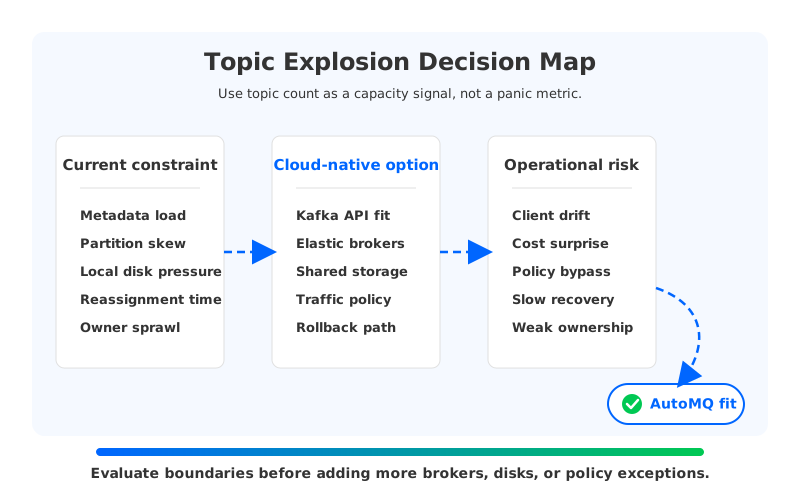
The useful question is not "how many topics is too many?" A better question is "which operating model breaks first when topic count, partition count, owner count, and retention diversity grow together?" That framing turns cleanup into architecture.
1Why Teams Search for topic explosion management kafka
The search intent is practical. Platform teams want a rule they can put in front of product teams without blocking legitimate use cases. SREs want to know whether the next batch of topics will harm controller stability, broker disk balance, rebalance time, alert volume, or cost. Architects want to know whether to stretch the existing cluster, split it, strengthen governance, or evaluate a Kafka-compatible platform with a different storage model.
The word "explosion" is doing real work here. A small topic increase is routine. A topic explosion changes operations because each topic often carries hidden multipliers:
- Partitions multiply metadata, leadership assignments, file handles, monitoring series, and operational decisions.
- Retention settings multiply storage profiles. One topic wants seven days, another wants 90 days, and another wants compaction.
- Ownership multiplies governance work. Every topic needs a reason to exist, an owner, an access policy, and a retirement path.
- Recovery multiplies blast radius questions. When a broker or disk fails, the team needs to know which workloads are exposed and how long recovery will take.
Apache Kafka's own model makes these dimensions explicit. Topics are split into partitions, partitions have offsets, consumers coordinate through Consumer groups, and the cluster tracks metadata through KRaft in Kafka versions that run without ZooKeeper. Those mechanics are mature, but they define the surface area that operators must manage.
2The Production Constraint Behind the Problem
Traditional Kafka runs as a Shared Nothing architecture. Each broker owns local storage, and partition replicas are distributed across brokers for durability and availability. This design made sense for Kafka's original environment: machines with local disks, application-level replication, and a clear mapping between broker identity and stored log segments. In the cloud, the same design can turn topic growth into a storage and movement problem.
The coupling is often hidden because a topic request starts as metadata. Someone asks for a topic name, partition count, retention setting, and ACL policy. Underneath that request, the platform inherits local disk placement, leader distribution, replica placement, inter-AZ replication, controller metadata, and future reassignment work. When dozens of teams do this independently, the cluster starts to feel less like a shared platform and more like a collection of local storage obligations.
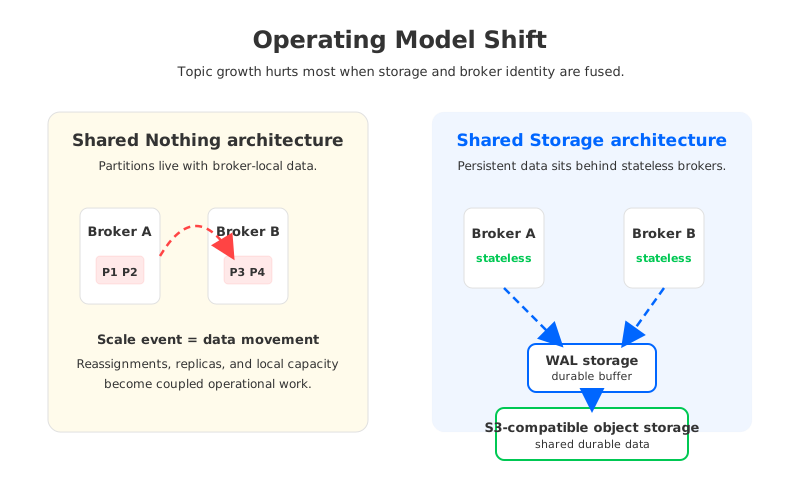
Partition reassignment is the clearest example. In a Shared Nothing architecture, moving partition ownership often means moving data. That data movement competes with production traffic, consumes network bandwidth, and extends the time required to rebalance a cluster. Tiered Storage can reduce the amount of historical data that must remain on local disks, and it is a valuable Kafka feature for long retention workloads. It does not make brokers stateless. Recent local segments, leadership, and operational recovery still depend on broker-local storage.
Cross-AZ economics add another boundary. Cloud providers publish data transfer pricing separately from compute and storage pricing. AWS, for example, documents data transfer charges for traffic that crosses Availability Zone boundaries in many same-region patterns. Kafka replication and client traffic can therefore show up as a network line item rather than a broker line item. More partitions, replicas, consumers, and rebalancing events increase the paths that must be understood.
The hidden constraint is not one metric. It is the interaction of metrics. A cluster might have acceptable CPU, acceptable disk utilization, and acceptable controller load, yet still be hard to operate because every change requires careful placement, every incident has too many owners, and every growth request triggers a debate about capacity. That is when the platform has crossed an operational boundary.
3Architecture Options and Trade-Offs
Topic growth can be handled in several ways, and none of them should be dismissed. A smaller organization might only need governance. A larger platform might need cluster segmentation. A cloud-heavy team might need a storage architecture shift. The wrong move is choosing one remedy before naming the failure mode.
| Option | Where it helps | Where it does not |
|---|---|---|
| Topic governance | Reduces duplicate topics, unclear ownership, weak naming, and unmanaged retention. | Does not change broker storage coupling or recovery mechanics. |
| Cluster segmentation | Separates noisy tenants, compliance domains, and workload classes. | Increases fleet management, networking, and migration work. |
| Partition and retention tuning | Controls metadata growth, disk pressure, and consumer parallelism. | Requires ongoing enforcement as application teams evolve. |
| Kafka Tiered Storage | Moves older log data to remote storage while retaining Kafka semantics. | Does not make brokers fully stateless or remove all local storage movement. |
| Kafka-compatible cloud-native storage | Changes how durable data is placed and recovered. | Requires compatibility validation, migration planning, and security review. |
The table is deliberately plain. If topic explosion is mostly caused by weak lifecycle policy, a platform migration is the wrong first answer. If the issue is broker-local storage and reassignment time, a naming policy will not fix the root cause. Good platform decisions start by separating governance debt from architecture debt.
There is also a client compatibility boundary. Kafka is not only brokers. It is Producer and Consumer clients, Kafka Connect, Kafka Streams, Schema Registry integrations, ACLs, transactions, idempotent producers, offset management, and operational tooling. A platform that claims Kafka compatibility has to be evaluated against the behavior applications actually use, especially transactional workloads, long-lived Consumer groups, lag-sensitive services, and connector-heavy pipelines.
4Evaluation Checklist for Platform Teams
Before changing the platform, score the boundary. A topic estate with 300 topics and disciplined ownership can be easier to operate than a 50-topic cluster with unclear retention, unstable consumers, and uncontrolled replication cost. The checklist should focus on decisions the platform team can defend during an incident, during a budget review, and during a migration review.
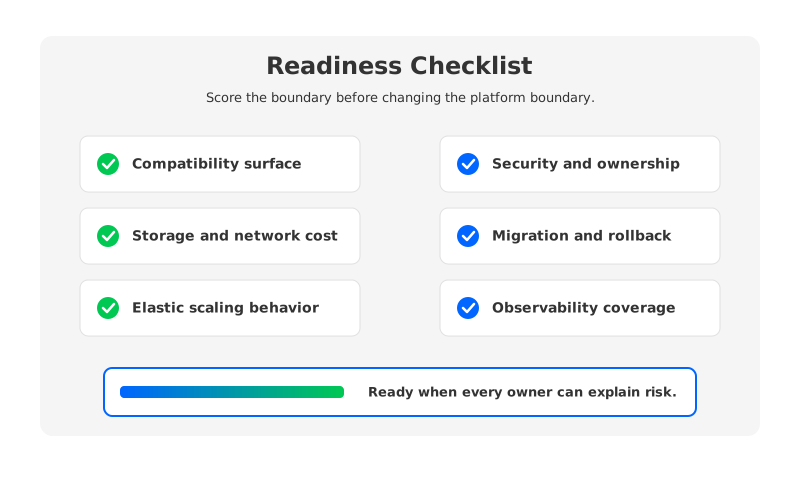
Use these questions as a working scorecard:
- Compatibility: Which Kafka APIs, client versions, transactions, Connect workloads, and consumer offset behaviors must be preserved?
- Cost: How much spend is tied to local or block storage, cross-AZ transfer, over-provisioned brokers, and long retention?
- Elasticity: Can the platform add and remove broker capacity without large data movement or long reassignment windows?
- Governance: Does every topic have an owner, retention class, access policy, naming pattern, and retirement process?
- Failure recovery: What happens when a broker, disk, Availability Zone, or network path fails?
- Migration: Can the team test dual writes, mirror traffic, offset alignment, rollback, and cutover with production-like workloads?
- Observability: Can operators see topic-level traffic, partition skew, Consumer group lag, storage growth, controller health, and network patterns?
The order matters. Compatibility comes before cost because a lower-cost platform that breaks application semantics is not a platform improvement. Migration comes before product enthusiasm because the cutover path is part of the architecture. Observability comes last in the list, but it should not be treated as an afterthought. A topic explosion without topic-level observability becomes a guessing game.
5How AutoMQ Changes the Operating Model
After the neutral checks are clear, the architectural question becomes sharper: what would change if durable Kafka data were no longer tied to broker-local disks? AutoMQ is a Kafka-compatible cloud-native streaming platform that answers this question with a Shared Storage architecture. It keeps Kafka protocol and API compatibility as the application-facing contract, while moving the storage layer to S3-compatible object storage through S3Stream.
In this model, AutoMQ Brokers are stateless brokers. They still serve Kafka requests, manage partition leadership, cache hot data, and participate in cluster coordination, but persistent stream data is stored through WAL (Write-Ahead Log) storage and S3 storage rather than being anchored to a broker's local disk. The WAL absorbs durable writes and supports recovery; object storage becomes the shared long-term data layer. That distinction matters for topic explosion because scaling is no longer primarily a data-copying exercise.
The operating model changes in four ways.
First, capacity planning shifts from "which broker has enough disk for these partitions?" to "how much compute do we need for current traffic, and what storage profile do we need for durability and retention?" Storage still has cost and performance characteristics, but it is no longer welded to a specific broker identity.
Second, reassignment becomes a metadata and traffic-placement problem more than a bulk data movement problem. When topic and partition counts grow, the platform still needs balanced leadership, cache efficiency, and good scheduling. It does not need to copy every byte of durable data from one broker-local disk to another to change ownership.
Third, failure recovery has a different shape. In Shared Nothing architecture, a broker failure raises questions about local replicas, catch-up, and disk state. In AutoMQ's Shared Storage architecture, durable data remains in shared object storage, while brokers can be replaced as compute nodes. WAL type still matters. AutoMQ Open Source uses S3 WAL, while AutoMQ commercial editions can use WAL options such as Regional EBS WAL or NFS WAL depending on deployment and latency needs.
Fourth, deployment boundaries become easier to explain to security and platform teams. AutoMQ BYOC runs the control plane and data plane inside the customer's cloud account or VPC, and AutoMQ Software runs in the customer's private environment. For teams managing topic growth under compliance constraints, this boundary is often as important as the storage architecture. The evaluation should include IAM, network paths, object storage ownership, audit requirements, and operational access.
This does not remove governance work. AutoMQ will not decide whether a product team deserves 200 topics, whether a topic should be compacted, or whether a naming convention is enforceable. It changes the cost of growth and recovery mechanics underneath those decisions. That is the right role for infrastructure: reduce accidental coupling without pretending that policy can disappear.
6A Migration Scorecard for Topic-Heavy Kafka Estates
Migration planning should start with the topic estate, not with a generic cluster checklist. Pick a representative slice of workloads: one high-throughput topic family, one long-retention family, one connector-backed workflow, one transactional or idempotent producer flow, and one Consumer group with strict lag expectations. If those paths work, the team has a useful signal. If they do not, a broad migration plan will hide the hard part.
A practical readiness scorecard has three levels:
| Level | What must be true | Exit signal |
|---|---|---|
| Inventory | Topics, owners, partitions, retention, ACLs, and traffic patterns are known. | Unknown ownership and stale topics are removed or marked. |
| Compatibility | Critical clients, Connect jobs, Consumer groups, offsets, and transactions are tested. | Workloads pass production-like validation. |
| Cutover | Mirror, rollback, observability, and support runbooks are ready. | The team can explain how to stop, revert, or continue under failure. |
This scorecard also prevents a common migration error: treating all topics as equal. They are not equal. Some topics are regulatory records. Some are temporary integration streams. Some are high-fanout operational feeds. Some are abandoned. Topic explosion management is partly about platform architecture, but it is also about refusing to migrate accidental complexity without inspecting it.
The same discipline applies after migration. A Shared Storage architecture can make growth less painful, but it should not become permission for unbounded sprawl. Keep topic lifecycle policy, retention review, chargeback or showback, and ownership review. The difference is that the platform team can enforce those rules from a stronger position because scaling and recovery are less tied to local disk placement.
7FAQ
7.1What is topic explosion in Kafka?
Topic explosion is uncontrolled or poorly governed growth in Kafka topics, partitions, owners, and retention profiles. The risk is not topic count alone. The risk is the operational work attached to metadata, storage, replication, monitoring, access policy, and recovery.
7.2Is there a universal topic limit for Kafka?
No universal limit is useful without workload context. A cluster's safe boundary depends on partition count, traffic, broker resources, controller health, retention, client behavior, and operational process. Treat topic count as an input to capacity and governance review, not as a standalone pass or fail metric.
7.3Does Kafka Tiered Storage solve topic explosion?
Kafka Tiered Storage can help with long retention by moving older log data to remote storage. It does not make brokers stateless, and it does not remove the need for topic governance, partition planning, client compatibility validation, or recovery planning.
7.4Where does AutoMQ fit?
AutoMQ fits when the hard boundary is broker-local storage, reassignment time, cloud storage cost, or elastic capacity. It keeps Kafka-compatible APIs while using Shared Storage architecture, stateless brokers, WAL storage, and S3-compatible object storage to change the operating model.
7.5What should a team do first?
Start with inventory. List topics, owners, partitions, retention, traffic, ACLs, Consumer groups, and dependencies. Then classify the problem: governance debt, capacity debt, storage architecture debt, or migration risk. The right next step depends on that classification.
If topic growth has become an operating boundary rather than an inventory issue, evaluate the storage model, recovery path, and ownership model together. To test a Kafka-compatible Shared Storage architecture in your own environment, start with AutoMQ BYOC.


