
Table of Contents
Table of Contents
An MSK estimate rarely fails because someone forgot the broker hourly rate. It fails because the spreadsheet treats a Kafka deployment as a small set of obvious billable units, while the production system creates cost adders through retention growth, network boundaries, private connectivity, recovery headroom, and operational work. The first bill may look like a service quote. The third bill often looks like an architecture diagram with prices attached.
Amazon MSK is a useful AWS-native way to run Apache Kafka without owning every broker lifecycle task. That value is real, especially for teams that want Kafka compatibility and managed operations on AWS. The harder question is whether the original cost model includes the deployment behaviors that make a Kafka platform expensive after it becomes important. Broker hours and storage are visible. Cross-AZ traffic, endpoint processing, replay load, storage expansion, partition growth, and migration risk are easier to miss.
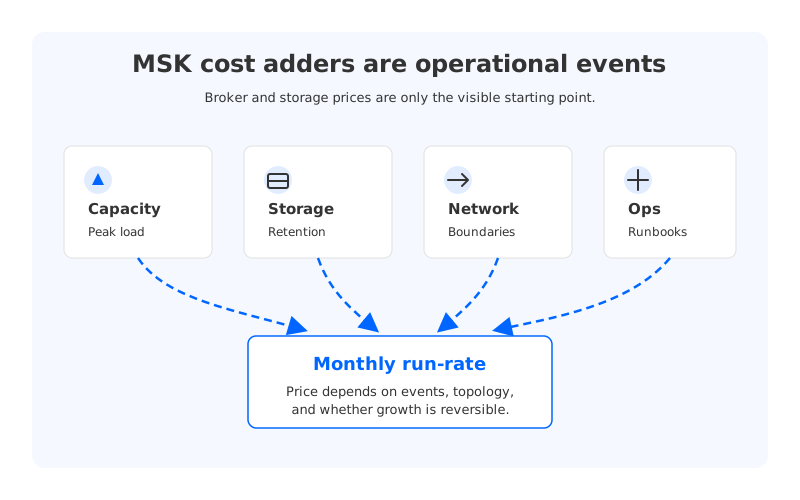
The right question is not "What does MSK cost?" It is "Which operational events add cost, and which of those costs become sticky?" That framing gives architects, SREs, and FinOps teams a common language. It also prevents the evaluation from turning into a shallow comparison of monthly totals that were built on different workload assumptions.
1Start with the published billable units
The AWS pricing page for Amazon MSK separates cost by deployment mode and related features. Provisioned clusters are shaped by broker instance usage, storage, optional storage throughput, and other AWS charges that may apply around the cluster. MSK Serverless uses a different model, including cluster hours and usage dimensions such as ingestion, storage, and partition-related charges. Private connectivity and data movement can also create charges outside the Kafka service line itself.
Those categories are a good starting point, but they are not a production model. A production model has to explain what causes each category to move. The same nominal ingest rate can produce different costs depending on read fanout, compression, retention, partition count, client network placement, and how often consumers replay old data. Kafka is not a single pipe; it is a distributed log with durable storage, replicated serving, consumer offsets, metadata, and recovery behavior.
| Cost surface | What appears in the estimate | What creates the operational adder |
|---|---|---|
| Broker or cluster hours | Running cluster capacity | Peak load, failure headroom, partition density, maintenance windows |
| Storage | Retention and backlog | Replication, growth bursts, compaction, replay windows, one-way expansion |
| Throughput | Write and read volume | Hot partitions, catch-up consumers, broker recovery, remote reads |
| Networking | Data transfer and connectivity | Cross-AZ clients, multi-VPC access, cross-Region movement, PrivateLink |
| Operations | Managed service assumption | Capacity reviews, quota management, runbooks, observability, migration planning |
This table is intentionally not a price calculator. Unit prices change by Region and service mode, and buyers should use current AWS pricing for the final estimate. The architectural point is more durable: a Kafka bill is the result of workload behavior interacting with deployment topology. If the topology changes what a burst, replay, or network boundary costs, the estimate must show that relationship.
2Model workload events, not average throughput
Average throughput is attractive because it gives the spreadsheet a clean input. It is also the number most likely to hide the expensive path. Kafka capacity must survive peak traffic, broker failure, rolling operations, consumer catch-up, retention changes, and replay. A cluster sized for average load can look cost-effective until an incident forces emergency scaling or aggressive retention changes.
A better estimate starts with workload events. For each event, ask which cost surface moves and whether the movement is temporary or permanent.
- Retention expansion: Which topics can grow from operational retention to analytical retention, and does that require more broker-attached storage, remote storage, or a separate cluster?
- Replay and backfill: When a consumer reprocesses large topics, does it stress broker I/O, remote storage fetch, network egress, or client-side limits?
- Partition growth: Does a higher partition count require more brokers for metadata, open files, network serving, or failure recovery rather than raw ingest?
- Network expansion: When clients move across VPC, account, AZ, or Region boundaries, which teams own the transfer and private connectivity charges?
- Failure recovery: During broker or AZ recovery, does the system need permanently paid spare capacity to keep the recovery path within the availability target?
This event-based view produces ranges instead of false precision. It also exposes the most important distinction in cost planning: some costs scale down when the event ends, while others become part of the monthly baseline. A one-week retention spike and a permanent storage expansion do not have the same financial meaning, even if both were triggered by the same incident.
3Network and connectivity charges need their own diagram
Kafka teams often discuss cost in broker and storage terms because those are closest to the cluster. Cloud bills do not care about that boundary. Data transfer and private connectivity are separate AWS cost surfaces, often owned by different teams than the Kafka service itself. That is how a streaming platform can look reasonable in the service estimate and still surprise FinOps after shared networking charges are allocated.
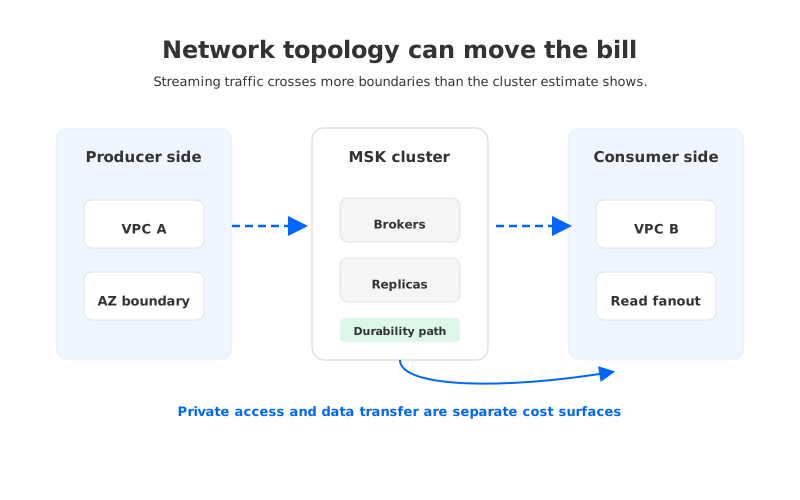
Three questions keep the network model honest. First, where do producers write from? A producer in another AZ, VPC, or Region changes both latency and cost behavior. Second, where do consumers read from? Read fanout can multiply traffic even when ingest is stable. Third, how is private access implemented? PrivateLink can be the right security and topology choice, but it has endpoint and data processing dimensions that should be modeled explicitly.
Cross-AZ traffic deserves careful treatment because Kafka availability patterns create data movement by design. Traditional Kafka replication keeps multiple broker copies for durability and availability, and client placement can create additional cross-zone paths. That does not make the design wrong. It means the design must be priced as a distributed system, not as a single managed endpoint.
The same rule applies to cross-Region replication, disaster recovery, and migration tooling. If a DR drill, migration backfill, or analytics replay moves terabytes through private or regional boundaries, the estimate should already contain that scenario.
4Serverless changes the surface, not the need for modeling
MSK Serverless can remove several provisioned-cluster decisions from the buyer's plate. Teams no longer pick broker instance types in the same way, and capacity management feels less like sizing a fixed cluster. That is valuable for workloads with uncertain demand.
The cost discipline does not disappear. Serverless pricing still depends on usage dimensions such as cluster time, data volume, storage, and partitions, and those dimensions are still driven by workload behavior. A low-traffic development cluster, a high-partition multi-tenant platform, and a replay-heavy event store can all have different cost profiles even if none of them is managed through broker instance selection.
This is where many small surprises begin. A service that feels idle from an application perspective may still have a baseline cost because the cluster exists. A workload with modest ingest may still carry partition or storage-related cost because Kafka's operating model is not only about bytes per second.
The practical comparison is therefore not "provisioned versus serverless" in isolation. It is "Which mode maps cleanly to the workload's cost drivers?" Provisioned can be attractive when demand is predictable and the team wants direct capacity control. Serverless can be attractive when demand is variable and the team values operational abstraction. Both still require a topology-aware estimate for networking, retention, replay, and client placement.
5Architecture determines which adders are structural
Some cost adders can be tuned away. Others are structural. If the architecture binds compute, hot storage, and durability to the broker, then scaling one dimension often moves the others. If the workload needs more retained data, the cluster may carry more broker-attached storage. If the workload needs more serving headroom, the platform may add brokers and rebalance data. If the design relies on server-side replica movement across zones, availability has a network cost shape.
Apache Kafka tiered storage changes part of this equation by moving completed log segments to remote storage while brokers keep the local tier for active data. That is a meaningful capability for retention-heavy workloads, and it can reduce pressure on broker-local disks. It is not the same as making the broker fully stateless. The hot path, local tier, topic configuration, remote-read behavior, and operational runbooks still matter.
The architectural question is sharper than the feature list: which cost adders remain coupled after the design is in production?
| Architecture choice | Cost adder it can reduce | Cost adder it may leave in place |
|---|---|---|
| Larger provisioned cluster | Emergency capacity pressure | Baseline spend, storage coupling, overprovisioned headroom |
| Tiered storage | Long-retention pressure on local disks | Hot-tier planning, broker serving pressure, remote-read behavior |
| Serverless MSK | Broker sizing work | Usage-driven storage, partition, data, and connectivity dimensions |
| Shared-storage Kafka-compatible design | Broker/storage coupling and some recovery movement | Migration validation, latency testing, governance integration |
This table is not a ranking. It keeps the evaluation fair. A workload with predictable traffic and modest retention may prefer the operational familiarity of an AWS-managed Kafka path. A workload with large replay windows, variable compute demand, and painful cross-zone traffic may need a different storage architecture to change the underlying cost curve.
6Where AutoMQ fits the evaluation
Once the evaluation reaches broker/storage coupling and cross-zone traffic, AutoMQ enters as a Kafka-compatible, cloud-native streaming architecture rather than as a discount on an MSK line item. AutoMQ keeps Kafka protocol compatibility while redesigning the storage layer around shared object storage. Its architecture uses stateless brokers, object-storage-backed durability, and a WAL/cache design so compute and durable storage can be scaled with fewer dependencies between them.
That matters because many MSK cost adders are symptoms of coupling. If durable data is tied to broker-local ownership, recovery, rebalancing, and storage growth become operational events around the broker fleet. If server-side replication moves data across zones, availability creates traffic that buyers need to model. AutoMQ's shared-storage approach changes those mechanics by placing durable log data in cloud storage and reducing broker ownership of long-lived data.
The evaluation still has to be empirical. Teams should test client compatibility, latency under their write path, consumer replay behavior, ACLs, quotas, observability, and rollback procedures. A Kafka-compatible system earns trust by matching the workload contract, not by claiming architectural elegance. AutoMQ is most relevant when that workload contract says the current cost problem is not a single price point but the way compute, storage, network, and operations are tied together.
For buyers comparing MSK and Kafka-compatible alternatives, the cleanest proof of concept uses the same workload trace on both sides. Keep ingest, read fanout, retention, partition count, failure test, and network placement constant. Then compare not only monthly cost, but also the operational steps required when the workload changes.
7A production cost-adder checklist
A useful MSK cost review should fit into a short engineering meeting. The goal is not to predict the future perfectly; it is to identify which future events would change the platform run-rate and who owns the decision when they happen.
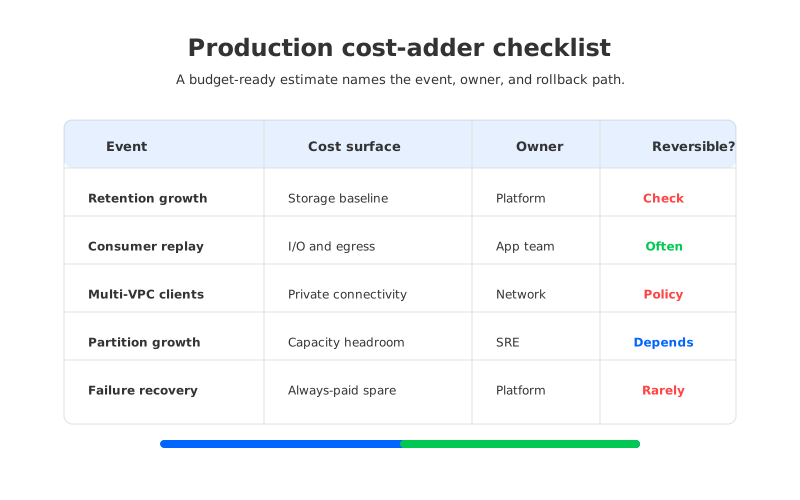
The checklist should begin with workload contract, not vendor choice. Define write throughput, read fanout, compression, retention, partition count, topic growth, client topology, and recovery objectives. Then add cost behavior for each operational event. If a line item has no owner, no trigger, or no rollback path, it is not ready for budget approval.
The most useful final column is "reversible?" It forces a sober discussion. A temporary replay that burns network for a day is different from a storage expansion that permanently raises the baseline. A private connectivity pattern that is correct for regulated traffic may still need an allocation model so application teams understand the charge. A broker headroom decision may be justified, but it should be visible as always-paid insurance.
Return to the original MSK estimate with that lens. The broker price and storage price still matter, but they are no longer the whole conversation. The mature question is whether the architecture makes cost growth predictable, attributable, and reversible when the workload changes.
If cross-AZ traffic and broker/storage coupling are part of your Kafka cost problem, review AutoMQ's technical guide to saving cross-AZ traffic costs with shared storage and use it as a starting point for a workload-specific proof of concept.
8References
- Amazon MSK pricing
- Amazon MSK Serverless developer guide
- AWS EC2 data transfer pricing
- AWS PrivateLink pricing
- Apache Kafka tiered storage documentation
- AutoMQ architecture overview
- AutoMQ compatibility with Apache Kafka
- AutoMQ cross-AZ traffic cost guide
9FAQ
9.1What are the most common MSK cost adders?
The most common adders are storage growth, cross-boundary data transfer, private connectivity, replay traffic, partition growth, and recovery headroom. They are easy to miss because some appear outside the main MSK service line or only occur during operational events.
9.2Is MSK Serverless always lower cost than provisioned MSK?
No. MSK Serverless changes the pricing surface and removes some capacity decisions, but cost still depends on workload dimensions such as data volume, storage, partitions, and cluster time. It should be compared against provisioned MSK using the same workload contract.
9.3Why does network topology matter for MSK cost?
Kafka traffic is not only producer writes. Consumers, replicas, backfills, migration jobs, and DR flows can all move data across AZ, VPC, account, or Region boundaries. Those boundaries can create AWS data transfer or private connectivity charges that belong in the streaming platform model.
9.4Does tiered storage eliminate broker/storage coupling?
Tiered storage can reduce pressure from long retention by moving older completed log segments to remote storage. It does not make brokers fully stateless, and teams still need to plan the hot tier, remote reads, topic configuration, and recovery behavior.
9.5When should AutoMQ be evaluated alongside MSK?
Evaluate AutoMQ when Kafka compatibility is required but the main cost pressure comes from architecture: broker/storage coupling, cross-AZ traffic, recovery movement, variable compute demand, or frequent capacity operations. The comparison should use the same workload trace and the same operational tests.


