
Table of Contents
Table of Contents
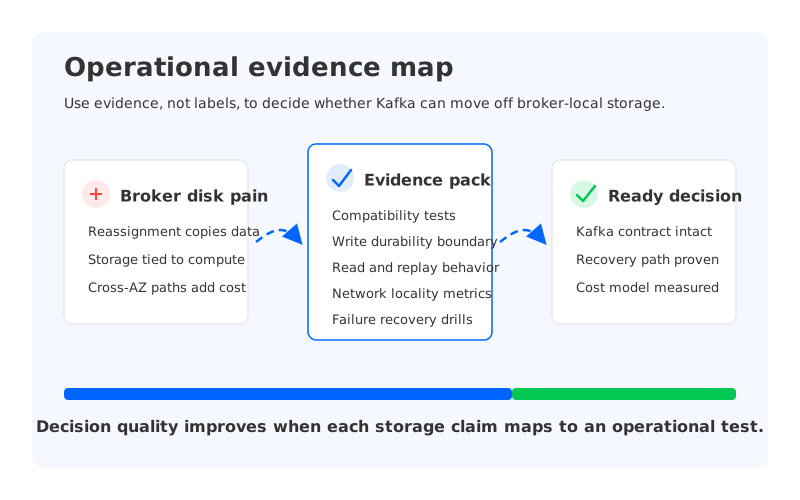
Teams usually search for diskless kafka after they have already felt the operational cost of broker-local storage. The cluster may be stable, but every capacity change is tied to disks, partition movement, replication traffic, and maintenance windows. Adding brokers does not only add compute. It also creates another data placement problem. Replacing brokers does not only replace instances. It reopens the question of where durable log data lives while clients continue to produce and consume.
That is why diskless Kafka is not a naming debate. It is a production evidence debate. A platform team considering this architecture needs proof across compatibility, durability, latency, network cost, failure recovery, and operational control. Without that evidence, "moving data off broker disks" can sound like a storage optimization when it is really a change to the failure model of the streaming platform.
1Why Broker Disks Became the Operational Bottleneck
Apache Kafka's classic architecture made sense in the environment where Kafka grew up. A broker owned local log segments, replicas were distributed across brokers, and availability came from keeping enough in-sync replicas alive. This model gave Kafka clear durability semantics and strong operational visibility. It also made the broker a combined compute, network, and storage unit.
That coupling becomes expensive in cloud operations because platform changes are rarely pure compute changes. When a hot topic needs more headroom, the team must ask whether partition placement and broker disks can absorb the change. When a broker is replaced, the team must reason about local log recovery and replica catch-up. When retention grows, the team buys more disk even if CPU is not the limiting resource. When a workload bursts for a few hours, over-provisioned storage can remain allocated long after the burst is gone.
Tiered storage improves one part of this picture by moving older log segments to remote storage. Apache Kafka's KIP-405 formalized this pattern as a way to offload log segments, but tiered storage does not automatically make brokers stateless. Active data, leader responsibility, local log layout, and replica mechanics can still keep day-to-day operations attached to broker-local state.
Diskless Kafka asks a sharper question: what evidence proves that the broker can be treated primarily as a compute node while durable storage lives outside the broker? The answer is not one benchmark. It is a set of operational checks that match how Kafka clusters fail, scale, recover, and get audited.
2The Evidence Buyers Should Ask For
The first evidence category is Kafka compatibility. A diskless or shared-storage design is not useful if it quietly changes the client contract that application teams depend on. Kafka users care about producer acknowledgments, ordering within a partition, offsets, consumer groups, ACLs, transactions where used, Kafka Connect behavior, monitoring, and the operational habits built around these APIs. A serious evaluation should test existing clients and tools before discussing savings.
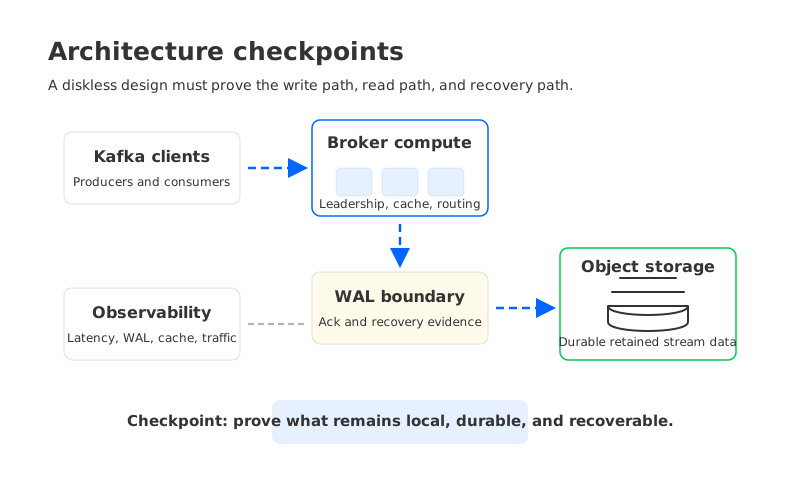
The second category is durability and acknowledgment semantics. If the broker no longer owns the primary durable log on local disk, the write path needs a clear persistence boundary. Evaluators should ask where data is durable when a producer receives an acknowledgment, what happens when a broker disappears, and how unflushed write buffers are recovered.
The third category is latency under load. Object storage is attractive for durability and cost, but object storage is not a drop-in replacement for local append latency. A production-ready design needs a write path that absorbs short-latency writes before data is organized into object storage. It also needs a read path that distinguishes tailing reads from catch-up reads, because the behavior of consumers reading the latest offsets is different from consumers replaying hours or days of history.
Those three categories are necessary, but the cloud bill and failure drills expose the rest of the design:
- Network locality: In a multi-AZ deployment, broker-to-broker replication and client-to-broker traffic can create inter-zone data transfer. AWS documents data transfer pricing separately from compute and storage, so the evaluation must model traffic paths rather than only disk capacity.
- Elasticity: Scaling should not require moving an entire retained log from one broker to another. The platform should show what changes during reassignment: metadata, ownership, cached state, WAL residue, or full data copies.
- Recovery operations: Broker loss should have a bounded recovery path that the team can test. The important metric is not only "did the cluster recover?" but what data had to be replayed, re-uploaded, or rebalanced.
- Governance and ownership: Procurement and security teams need to know where data is stored, which account owns it, which identity can access it, and how audit controls apply.
- Observability: The design should expose metrics for write latency, object storage requests, cache hit rate, WAL health, reassignment progress, and cross-AZ traffic.
3A Practical Evaluation Framework
The safest way to evaluate diskless Kafka is to start with the workload, not the vendor architecture diagram. A telemetry pipeline with high retention, bursty ingestion, and replay-heavy consumers has a different risk profile from a low-latency transaction stream with strict p99 requirements. Both can run on Kafka-compatible infrastructure, but they stress different parts of the storage path.
Start with the write path. For each critical topic, record peak produce throughput, acknowledgment policy, current replication factor, target p95 and p99 produce latency, and the largest acceptable recovery point. Then ask the platform to map those requirements to its persistence boundary. If it uses a write-ahead log, identify the WAL backend and failure domain.
Then test the read path. Most Kafka incidents are not steady-state demos; they are replays, catch-up events, consumer lag recovery, and backfills after downstream failure. A diskless architecture should explain where hot data is served from, when cold data comes from object storage, and how cache behavior changes when many consumers replay the same range. This is where a generic storage-cost story becomes a platform operations story.
Cost modeling should follow the traffic path rather than the instance list. Broker-local Kafka combines broker compute, broker storage, replica replication, client traffic, and operational over-provisioning. A shared-storage architecture changes that bill by shifting durable data to object storage and reducing the need to size brokers around retained data. It can also change inter-zone traffic behavior when the design controls producer, consumer, and replication paths across availability zones.
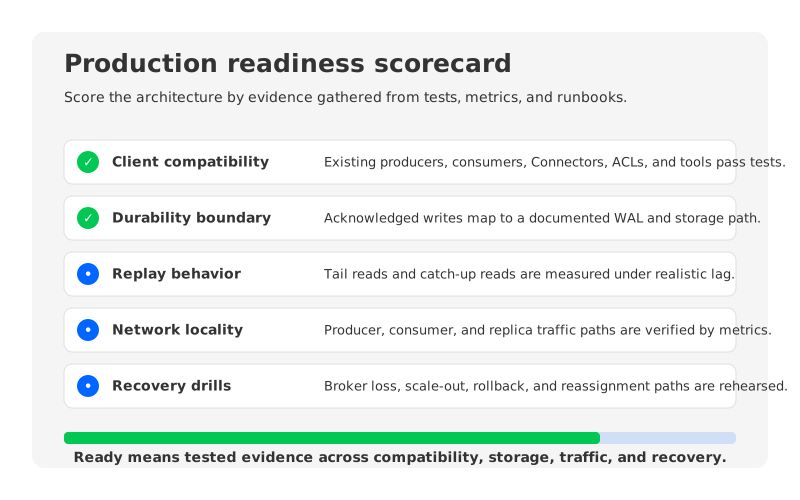
The following scorecard keeps the evaluation grounded:
| Evidence area | What to request | Why it matters |
|---|---|---|
| Client compatibility | Test results for existing producers, consumers, Connectors, ACLs, and admin tools | A storage change should not force application rewrites. |
| Write durability | Acknowledgment boundary, WAL behavior, object storage commit path, and broker failure drill | The team must know what "acknowledged" means after broker loss. |
| Read behavior | Tail-read latency, catch-up throughput, cache policy, and replay tests | Replays expose storage architecture faster than steady-state reads. |
| Network cost | AZ-aware traffic map and measured inter-zone data transfer | Cloud transfer fees can dominate large streaming bills. |
| Reassignment | Partition movement procedure and elapsed time under retained data | Elasticity fails if scale-out still means copying retained logs. |
| Operations | Metrics, alerts, upgrade path, rollback plan, and data ownership model | Platform teams need evidence they can run, not only architecture claims. |
The table is intentionally operational. It avoids a common evaluation mistake: comparing product labels before comparing failure behavior. "Diskless" is only valuable when the evidence shows that the platform can keep Kafka semantics while changing the storage and recovery mechanics that made classic broker disks painful.
4Where AutoMQ Fits the Framework
Once the evaluation reaches this point, AutoMQ becomes relevant as a Kafka-compatible shared-storage implementation rather than as a generic Kafka replacement. AutoMQ keeps the Kafka protocol and upper-layer semantics while replacing Kafka's local log storage with S3Stream, its streaming storage layer built around WAL storage and S3-compatible object storage. Brokers handle Kafka requests, caching, leadership, and scheduling, while durable data is organized in shared storage.
This matters for the evidence categories above. AutoMQ documents its Shared Storage architecture, where WAL storage absorbs low-latency writes and object storage holds durable stream data. The WAL is not a second long-term storage system; it is a write buffer and recovery component. Operators should validate which WAL backend is used and what recovery behavior it provides under broker loss.
AutoMQ also addresses elasticity through stateless brokers and metadata-driven partition reassignment. Traditional Kafka reassignment can require copying large amounts of partition data because the partition's retained log is tied to broker storage. In AutoMQ's shared-storage model, most data is already in object storage, so reassignment can focus on metadata, leadership, and any data temporarily held in WAL. AutoMQ's documentation describes partition reassignment in seconds and continuous self-balancing as capabilities built on that storage separation.
The network-cost angle is equally practical. In a multi-AZ Kafka deployment, replication and client placement can create cross-AZ traffic. AutoMQ's documentation describes an S3-based architecture and AZ-aware routing features designed to avoid cross-AZ replica replication and reduce producer and consumer inter-zone traffic when deployment and client configuration meet documented constraints. Evaluators should verify this by matching producer, broker, and consumer placement with cloud network metrics.
For deployment control, AutoMQ BYOC is also relevant to security and procurement teams. In a Bring Your Own Cloud model, the control plane and data plane run in the customer's cloud environment, and the customer's Kafka data remains in customer-owned infrastructure. IAM, bucket policy, encryption, and audit logging still need review, but the ownership boundary is concrete.
The right conclusion is not that every Kafka workload should move off broker disks immediately. The better conclusion is that broker-local storage should no longer be treated as the default answer for every Kafka workload in the cloud. If the workload is retention-heavy, bursty, expensive to rebalance, or exposed to high cross-AZ traffic, shared storage deserves a serious proof of evidence.
5Migration Evidence Before Cutover
A diskless Kafka evaluation becomes real when it reaches migration planning. This is where platform teams discover whether the architecture preserves the details that applications depend on: topic names, partition counts, offsets, consumer group behavior, ACLs, dashboards, and runbook assumptions. The migration plan should prove those details before the first production cutover window.
Use a staged proof rather than a single all-or-nothing migration. Mirror representative topics, run existing consumers against the target platform, compare lag and throughput, and execute rollback drills. Include replay-heavy, broker-failure, scale-out, and traffic-locality tests while the rollback path is still simple.
Procurement should be involved before final technical sign-off because the cost model changes shape. Broker disks may shrink, object storage may grow, inter-zone transfer may change, and operational labor may move from partition rebalancing toward object storage and IAM governance. A credible business case should show assumptions for retention, ingest rate, read fan-out, availability-zone placement, object storage class, and network transfer.
6What "Ready" Looks Like
A team is ready to move Kafka storage out of broker disks when it can answer five questions without hand-waving. What client behavior changes? Where is an acknowledged write durable? How does the platform recover when a broker disappears? Which traffic paths cross availability zones? What metrics prove that scaling and reassignment are working? These questions are deliberately plain because production incidents are plain. Either the platform has evidence, or the team is carrying unknown risk.
The strongest diskless Kafka case is not that disks disappear. Disks were never the real issue. The issue is that broker-local durable state makes cloud Kafka harder to scale, harder to rebalance, and harder to cost-control than the rest of the cloud infrastructure around it. Moving storage out of brokers is worth doing only when the target architecture can prove that it keeps the Kafka contract while improving those operational constraints.
If you are building that evidence pack, start with the shared-storage mechanics and the operational tests rather than a feature checklist. AutoMQ's architecture documentation is a useful next step for teams evaluating Kafka-compatible shared storage, stateless brokers, and object-storage-backed durability: review the AutoMQ architecture docs.
7References
- Apache Kafka KIP-405: Kafka Tiered Storage
- Apache Kafka KIP-1150: Diskless Topics
- AWS EC2 On-Demand Pricing: Data Transfer
- AWS S3 Pricing
- AutoMQ Shared Storage Architecture
- AutoMQ Compatibility with Apache Kafka
- AutoMQ and Tiered Storage Differences
- AutoMQ Partition Reassignment in Seconds
- AutoMQ Cross-AZ Traffic Optimization
8FAQ
8.1Is diskless Kafka the same as Kafka tiered storage?
No. Tiered storage moves older log segments to remote storage while brokers can still depend on local storage for active log data and replica behavior. Diskless or shared-storage Kafka changes the primary storage model more deeply by reducing the broker's dependence on local durable data. The exact boundary depends on the implementation, so evaluators should ask where acknowledged writes become durable and what remains on the broker.
8.2Does moving Kafka off broker disks remove all storage risk?
No. It changes the storage risk profile. Object storage durability, WAL behavior, metadata consistency, cache behavior, IAM permissions, and network access become part of the operating model. The benefit is that these concerns can be managed separately from broker instance lifecycle, but they still need explicit tests and runbooks.
8.3What workloads are strong candidates for diskless Kafka evaluation?
Good candidates include retention-heavy topics, bursty workloads, clusters with frequent scaling pressure, replay-heavy analytics pipelines, and multi-AZ deployments where replication or client placement creates significant inter-zone traffic. Ultra-low-latency workloads can still be candidates, but the WAL backend, p99 latency profile, and failure-domain design need closer validation.
8.4What should be tested before migrating from Apache Kafka?
Test existing clients and admin tools, producer acknowledgment behavior, consumer group offsets, replay throughput, broker failure recovery, partition reassignment, observability, ACLs, and rollback. Include cost telemetry from the cloud account so the migration decision is tied to measured compute, storage, and network behavior rather than estimates alone.
8.5How does AutoMQ relate to diskless Kafka?
AutoMQ is a Kafka-compatible streaming platform that uses a Shared Storage architecture with S3Stream, WAL storage, and S3-compatible object storage. Its brokers are designed to be stateless from the perspective of durable log storage, which supports faster reassignment, elastic scaling, and cloud-native cost controls while preserving Kafka protocol compatibility.


