
Table of Contents
Table of Contents
Teams usually do not search for ai personalization backbone kafka when the first recommendation model goes live. They search for it after the personalization surface starts touching revenue, support load, or user trust. Feature events arrive from applications, model outputs need to be explainable, user profiles must stay fresh, and the streaming layer becomes the place where product velocity meets operational risk. Kafka is a natural fit for this backbone because it gives platform teams durable event streams, Consumer group isolation, offsets, replay, and a large ecosystem around producers, consumers, stream processing, and connectors.
The problem is that personalization traffic does not behave like a tidy analytics feed. A model launch can change write throughput in a few hours. A ranking experiment can create read fan-out from feature builders, online services, model monitoring jobs, and fraud or safety checks. A bad schema change can poison several downstream paths before the owning team knows which consumer is behind. The backbone has to behave like a product platform, not a queue hidden behind one service team.
The useful question is not whether Kafka can carry AI personalization events. It can. The useful question is whether the operating model around Kafka can keep up when freshness, rollback, governance, and cost all become first-order constraints.
1Why teams search for ai personalization backbone kafka
An AI personalization backbone is the event layer that connects user behavior, profile updates, feature computation, model scoring, experimentation, and downstream audit or analytics systems. In a mature setup, the backbone is not one topic. It is a set of event contracts, retention policies, replay paths, access controls, and operational rules that make personalization reproducible under load.
That is why Kafka remains a common starting point. The Apache Kafka documentation defines the core concepts platform teams depend on: producers write records to topics, consumers read those records, Consumer groups coordinate partition ownership, and offsets give applications a durable position in each Partition. Kafka transactions and idempotent producers also matter for teams that need stronger write guarantees across partitions or retries. Those semantics are more important for personalization than they first appear, because a recommendation is often the visible output of many small event decisions.
The search intent behind ai personalization backbone kafka usually contains four production concerns:
- Freshness pressure. User actions, inventory changes, fraud signals, and content features lose value quickly. Batch recomputation may still exist, but the serving path needs fresher state than a nightly pipeline can provide.
- Fan-out pressure. The same events feed online features, offline training sets, monitoring, experimentation, and customer analytics. Each extra consumer increases the need for clear ownership and lag visibility.
- Governance pressure. Personalization data often contains user identifiers, consent state, location, purchase behavior, or inferred preferences. The streaming platform must respect data boundaries, not bolt them on after launch.
- Elasticity pressure. Model experiments are uneven. Traffic rises during launches, campaigns, incidents, and backfills, while stable periods may not support permanently reserved capacity.
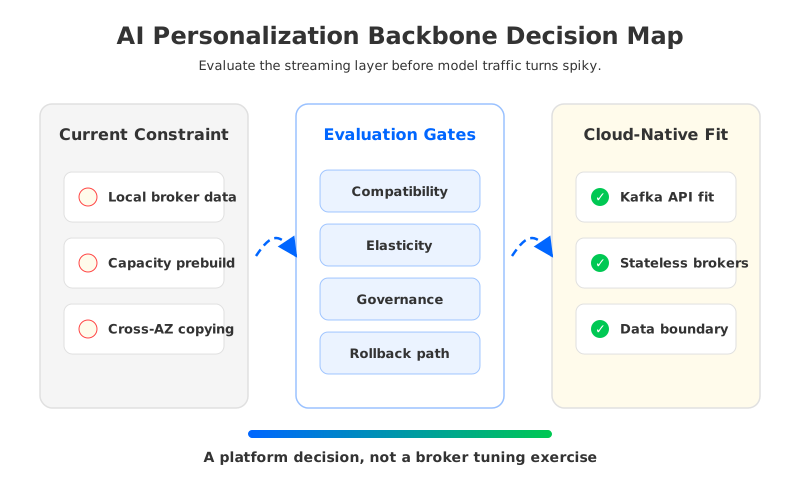
These pressures are connected. A team that only optimizes for throughput may miss the governance problem. A team that only optimizes for access control may still discover that broker-local storage makes capacity planning and recovery painfully slow. The backbone decision needs a framework that treats Kafka semantics, cloud operations, and organizational boundaries together.
2The production constraint behind the problem
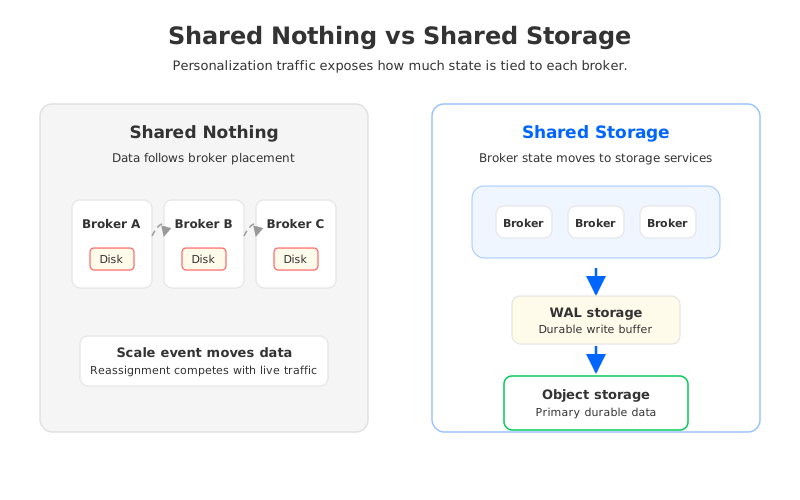
Traditional Kafka uses a Shared Nothing architecture. Each broker owns local storage for the partitions it hosts, and reliability comes from replication across brokers. That model was the right trade-off for Kafka's original data center environment. It keeps partitions independent, gives predictable append behavior, and lets clients reason about offsets and ordering without depending on a remote storage service for every operation.
Cloud infrastructure changes the cost and recovery shape of that design. When a broker owns persistent data, scaling out means adding compute and then waiting for the data layout to catch up. The cluster has to rebalance partition leadership and, in many cases, move data. When a broker is overloaded, the corrective action can compete with the live workload it is trying to protect. When a team increases retention to support feature replay, the broker storage footprint grows even if the compute need does not. When the deployment spans Availability Zones, replication and consumer traffic can create network costs that sit outside the broker sizing conversation.
For AI personalization, the mismatch shows up in ordinary operations rather than exotic failures. A team may add partitions for an additional feature family and then find that reassignment work affects tail latency. A model monitoring job may need to replay a week of feature events and steal disk or network headroom from live consumers. A product launch may push traffic above the planned peak, but adding brokers does not immediately create balanced capacity because the data layout still has to catch up.
Apache Kafka's Tiered Storage reduces some pressure by moving older log segments to remote storage. That is useful for retention-heavy workloads, and platform teams should evaluate it honestly. It does not fully remove the local storage operating model, because recent data, broker placement, and partition reassignment still matter. For a personalization backbone, the question is whether the platform can scale and recover around bursty, model-facing traffic without turning every launch into a storage migration event.
3Architecture options and trade-offs
There are three broad paths for a team building a Kafka-compatible personalization backbone. None is universally correct, and the wrong answer usually comes from treating the choice as a feature checklist instead of an operating model decision.
| Option | What changes | Where it fits | Main risk |
|---|---|---|---|
| Operate standard Kafka more carefully | Better partition planning, quota controls, storage sizing, and runbooks | Teams with stable traffic and strong Kafka SRE ownership | Operational effort grows with every model and consumer path |
| Add Tiered Storage | Historical data moves to remote storage while Kafka keeps its local hot path | Retention and replay cost dominate the problem | Elasticity and reassignment still depend on broker-local state |
| Adopt Kafka-compatible Shared Storage architecture | Brokers become mostly stateless while durable data moves to object storage plus WAL storage | Teams that need elastic scaling, simpler recovery, and stronger cloud alignment | Requires validation of latency, migration, tooling, and deployment boundaries |
The evaluation should start with compatibility because AI stacks accumulate dependencies quietly. A personalization pipeline may include Flink jobs, Kafka Connect connectors, schema tooling, internal SDKs, consumer lag dashboards, and incident automation built around Kafka APIs. Any platform change that breaks those contracts turns an infrastructure project into an application migration. Client compatibility, Consumer group behavior, offsets, transactions, and connector support should be verified before cost or elasticity claims receive much weight.
Cost comes next, but it needs to be modeled as TCO (Total Cost of Ownership), with broker instance price as one line item rather than the whole answer. For cloud Kafka, the durable cost envelope often includes compute, block storage or local disks, object storage for longer retention, cross-AZ traffic, PrivateLink or network endpoint charges, and the human cost of operating reassignments and incidents. A platform that looks lower cost in steady state may become expensive during replay, migration, or experiments if teams need to overprovision for rare peaks.
Governance is the third gate. Personalization data has a habit of spreading. The backbone should make it clear which data stays in which VPC (Virtual Private Cloud), which topics contain regulated fields, how retention maps to consent and deletion rules, and how audit teams can reconstruct data flow. A managed service outside the customer's boundary may be acceptable for some workloads, while other organizations need the control plane and data plane to run inside their own cloud account or private environment.
The final gate is migration risk. The safest target architecture still fails the business if producers, consumers, offsets, and rollback are treated as a weekend cutover. A good migration plan defines topic scope, starting positions, consumer progress, dual-read or proxy behavior, promotion criteria, and rollback windows. It also sets a rule for the old path: keep it valid until the target path has passed both technical validation and owner sign-off.
4Evaluation checklist for platform teams
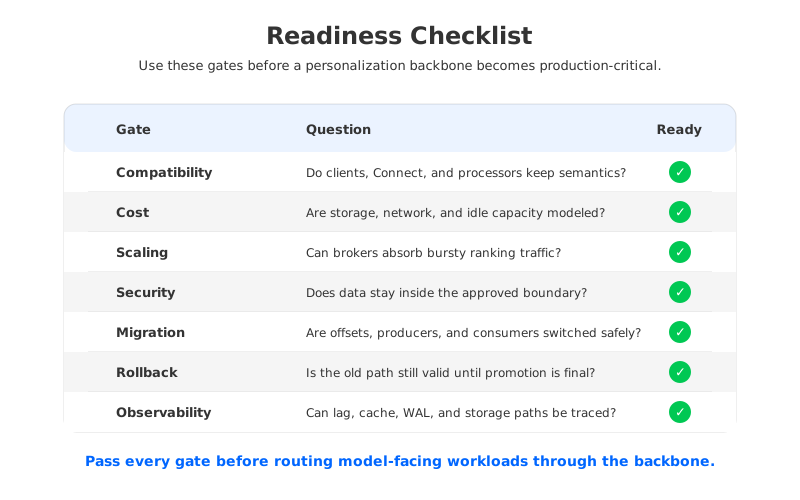
A practical checklist should force architecture and operations into the same conversation. The following scorecard works well before a proof of concept because every item can be tested or assigned to an owner.
| Gate | What to verify | Failure signal |
|---|---|---|
| Compatibility | Existing producers, consumers, Connect jobs, stream processors, ACLs, and schema tooling continue to work | Application teams need client rewrites before platform value is visible |
| Freshness | Consumer lag SLOs are defined per workload class, not averaged across the cluster | Feature builders and online services compete without priority |
| Elasticity | Scale-out and scale-in procedures are measured during burst and backfill traffic | Adding brokers does not relieve pressure quickly enough |
| Storage model | Retention, replay, and hot data placement are separated in the design | Longer retention forces compute or disk overprovisioning |
| Network cost | Cross-AZ produce, replication, fetch, and connector paths are mapped | The bill grows faster than topic volume |
| Governance | Data boundary, encryption, identity, audit, and deletion rules are explicit | Sensitive event streams rely on tribal knowledge |
| Migration | Offset continuity, producer switching, consumer switching, and rollback are tested | The cutover plan assumes downtime or manual offset repair |
| Observability | Lag, broker load, WAL storage, cache behavior, and object storage paths are visible | Incidents become arguments between platform, ML, and application teams |
This checklist intentionally avoids a single pass/fail score. A low-risk recommendation feed and a regulated real-time credit decisioning path will not have the same threshold. The point is to expose which risks belong to Kafka semantics, which belong to cloud infrastructure, and which belong to the organization that owns the data.
5How AutoMQ changes the operating model
After the neutral evaluation, the architectural direction becomes easier to state. If the main constraint is broker-local state, then the deeper fix is not another round of broker tuning. It is a Kafka-compatible system that keeps Kafka semantics while moving durable storage out of the broker lifecycle.
AutoMQ is a Kafka-compatible cloud-native streaming platform built around a Shared Storage architecture. It keeps the Kafka protocol and ecosystem surface while replacing Kafka's local log storage with S3Stream, a storage layer that uses WAL (Write-Ahead Log) storage for durable write buffering and S3-compatible object storage as the primary data repository. In that model, AutoMQ Brokers handle Kafka protocol processing, leadership, caching, routing, and scheduling, while persistent data is no longer tied to a specific broker's local disk.
AutoMQ's official documentation describes several relevant pieces for this decision:
- AutoMQ's Kafka compatibility documentation states that it aligns with Kafka protocol and ecosystem expectations, including clients, connectors, and related components.
- The Shared Storage architecture documentation explains how WAL storage and object storage replace broker-local log storage and make brokers stateless.
- AutoMQ BYOC keeps control plane and data plane components inside the customer's cloud account boundary, which matters for teams that cannot route personalization data through an external vendor data plane.
- Kafka Linking supports migration workflows that preserve topic data and consumer progress, which reduces the risk of treating a backbone migration as a hard cutover.
For AI platform teams, the most important shift is organizational. The streaming platform can stop being a fragile shared cluster where every model launch competes for broker-local storage headroom. It can become a Kafka-compatible substrate with clearer scaling, ownership, and recovery boundaries. That is the difference between "Kafka as a service dependency" and "Kafka as a personalization backbone."
6FAQ
6.1Is Kafka still a good choice for an AI personalization backbone?
Yes, Kafka remains a strong fit when teams need durable event streams, replay, Consumer groups, offsets, and mature ecosystem integrations. The design question is less about Kafka APIs and more about whether the chosen Kafka-compatible platform can handle bursty personalization traffic, governance boundaries, and recovery requirements.
6.2Does Tiered Storage solve the personalization backbone problem?
Tiered Storage helps when long retention and historical replay are major cost drivers. It does not fully remove the operational dependency on broker-local hot storage and partition placement. Teams should evaluate it as one option, not as a complete replacement for an elastic operating model.
6.3When should a team consider Shared Storage architecture?
Shared Storage architecture becomes attractive when broker-local storage is the bottleneck behind scaling, recovery, or TCO. It is especially relevant when traffic is bursty, retention windows are long, or cross-AZ data movement and reassignment work create recurring operational friction.
6.4What should be tested before migrating a personalization backbone?
Test client compatibility, producer behavior, Consumer group offsets, replay speed, lag under burst, schema handling, access controls, observability, and rollback. The migration is ready only when the old path can remain valid until topic promotion and consumer switching have been verified.
6.5How does AutoMQ fit BYOC requirements?
AutoMQ BYOC is designed so the control plane and data plane run in the customer's own cloud account and VPC. For personalization workloads with strict data residency or security boundaries, that deployment model lets teams evaluate a Kafka-compatible Shared Storage architecture without moving event data into an external vendor-hosted data plane.
7References
- Apache Kafka documentation
- AutoMQ compatibility with Apache Kafka
- AutoMQ Shared Storage architecture
- AutoMQ WAL storage
- AutoMQ Kafka Linking overview
- AutoMQ Continuous Self-Balancing
- Amazon S3 data durability
If your personalization roadmap is starting to turn Kafka into a shared product surface, evaluate the backbone before the next launch makes the decision for you. Start with the checklist above, then compare it against AutoMQ BYOC for a Kafka-compatible deployment model that keeps cloud infrastructure and data boundaries under your control.


