
Table of Contents
Table of Contents
Teams searching for ai ready event schemas kafka are rarely looking for a serialization tutorial. They already know that Avro, Protobuf, JSON Schema, and Kafka headers can carry well-structured events. The harder question is whether those events can survive production AI workloads: fast feature updates, agent feedback loops, model evaluation streams, replay-heavy experiments, and governance reviews that ask where a decision came from. A schema is AI-ready only when the platform around it keeps the data fresh, traceable, evolvable, and recoverable without turning every change into a Kafka operations project.
That changes the bar for a Kafka-compatible streaming platform. The schema registry, producer contracts, and data quality checks matter, but they sit on top of partitions, offsets, consumer groups, transactions, Kafka Connect pipelines, retention settings, and storage architecture. If the platform cannot scale a hot topic, recover a failed broker, replay older events, or move workloads across environments without large operational ceremonies, the event schema may be clean on paper and fragile in practice. The operational guardrail is the useful unit of design.
1Why teams search for ai ready event schemas kafka
AI platform teams usually arrive at event schemas from a concrete failure. A recommendation model starts consuming a clickstream topic whose fields were designed for dashboard analytics, not online feature generation. An agent workflow needs the prompt, retrieved context, tool output, and final answer in the same trace, but those records were emitted by different services with different naming habits. A fraud model needs low-latency signals and a replayable audit trail, while the governance team asks whether the schema can preserve consent, tenant, lineage, and policy metadata.
The phrase "AI-ready" is doing real work here. It means the event can serve multiple readers without losing meaning. Training jobs need historical replay. Online inference needs fresh events. Evaluation jobs need deterministic joins across model versions, features, and outcomes. Compliance reviewers need enough context to reconstruct why a model saw a particular input. Kafka is a natural backbone because it preserves ordered records within partitions, assigns offsets, supports independent Consumer groups, and integrates with Kafka Connect and stream processing ecosystems. The catch is that Kafka does not remove the need for operational discipline.
A practical AI-ready event design usually needs four schema layers:
Those layers are not a reason to inflate every record. They are a reason to decide which metadata belongs in the record value, which belongs in headers, and which belongs in a catalog or registry. The design point is simple: if a future consumer cannot tell whether the event is safe and useful for an AI workflow, the schema is not ready yet.
2The production constraint behind the problem
Schema work becomes operational work as soon as the event stream carries real traffic. A producer can evolve a field in minutes; a downstream training pipeline may replay months of data that includes every old shape of that field. A consumer group can lag during a model backfill; the platform must retain data long enough for the group to recover. A transactional producer can protect multi-partition writes, but only when the application and broker configuration preserve the expected Kafka semantics. The schema team can define the contract, yet the streaming platform decides whether the contract remains usable during load, failure, and migration.
Traditional Kafka's Shared Nothing architecture makes that pressure visible. Each broker owns local log segments for its partitions, and replicas are copied between brokers for durability and availability. This model is proven and well understood, but cloud deployments add a cost and elasticity dimension that schema governance teams feel indirectly. Longer retention means more broker-attached storage. Rebalancing partitions means moving data across nodes. Multi-AZ durability means replication traffic across failure domains. Backfills and catch-up reads compete with the same fleet that is serving fresh writes and tailing reads.
For AI workloads, the mismatch appears in a predictable sequence. First, teams add metadata to make events more useful for models and audits. Then they increase retention because experiments and investigations need replay. Then model training, feature generation, and evaluation jobs create bursty read patterns. Finally, platform owners discover that a schema governance initiative has become a storage, network, and capacity planning problem. The schema itself did not cause the problem; it revealed how tightly event quality is coupled to the operating model.
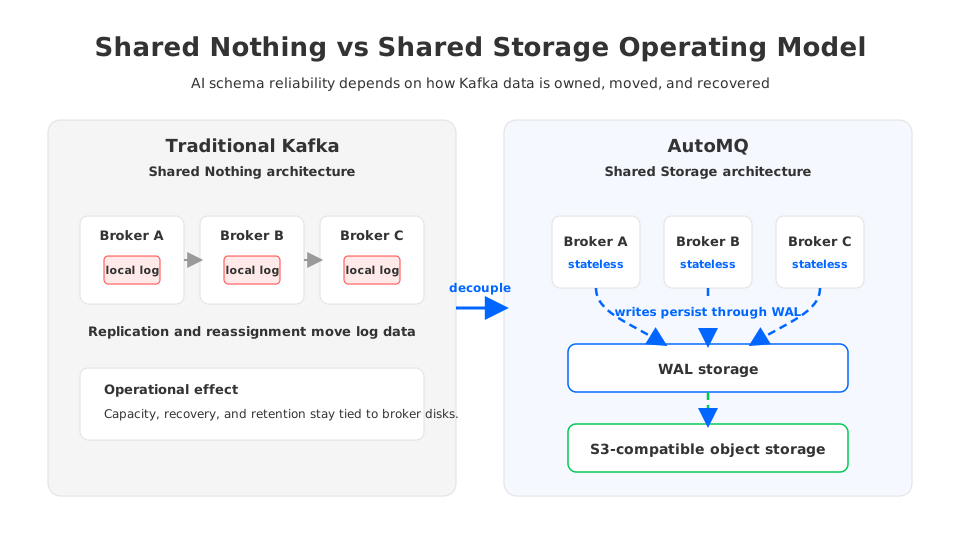
Kafka Tiered Storage can help when historical data dominates local disk pressure, and platform teams should evaluate it honestly. It offloads older log segments to remote storage while preserving Kafka's broker model for active data. That can be a good fit when the main pain is long retention. It does not, by itself, make brokers stateless or remove the need to reason about local hot data, partition ownership, replication behavior, and operational movement during scaling or recovery. AI-ready schemas need both retention and elasticity; confusing those two creates bad architecture choices.
3Architecture options and trade-offs
The first design decision is whether schema governance is only an application concern or a platform concern. Treating it as an application concern keeps the streaming layer simple: define schemas, enforce compatibility, document owners, and let each team manage the consequences. That approach works while traffic is stable and consumers are known. It starts to break when a single topic feeds online inference, offline training, feature stores, audit systems, and customer-facing automations with different freshness and replay needs.
The trade-off is not "strict governance or developer speed." It is where the platform places the friction. Loose schemas make the first producer fast and every later consumer slower. Overly rigid schemas protect consumers but push teams toward shadow topics and out-of-band data copies. A useful architecture gives teams a narrow, well-lit path: version compatible changes, reject unsafe changes early, expose lineage and ownership, and make replay and rollback routine enough that teams test them before an incident.
The following decision map is a compact way to evaluate the platform side of the problem.
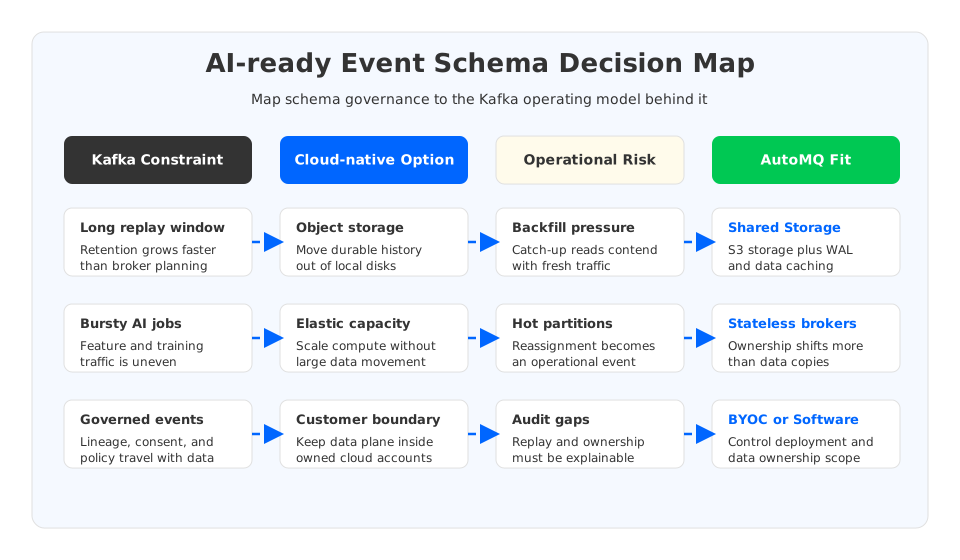
| Decision area | What to ask | Why it matters for AI workloads |
|---|---|---|
| Compatibility | Can existing Kafka clients, serializers, Consumer groups, transactions, and Connect jobs keep their expected behavior? | AI teams often reuse existing data paths; breaking client semantics turns schema work into migration work. |
| Cost model | Does retention, replay, and multi-AZ deployment scale with broker-local disks, replicated bytes, or object storage? | Training and evaluation create historical reads that can make storage and network assumptions visible. |
| Elasticity | Can the cluster absorb bursty producers, backfills, and catch-up consumers without long partition movement? | Feature generation and model refresh jobs are rarely smooth, steady workloads. |
| Governance | Are ownership, schema version, data classification, consent, and lineage first-class fields or enforceable metadata? | AI outputs are hard to audit when the input event cannot explain its origin and policy scope. |
| Recovery | Can the platform recover broker capacity, preserve offsets, and resume consumers predictably? | A model pipeline that misses or duplicates events may produce silent quality drift. |
| Migration | Can teams move topics, offsets, and producers with a rollback path? | Schema modernization often happens while production systems still depend on older topics. |
This framework keeps product selection in its proper place. A self-managed Kafka cluster, managed Kafka service, Kafka with Tiered Storage, or Kafka-compatible shared-storage system can all be reasonable depending on workload shape and team boundaries. The wrong choice is the one that optimizes only for schema syntax while ignoring the cost and recovery path that will carry those schemas for years.
4Evaluation checklist for platform teams
The checklist should start with the event contract and move outward to the operating model. A schema that is technically compatible but operationally unreplayable is not a production contract. The reverse is also true: a scalable streaming platform cannot save an event design that hides meaning in undocumented fields.
Use these checks before approving a high-value AI event stream:
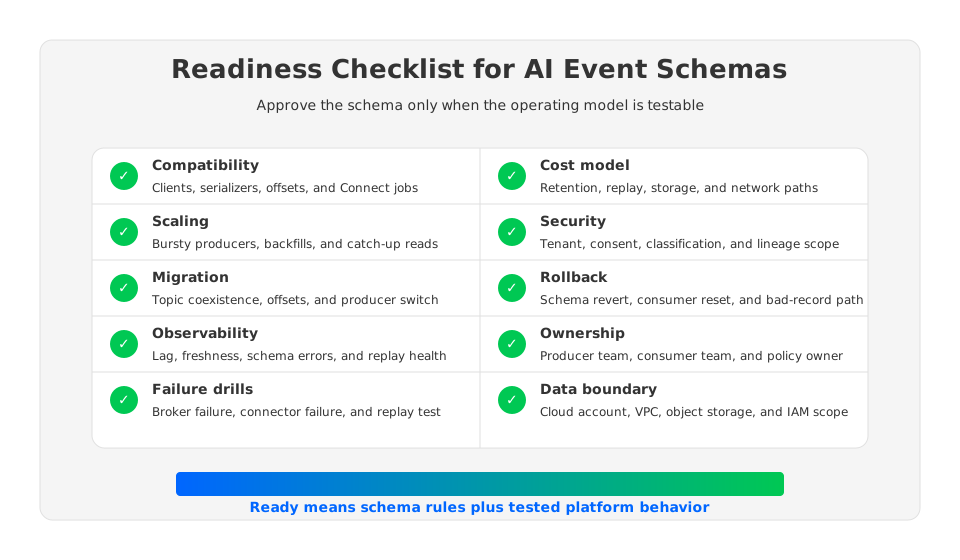
The checklist is intentionally operational. Many schema reviews stop at field names, optionality, and compatibility mode. Those checks are necessary, but AI systems fail in less tidy ways: a consumer silently falls behind, a backfill reads more data than the cluster can serve, a connector emits malformed records for one tenant, or a producer changes an enum that an evaluator treats as a label. The platform has to make these failures observable and reversible.
5How AutoMQ changes the operating model
Once the evaluation framework points to storage-bound scaling, replay cost, and broker recovery as recurring risks, a different architecture becomes worth considering. AutoMQ is a Kafka-compatible cloud-native streaming platform that keeps Kafka protocol and ecosystem compatibility while changing the storage layer underneath. Instead of binding durable log data to broker-local disks, AutoMQ uses a Shared Storage architecture with S3-compatible object storage, WAL (Write-Ahead Log) storage, data caching, and stateless brokers.
That change matters for AI-ready schemas because the operating unit shifts. In traditional Kafka, a partition's data placement is tightly coupled to broker storage. Scaling, recovery, and reassignment often become data movement problems. In AutoMQ, durable data is stored in shared object storage, while brokers focus on Kafka request handling, ownership, caching, and scheduling. Partition reassignment can focus more on metadata and traffic ownership than on copying large broker-local logs. For teams that frequently add AI consumers, run backfills, or resize capacity around training windows, this reduces the friction around the schema lifecycle.
The write path also deserves a careful reading. AutoMQ's S3Stream layer persists writes through WAL storage before data is uploaded and compacted into S3 storage. The WAL is not a replacement for the event schema or the governance layer; it is the persistence mechanism that lets the platform decouple fast writes from long-term object storage. Different AutoMQ deployments can use different WAL types, so latency and durability planning should be tied to the chosen edition and cloud environment. AutoMQ Open Source uses S3 WAL, while AutoMQ BYOC and AutoMQ Software can support other WAL storage options for production requirements.
The governance boundary is also different from a hosted SaaS assumption. In AutoMQ BYOC, the control plane and data plane run inside the customer's cloud account and VPC. Customer message data remains in customer-owned infrastructure, including the object storage backing the data plane. That deployment boundary is useful when AI event streams carry regulated, tenant-scoped, or sensitive operational data. It does not remove the need for schema policy, IAM, encryption, and network review, but it gives platform teams a clearer ownership model than pushing event data through an external service boundary.
AutoMQ is not the answer to every schema problem. If your main issue is a poorly named field, fix the schema. If your main issue is one connector that lacks dead-letter handling, fix the connector. AutoMQ becomes relevant when the same AI schema program keeps running into broker-local storage, long reassignments, cross-Availability Zone traffic, retention cost, and migration risk. At that point, the architecture underneath Kafka compatibility is part of the schema strategy.
6FAQ
6.1What makes an event schema AI-ready in Kafka?
An AI-ready event schema carries enough stable meaning for real-time inference, offline training, evaluation, replay, and audit. That usually includes a compatible payload, event time, producer identity, correlation or trace IDs, schema version, data classification, lineage, and policy context where required by the use case.
6.2Should governance metadata go in Kafka headers or the record value?
Put metadata in the record value when consumers need it as part of the durable business contract. Headers are useful for routing, tracing, and operational context, but teams should verify how their serializers, connectors, stream processors, and sinks preserve headers before treating them as governance-critical.
6.3Is Kafka Tiered Storage enough for AI replay workloads?
Tiered Storage can reduce local disk pressure for historical data, and it is worth evaluating for retention-heavy workloads. It does not make brokers fully stateless or remove every scaling, recovery, and partition ownership concern. AI teams should test hot reads, catch-up reads, backfills, and failure recovery rather than evaluating retention alone.
6.4Where does AutoMQ fit in an AI data platform?
AutoMQ fits when teams need Kafka-compatible streaming but want a cloud-native operating model based on Shared Storage architecture, stateless brokers, object-storage-backed durability, and customer-controlled deployment boundaries. It is most relevant when AI workloads create bursty reads, longer retention, frequent replay, and scaling pressure.
6.5How should a team start without overengineering?
Start with one high-value event stream and write down the producers, consumers, schema evolution rules, freshness SLO, replay window, governance metadata, and rollback path. Then run a failure and replay drill. The gaps from that exercise will tell you whether the next investment belongs in schema design, Connect operations, observability, or platform architecture.
7Closing the loop
The search for ai ready event schemas kafka starts with fields and formats, but it ends with operating guarantees. The events that feed AI systems have to remain meaningful while producers evolve, consumers replay, brokers fail, and governance questions arrive long after the original request. If your review keeps exposing storage-bound scaling, replay friction, or migration risk, evaluate whether a Kafka-compatible Shared Storage architecture belongs in the platform plan.
To explore that path, review AutoMQ's cloud-native Kafka architecture and run a focused proof of concept against one AI event stream: start with AutoMQ.
8References
- Apache Kafka documentation
- Apache Kafka 4.3 documentation
- Apache Kafka Tiered Storage documentation
- AutoMQ compatibility with Apache Kafka
- AutoMQ difference with Apache Kafka
- AutoMQ WAL storage documentation
- AutoMQ Kafka Linking overview
- AutoMQ Table Topic overview
- AutoMQ zero inter-zone traffic overview
- AWS data transfer pricing
- Amazon S3 pricing


