
Table of Contents
Table of Contents
Teams searching for llm feedback loop kafka are usually past the demo phase. They already know how to capture prompts, model responses, tool calls, retrieval context, evaluation scores, and human corrections as events. The harder question is whether the streaming layer can keep that loop fresh, governed, reversible, and cost-aware once it becomes part of the production AI platform.
That pressure is different from a conventional analytics pipeline. An LLM feedback loop is not a one-way stream into a warehouse. It is a living control loop: application events feed evaluation jobs, evaluation output changes prompts or routing policy, updated behavior creates more events, and the platform team has to prove that the loop did not drift into an unsafe state. Apache Kafka is a natural fit for this pattern because it gives teams durable logs, partitions, offsets, consumer groups, and broad ecosystem integration. The operating model around Kafka, however, decides whether the loop stays manageable.
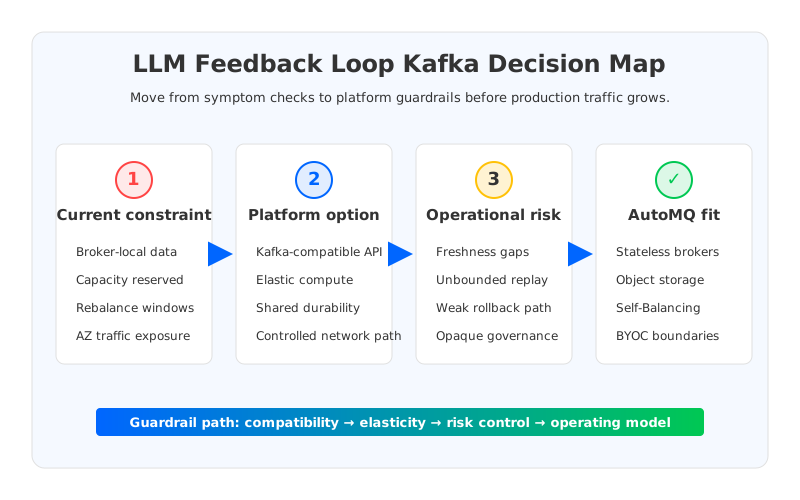
The useful question is not "Can Kafka move AI events?" It can. The useful question is: what guardrails must exist around a Kafka-compatible streaming platform before an LLM feedback loop becomes a dependency for product quality, safety review, and customer-facing automation?
1Why teams search for llm feedback loop kafka
The search term usually hides a practical architecture review. AI platform teams want a real time data pipeline for AI, but they also need a system of record for how model behavior changed over time. A model response without its prompt, retrieval context, policy version, tool trace, user feedback, and evaluator output is hard to audit. A correction event without a stable offset or schema is hard to replay. An additional evaluation job without capacity planning can quietly turn into a second production workload.
Kafka's event model maps well to that shape. Topics can separate raw interaction events from curated feedback signals. Partitions can preserve ordering where the key matters, such as conversation ID, user account, tenant, or agent session. Consumer groups let evaluators, feature builders, moderation jobs, and observability pipelines read the same stream independently. Offsets provide a concrete checkpoint for replay, backfill, and incident review.
Those primitives are necessary, but they are not enough. A production feedback loop needs guardrails across six areas:
This is why the streaming platform choice matters. The events are small compared with model checkpoints, but the operational blast radius is large. If feedback data arrives late, the model team optimizes against stale signals. If replay is unreliable, incident review becomes guesswork. If retention grows faster than broker storage, platform teams end up tuning disks instead of improving the AI system.
2The production constraint behind the problem
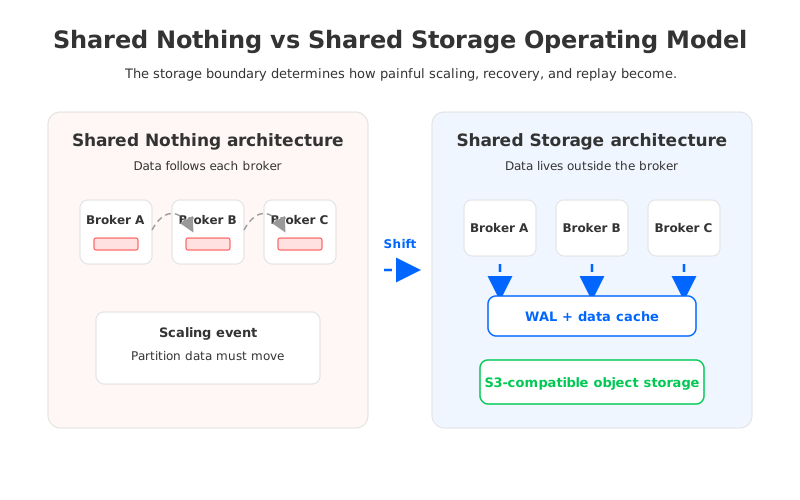
Traditional Kafka deployments use a Shared Nothing architecture: each broker owns local storage, partitions are assigned to brokers, and durability comes from replication between brokers. That design has served the Kafka ecosystem well because it keeps the log close to the compute path and gives operators direct control over replication, placement, and recovery. It also means that data placement becomes an operational concern whenever traffic, retention, or cluster shape changes.
LLM feedback loops amplify that concern because they mix hot and cold access patterns. The newest events need low-latency reads for online evaluation, guardrail checks, and near-real-time alerting. Older events need long retention for audit, regression testing, fine-tuning datasets, and policy review. A conventional cluster can handle both, but the operator pays for enough broker-local storage and network capacity to cover the combined shape.
The storage binding shows up during scaling. If an evaluation rollout doubles consumer demand, adding brokers is only part of the job; partitions and local data may need to move so the added capacity can carry load. If retention expands because the governance team asks for longer audit windows, disk planning changes again. If the cluster runs across multiple Availability Zones, replication and client placement can introduce cross-zone data movement that is often overlooked until finance reviews the bill.
There are valid mitigations. Tiered Storage in Kafka can move older log segments to remote storage while keeping recent data local. Careful partitioning can reduce hotspots. Rack-aware placement and follower fetching can reduce some network waste. These are useful tools, and many teams should use them. The limitation is that they do not fully remove the broker-local storage model from the operational path. Recent data, leadership, replication, and recovery still require close attention when traffic changes.
For an LLM feedback loop, the risk is not one dramatic failure mode. It is the slow accumulation of operational friction: retention gets shortened because disk is tight, replay windows are negotiated instead of guaranteed, evaluation jobs wait for capacity, and data governance becomes scattered across topics, storage volumes, access policies, and ad hoc exports. By the time the AI team asks for another feedback dimension, the streaming platform is already carrying a set of hidden constraints.
3Architecture options and trade-offs
A neutral evaluation should start with operating requirements, not vendor categories. Most teams have four realistic options: continue with an existing Kafka cluster, add Tiered Storage, adopt a managed Kafka service, or move to a Kafka-compatible cloud-native architecture. None is universally right. The right answer depends on how the feedback loop uses replay, how sensitive the data is, how much operational control the team needs, and how quickly workload shape changes.
| Option | Where it works well | What to validate for LLM feedback loops |
|---|---|---|
| Existing Kafka cluster | Stable traffic, known retention, mature operations | Whether local storage, rebalance windows, and cross-zone traffic can absorb AI workload growth |
| Kafka with Tiered Storage | Long retention with colder historical reads | Whether hot data, recovery behavior, and operational tooling still meet freshness and rollback needs |
| Managed Kafka service | Teams that prefer service abstraction over infrastructure control | Data boundary, networking, pricing model, limits, client compatibility, and migration path |
| Kafka-compatible cloud-native streaming | Elastic workloads that need Kafka APIs with a different storage model | Compatibility depth, failure recovery, observability, governance, and workload-specific latency targets |
The table is intentionally operational. An LLM feedback loop does not care whether the architecture sounds elegant; it cares whether a failed broker changes the replay story, whether adding compute requires moving data, whether sensitive prompt data stays inside the expected boundary, and whether audit consumers can read historical streams without disturbing online paths.
Compatibility is the first gate. The platform should support the Kafka protocol and client behaviors your applications depend on: producer idempotency where needed, transactions if the pipeline uses atomic writes, consumer group behavior, offset management, schema tooling, Kafka Connect integrations, and monitoring systems. A feedback loop often touches many teams, so "mostly compatible" can become expensive if one evaluator, connector, or internal tool needs special handling.
The second gate is the cost model. Avoid looking only at broker instance price or storage price. A useful model includes broker compute, local or remote storage, replication overhead, cross-Availability-Zone traffic, connector capacity, monitoring, retention growth, and the human cost of rebalancing and recovery. AWS states that data transferred between Amazon S3 and EC2 in the same AWS Region is not charged for data transfer, while cross-Region and other network paths have their own pricing rules. That kind of detail matters because architecture can change which meter moves.
The third gate is reversibility. A production feedback loop should have a tested path for replaying from a known offset, pausing a consumer group, rolling back a prompt or policy change, isolating a bad topic, and proving that downstream evaluators did not consume corrupted or misclassified events. Streaming systems are often judged by throughput, but feedback loops fail more painfully when the platform cannot explain what happened.
4Evaluation checklist for platform teams
Start the review with a written checklist. It sounds mundane, but it prevents the AI team from optimizing for freshness while the SRE team quietly worries about recovery, or the security team discovers late that prompt data left the expected account boundary. The checklist should be owned by the platform team and signed off by AI engineering, security, data governance, and operations.
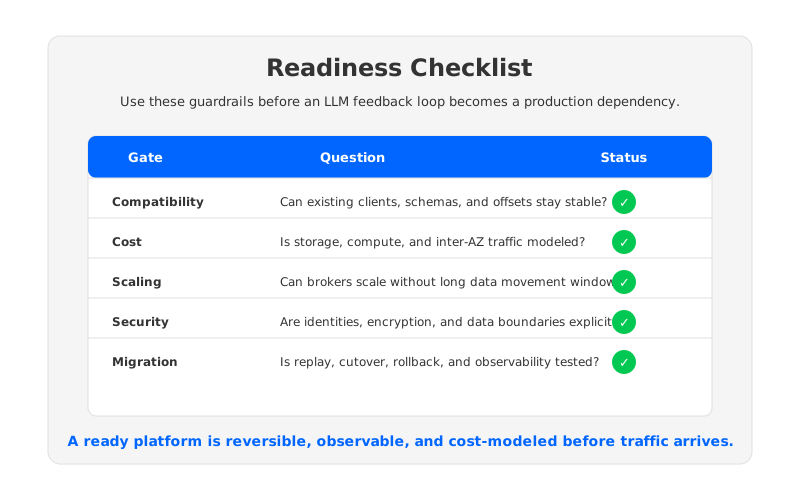
The practical version looks like this:
The scorecard should produce a decision, not a pile of notes. A platform is ready when the team can answer three questions without a meeting: where the data is, who can replay it, and how the system returns to a known-good state after a bad feedback cycle. If any answer depends on a person remembering the right manual step, the loop is not yet production-grade.
5How AutoMQ changes the operating model
Once the neutral requirements are clear, the architectural question becomes sharper: can the Kafka-compatible layer keep familiar client semantics while removing broker-local storage from the hardest operational paths? That is where AutoMQ fits. AutoMQ is a Kafka-compatible cloud-native streaming platform that keeps Kafka protocol compatibility while using a Shared Storage architecture backed by S3-compatible object storage.
In AutoMQ, brokers are stateless for persistent data. The storage layer is implemented through S3Stream, with WAL (Write-Ahead Log) storage for durable writes and S3 storage as the primary storage layer. This changes the scaling and recovery model. Adding or replacing brokers is no longer equivalent to moving large volumes of partition data between local disks. Partition ownership, leadership, and traffic placement can change while durable data remains in shared object storage.
That distinction matters for LLM feedback loops because elasticity and governance are connected. If evaluation workloads spike, the platform can scale compute without treating storage movement as the center of the operation. If retention grows for audit or regression testing, the long-term data path is object storage rather than broker-local disk. If teams deploy through AutoMQ BYOC, both the control plane and data plane run inside the customer's own cloud account or VPC, which keeps customer data within the deployment boundary defined by the customer.
AutoMQ also provides operational features that map directly to feedback-loop guardrails. Self-Balancing helps redistribute traffic across brokers. Seconds-level partition reassignment avoids the long data-copying behavior associated with traditional broker-local storage in typical production scenarios. AutoMQ's documentation describes zero cross-AZ traffic as an architectural capability for S3-based shared storage, which is relevant when AI feedback events fan out to many consumers across zones. For migration planning, AutoMQ Linking for Kafka is designed for zero-downtime migration with offset consistency, which is the kind of detail platform teams should test before moving a feedback loop.
There are still decisions to make. WAL type affects latency and deployment shape. Object storage configuration, identity permissions, encryption, network routing, and observability must be reviewed with the same seriousness as any other production data platform. The benefit is not that the platform removes operational thinking. The benefit is that the hardest questions move from "How do we move data between brokers?" to "What guardrails do we want around compute, storage, replay, and governance?"
For teams building event driven AI architecture, that is a better level of abstraction. The feedback loop should make model behavior more measurable and controllable. It should not turn Kafka operations into the bottleneck every time the AI team adds another evaluator, expands a retention window, or replays a week of traces after a policy change.
6FAQ
6.1Is Kafka a good fit for LLM feedback loops?
Kafka is a strong fit when the feedback loop needs durable events, ordered processing by key, independent consumers, replay, and integration with existing data infrastructure. It is less useful as a standalone answer if the team has not defined schemas, retention policy, privacy controls, replay boundaries, and rollback procedures.
6.2What topics should an LLM feedback loop use?
A common pattern is to separate interaction events, model output, tool traces, retrieval context, evaluator scores, human feedback, policy changes, and audit events. The exact split should follow ownership, retention, and access-control boundaries. Do not put all feedback data into one topic only because it is easier for the first producer.
6.3How should teams choose partition keys?
Choose the key that matches the unit of ordering and investigation. Conversation ID is useful for dialog continuity, tenant ID for isolation and quota analysis, user ID for account-level review, and agent session ID for tool-driven workflows. The key should also be checked for skew so one large tenant or workflow does not dominate a partition.
6.4Does Tiered Storage solve the operational problem?
Tiered Storage can help with long retention by offloading older log segments to remote storage, but it does not fully remove the broker-local operating model. Platform teams still need to validate hot data behavior, recovery paths, local capacity, rebalance impact, and how historical reads affect online workloads.
6.5Where does AutoMQ fit in the architecture?
AutoMQ fits when a team wants Kafka-compatible clients and ecosystem integration with a Shared Storage architecture, stateless brokers, object-storage-backed durability, and customer-controlled deployment boundaries through AutoMQ BYOC or AutoMQ Software. It should be evaluated after the team defines compatibility, latency, governance, and migration requirements.
When the feedback loop becomes part of production behavior, the platform review should move from "Can we stream these events?" to "Can we replay, govern, scale, and reverse this loop under pressure?" If you want to evaluate that operating model with Kafka-compatible APIs and customer-controlled deployment boundaries, start with AutoMQ Cloud.


