
Table of Contents
Table of Contents
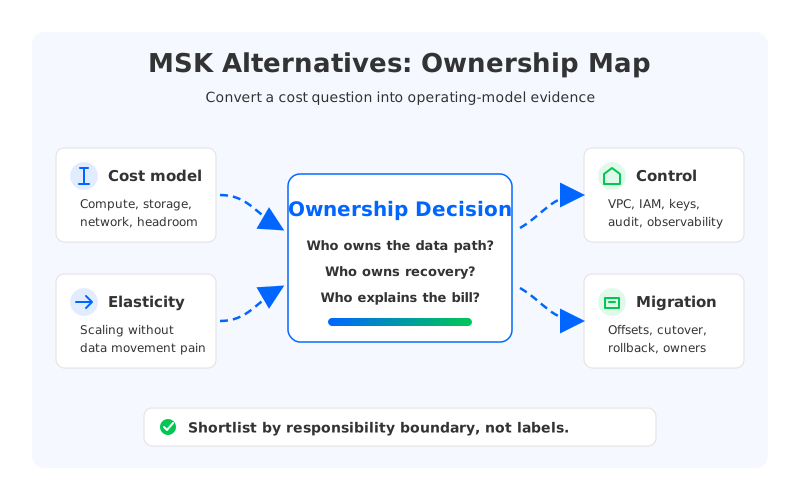
Teams usually search for msk alternatives after Amazon MSK has already solved a real problem for them. They wanted Apache Kafka without operating every broker lifecycle task by hand, and MSK gave them an AWS-native path with familiar Kafka APIs, VPC integration, security options, and managed service operations. The search starts later, when the platform team realizes that "managed Kafka" does not automatically mean "no Kafka ownership." Someone still owns the cost model, the scaling policy, the partition plan, the recovery runbook, and the migration risk when business requirements change.
That is the useful way to read MSK alternative research. It is not a contest to find a product with a more attractive landing page. It is a way to decide which operational responsibilities should stay with the platform team, which should move to a cloud service, and which should be reduced by changing the architecture itself.
1Why Teams Search for MSK Alternatives
The first trigger is often cost, but cost is rarely the whole story. AWS MSK pricing separates broker usage, storage, Serverless dimensions, provisioned throughput where applicable, MSK Connect, MSK Replicator, and related AWS networking charges. A buyer can read those dimensions and still not know whether the next year of workload growth will be a finance issue, a reliability issue, or a staffing issue.
Kafka makes that ambiguity easy to miss because the platform exposes familiar knobs. More retention means more retained bytes. More throughput means more broker capacity. More consumers mean more read traffic. More Availability Zones improve availability but make placement and data movement matter. Each knob looks technical, yet every knob creates an ownership question: who will predict it, monitor it, tune it, and explain the bill when the workload changes?
The practical search intent behind msk alternatives usually falls into four groups:
- Cost transparency. FinOps wants to know which lines scale with write throughput, read fan-out, retention, storage class, requests, and cross-AZ traffic.
- Operational elasticity. SREs want to know whether scaling is a routine platform action or a maintenance project with partition reassignment and watch windows.
- Data-plane control. Architects want to know where the data plane runs, who owns the cloud account boundary, and how networking, encryption, IAM, and observability are handled.
- Migration risk. Application owners want to know whether clients, offsets, ACLs, connectors, stream processors, and rollback procedures survive the change.
A useful alternative evaluation starts by naming these ownership domains. Otherwise the team compares vendor labels, not operating models.
2Pricing Is Where Ownership Starts
The most common mistake is to compare hourly broker rates and stop there. That shortcut treats Kafka as a compute service. Production Kafka is closer to a stateful data platform: compute, storage, replication, networking, recovery, and client behavior all shape the cost.
| Cost or risk area | Ownership question | Evidence to collect |
|---|---|---|
| Broker capacity | Who decides headroom for peak traffic, failures, and rolling changes? | CPU, network, disk, partition count, and maintenance history |
| Storage and retention | Is retained data tied to broker-local disks, a remote tier, or primary object storage? | Retained GiB, hot/cold read ratio, compaction usage, replay needs |
| Cross-AZ data movement | Which produce, replication, and consume paths cross Availability Zones? | Client placement, leader placement, replica traffic, private connectivity |
| Scaling operations | Does scaling require copying partition data or changing only compute capacity? | Reassignment duration, rebalance load, rollback plan, staffing |
| Migration path | Can the team preserve offsets and cut over gradually? | Client versions, auth modes, topic inventory, consumer groups, connectors |
This table matters because two platforms can have similar unit prices and very different ownership outcomes. A service can reduce broker maintenance while leaving storage planning and cross-zone traffic management to the customer. Another can change the storage model so retained data no longer dictates broker shape. A fully managed platform can reduce operational work but move the control boundary outside the customer's cloud account. None of these choices is automatically right; they solve different ownership problems.
AWS also offers several paths inside the MSK family itself. Provisioned clusters keep direct sizing control. MSK Serverless changes capacity management for workloads that fit its service model and quotas. Tiered Storage can help eligible Standard broker workloads with long retention by moving older data to a remote tier. Those are legitimate options to evaluate before replacement. The point is not to leave MSK by default; it is to identify whether the problem is a tunable configuration issue or a structural mismatch between workload growth and the current operating model.
3Architecture Criteria Behind the Shortlist
Once the team has a workload model, the shortlist becomes easier to reason about. The names vary, but the architectural choices are usually variations on four paths: keep MSK and optimize it, run Apache Kafka with more direct self-management, use a broader managed streaming platform, or adopt a Kafka-compatible system that changes the storage architecture.
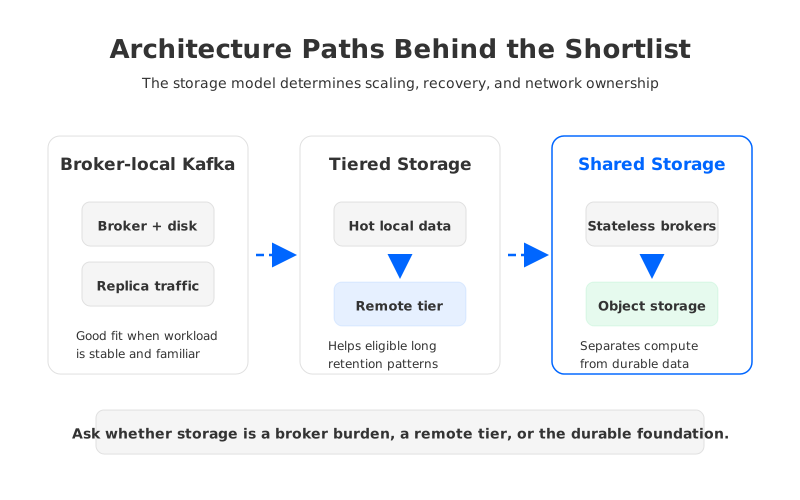
The storage question is the most important one because it shapes the rest of the platform. Traditional Kafka uses broker-local storage and replication between brokers. That model is proven and widely understood, but it couples retained data to broker capacity and makes data movement part of scaling and recovery. Tiered Storage changes part of the retention story by moving older data to remote storage, while the hot path and primary broker operations remain tied to local broker behavior. A shared-storage design goes further: durable log data lives in shared object storage, and brokers become more stateless compute.
The second criterion is network locality. Multi-AZ deployments are a reasonable production default, but cloud networking is not free in either money or complexity. Producers, leaders, followers, consumers, connectors, and private endpoints all have placement. A platform team that is constantly adjusting client locality to manage cross-AZ traffic is not merely doing cost tuning; it is compensating for a data path that leaks into application architecture.
The third criterion is compatibility. "Kafka-compatible" should never be accepted as a vague claim. Buyers should test real producer settings, consumer groups, transactions if used, ACL behavior, admin APIs, Kafka Connect dependencies, monitoring, schema tooling, and stream processing jobs. Apache Kafka compatibility is an operational promise only when the team's actual clients and workflows are included in the proof.
The fourth criterion is failure recovery. A broker failure, an Availability Zone event, a bad rollout, and a region-level recovery are different scenarios. If the alternative reduces one failure mode while making another less visible, the team has only moved the risk. Good evaluation separates high availability inside one cluster from disaster recovery across clusters, then measures the runbook for both.
4Migration and Ownership Questions for Platform Teams
Migration is where abstract architecture becomes concrete. A replacement candidate may look compelling on storage or cost, but the business still has producers, consumers, connectors, dashboards, IAM policies, and incident procedures that assume the current Kafka estate.
The safest migration plan starts with an inventory, not a demo. Topic owners need to identify retention, partition count, write rate, read fan-out, compaction policy, schema dependencies, consumer group criticality, and restart tolerance. Platform teams need to map authentication modes, network access paths, monitoring integrations, and operational runbooks. Finance needs a baseline that separates broker compute, storage, network, and managed service fees.
Then the team should ask harder questions:
- What does the first migrated workload prove? A low-risk topic with no consumers proves almost nothing; a critical topic proves too much too early. Pick a workload that has real clients, measurable volume, and a rollback path.
- How are offsets preserved or translated? Downstream systems care less about the platform name than about whether they resume from the correct position.
- Who owns dual-running cost and duration? Migration creates temporary overlap, and overlap needs budget, observability, and a clear exit condition.
- What is the rollback trigger? A vague "if something goes wrong" is not a rollback plan. Define lag, error-rate, latency, or application behavior thresholds before cutover.
- Which operational tasks disappear, and which remain? A platform that removes broker disk management may still require governance work around quotas, identities, data access, and cloud infrastructure.
This is where MSK alternative research often becomes more disciplined. The team stops asking, "Which vendor is better?" and starts asking, "Which ownership model fits our next three years of Kafka use?"
5A Production Readiness Scorecard
A scorecard prevents the evaluation from drifting toward whichever pain is loudest this month. Cost matters, but so do client behavior, failure recovery, security boundaries, and human workload. The goal is not to produce a decorative comparison table; it is to define the evidence required before a platform becomes a production standard.
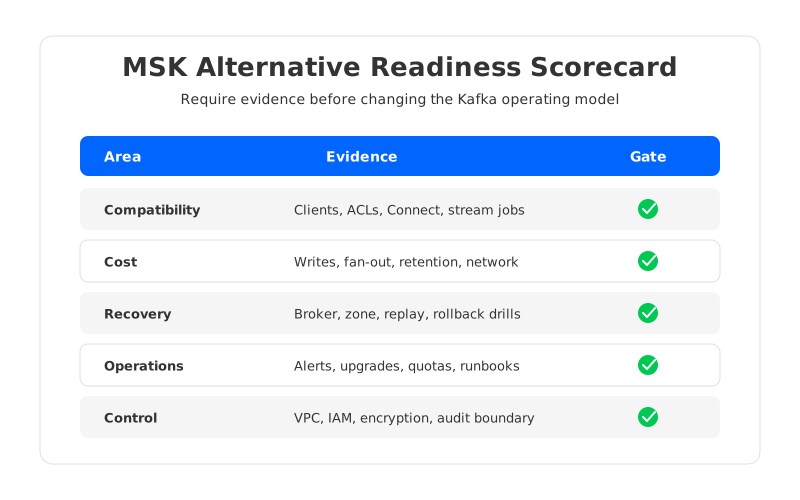
Use the scorecard as a gate. If a candidate does not meet the compatibility gate, cost savings are premature. If it meets compatibility but fails recovery drills, it is not ready for critical domains. If it passes both but creates unclear ownership around observability, upgrades, or cloud account boundaries, the team has found a governance risk rather than a technology blocker.
A practical scorecard should include:
- Compatibility evidence. Real client versions, authentication modes, ACLs, admin tooling, Connect workloads, and stream processors should be exercised in the pilot.
- Cost evidence. Model logical writes, retained data, read fan-out, network paths, request charges, idle headroom, migration overlap, and support or subscription fees.
- Recovery evidence. Test broker replacement, zone disruption, replay from retained data, consumer restart behavior, and rollback from the migration path.
- Operations evidence. Define who handles upgrades, autoscaling, alert thresholds, quota enforcement, capacity reviews, and incident response.
This is also the point where a team may decide not to migrate. If MSK tuning, Tiered Storage, improved client placement, or better capacity management solves the problem, replacement is unnecessary risk. The best alternative research sometimes ends with a stronger MSK operating model. That is still a useful outcome.
6How AutoMQ Fits the Evaluation
If the evidence points to a structural storage and operations problem, a shared-storage Kafka-compatible system becomes relevant. AutoMQ fits that category: it is a cloud-native streaming platform compatible with Apache Kafka that replaces broker-local log storage with S3-based shared storage through S3Stream. In this model, durable data is stored in object storage, while a WAL (Write-Ahead Log) layer absorbs writes before data is organized into object storage.
The important point is not that AutoMQ is another line in a vendor comparison. The point is that it changes the ownership questions. Stateless brokers reduce the amount of durable state attached to any single broker. Separation of compute and storage lets teams reason about broker capacity and retained data more independently. In supported deployments, AutoMQ's Zero cross-AZ traffic design can reduce the operational pressure of managing traditional cross-zone replication paths. AutoMQ BYOC also keeps the control plane and data plane inside the customer's cloud account VPC, which can matter for regulated or infrastructure-conscious teams.
Those properties should still be tested with the same scorecard. Kafka compatibility should be validated with existing clients and ecosystem tools. Migration should be rehearsed with real topics, consumer groups, and rollback steps. Cost should be modeled with the team's own throughput, read fan-out, retention, and cloud region. A shared-storage design changes the architecture, but production trust still comes from evidence.
The cleanest way to evaluate AutoMQ against MSK is not to ask whether one is universally better. Ask whether your current pain comes from fixable MSK configuration work or from the deeper coupling of broker compute, local storage, replication, and recovery. If it is the latter, AutoMQ gives the team a different architecture to test rather than another managed wrapper around the same ownership pattern.
Before you shortlist any MSK alternative, make the ownership model explicit: who owns the data path, the cost curve, the migration path, and the recovery path? If shared-storage Kafka compatibility is worth validating for your AWS workload, use AutoMQ's pricing model as a concrete next step: estimate your workload on AutoMQ.
7References
- Amazon MSK pricing
- Amazon MSK best practices for Standard brokers
- Amazon MSK quotas
- Amazon MSK Serverless documentation
- Amazon MSK Tiered Storage documentation
- Apache Kafka documentation
- AutoMQ overview
- AutoMQ migration overview
- AutoMQ Zero cross-AZ traffic documentation
8FAQ
8.1Are MSK alternatives only about lowering cost?
No. Cost usually starts the conversation, but the deeper question is ownership. Teams evaluate MSK alternatives when they need a different balance of broker operations, storage architecture, cross-AZ data movement, migration risk, data-plane control, and recovery responsibility.
8.2Should we optimize MSK before evaluating alternatives?
Yes. Many problems are fixable with better topic design, retention policy, broker sizing, client placement, monitoring, or Tiered Storage where it fits. Replacement makes sense when the main issue is architectural rather than operational hygiene.
8.3What should a proof of concept include?
Use real producer and consumer versions, representative topics, authentication, ACLs, monitoring, failure drills, and rollback steps. A useful pilot measures compatibility, cost, latency, recovery behavior, and operator workload under conditions that resemble production.
8.4How is AutoMQ different from MSK Tiered Storage?
Tiered Storage moves older data from broker storage to a remote tier for eligible MSK Standard broker workloads. AutoMQ is built around Shared Storage architecture: object storage is the durable foundation, and brokers are designed to be stateless.
8.5Is AutoMQ a fit for every MSK workload?
No platform is universal. AutoMQ is most relevant when Kafka compatibility, cloud account ownership, storage-cost control, reduced broker state, and elastic operations matter together. Stable, small, or already well-optimized MSK workloads may not justify migration effort.


