
Table of Contents
Table of Contents
Searches for consumer group migration kafka usually happen when a migration plan has moved from diagram to calendar. Topic replication is running, the target cluster accepts clients, and someone has to decide which Consumer group moves first. That decision looks small from the outside, but it carries the real production risk: a Consumer group is where Kafka infrastructure becomes application behavior.
A Consumer group migration is not only a bootstrap-server change. It is a controlled transfer of committed offsets, partition ownership, lag expectations, retry behavior, external side effects, and rollback authority. If the group resumes too early, downstream systems may see duplicate writes. If it resumes too late, the business may miss records even though Kafka still has the bytes. The operational question is not "can the target cluster consume?" It is "can this exact group resume at the intended business point, and can we prove it under failure?"
1Why Teams Search for consumer group migration kafka
Kafka makes Consumer groups elegant in steady state. Consumers with the same group ID divide partitions among themselves, commit offsets, rebalance when membership changes, and give operators a compact way to measure lag. During migration, that elegance becomes a contract. The group ID, offset store, assignment strategy, session settings, client version, and application idempotency model all have to line up with the new cluster.
The search intent is often practical rather than academic. A platform team may be replacing aging self-managed Kafka, consolidating clusters after an acquisition, moving workloads into a new cloud account, or evaluating a Kafka-compatible streaming platform. In each case, the team needs a readiness checklist that is specific enough for SREs and application owners to sign, but broad enough to include architecture, cost, governance, and rollback.
Three failure modes deserve early attention:
- Offset mismatch: The target group starts from a position that does not represent the same record boundary as the source side. This can happen when replication changes offsets, topic mappings differ, or the group is reset without a partition-level audit.
- Rebalance surprise: Consumer membership, assignment strategy, heartbeat settings, or client version differences trigger longer-than-expected rebalances during cutover. The migration team then confuses rebalance delay with data loss or target instability.
- Side-effect drift: The Consumer group writes to a database, cache, object store, search index, or workflow engine. Kafka may resume correctly while the external side effect is duplicated, skipped, or committed in a different order.
The checklist has to make those risks visible before the migration window. Waiting until the final cutover to discover that a group uses manual partition assignment, old client libraries, or fragile downstream writes turns a platform migration into an application incident.
2The Production Constraint Behind the Problem
Traditional Apache Kafka uses a Shared Nothing architecture. Each broker owns local log segments for the partitions assigned to it, and replication keeps copies on other brokers for availability. That design is explicit and well understood, but it couples durable data, broker capacity, partition leadership, and recovery work. Consumer group migration inherits that coupling because the target cluster must handle replication catch-up, validation reads, consumer startup, and normal production load at the same time.
The pressure is not limited to CPU or disk. In a multi-Availability Zone deployment, broker-to-broker replication and client traffic may cross zones. During migration, additional copy jobs, validation consumers, and rollback windows can expand the amount of data moving through the network. A team that only sizes the target for steady-state throughput may under-provision the most stressful part of the migration.
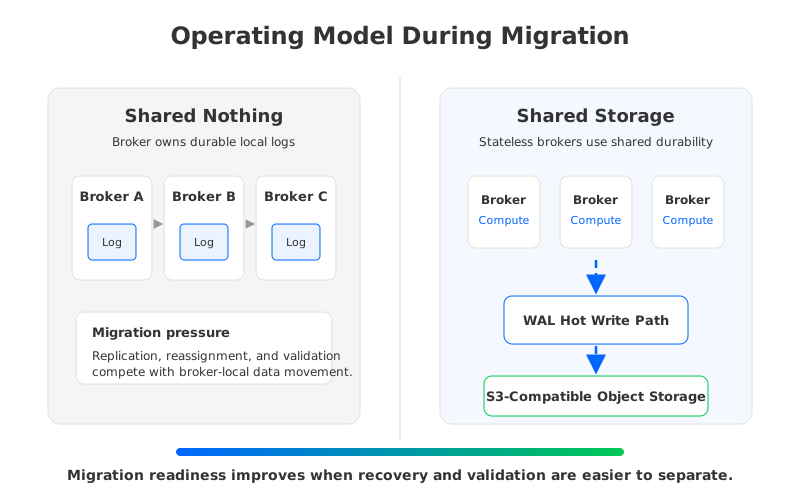
Storage architecture also affects the recovery clock. In a broker-local model, adding capacity or replacing a failed broker can involve partition reassignment, replica catch-up, and background data movement. Those operations are not automatically unsafe, but they compete with the quiet, explainable environment that Consumer group migration needs. The cleaner the operating model, the easier it is to separate an application resume problem from a broker recovery problem.
This is where many migration plans become too narrow. They treat Consumer groups as metadata to copy after topics are replicated. In production, a Consumer group is a live agreement between application code and infrastructure state. The right readiness review starts from that agreement and then asks which architecture best preserves it.
3Architecture Options and Trade-Offs
Consumer group migration should be evaluated neutrally before any platform is selected. The goal is not to find a tool that promises a magic cutover. The goal is to choose an operating model where compatibility, capacity, observability, and rollback can be verified with evidence.
| Architecture option | What it can help with | What still needs proof |
|---|---|---|
| Self-managed Kafka migration | Full control over brokers, networking, tools, and timing | Offset mapping, replication lag, broker capacity, rollback ownership, and operator workload |
| Managed Kafka service | Less broker lifecycle work and clearer service ownership | Client compatibility, migration limits, private networking, cost model, and service-specific controls |
| Kafka with Tiered Storage | Lower pressure from long retention on broker disks | Hot data behavior, broker-local recovery, Consumer group cutover, and validation reads |
| Kafka-compatible Shared Storage architecture | Durable stream data is separated from broker-local disks, changing scaling and recovery mechanics | WAL behavior, cache behavior, object storage access, compatibility, and migration evidence |
Tiered Storage is useful when historical retention is the main pain point, but it does not make brokers stateless. Managed Kafka can reduce infrastructure work, but it does not remove the need to prove where a Consumer group resumes. Application-level dual writes can provide control for some systems, but they often push ordering and deduplication complexity into business code.
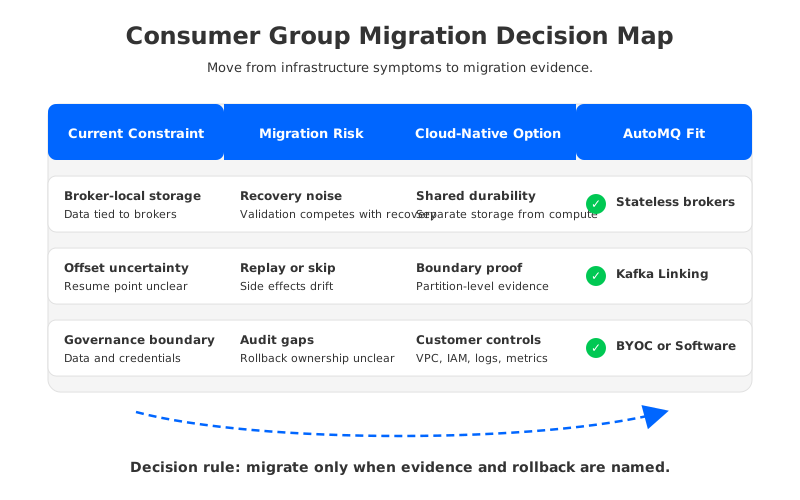
The most useful comparison is operational rather than ideological. Ask how each option behaves when a broker fails during validation, when a group has to roll back after partial processing, when a connector task restarts, when a client library is older than expected, and when network or security boundaries block a dependency. A platform that looks attractive in steady state may still be a poor migration target if it makes those questions hard to rehearse.
4Evaluation Checklist for Platform Teams
A readiness checklist should begin with the Consumer groups that carry the highest business consequence, not the groups that are easiest to move. Pick representative workloads: a stateless consumer, a stateful stream processor, a sink connector, a batch catch-up job, and one service with non-idempotent downstream writes. The mix matters because each group tests a different part of the migration plan.
For each group, capture the runtime contract before touching infrastructure. Record the group ID, subscribed topics, partition counts, assignment mode, client version, commit strategy, session and heartbeat settings, lag threshold, retry behavior, and external side effects. Then agree on the cutover unit. A group that spans unrelated business domains is harder to roll back than a group tied to one application slice.
| Readiness area | Questions to answer | Evidence to collect |
|---|---|---|
| Compatibility | Do the same clients, Consumer group protocols, transactions, Kafka Connect jobs, and admin tools work on the target? | Client matrix, integration tests, connector startup checks, protocol validation |
| Offset and record boundary | Does the target resume point represent the same record boundary for every partition? | Partition-level offset audit, sample record hashes, timestamp checks, lag comparison |
| Rebalance behavior | What happens when the group joins the target cluster under realistic membership changes? | Dry-run startup, rebalance timing, assignment comparison, error logs |
| Side effects | Can downstream systems tolerate replay, pause, or partial progress? | Idempotency review, duplicate-write test, sink validation, application-owner signoff |
| Capacity and cost | Can the target handle replication, validation reads, Consumer catch-up, and normal traffic together? | Load test, broker or worker saturation, object storage metrics, network-path review |
| Governance | Where do data, credentials, audit logs, metrics, and control actions live? | VPC diagram, IAM review, encryption settings, RBAC proof, audit log sample |
| Rollback | Who can stop the cutover, and what position does the source group resume from? | Rollback trigger, source resume point, target stop point, owner list, incident timeline |
This checklist prevents a common migration mistake: treating "Consumer lag is zero" as a complete readiness signal. Lag is necessary, but it is not sufficient. A group can have zero lag and still be unsafe to move if the target offset does not map to the same record, the application cannot tolerate replay, or the rollback procedure resets the wrong partition.
The rehearsal should be boring by design. Stop the source group, sync or verify offsets, start the target group, observe processing, validate downstream writes, and document the rollback path. Repeat with a smaller blast radius if any step requires interpretation during the test. Production cutover should execute a known procedure, not discover one.
5How AutoMQ Changes the Operating Model
After that neutral framework is defined, AutoMQ becomes relevant as a Kafka-compatible architecture to evaluate. AutoMQ keeps the Kafka protocol and ecosystem contract while replacing broker-local durable storage with Shared Storage architecture. S3Stream handles stream storage, WAL (Write-Ahead Log) storage supports the hot write path, and S3-compatible object storage holds durable data. AutoMQ Brokers are stateless brokers, so broker replacement and scaling are less dominated by moving retained log data between machines.
For Consumer group migration, that changes the operating model around the cutover. The target still needs compatibility validation, offset proof, application rehearsal, and rollback rules. What changes is the background work the platform has to manage while those tests are running. Scaling and recovery are less tied to broker-local data ownership, and object-storage-backed durability changes the cross-zone replication pattern. In cloud deployments, that can reduce the operational noise around validation windows.
AutoMQ commercial editions also provide Kafka Linking for migration scenarios that require byte-to-byte message synchronization and synchronized Consumer group progress. That matters because many application owners do not care that records were copied in the abstract; they care that their group resumes from the same business point after the move. Kafka Linking should still be tested with the exact clients, topics, security settings, and rollback behavior used in production.
Governance boundaries are part of the same discussion. AutoMQ BYOC runs the control plane and data plane in the customer's cloud environment, while AutoMQ Software targets customer-operated private environments. For regulated teams, this means the migration checklist can include where data, credentials, operational logs, metrics, and administrative actions live instead of treating them as vendor-side assumptions.
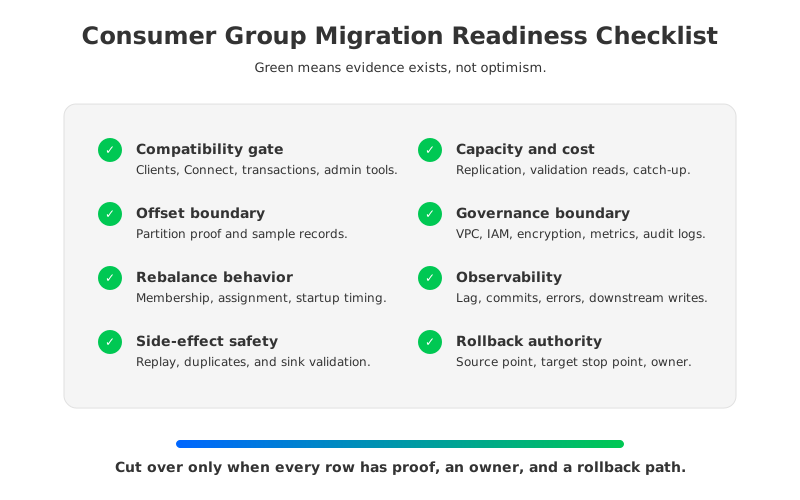
The post-migration checklist also changes. Instead of watching only broker disk and replica reassignment, teams should monitor WAL storage, object storage access, cache behavior, cold reads, Self-Balancing, Consumer group lag, and application errors. The platform is still Kafka-compatible, but the operating signals reflect a different storage architecture.
6A Practical Readiness Scorecard
The final artifact should be a scorecard, not a long meeting note. Each Consumer group gets a status for compatibility, offset mapping, side effects, capacity, security, observability, and rollback. Green means evidence exists. Yellow means the risk is understood and assigned. Red means the cutover is blocked.
Use the scorecard in three passes. First, record what has been proven with commands, dashboards, logs, or application tests. Second, mark assumptions that still depend on human interpretation, such as "duplicates are acceptable" or "the connector will restart cleanly." Third, turn the riskiest assumptions into rehearsal tasks. This keeps the migration team from replacing evidence with optimism.
A concise production rule works well: no Consumer group moves until the team can name the source resume point, target resume point, validation evidence, rollback owner, and application signoff. That rule is deliberately strict. It protects the migration team from moving infrastructure faster than applications can absorb.
The same rule applies when the platform changes underneath Kafka. A Kafka-compatible target should preserve the client contract, but production readiness comes from proof at the group level. If your team is evaluating cloud-native Kafka architecture as part of a migration, test one real Consumer group against the checklist before expanding the wave. The AutoMQ project and deployment materials are available through AutoMQ on GitHub, and the right first experiment is the group you can explain end to end.
7FAQ
7.1What is Consumer group migration in Kafka?
Consumer group migration is the process of moving a Kafka Consumer group from one cluster, deployment, or platform to another while preserving the intended resume point and application behavior. It includes committed offsets, group membership behavior, client compatibility, lag expectations, downstream side effects, and rollback planning.
7.2Is copying Kafka offsets enough for Consumer group migration?
No. Copying offsets is useful only when the target offset maps to the same record boundary and the application can safely resume there. Teams should also validate sample records, timestamps, lag, rebalance behavior, downstream writes, and rollback positions.
7.3How should teams test a Consumer group before cutover?
Choose a representative group, stop or isolate its source-side processing, verify partition-level offsets and sample records, start it on the target cluster, observe rebalance and lag, validate downstream side effects, and rehearse rollback. The test should produce evidence that application owners can review.
7.4Does Shared Storage architecture remove migration risk?
No. Shared Storage architecture changes scaling and recovery mechanics by separating durable data from broker-local disks, but Consumer group migration still needs compatibility, offset, side-effect, observability, and rollback validation. It improves the operating model; it does not replace the readiness process.
7.5Where does AutoMQ fit in the checklist?
AutoMQ fits after the neutral readiness framework is defined. It provides a Kafka-compatible Shared Storage architecture with stateless brokers, object-storage-backed durability, and migration capabilities such as Kafka Linking in AutoMQ commercial editions. Teams should validate it with their actual clients, Consumer groups, topics, and rollback rules.
8References
- Apache Kafka documentation
- Apache Kafka protocol guide
- Apache Kafka Connect documentation
- Apache Kafka Tiered Storage documentation
- AutoMQ architecture overview
- AutoMQ compatibility with Apache Kafka
- AutoMQ S3Stream shared streaming storage
- AutoMQ WAL storage
- AutoMQ Kafka Linking migration overview
- AutoMQ migration execution guide
- AutoMQ zero cross-AZ traffic overview
- AutoMQ manage Consumer groups


