
Table of Contents
Table of Contents
Searches for consumer offset validation kafka usually come from a very specific moment. Records are being mirrored, the target cluster looks healthy, dashboards show lag moving in the right direction, and the migration plan says "cut over consumers" as if that were one step. Then an application owner asks the awkward question: when this consumer starts on the target cluster, will it resume at the same business point, or will it skip work, replay side effects, or stall behind a different offset timeline?
That question is not only about Kafka offsets. It is about whether the platform team can prove application continuity while the storage layer, broker layout, network path, security boundary, and operational ownership may be changing at the same time. Consumer offset validation is a cutover gate, not a migration afterthought. If the gate is weak, the migration remains reversible only on paper.
1Why Teams Search for consumer offset validation kafka
Kafka makes offsets look deceptively small. Each partition has an ordered sequence of records, and each Consumer group commits positions that say where its members should resume. During migration, disaster recovery, cluster replacement, or platform consolidation, offsets become a contract between infrastructure and application behavior.
The contract matters because "same offset" is not always the same as "same business result." A payment consumer may write to an external database. A fraud scoring service may update state in a feature store. A sink connector may deliver records to an object store or warehouse. If the consumer resumes too early, duplicate side effects need to be safe. If it resumes too late, records may be lost from the application's point of view even though they still exist somewhere in Kafka.
Offset validation therefore has to answer three questions at once:
- Position: Does the target Consumer group start from the intended partition offset for each topic?
- Meaning: Does that offset refer to the same record boundary and business event as the source side?
- Recovery: If validation fails after partial cutover, can the team stop, roll back, and explain which records were processed?
Those questions sit between teams. Platform engineers can compare offsets and lag, application teams understand idempotency and state stores, SRE owns the cutover window, and security owns credentials and network paths. A good checklist forces these owners into the same readiness review before the first production Consumer group moves.
2The Production Constraint Behind Offset Validation
Traditional Apache Kafka runs on a Shared Nothing architecture: each broker owns local log storage, and partition replicas are placed across brokers for durability and availability. That model is proven and explicit. The constraint is that durable data, partition leadership, and broker capacity are tightly coupled.
That coupling shows up during offset validation in ways that are easy to miss. A target cluster must have enough broker capacity for steady traffic, catch-up replication, validation reads, Consumer group tests, and rollback windows. Rebalancing or reassignment can add background data movement at exactly the moment when application owners want a quiet system. Multi-Availability Zone deployments add another dimension: producer routing, follower replication, and consumer reads may cross zone boundaries.
Migration tools can copy records, synchronize checkpoints, or replicate Consumer group metadata, but they do not remove the need for operational proof. The team still has to map topics, verify configuration, validate committed positions, observe lag, test consumer startup, and define a failed cutover. Without that discipline, the target cluster may contain the right bytes while the application resumes from the wrong business point.
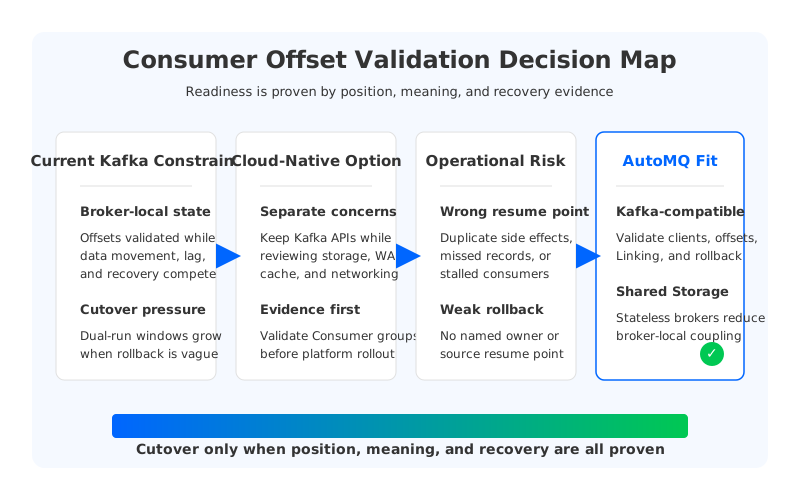
The readiness problem becomes sharper when the migration is also an architecture change. Moving to a cloud-native Kafka-compatible platform adds questions about shared storage, WAL behavior, object storage access, private networking, IAM, observability, and rollback ownership. They belong in the offset validation gate because they can change how quickly the team can detect and recover from a bad resume point.
3Architecture Options and Trade-Offs
Offset validation should be neutral before it becomes product-specific. A platform team may improve self-managed Kafka automation, use MirrorMaker 2, choose a managed replication service, run application-level dual writes, or evaluate a Kafka-compatible architecture with a different storage model. The right question is which option gives the team evidence and rollback control for its most important Consumer groups.
| Option | What it can help with | What still needs validation |
|---|---|---|
| Self-managed Kafka migration | Full control over tooling, networking, and broker configuration | Manual offset mapping, capacity for replication, Consumer group cutover, rollback, and operator workload |
| Managed Kafka service | Less broker lifecycle work and clearer service ownership | Client compatibility, supported versions, private networking, cost dimensions, and service-specific migration limits |
| Kafka with Tiered Storage | Reduced pressure from historical retention on broker disks | Hot data, partition leadership, Consumer group behavior, and broker-local recovery remain operational concerns |
| Kafka-compatible Shared Storage architecture | Durable data is separated from broker-local disks, changing scaling and recovery mechanics | WAL choice, cache behavior, object storage access, compatibility surface, and migration evidence still need tests |
Tiered Storage can help when retention dominates local disk pressure, but it does not make brokers stateless. Managed services can reduce administration, but they do not automatically make a Consumer group cutover correct. Shared Storage architecture can reduce broker-local data movement, but it still needs validation around Kafka compatibility, WAL storage, cache, and object storage.
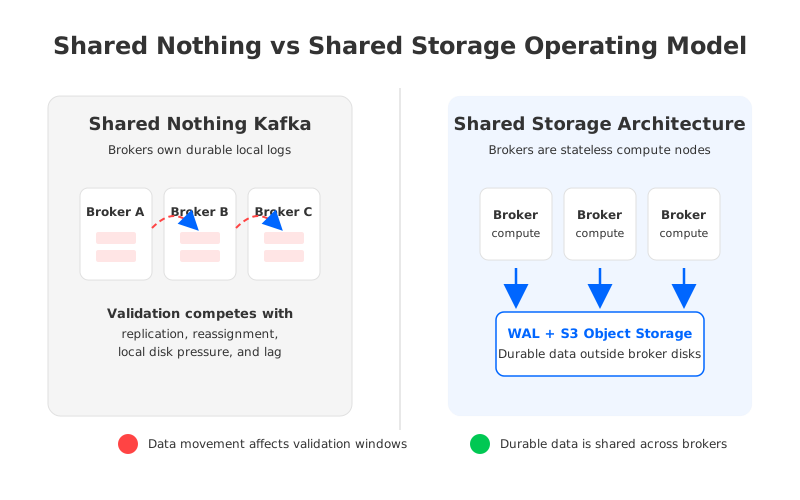
The architectural distinction matters because offset validation is partly a time problem. The longer it takes to rebalance, recover, or add capacity, the longer the migration team has to keep source and target systems in a dual-run state. Shared Storage architecture changes that boundary by placing durable stream data in shared object storage and making brokers primarily responsible for protocol handling, leadership, caching, and request processing.
That does not make offsets safe by default. It changes what the team has to rehearse: stateless broker replacement, cold-read behavior during validation, and rollback to the source cluster without losing the audit trail.
4Evaluation Checklist for Platform Teams
Start the checklist with application behavior, not infrastructure. Pick a small set of representative Consumer groups, including at least one stateful workload, one connector, and one workflow with external side effects. For each group, identify topic partitions, commit frequency, idempotency guarantees, replay tolerance, lag budget, and owner signoff.
Then build an offset validation gate with evidence for each layer:
| Readiness area | Questions to answer | Evidence to collect |
|---|---|---|
| Kafka compatibility | Which client versions, Consumer group protocols, transactions, idempotent producers, Kafka Connect jobs, and admin tools must work unchanged? | Client matrix, integration tests, protocol checks, connector startup tests |
| Offset consistency | Do source and target offsets refer to the same record boundary for each partition? | Partition-level offset comparison, sample record hashes, timestamp checks, lag windows |
| Consumer behavior | What happens when the consumer starts on the target cluster? | Dry-run startup, controlled resume test, duplicate handling, external side-effect checks |
| Failure recovery | What fails the cutover, and who decides? | Rollback trigger, stop-the-line authority, source resume point, incident timeline |
| Cost and capacity | Can the target absorb replication, validation reads, and consumer catch-up without distorting normal traffic? | Load test, broker or worker saturation, object storage metrics, network billing dimensions |
| Governance | Where do data, credentials, metadata, logs, metrics, and control actions live? | VPC diagram, IAM policy review, encryption settings, audit log proof |
| Observability | Can teams see source lag, target lag, committed offsets, consumer errors, and external writes in one view? | Dashboard, alert thresholds, runbook links, application-owner signoff |
A readiness gate should also define what not to validate during the cutover window. Topic naming debates, partition-count redesign, retention policy changes, and schema cleanup may all be worthwhile, but mixing them into offset validation expands the blast radius. The cleanest migration unit is usually an application slice or topic family with clear owners. If the team cannot state the unit of rollback, it is not ready to move the unit of traffic.
5How AutoMQ Changes the Operating Model
After the neutral framework is in place, AutoMQ becomes relevant as a specific Kafka-compatible architecture to evaluate. AutoMQ keeps the Kafka protocol and ecosystem contract while replacing broker-local durable storage with Shared Storage architecture. It uses S3Stream for stream storage, WAL (Write-Ahead Log) storage for the hot write path, and S3-compatible object storage for durable data. AutoMQ Brokers are stateless brokers rather than machines that own irreplaceable local log segments.
For consumer offset validation, that architecture changes the long-term operating model. Broker replacement and scaling are less dominated by copying retained Kafka data between brokers. Object-storage-backed durability changes the cross-zone replication model. Customer-controlled deployment options such as AutoMQ BYOC and AutoMQ Software also let governance teams review where the data plane, control plane, credentials, logs, and metrics live.
Migration mechanics still matter. AutoMQ commercial editions provide Kafka Linking for migration scenarios that require byte-to-byte message synchronization and Consumer group progress synchronization. That capability is relevant because application owners care where a Consumer group resumes, not only whether the target topic contains records. The safe path remains evidence-driven: choose topic groups, synchronize data, compare offsets, run consumers in a controlled window, confirm side effects, and keep rollback criteria visible.
The storage model also changes what teams should measure after migration. In AutoMQ, the review shifts toward WAL storage behavior, object storage access, cache hit rate, cold read performance, Self-Balancing behavior, observability, and security boundaries. That is a different checklist, not an excuse to skip one.
6Readiness Scorecard for Consumer Offset Validation
The output should be a scorecard that application owners can understand without becoming Kafka operators. A green row means the team has evidence, not confidence. A red row means the cutover should stop because rollback is not credible.
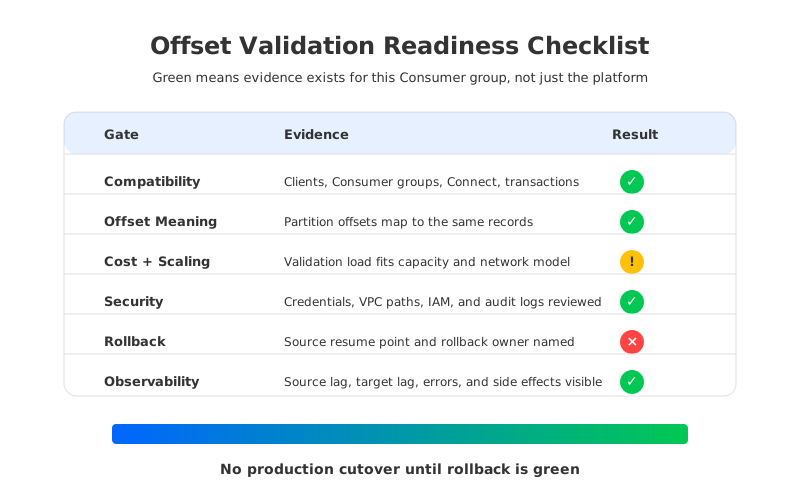
Use the scorecard in three passes: record what is proven, mark assumptions around duplicate side effects and Consumer group behavior, and turn the riskiest assumptions into rehearsal tasks. This keeps "looks good" from meaning something different to every team.
A practical cutover rule can be concise: no Consumer group moves until the team can name the source resume point, target resume point, validation evidence, rollback owner, and application signoff. If any one is missing, the next action is another rehearsal with a smaller blast radius.
The same rule applies after the platform changes. A Kafka-compatible target should preserve the application contract, but production readiness comes from proof: partition by partition, Consumer group by Consumer group.
If your team is using offset validation to evaluate a broader Kafka migration or cloud-native streaming architecture, compare the operating model as well as the migration tool. Start with the AutoMQ project and deployment materials at AutoMQ on GitHub and test the checklist against one real Consumer group before expanding the migration wave.
7FAQ
7.1What is consumer offset validation in Kafka?
Consumer offset validation is the process of proving that a Consumer group can resume from the intended position after migration, failover, or cluster replacement. It should compare partition offsets, record boundaries, lag, application behavior, and rollback paths rather than only checking that records were copied.
7.2Why is offset validation important during Kafka migration?
Kafka migration changes where consumers read from and often changes networking, security, observability, and storage behavior at the same time. Offset validation reduces the risk of skipped records, duplicate side effects, failed consumer startup, or unclear rollback after partial cutover.
7.3Is matching source and target offsets enough?
Not always. Matching offsets is useful only when the target offset refers to the same record boundary and the application can safely resume there. Teams should also validate sample records, timestamps, lag, committed Consumer group state, and external side effects.
7.4How does Shared Storage architecture affect migration readiness?
Shared Storage architecture separates durable data from broker-local disks, which can reduce broker-local data movement during scaling and recovery. It does not remove the need for migration testing. Teams still need to validate Kafka compatibility, WAL behavior, object storage access, consumer startup, observability, and rollback.
7.5Where does AutoMQ fit in a consumer offset validation plan?
AutoMQ fits after the team has defined its neutral validation framework. It provides a Kafka-compatible Shared Storage architecture with stateless brokers, object-storage-backed durability, and migration capabilities such as Kafka Linking in AutoMQ commercial editions. The platform should still be validated with the exact clients, topics, Consumer groups, and rollback rules used in production.


