
Table of Contents
Table of Contents
Teams rarely search for redpanda alternatives because they dislike one vendor name. They search because a streaming platform decision has reached the point where architecture, operations, migration, and budget all collide. Redpanda may already be on the shortlist because it offers a Kafka-compatible API and an implementation that differs from Apache Kafka's Java and JVM-based internals. That can be attractive. The real question is whether the choice reduces operational risk for your workload, or merely moves the risk into a different part of the system.
That distinction matters because event streaming platforms become long-lived infrastructure. A Kafka-compatible platform becomes a shared dependency for producers, consumers, connectors, stream processors, security policy, monitoring, and incident response. Once it sits in the middle of a payment flow, telemetry pipeline, or data lake ingestion path, replacing it becomes a migration program.
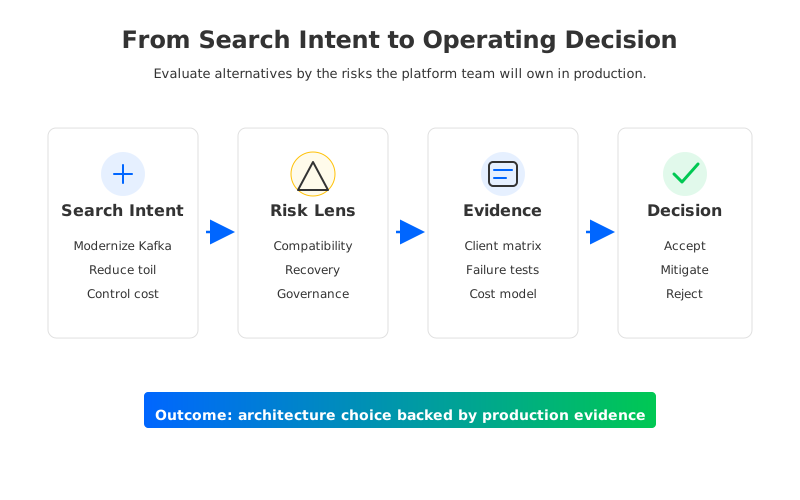
The strongest evaluation starts with a neutral model. Begin with the risks your platform team will own after deployment: compatibility drift, recovery behavior, storage growth, network boundaries, migration reversibility, and the amount of operational state tied to each broker. Those are the risks that show up during a regional incident, a traffic spike, or a cost review.
1Why teams search for Redpanda alternatives
Redpanda sits in a familiar decision space: it speaks the Kafka protocol but is not Apache Kafka internally. For some teams, that is exactly the point. They want lower operational overhead, simpler deployment, predictable latency, or a different storage and threading model while keeping Kafka clients and ecosystem integrations. For other teams, the same difference creates due diligence work. Kafka compatibility is not a slogan; it is a contract with every producer, consumer, connector, and stream processing application that already depends on Kafka behavior.
The search usually starts after one of four events. A team may be replacing a self-managed Kafka estate that has become too expensive to operate. A buyer may be comparing managed Kafka services and Kafka-compatible engines before a new platform build. A FinOps group may have found that storage, replication, and cross-zone network costs scale faster than business traffic. Or an architecture review may ask how much of the existing operational playbook still applies when the platform changes the Kafka implementation.
Each trigger leads to a different evaluation path:
- Platform modernization: Kafka APIs, offsets, security, and ecosystem tools.
- Cost reduction: storage media, replication traffic, partition density, and data transfer.
- Operational simplification: upgrades, broker replacement, partition movement, and scaling events.
- Data ownership: data plane location, network boundary, and metadata exposure.
These dimensions are related, but they are not interchangeable. A system can be Kafka-compatible for common clients and still require validation for transactions, idempotent producers, ACL behavior, Schema Registry integration, or Kafka Connect. A service can reduce day-to-day operations and still constrain data residency or migration exit paths. A platform can look cost-effective at small scale and become expensive once cross-Availability Zone traffic and long retention enter the bill.
2The first filter: compatibility is behavior, not branding
For Kafka platform owners, compatibility has three layers. The first is the wire protocol: existing producers and consumers can connect and exchange records. The second is operational semantics: consumer groups rebalance as expected, offsets remain meaningful, idempotent and transactional producers behave correctly, and admin tooling can manage topics and ACLs. The third is ecosystem compatibility: Kafka Connect, stream processors, monitoring exporters, schema tooling, and security integrations continue to work without special-case code.
That is why a proof of concept should test behavior rather than hello-world throughput. Bring a representative client matrix: your oldest maintained client version, highest-throughput producer, most stateful consumer, and hardest connector or stream processor to migrate. Then add failure cases: broker restart, leader movement, network interruption, consumer group rebalance, produce retries, and topic expansion. The result should be a risk register, not only a latency chart.
| Area | Test | Signal |
|---|---|---|
| Clients | Producers, consumers, admin clients | Real client mix works |
| Consumers | Rebalances, commits, lag recovery | Offset semantics hold |
| Writes | Idempotence, retries, acks, transactions | Duplicate risk is understood |
| Ecosystem | Connect, Schema Registry, monitoring, ACLs | Tooling survives migration |
| Recovery | Broker loss, network interruption, upgrades | Failure behavior is known |
Redpanda and other Kafka-compatible platforms should be evaluated with this same discipline. The goal is to make architectural differences visible before they become production assumptions.
3The second filter: storage architecture determines your operating model
Most streaming platform comparisons become clearer once you ask a simple question: where does durable log data live, and which component owns it? Traditional Apache Kafka follows a Shared Nothing architecture. Each broker owns local log data, and Kafka uses replication across brokers to protect availability and durability. In cloud deployments, that ties storage ownership, broker lifecycle, and network replication together.
Kafka Tiered Storage changes part of that equation by moving older segments to remote storage while recent data remains on broker-attached storage. That can help with long retention and storage pressure, but the hot path still depends on broker-local storage and partition ownership. Scaling events can still require data movement, and recovery still depends on how much state is tied to each broker.
Kafka-compatible engines that are not Apache Kafka may change the internals in different ways, but the same architectural question applies. If brokers remain stateful owners of durable log data, operations will still revolve around broker capacity, disk pressure, rebalance planning, and recovery time. If storage is separated from compute, operations shift toward metadata movement, cache behavior, and object-storage-backed durability.
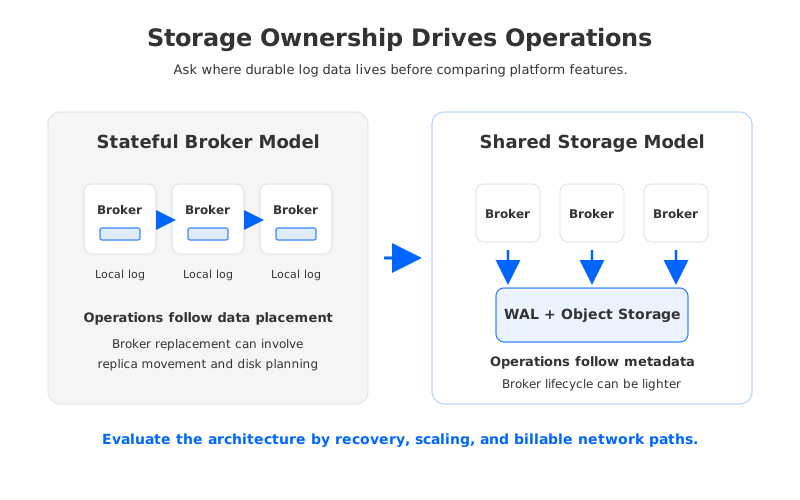
This is where cloud cost and operational risk meet. Replication across Availability Zones can be the right durability design, but it is not free in public clouds. AWS documents data transfer pricing separately from compute and storage, and Amazon MSK pricing separates broker, storage, and other service dimensions. The exact bill depends on region, workload, read fanout, retention, and deployment shape, so model how the architecture creates billable events instead of quoting a universal savings number.
For a Redpanda alternatives review, the storage section of the worksheet should answer these questions:
- Does the platform require broker-local persistent storage for the hot log?
- How does it protect durable data across zones or failure domains?
- What happens to partition data when brokers are added, removed, replaced, or upgraded?
- Which traffic paths cross Availability Zones, VPC boundaries, or cloud account boundaries?
- Can storage and compute scale independently, or does one force provisioning of the other?
- How does the platform behave when retention grows faster than throughput?
The answers often matter more than a feature checklist. A broker that owns a large amount of durable state is harder to replace quickly. A system that copies data between zones on the write path has a different cost profile from a system that uses shared storage as the durability boundary. A service that hides infrastructure details may reduce toil, but it can also make FinOps modeling and incident forensics harder.
4Migration risk is a first-class architecture criterion
Every Kafka-compatible alternative promises an easier future. The migration decides whether you get there. A streaming migration has two hard parts: preserving application correctness and keeping a rollback path open long enough to trust the new platform.
Application correctness depends on more than copying records. Producers may need phased cutover. Consumers need offset continuity or a controlled reset plan. Stateful jobs may depend on exact input offsets and ordering assumptions. Connectors may carry their own offsets and external side effects. Security policy, topic configuration, quotas, and alerts must move with the workload because missing operational metadata can cause incidents after the data path looks healthy.
Rollback is equally important. A migration plan that only works forward is risky for infrastructure that serves many teams. The safer pattern is parallel replication, staged consumer validation, controlled producer movement, and a clear stop condition for each phase. Apache Kafka's MirrorMaker2 can help in many open-source migration scenarios, but teams should understand its offset and duplication trade-offs.
At this point, procurement questions become engineering questions:
- Which topics can tolerate replay or duplicate records?
- Which consumers maintain external state keyed by Kafka offsets?
- Can the target platform preserve offsets in the way your applications need?
- How long will source and target clusters run in parallel?
- What metrics prove that the target platform is ready for a producer cutover?
- What is the rollback action if a workload behaves differently?
A strong alternative is not merely easier to deploy. It is easier to test, migrate, observe, and reverse during the period when certainty is lowest.
5How AutoMQ fits this evaluation
Once the worksheet separates compatibility, storage ownership, network paths, and migration risk, AutoMQ becomes relevant as a specific architectural option rather than a generic vendor replacement. AutoMQ is a Kafka-compatible cloud-native streaming platform built around a Shared Storage architecture. It keeps the Kafka protocol and ecosystem expectations while replacing broker-local log storage with S3Stream, a storage layer backed by WAL (Write-Ahead Log) storage and S3-compatible object storage.
The practical effect is that AutoMQ Brokers are stateless. Durable stream data is not tied to a broker's local disk. Brokers can be added, removed, or replaced with much less data movement because partition reassignment is primarily a metadata and ownership operation rather than a large copy of local log files. For teams driven by scaling, recovery, or cloud infrastructure cost, that distinction is worth testing directly.
AutoMQ also changes the network cost conversation. In traditional multi-AZ Kafka deployments, producer placement, partition leadership, replica replication, and consumer reads can all create inter-zone paths. AutoMQ uses S3-based shared storage and an inter-zone routing design to reduce cross-AZ data transfer in supported deployments. That does not remove the need for workload modeling, but it gives FinOps and platform teams a different architecture to model: durable data in object storage, stateless compute on top, and fewer broker-to-broker replication paths.
The trade-off is not magic. Object storage is not a low-latency append log by itself. AutoMQ addresses this with WAL storage: writes are persisted through the WAL first, then flushed to object storage asynchronously. AutoMQ Open Source uses S3 WAL, which is simpler and suited to latency-tolerant workloads such as logging and monitoring. AutoMQ commercial editions can use lower-latency WAL options such as Regional EBS WAL or NFS WAL. That choice should be explicit because latency expectations, durability boundaries, and cloud resources differ by WAL type.
For migration, AutoMQ supports open-source migration paths with MirrorMaker2 and provides AutoMQ Linking in AutoMQ commercial editions for smoother Kafka migration scenarios. No tool removes all migration risk. The architecture and migration method should be evaluated together: a stateless target platform is most valuable when the cutover plan preserves the application contracts your teams already depend on.
6A practical scorecard for the final shortlist
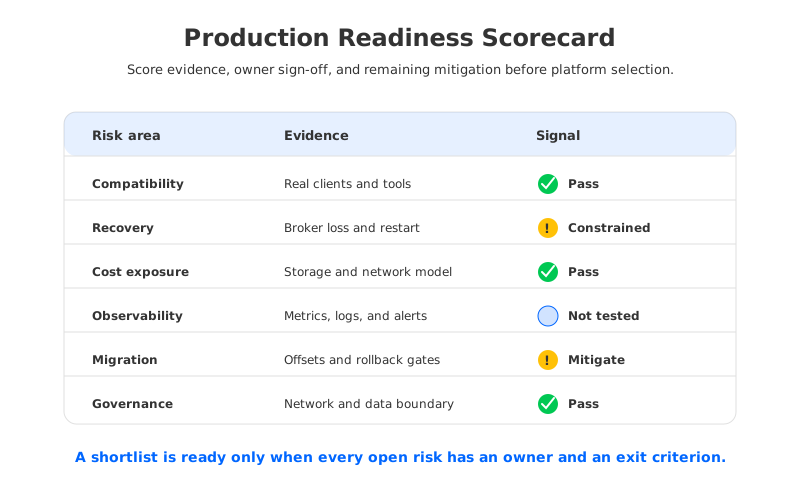
By the time a team reaches the final shortlist, a long comparison table often creates more noise than clarity. The better artifact is a scorecard with evidence. Each row should name a risk, the test, the owner who signs off, and the exit criterion. That forces the discussion away from general claims and toward operating responsibility.
Use five scores: Pass, Pass with constraint, Needs mitigation, Not tested, and Not acceptable. Avoid vague numeric rankings unless the team can explain the difference between a 3 and a 4. A platform that receives Pass with constraint for latency may still fit analytics ingestion. A platform that receives Not tested for transactions should not enter production for transactional workloads.
The final review should cover at least these areas:
| Risk area | Evidence | Signal |
|---|---|---|
| Kafka compatibility | Client, connector, security, and admin tests | Applications move cleanly |
| Storage and recovery | Broker replacement and retention growth | Local-log movement is not the bottleneck |
| Cloud cost exposure | Storage, compute, network, migration overlap | The bill is explainable |
| Observability | Metrics, logs, lag, latency, alerts | SREs can diagnose incidents |
| Migration safety | Offset plan, cutover gates, rollback path | Teams can stop safely |
| Governance | Encryption, ACLs, network boundary, audit | Security can approve the model |
This scorecard also keeps the conversation respectful. Redpanda, Apache Kafka, managed Kafka services, and cloud-native Kafka-compatible systems solve overlapping but different problems. The right choice depends on workload, skill set, cloud boundary, latency target, and appetite for operational ownership.
7Closing the loop
The phrase redpanda alternatives looks like a vendor comparison query, but the decision behind it is deeper. It is a question about which risks your team wants to own for the next several years. If your current shortlist still looks like a feature matrix, turn it into an operational risk review before you choose.
If your evaluation points toward Kafka compatibility with stateless brokers, object-storage-backed durability, independent compute and storage scaling, and lower cross-AZ traffic exposure, run your workload through the AutoMQ pricing calculator and use the same assumptions in your Redpanda alternatives scorecard.
8References
- Apache Kafka: https://kafka.apache.org/documentation/
- Kafka Tiered Storage: https://cwiki.apache.org/confluence/display/KAFKA/KIP-405%3A+Kafka+Tiered+Storage
- MirrorMaker2: https://kafka.apache.org/documentation/#mirrormakerconfigs
- Amazon MSK pricing: https://aws.amazon.com/msk/pricing/
- AWS data transfer pricing: https://aws.amazon.com/ec2/pricing/on-demand/#Data_Transfer
- Amazon MSK docs: https://docs.aws.amazon.com/msk/latest/developerguide/what-is-msk.html
- Redpanda architecture: https://docs.redpanda.com/current/get-started/architecture/
- Redpanda Kafka clients: https://docs.redpanda.com/current/develop/kafka-clients/
- AutoMQ architecture: https://docs.automq.com/automq/architecture/overview?utm_source=blog&utm_medium=reference&utm_campaign=gs100-0035
- AutoMQ WAL storage: https://docs.automq.com/automq/architecture/s3stream-shared-streaming-storage/wal-storage?utm_source=blog&utm_medium=reference&utm_campaign=gs100-0035
- AutoMQ inter-zone traffic: https://docs.automq.com/automq-cloud/eliminate-inter-zone-traffics/overview?utm_source=blog&utm_medium=reference&utm_campaign=gs100-0035
- AutoMQ migration: https://docs.automq.com/automq/migration/overview?utm_source=blog&utm_medium=reference&utm_campaign=gs100-0035
9FAQ
9.1What is the safest way to compare Redpanda alternatives?
Start with operational risk, not vendor positioning. Test Kafka client behavior, consumer groups, recovery, storage growth, network paths, observability, and rollback. A shortlist is useful only when each option has evidence behind it.
9.2Is Kafka protocol compatibility enough for production migration?
No. Protocol compatibility is the entry point. Production migration also needs compatible behavior across offsets, consumer groups, retries, transactions if used, security policy, monitoring, connectors, and tooling.
9.3When does Shared Storage architecture matter most?
It matters when broker-local state becomes a bottleneck for scaling, recovery, retention, or cloud cost. Shared storage can make broker lifecycle lighter, though cache and WAL design still need validation.
9.4Should every team choose a diskless or object-storage-backed Kafka-compatible platform?
No. Workload latency, cloud environment, operational skills, governance, and migration constraints all matter. Diskless and shared-storage designs are strongest when elasticity, long retention, fast broker replacement, and cost transparency are high priorities.
9.5Where should AutoMQ be evaluated against Redpanda and other options?
Evaluate AutoMQ where the framework calls for Kafka compatibility, stateless brokers, object-storage-backed durability, independent scaling, migration planning, and cross-AZ traffic reduction. Use the same workload tests and cost assumptions for every option.


