
Table of Contents
Table of Contents
Teams rarely search for client compatibility test suite kafka because they want a prettier test report. They search for it because a platform change is getting close to production, and application owners are asking the question that matters: will our existing clients keep behaving the same way when the underlying Kafka-compatible system changes? A few happy-path produce and consume checks are not enough when the estate includes old client libraries, transactional producers, Kafka Connect jobs, consumers with strict offset expectations, and SRE runbooks built around broker behavior.
The uncomfortable part is that compatibility is not a single feature. It is a chain of behaviors across protocol handling, metadata, authentication, client retry logic, consumer group coordination, offset commits, Admin API calls, and failure recovery. A platform can pass a demo with a sample producer while still breaking an application that relies on idempotent writes, offset commits inside a transaction, or a rebalancing pattern that appears during a rolling restart. The useful runbook does not ask, "Does the system speak Kafka?" It asks, "Can our applications, automation, and incident procedures keep their assumptions?"
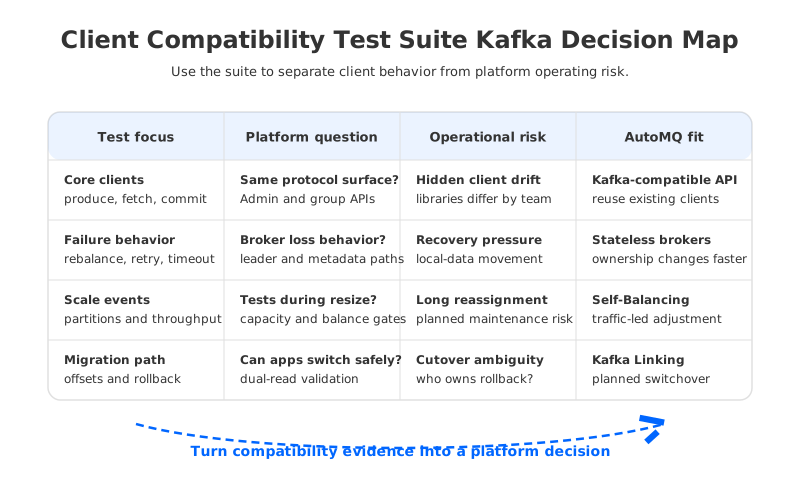
That is the lens for this article. A Kafka client compatibility suite should help platform teams evaluate a Kafka-compatible streaming platform without turning the exercise into a vendor checklist. It should connect client behavior to operating reality: storage architecture, scaling model, cost exposure, governance boundaries, failure recovery, and migration safety.
1Why teams search for client compatibility test suite kafka
The search usually starts after a platform team has narrowed its options. The current Kafka environment might be expensive to scale, hard to rebalance, or tied to broker-local disks. A cloud-native alternative looks attractive because it promises better elasticity or a cleaner operating model, but the application portfolio is not a lab. It contains services written in different languages, consumers with different commit patterns, connectors that hide their client behavior, and operational scripts that call Kafka Admin APIs directly.
A serious compatibility suite has to cover at least five surfaces. First, it needs direct producer and consumer behavior: produce, fetch, retry, timeout, batching, compression, idempotence, and offset commit behavior. Second, it needs group coordination behavior, because many production incidents show up as unstable rebalances rather than as clean request failures. Third, it needs AdminClient behavior for topic creation, partition inspection, ACL checks, and metadata refresh. Fourth, it needs security and network behavior, including TLS, SASL, advertised listeners, private endpoints, and client-side DNS assumptions. Fifth, it needs ecosystem behavior for Kafka Connect, Kafka Streams, schema tooling, and observability agents.
The suite should be small enough to run often and realistic enough to matter. A good pattern is to build three layers:
- Smoke tests prove that common clients can connect, produce, consume, commit offsets, and call metadata APIs.
- Behavioral tests exercise production-specific features such as transactions, idempotent producers, consumer group rebalances, connector tasks, and failure retries.
- Operational tests run the same client workload while the platform is being resized, restarted, upgraded, or used as a migration target.
The third layer is where many test plans become useful. Client compatibility is not static. A client that behaves correctly on a quiet cluster might expose hidden assumptions during broker replacement, leader movement, network interruption, or migration cutover. Treating those events as part of the suite prevents a false sense of readiness.
2The production constraint behind the problem
Traditional Kafka is built around a Shared Nothing architecture. Each broker owns local storage, and the cluster uses replication across brokers to protect partition data. That design has served Kafka well, but it turns many operational changes into data movement problems. Rebalancing partitions, replacing failed nodes, expanding capacity, and recovering from hardware issues all have to respect the fact that useful data is attached to specific brokers.
That matters for compatibility testing because clients do not experience architecture directly. They experience it through metadata changes, leader changes, request latency, rebalance frequency, timeout behavior, and maintenance windows. When a broker is overloaded or a partition reassignment is running, a consumer group might rebalance more often. When capacity is tight, a producer might hit longer request latency or different retry patterns. When a migration tool rewrites offsets or changes topic naming, downstream applications might pass basic reads but fail correctness checks.
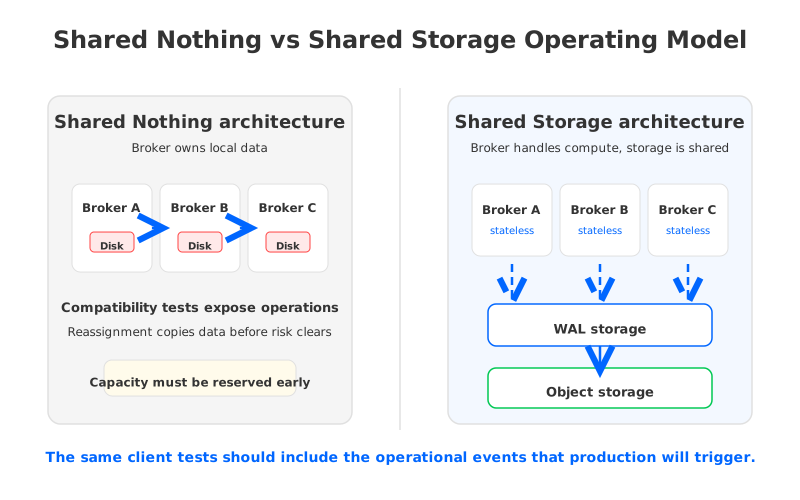
The test suite therefore needs to include the production events that create pressure:
- Broker loss: verify that producers retry without duplication, consumers recover without offset regression, and operational alerts distinguish platform recovery from application failure.
- Capacity expansion: run load while partitions are reassigned or balanced, then compare client error rates, consumer lag, and end-to-end latency before and after the event.
- Security rotation: test certificate, secret, ACL, and listener changes with the client libraries and automation that production actually uses.
- Migration rehearsal: validate offset continuity, producer cutover behavior, consumer resume points, and rollback steps using representative topics.
- Governance boundary checks: confirm where data, metadata, metrics, and logs flow, especially when the target platform runs inside a customer-owned cloud account or private network.
This is also where cost enters the discussion. A compatibility suite should not become a spreadsheet, but it should expose the operational choices that drive cost. Broker-local storage tends to push teams toward pre-provisioned disk, reserved headroom, and cross-zone replication traffic. A cloud-native architecture may shift cost toward object storage requests, cache design, network placement, or managed control components. The right question is not whether one line item is lower. The right question is whether the operating model matches the workload's growth, retention, fan-out, and failure expectations.
3Architecture options and trade-offs
A platform team evaluating Kafka-compatible systems should separate compatibility from architecture. Compatibility answers whether existing clients and tools can continue to use Kafka APIs and semantics. Architecture answers what the platform must do internally to make that possible at production scale.
The evaluation usually falls into four categories:
| Option | What to test | Main operating trade-off |
|---|---|---|
| Traditional Kafka with broker-local disks | Client behavior during reassignment, broker replacement, and storage pressure | Mature ecosystem, but operations remain tied to local data placement |
| Kafka with Tiered Storage | Reads across local and remote tiers, retention behavior, cold-read performance | Longer retention can become more cost-effective, but brokers still keep local storage responsibilities |
| Managed Kafka service | Authentication, network paths, API surface, and service limits | Lower infrastructure burden, but platform teams must accept service boundaries and scaling controls |
| Kafka-compatible shared-storage platform | Protocol behavior plus failure, scaling, and migration events | Different storage model can reduce broker-local operations, but teams must validate object storage, WAL, and governance assumptions |
This comparison makes the suite more honest. If the target is traditional Kafka, the suite should emphasize operational safety around reassignment and local disk pressure. If the target uses Tiered Storage, the suite should add cold-read and retention tests. If the target is managed, the suite should test service limits, private connectivity, IAM boundaries, and observability access. If the target uses shared storage, the suite should verify that stateless broker operations, write-ahead logging, and object-storage-backed durability behave correctly under the application's traffic pattern.
The decision point is not "pass or fail" in the abstract. A test can pass while still revealing a cost or ownership concern. For example, a consumer might resume correctly after a broker restart, but the operational event might require a long maintenance window. A connector might run correctly, but the platform team might discover that observability is split across too many systems. A migration rehearsal might preserve offsets, but rollback may still require application teams to coordinate a freeze. Those are useful findings because they turn vague risk into explicit work.
4Evaluation checklist for platform teams
The runbook should have a clear owner for each gate. Developer experience teams usually own client libraries and test harnesses. SREs own failure drills, monitoring, and incident procedures. Security teams own identity, network, encryption, and audit requirements. Platform engineering owns the final decision because it has to reconcile the evidence.
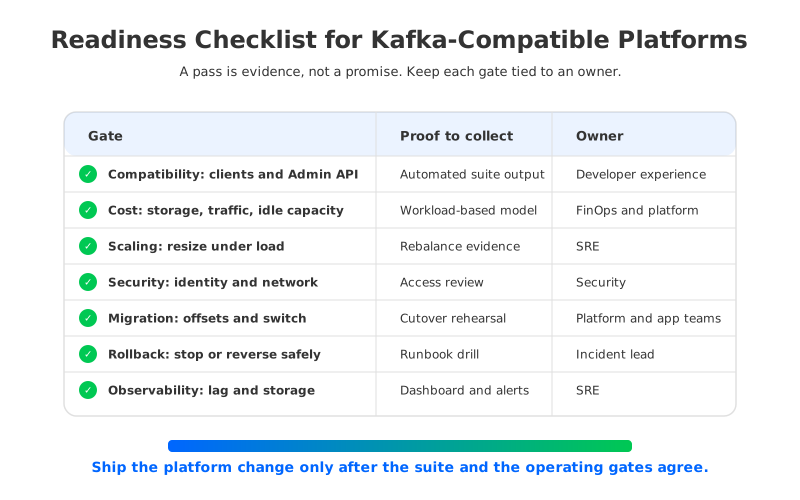
A practical checklist looks like this:
- Define the client matrix. Include language, library version, authentication mode, transaction usage, compression, schema tooling, and runtime platform for every representative application.
- Define the behavior matrix. Cover produce, fetch, offset commit, rebalance, AdminClient calls, transactions, Connect tasks, Streams state behavior, and operational scripts.
- Define the operating events. Include broker restart, broker loss, scale-out, scale-in, security rotation, network interruption, upgrade, and migration rehearsal.
- Define the evidence. Capture client logs, broker metrics, consumer lag, error rates, latency percentiles, offset positions, topic metadata, and runbook timestamps.
- Define exit criteria. Write down what counts as acceptable, who can waive a warning, and what requires a design change before production.
This is where many teams benefit from a scorecard instead of a single test result. A scorecard can mark compatibility as pass while flagging migration rollback as not ready, or mark scaling as acceptable while requiring a monitoring gap to be closed. The platform decision becomes more disciplined because each risk has a named owner and a next action.
5How AutoMQ changes the operating model
After the neutral evaluation is in place, AutoMQ becomes relevant as an architectural answer to a specific problem: how to keep Kafka-compatible client behavior while reducing the operational coupling between brokers and persistent data. AutoMQ is a Kafka-compatible streaming platform that uses a Shared Storage architecture. Brokers handle Kafka protocol processing and compute responsibilities, while durable data is stored through WAL (Write-Ahead Log) storage and S3-compatible object storage.
That changes what the compatibility suite should observe. In a broker-local model, a broker event often implies data movement or recovery from local replicas. In AutoMQ's Shared Storage architecture, brokers are stateless, and the system can shift ownership and traffic without copying a full partition's historical data between broker disks. The suite should still test the same client behaviors, but the operating events have a different shape: scale events, Self-Balancing, broker replacement, and recovery become first-class evidence for whether the platform reduces daily friction.
AutoMQ also changes the boundary between platform and application teams. Existing Kafka clients can keep using Kafka APIs, while platform teams can manage clusters through AutoMQ Console, Terraform workflows, monitoring integrations, and migration tooling. For migration projects, Kafka Linking is designed to preserve message and offset continuity during planned switchover scenarios. For operations, Self-Balancing and Self-healing help reduce the amount of manual partition movement and incident coordination that application teams have to understand.
The important point is not that architecture removes the need for testing. It makes the tests more targeted. Instead of spending most of the runbook proving that every client survives long data-copy operations, the team can measure whether a shared-storage operating model actually shortens risky events, keeps client behavior stable, and fits its governance boundary. In AutoMQ BYOC, both control and data plane components run in the customer's cloud environment, so the suite should also verify network, identity, logging, metrics, and data-residency assumptions against that deployment model.
6Migration and rollout runbook
Treat the compatibility suite as a release artifact. It should live outside any single application repository, but it should be close enough to application owners that changes in client behavior are noticed. The best suite is not a huge framework. It is a repeatable set of checks that can be run before architecture selection, during proof of concept, during migration rehearsal, and after production cutover.
The rollout sequence should be conservative:
- Baseline the current platform with the same suite. This prevents teams from blaming the target platform for behavior that already exists.
- Run the suite against the target platform in a quiet environment. Fix basic connection, authentication, metadata, and client-library issues first.
- Add representative load and run operational events. Measure client errors, lag, latency, and recovery timestamps.
- Rehearse migration and rollback. Validate offsets, producer switching, consumer resume behavior, and the exact point where the old platform can no longer be treated as the recovery baseline.
- Promote in waves. Start with applications that have simple client behavior, then move transactional, stateful, and connector-heavy workloads after the runbook has evidence.
The final decision should be boring. If the scorecard shows compatible clients, stable operations, clear ownership, validated rollback, and acceptable cost exposure, the production change becomes an execution task rather than a leap of faith. If one of those gates is weak, the suite has done its job by stopping the team before production traffic discovers the gap.
If your team is evaluating a Kafka-compatible platform and wants to compare client behavior with the operating model behind it, start with the runbook above and then test the architecture directly. For AutoMQ BYOC or AutoMQ Software evaluation, you can open a technical discussion through AutoMQ Cloud with your client matrix, migration goals, and governance requirements ready.
7FAQ
7.1What should a Kafka client compatibility test suite include?
It should include producer, consumer, AdminClient, authentication, consumer group, offset, transaction, connector, and failure-recovery behavior. The suite should also run during operational events such as broker restart, scaling, upgrade, and migration rehearsal.
7.2Is API compatibility enough for a Kafka-compatible streaming platform?
No. API compatibility is necessary, but production readiness also depends on operational behavior, observability, security boundaries, cost model, failure recovery, and migration safety. The test suite should connect client behavior to those operating conditions.
7.3How often should the suite run?
Run it before platform selection, before migration rehearsal, before production cutover, and after major client-library or platform upgrades. Teams with many Kafka client versions can also run a smaller smoke suite on a scheduled basis.
7.4Where does AutoMQ fit in this evaluation?
AutoMQ fits after the neutral compatibility and operations framework is defined. It should be evaluated as a Kafka-compatible shared-storage platform with stateless brokers, WAL storage, object-storage-backed durability, and customer-controlled deployment boundaries.
8References
- Apache Kafka documentation
- Apache Kafka protocol guide
- Apache Kafka semantics
- Apache Kafka Connect documentation
- AutoMQ compatibility with Apache Kafka
- AutoMQ Shared Storage architecture overview
- AutoMQ WAL storage
- AutoMQ Continuous Self-Balancing
- AutoMQ Kafka Linking overview
- AutoMQ observability overview


