
Table of Contents
Table of Contents
Teams usually search for developer self service connectors kafka after the first informal process breaks down. One application team needs a Salesforce source connector. Another needs a database change stream. A third wants a sink into object storage for analytics. The platform team can keep approving tickets one by one for a while, but the queue turns into a hidden integration platform that nobody designed on purpose.
The hard part is not letting developers create connectors. The hard part is doing it without handing every team a different failure mode. Kafka Connect gives the integration runtime, task model, offsets, and connector plugin ecosystem. Production self-service needs intake rules, capacity boundaries, security review, observability, rollback, and a clear answer when connector demand outgrows the Kafka cluster behind it.
That is where the operating model matters more than the portal. A button that says "create connector" is useful only when the platform underneath can absorb the traffic, storage, and governance consequences. This runbook gives platform engineering teams a practical way to decide when self-service connectors are ready for production in Kafka-compatible streaming systems.
1Why teams search for developer self service connectors kafka
The search query is awkward because the real problem is awkward. Developers want integration speed, SREs want blast-radius control, security teams want reviewable access paths, and Kafka operators want to avoid a surprise capacity event caused by a connector that looked harmless in a form. Everyone is right. The conflict comes from treating connector creation as an application feature when it is actually an infrastructure workflow.
Kafka Connect already separates connector configuration from application code. A source connector writes records into Kafka topics; a sink connector reads from topics and delivers records somewhere else. Workers run tasks, track offsets, and coordinate through Kafka. That model is powerful because developers do not need to build every integration from scratch, but it also concentrates risk in a shared runtime. One connector template can create many production tasks, and one bad template can create repeated production incidents.
Self-service should start with the request shape, not the UI. A useful request contains the system being connected, topic names, expected rate, serialization format, authentication method, secret rotation path, retention expectation, and rollback owner. If the request cannot describe those fields, the platform team is being asked to approve an unknown workload.
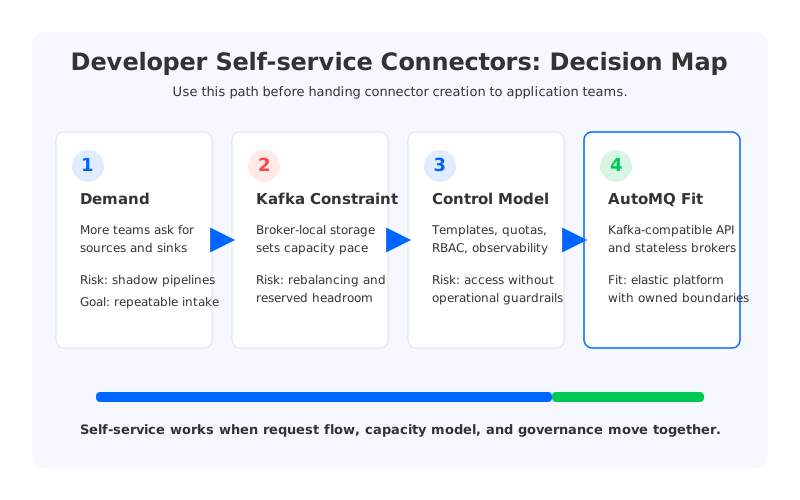
The decision map above is deliberately operational. It does not ask whether a connector is possible. It asks whether the platform can make repeated connector creation boring enough for production. That means templates, quotas, network policy, RBAC, task health alerts, and broker capacity all have to be part of the same review.
2The production constraint behind the problem
Traditional Kafka clusters use a Shared Nothing architecture. Each broker owns local log storage, partitions are assigned to brokers, and durability is maintained through replica placement and ISR (In-Sync Replicas). This design has served Kafka well, but it creates a specific constraint for self-service connectors: each added integration eventually consumes broker-local resources, even if the integration is created far away from the broker team.
Connector workloads are noisy in a different way from application producers and consumers. A source connector may write steadily for months, then spike during a backfill. A sink connector may look idle until a downstream system slows down and consumer lag starts to rise. A connector that reads from several high-retention topics can turn a minor integration into a sustained read workload. The Kafka cluster sees bytes, partitions, requests, and lag. It does not see the organizational story behind the request.
That gap turns into several operational constraints:
- Capacity is approved at the wrong layer. Developers request a connector, but the cluster absorbs storage, network, and task-side retry behavior. The approval workflow needs to map connector intent to cluster-level impact.
- Rebalancing is not a paperwork problem. When broker-local data must move during scaling or reassignment, connector growth can make capacity changes slower and riskier than the request form suggests.
- Cross-AZ traffic can hide in normal operations. Multi-AZ Kafka deployments protect availability, but replication and client placement can create network traffic that connector owners never see in their own budgets.
- Rollback needs offsets, not only a disable button. Turning off a connector is a mechanical action. Knowing which records were written, consumed, retried, or duplicated is the production question.
The platform team therefore needs an operating contract. A connector template should define its data contract, resource envelope, deployment boundary, and failure behavior. Without that contract, self-service becomes ticketless change management.
3Architecture options and trade-offs
There are three common ways to build developer self-service connectors around Kafka-compatible systems. The first is a centralized platform team that owns all connector deployment. This gives strong control and consistent review, but it does not scale well when every application team needs a different integration. It also turns the platform team into an integration help desk.
The second is a shared Kafka Connect runtime with approved templates. Developers choose from known connector types, fill in parameters, and receive a managed deployment. This is often the right first production step because it keeps plugin management, worker sizing, secrets, and monitoring under platform control. The trade-off is that the shared runtime becomes a multi-tenant system. Quotas, namespace isolation, and connector-specific alerts become mandatory.
The third is a platform API or internal developer portal that provisions connector runtimes, topics, credentials, and monitoring as one workflow. This can work well for large organizations, but the portal should not hide the infrastructure model. If the Kafka layer still requires manual broker expansion, storage planning, and partition movement, the portal only moves the bottleneck from a ticket queue to an operations queue.
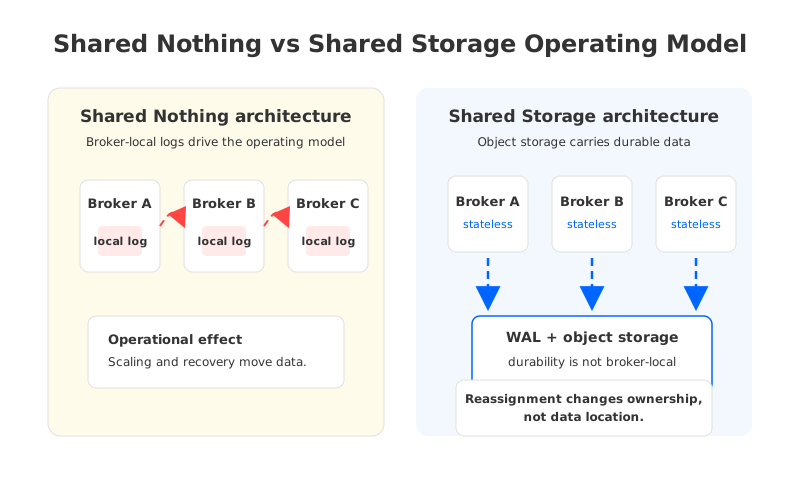
The architectural difference is not cosmetic. In a Shared Nothing architecture, scaling and recovery are coupled to where data lives. In a Shared Storage architecture, durable data is kept in shared object storage, while brokers handle Kafka protocol processing, request routing, leadership, caching, and scheduling. That changes the self-service discussion because a connector request no longer has to be evaluated only against fixed broker-local storage.
Tiered Storage is often confused with this shift. Apache Kafka Tiered Storage moves older log segments to remote storage while keeping active data on local broker storage. It can help with long retention, but it does not make brokers stateless. For self-service connectors, that distinction matters. A platform that still depends on broker-local primary storage still has to plan around local disk, data movement, and reassignment behavior.
4Evaluation checklist for platform teams
Before enabling self-service, run the same checklist for every connector category. The point is not to slow teams down. The point is to avoid granting self-service to a workflow that still depends on informal review.
| Evaluation area | Production question | What "ready" looks like |
|---|---|---|
| Compatibility | Will the connector, client behavior, and data format work with the target Kafka-compatible platform? | Kafka Connect behavior, serialization, offsets, and client settings are tested before template approval. |
| Cost boundary | Who owns storage, network, worker, and retry costs? | Each template has quotas, retention limits, and traffic expectations. |
| Elasticity | What happens when backfill or fan-out increases? | Worker scaling and broker capacity are modeled together. |
| Governance | Who can create, modify, pause, and delete connectors? | RBAC, audit logs, secret handling, and approval policy are explicit. |
| Failure recovery | What happens when the downstream system slows or the connector restarts? | Lag, retry, dead-letter, and replay paths are documented. |
| Migration risk | Can existing connectors move without application rewrites? | Bootstrap servers, credentials, offsets, and topic contracts are mapped. |
| Observability | Can operators see task health and Kafka-side pressure in one place? | Connector metrics and broker metrics are correlated. |
This checklist should be applied before the first portal release, then repeated whenever another connector class is added. A low-risk sink connector and a database source connector do not deserve the same approval path. The former may be mostly about throughput and credentials. The latter may involve snapshots, transaction boundaries, schema drift, and a more complex rollback path.
There is also a team-boundary question hiding inside the checklist. Developers should own the business intent of the connector: what data moves, why it moves, and what downstream behavior is expected. The platform team should own the reusable runtime, allowed connector types, security controls, and cluster capacity model. SRE should own alert thresholds and incident routing. When those boundaries are vague, every incident becomes a debate about who approved what.
5How AutoMQ changes the operating model
Once the evaluation framework is clear, the platform requirement becomes more specific: keep Kafka compatibility for the developer ecosystem, but reduce the broker-local storage and reassignment burden that makes self-service hard to scale. AutoMQ is a Kafka-compatible, cloud-native streaming platform built around Shared Storage architecture. It keeps Kafka protocol compatibility while moving durable stream storage to S3-compatible object storage through S3Stream and WAL storage.
For connector self-service, the practical effect is that brokers become more replaceable. AutoMQ Brokers are stateless brokers in the sense that durable data is not tied to local broker disks. Partition reassignment becomes an ownership and scheduling operation rather than a large broker-to-broker data copy. That does not remove the need for capacity planning, but it changes the bottleneck. Platform teams can reason more directly about compute, cache, worker capacity, and object storage boundaries.
The control plane matters here as much as the storage layer. AutoMQ Console and Terraform workflows can help platform teams expose standardized operations without asking every developer to understand broker internals. Managed Connector workflows, monitoring, Self-Balancing, Self-healing, Kafka compatibility, and customer-controlled deployment boundaries all support the same goal: let application teams move faster while keeping platform teams in control of the shared runtime.
The governance benefit is not that every connector becomes harmless. No serious platform should make that promise. The benefit is that the operating model becomes easier to encode. A connector template can be tied to topic policy, identity, worker sizing, traffic expectations, alert rules, and rollback steps. The streaming layer underneath is less likely to turn each increase in connector demand into a broker-local storage project.
AutoMQ BYOC is especially relevant for teams that need customer-controlled cloud boundaries. The control plane and data plane run in the customer's own cloud account and VPC, while the data path remains inside the customer environment. That matters for self-service connectors because connectors often touch sensitive application systems, credentials, and regulated data flows. The platform can offer self-service without moving the operating boundary outside the customer's environment.
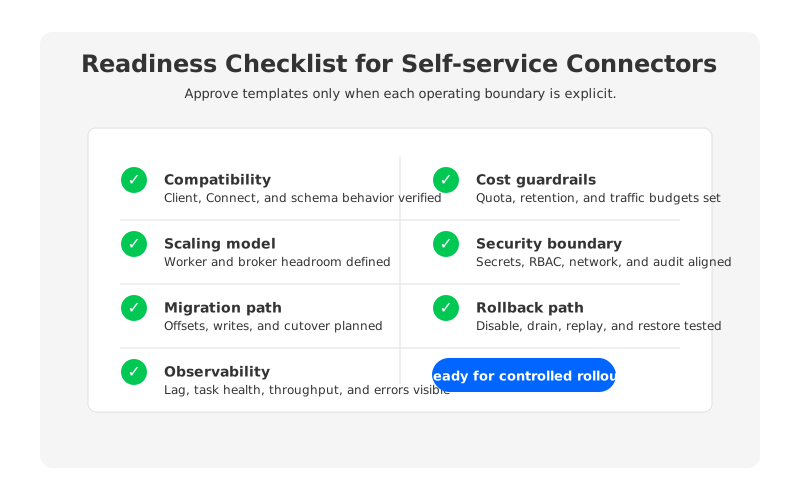
The readiness checklist is the simplest way to keep the rollout honest. If a connector type cannot pass compatibility, cost, scaling, security, migration, rollback, and observability checks, it is not ready for self-service. It may still be a valid managed integration, but it should stay behind a platform review until the missing control is built.
6A rollout sequence that avoids the usual failure mode
Start with one connector class, not every connector your developers ask for. Pick a workflow with clear ownership, stable throughput, and a clear rollback path. A sink connector from Kafka into an analytics store is often less complex to standardize than a source connector that snapshots a transactional database. The goal is to validate the self-service operating model before adding connector diversity.
Then define a template contract. A useful template includes allowed connector versions, required fields, secret handling, topic naming, default error handling, quota limits, monitoring labels, and owner metadata. Put the contract in code through Terraform, an internal platform API, or another repeatable workflow. A template stored only in a wiki will drift as soon as teams start copying it.
After that, connect the template to observability. Connector task status is not enough. Operators need to see Kafka topic throughput, consumer lag, failed records, retry behavior, worker CPU and memory, and broker-side pressure. A self-service connector should create its monitoring surface at the same time it creates the connector. If observability is a follow-up task, the first incident will find the gap.
Finally, rehearse rollback. Pause the connector, restart it, replay from a known offset, rotate credentials, and simulate a downstream outage. These tests sound mundane because they are. That is the point. Self-service is production-ready when the common failure paths are documented and repeatable, not when the happy path works in a demo.
7FAQ
7.1Is Kafka Connect enough for developer self-service?
Kafka Connect provides the connector runtime, task coordination, and offset handling. Developer self-service also needs governance, quota management, template control, monitoring, secrets management, and rollback rules. Treat Kafka Connect as the runtime layer, not the complete platform workflow.
7.2Should every connector be self-service?
No. Connector types with unclear data ownership, unstable throughput, complex transaction semantics, or weak rollback paths should stay behind platform review. Self-service is a maturity level for a connector category, not a universal permission.
7.3How does Shared Storage architecture help connector operations?
Shared Storage architecture reduces the dependency between durable data and individual broker disks. For connector-heavy platforms, that can make scaling, broker replacement, and partition reassignment easier to operate because the platform is not constantly moving primary data between brokers.
7.4Does AutoMQ require application changes for Kafka-compatible workloads?
AutoMQ is designed for Kafka compatibility, so existing Kafka clients and ecosystem tools can usually keep using Kafka APIs and protocols. Platform teams should still test client versions, authentication, connector behavior, offsets, and operational tooling before migration.
7.5What should a platform team measure before rollout?
Measure connector task health, worker resource usage, topic throughput, consumer lag, error rates, retry volume, broker pressure, storage growth, and network traffic. The exact metrics vary by connector type, but the dashboard should show both connector-side and Kafka-side impact.
If your team is turning Kafka integration tickets into self-service, use the checklist above as the first gate. To evaluate the same operating model with a Kafka-compatible platform built for Shared Storage architecture, start from AutoMQ Cloud.
8References
- Apache Kafka Documentation
- Apache Kafka Documentation: Kafka Connect
- Apache Kafka Documentation: Consumer Groups
- Apache Kafka Documentation: Transactions and Exactly-once Semantics
- Apache Kafka Documentation: KRaft
- AutoMQ Kafka Compatibility
- AutoMQ Architecture Overview
- AutoMQ WAL Storage
- AutoMQ Kafka Connect Overview
- AutoMQ Continuous Self-Balancing


