
Table of Contents
Table of Contents
Searches for banking risk signals kafka usually come from a practical moment, not a curiosity about event streaming. A fraud, credit, AML, or account-risk team has already learned that nightly scoring is too slow for part of the business. They need payment events, login signals, device fingerprints, account changes, sanctions screening outputs, and model decisions to move through the bank with enough ordering, replay, and isolation that downstream teams can act on them without rebuilding the pipeline for every additional risk rule.
The hard part is not putting risk events into Kafka. Most banking platform teams already know how to create topics, assign partitions, and connect producers and consumers. The hard part is making the streaming layer behave like production financial infrastructure: predictable recovery, bounded consumer lag, controlled access, auditable change, and cost that does not punish the team every time another risk model needs more replay or fan-out. That is where operational SLOs matter more than a generic architecture diagram.
1Why Teams Search for banking risk signals kafka
A banking risk signal is rarely a single event. It is usually a stateful interpretation of several facts: a card-not-present transaction, a device reputation update, a geolocation change, a merchant risk score, a customer profile update, and a model output that expires if it arrives late. Kafka fits this pattern because it gives teams a durable commit log, ordered partitions, consumer groups, offsets, and replay. Those primitives let independent systems consume the same stream at their own pace while preserving a shared event history.
Risk workloads stress Kafka differently from clickstream or observability pipelines. The traffic may be bursty around market hours, payroll cycles, settlement windows, incident response, or fraud campaigns. Some consumers need tail latency; others need historical replay for model backtesting or case investigation. The same event may feed a decision engine, a customer notification workflow, a ledger control, and an offline analytics path. Each consumer has a different failure mode, but the shared platform owns the blast radius when lag or broker recovery goes wrong.
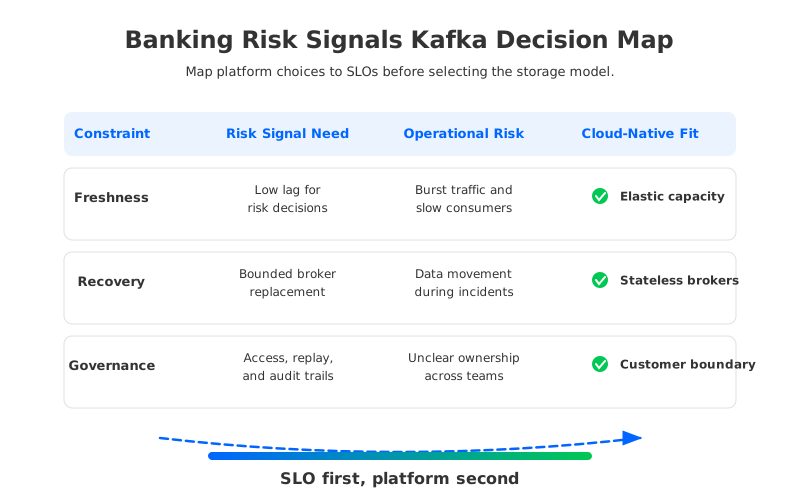
Good SLOs translate that messy workload into measurable platform behavior:
- Freshness SLO: How far behind can a risk-decision consumer fall before the business outcome changes?
- Replay SLO: How quickly can a team reprocess a window of historical events after a model, ruleset, or enrichment bug?
- Recovery SLO: How long can a broker, zone, or storage failure affect partition leadership and reads?
- Governance SLO: Can the platform prove who produced, consumed, retained, and changed a risk topic?
- Cost SLO: Can the team add retention, fan-out, or backtesting capacity without pre-buying months of local disk?
These questions push the platform conversation past "Can Kafka handle the throughput?" Throughput is one constraint. Banking risk systems also need predictable operating boundaries when the system is under pressure.
2The Production Constraint Behind the Problem
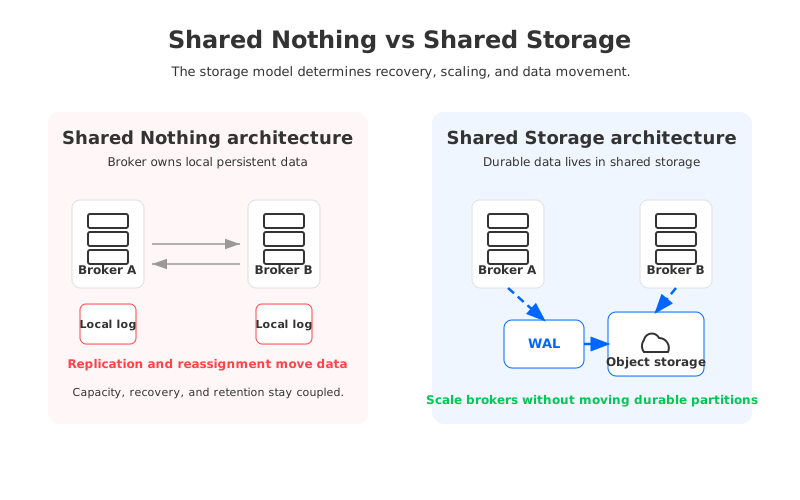
Traditional Kafka uses a Shared Nothing architecture. Each broker owns local storage for its partition replicas, and replication moves data between brokers to maintain durability and availability. That design made sense for data centers where local disks were the natural persistence layer and machine-to-machine traffic did not show up as a separate cloud line item. In the cloud, the same design turns storage ownership into an operational constraint.
The constraint shows up first as capacity planning. If a banking risk topic needs longer retention for investigation, local broker storage has to be sized before the data arrives. If traffic spikes, the team can add brokers, but partition reassignment still means data movement. If a broker fails, replacement capacity is not enough by itself because the data tied to the failed broker has to be recovered or reassigned. The platform is scaling compute and storage together even when the workload only needs one of them.
It also shows up as network cost and fault-domain complexity. In a multi-Availability Zone deployment, replication can move large volumes of data across zones. Cloud providers charge for some cross-zone traffic patterns, and the exact bill depends on region, service, direction, and architecture. A risk platform should not treat that as an afterthought. A clean cost model needs to separate producer ingress, replication traffic, consumer egress, cross-zone reads, PrivateLink or endpoint processing, and object storage requests.
The deeper issue is recovery. Banking teams can tolerate many kinds of slowness if they are bounded and visible. They have a harder time with an unexpected data movement event that competes with live traffic, slows catch-up consumers, and extends the time before a failed node is fully replaced. Operational SLOs should therefore measure the recovery behavior of the storage model, not only the normal path of produce and consume.
3Architecture Options and Trade-offs
The neutral way to evaluate Kafka-compatible streaming for banking risk signals is to separate API semantics from storage mechanics. The application teams care about producers, consumers, offsets, transactions, consumer groups, Connect integrations, and client compatibility. The platform team cares about where durable data lives, how partitions move, how failures recover, how retention is paid for, and how access is audited. A platform can be Kafka-compatible at the client layer while making very different choices underneath.
| Option | What it preserves | Operational trade-off | When it fits |
|---|---|---|---|
| Traditional Kafka on local or cloud block storage | Kafka protocol, local log semantics, mature ecosystem | Compute and storage scale together; reassignment and recovery involve data movement | Stable workloads with predictable retention and strong existing operations |
| Kafka with Tiered Storage | Kafka protocol with older segments offloaded to object storage | Recent data still depends on local broker storage; hot recovery and rebalancing still need planning | Teams that mainly need longer retention for historical reads |
| Kafka-compatible Shared Storage architecture | Kafka API with durable data placed in shared object storage | Requires platform validation of WAL, cache, object storage, and operational tooling | Teams that want elastic brokers, lower storage coupling, and simpler replacement workflows |
No option removes the need for Kafka discipline. Topic design still matters. Partition keys still define ordering boundaries. Consumer groups still need lag monitoring and rebalance hygiene. Transactions and idempotent producers still need application-level care. The difference is where the platform spends its effort: copying data between brokers, operating the local storage fleet, or validating a shared storage layer with explicit write-ahead logging and cache behavior.
A practical architecture review should ask how each option behaves in four uncomfortable moments. First, what happens when a broker disappears during a traffic spike? Second, what happens when a model team needs to replay a defined historical window into an additional feature pipeline? Third, what happens when a regulator or internal audit asks for proof of retention, access, and change control? Fourth, what happens when the business asks for another consumer group that raises read fan-out? The right answer is not a slogan. It is a set of measured behaviors that your team can operate.
4Evaluation Checklist for Platform Teams
Start with compatibility, but do not stop there. Banking teams often have existing producers, consumers, schema conventions, Connect workers, ACLs, observability dashboards, and incident runbooks. A platform that requires broad client rewrites creates migration risk before the technical evaluation begins. The first checkpoint is whether the platform can keep the Kafka API contract stable enough that application teams can move in phases.
The second checkpoint is the cost model. Avoid a single "Kafka cost" bucket. Break the model into storage, compute, inter-zone traffic, endpoint traffic, observability, backup or export jobs, and operational labor. Use cloud provider pricing pages for the region where the workload runs, and keep the assumptions in the review. The point is not to predict the invoice perfectly. The point is to identify which cost grows with retained data, which cost grows with fan-out, and which cost grows when the platform recovers from failure.
Use this checklist before selecting or migrating the platform:
- Client behavior: Producers and consumers should keep their Kafka client libraries, serialization formats, offset behavior, and retry patterns unless there is a documented reason to change them.
- Topic and partition model: Risk domains should have clear ordering keys, retention policies, compaction choices, and ownership. Avoid one giant "risk events" topic that becomes impossible to govern.
- Failure recovery: The platform should define broker replacement behavior, leadership movement, catch-up reads, and replay capacity under a failed-node scenario.
- Security boundary: Network paths, IAM roles, encryption, ACLs, audit logs, and administrative access should match the bank's control model.
- Migration path: The plan should include dual writing or linking, offset validation, rollback, cutover criteria, and a way to compare lag and record counts.
- Observability: Dashboards should expose consumer lag, produce latency, fetch latency, broker health, storage path health, request errors, and quota pressure.
- Cost ownership: The team should know who pays for retained data, replay jobs, cross-zone paths, and extra consumers before those patterns become production dependencies.
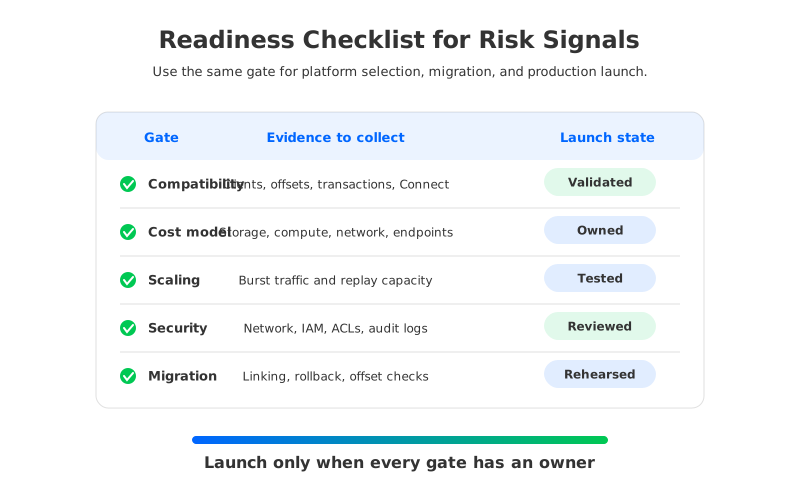
The checklist is deliberately operational. A design that looks clean in a whiteboard review can still fail if nobody owns rollback, if replay consumes the same capacity needed for live decisions, or if a new consumer group turns into a surprise network bill. For banking risk signals, the platform is part of the control environment.
5How AutoMQ Changes the Operating Model
Once the evaluation framework is clear, the architectural question becomes sharper: can the platform keep Kafka semantics while reducing the amount of state tied to each broker? AutoMQ is a Kafka-compatible streaming platform that answers this with a Shared Storage architecture. It keeps the Kafka protocol and client ecosystem, while moving durable data into S3-compatible object storage through S3Stream and a WAL (Write-Ahead Log) layer.
That changes the broker's job. In traditional Kafka, a broker is both compute and the owner of local persistent data. In AutoMQ, brokers are stateless brokers for the durable data path. They still handle Kafka requests, partition leadership, caching, and coordination, but persistent data is not trapped on the broker's local disk. Broker replacement and scaling therefore become more about ownership and traffic movement than about copying large partition replicas from one local disk fleet to another.
For a banking risk platform, this matters in three concrete ways. Capacity planning can focus separately on compute and retained data. Recovery planning can test broker replacement without assuming large local data movement. Cost review can examine object storage, WAL storage, and inter-zone paths directly instead of hiding them inside a single broker-storage budget. Those are operating-model changes, not cosmetic implementation details.
AutoMQ's deployment boundary also matters for banks. AutoMQ BYOC runs the control plane and data plane in the customer's own cloud account and VPC, while AutoMQ Software is designed for customer-operated private environments. That gives platform teams a way to evaluate Kafka-compatible streaming without moving business data into an external hosted data plane. The right deployment choice still depends on cloud account design, network controls, IAM review, observability integration, and the bank's own operating model.
The migration story should remain boring by design. A bank should not rewrite fraud detection or credit risk services to prove a streaming platform. It should validate compatibility, mirror or link data, compare offsets and lag, run replay tests, and cut over bounded domains first. AutoMQ Linking is designed for migration scenarios where offset consistency and message synchronization matter, but the readiness gate should still be owned by the platform team, not by a product checkbox.
6FAQ
6.1Is Kafka a good fit for banking risk signals?
Kafka is a strong fit when risk events need ordering, replay, fan-out, and decoupled consumers. It is less useful if the workload is only a synchronous request-response decision with no need for durable event history. Most banking risk platforms end up with both: synchronous decisions for the customer path and Kafka-compatible streams for event distribution, enrichment, audit, replay, and model feedback.
6.2What SLOs should a banking risk streaming platform track first?
Start with freshness, consumer lag, recovery time after broker failure, replay time for a defined historical window, and access-change auditability. Then add cost SLOs for retention and read fan-out. The useful test is whether an SLO maps to a business decision, such as whether a transaction can be scored in time or whether investigators can replay a disputed window.
6.3Does Tiered Storage solve the operating problem?
Tiered Storage helps when the main pressure is retaining older data without keeping every segment on local broker disks. It does not fully remove broker-local storage from the hot path. If the platform goal is elastic broker replacement and separation of compute and storage, evaluate Shared Storage architecture separately instead of treating Tiered Storage as the same pattern.
6.4Where should AutoMQ enter the evaluation?
AutoMQ should enter after the team has defined compatibility, recovery, governance, migration, and cost requirements. It is a candidate when the team wants Kafka-compatible APIs with Shared Storage architecture, stateless brokers, object-storage-backed durability, and customer-controlled deployment boundaries.
7Closing Checklist
The original search for banking risk signals kafka usually means the team has outgrown a batch-oriented or service-by-service integration model. Do not answer that search with a generic stream-processing diagram. Answer it with SLOs: how fresh the signal must be, how replay works, how recovery behaves, who controls access, and which costs grow when the business adds consumers.
If you are evaluating a Kafka-compatible platform for banking risk signals, test AutoMQ against one bounded risk domain before touching the entire estate. Start with compatibility, replay, broker replacement, and cost visibility. You can try AutoMQ through the BYOC console here: start an AutoMQ evaluation.
8References
- Apache Kafka documentation
- Apache Kafka operations documentation for KRaft and storage operations
- Apache Kafka transaction protocol documentation
- Apache Kafka Connect user guide
- AutoMQ compatibility with Apache Kafka
- AutoMQ architecture overview
- AutoMQ WAL storage documentation
- AWS Amazon S3 pricing
- AWS PrivateLink pricing


