
Table of Contents
Table of Contents
Teams do not search for connected vehicle telemetry kafka because they need another generic event streaming diagram. They search because the vehicle data path has become operationally awkward: more devices, more topics, more downstream consumers, stricter incident response expectations, and a cost line that grows when the platform team is already trying to make the system more reliable. A vehicle stream is not one workload. It is a mix of GPS pings, battery state, diagnostics, driver behavior, command acknowledgments, firmware events, and service alerts, each with a different tolerance for latency, loss, replay, and retention.
That variety is what makes the Kafka decision hard. Apache Kafka gives teams a familiar abstraction for ordered logs, Consumer group processing, offset tracking, transactions, and a large integration ecosystem. The production question is whether the operating model can keep up when the workload moves from pilot fleet to regional or global fleet. The right evaluation starts with SLO ownership, not with a product checklist.
1Why teams search for connected vehicle telemetry kafka
Connected vehicle telemetry is usually born as a clean streaming problem. Vehicles emit events, an ingestion tier accepts them, Kafka topics buffer and order them, stream processors enrich them, and applications consume the results. On a whiteboard, the path is tidy. In production, the same path has to absorb poor mobile networks, uneven fleet activity, regional bursts, firmware rollouts, consumer lag, schema changes, and investigations that need replayable history.
The search intent behind connected vehicle telemetry kafka best practices is often a sign that the team already knows Kafka can move the data. What they need is a way to decide which operational promises the platform must make. A fleet operations application may care about fresh location updates. A warranty analytics job may care about replay depth. A safety monitoring service may care about bounded failover. A data science team may care about clean historical feeds into an object store or lakehouse. These are not separate platform choices, but they do create separate failure modes.
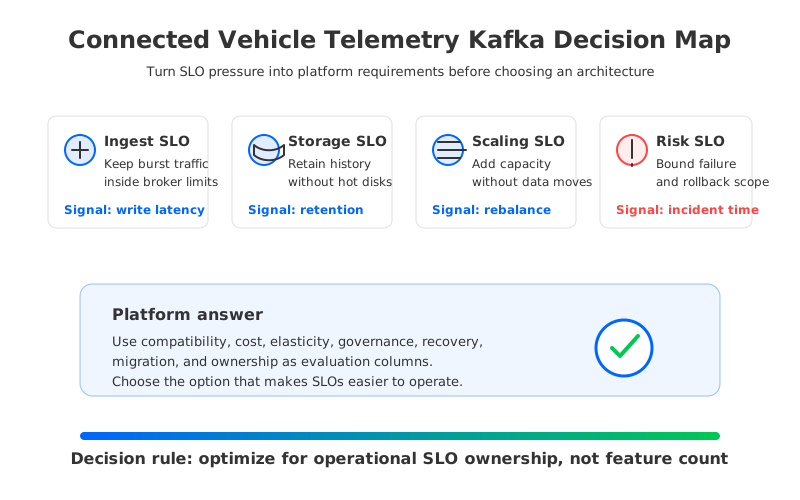
The first useful move is to turn the telemetry platform into a small set of SLO questions:
- Ingest SLO: Can the platform absorb predictable and unexpected bursts without pushing producers into long retry loops?
- Replay SLO: Can teams retain enough history for investigations and backfills without making hot broker disks the limiting resource?
- Recovery SLO: Can the platform survive broker, zone, network, and deployment failures without long data movement windows?
- Change SLO: Can schemas, consumers, Connect jobs, and stream processors evolve without forcing risky cutovers?
- Cost SLO: Can cost scale with useful data volume rather than with peak capacity that sits idle between bursts?
These questions are plain, but harder to satisfy than a feature matrix because each crosses application, platform, cloud, and operations boundaries.
2The production constraint behind the problem
Traditional Kafka is built around a Shared Nothing architecture. Each broker owns local storage for the partitions it hosts, and reliability comes from replicating partition data across brokers. This model is a proven design for many environments, and it explains much of Kafka's operational behavior: leadership matters, replica placement matters, disk capacity matters, and rebalancing means moving partition data. For connected vehicle telemetry, that storage placement becomes the hidden constraint behind many visible SLO issues.
Consider a telemetry topic that grows because the fleet adds higher-frequency diagnostics. The immediate symptom is more throughput and more retained data. Under a broker-local storage model, the deeper effect is that brokers need enough disk, network, and replica capacity to handle both the application workload and the internal work of keeping replicas healthy. When the team adds brokers, it may also trigger partition reassignment. When a broker fails, recovery is not only a matter of starting compute somewhere else; the system still has to account for where durable data lives and how replicas catch up.
This is where platform teams get surprised. The operational work is not always caused by telemetry complexity itself. Some of it comes from forcing a cloud workload into an architecture where durable data remains tightly bound to individual brokers. The fleet may be elastic, the applications may be cloud-native, and the downstream consumers may be serverless or containerized, but the streaming core still has a storage placement problem.
The pressure usually shows up in five places:
- Capacity planning: Fleet bursts require headroom, yet over-provisioned broker disks and compute sit idle when traffic drops.
- Reassignment windows: Scaling or reshaping the cluster can take longer than the business event that caused the burst.
- Cross-AZ traffic: Multi-zone durability and follower replication can turn reliability choices into network charges.
- Cold reads: Analytics, investigations, and delayed consumers compete with hot ingest when historical data is served from the same operational surface.
- Operational coupling: Storage, compute, leadership, and recovery decisions land on the same broker fleet, which narrows the SRE team's room to maneuver.
None of this means Kafka is the wrong abstraction for vehicle telemetry. It means the Kafka-compatible platform has to be judged by its operating model, not by protocol support alone.
3Architecture options and trade-offs
There are several valid ways to build a connected vehicle telemetry Kafka architecture. The wrong move is pretending they are interchangeable. A self-managed Kafka cluster gives maximum control and direct access to every broker-level knob, but that control comes with ownership of storage sizing, partition strategy, failure drills, upgrades, security hardening, and cloud cost modeling. A managed Kafka service can reduce routine operations, but platform teams still need to inspect how it charges for partitions, storage, networking, private connectivity, and regional deployment patterns.
Tiered Storage changes part of the equation by moving older log segments to remote storage. It can help retention economics and reduce pressure from long historical windows. The important detail is that Tiered Storage does not automatically make brokers stateless. Recent data, leader placement, replication, and operational recovery can still depend on broker-local resources. For telemetry workloads with heavy replay requirements, this distinction matters: offloading old segments is useful, but it is not the same as removing broker-local durable data from the core operating model.
A cloud-native Kafka-compatible platform takes a different path when it separates compute and storage. In that model, brokers focus on Kafka protocol handling, partition leadership, request routing, caching, and scheduling, while durable data is stored in a shared storage layer. The architectural bet is that elasticity, recovery, and cost improve when broker replacement or scale-out no longer implies large partition data movement.
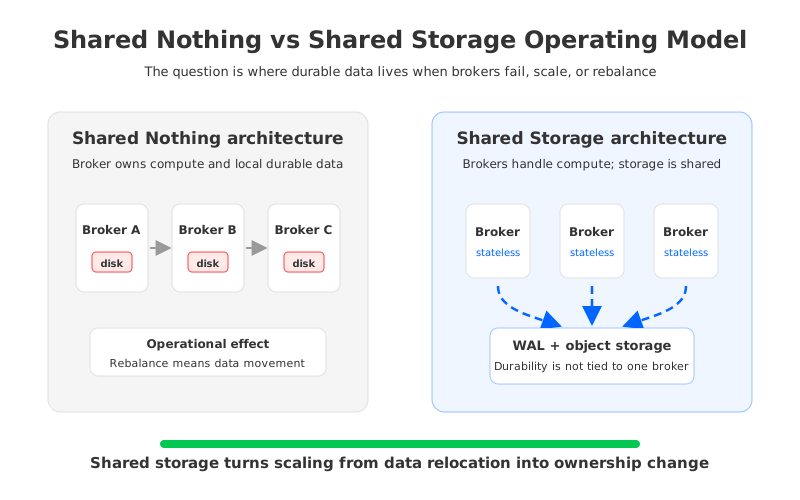
The trade-off is not magic. Shared storage systems must still solve write durability, read latency, metadata scale, and object storage request efficiency. They need a predictable write path, a read path that distinguishes hot tailing reads from catch-up reads, and clear failure semantics.
That is why the architecture decision should be framed as an SLO mapping exercise:
| Decision area | What to validate | Why it matters for vehicle telemetry |
|---|---|---|
| Kafka behavior | Producers, Consumer groups, offsets, transactions, and admin operations | Client changes are expensive across vehicle, edge, and cloud teams |
| Storage model | Broker-local disks, Tiered Storage, or Shared Storage architecture | Retention and recovery depend on where durable data lives |
| Scaling path | Partition movement, broker replacement, and traffic rebalance behavior | Fleet bursts should not create long maintenance windows |
| Network model | AZ placement, private connectivity, and replication traffic | Reliability patterns should not hide uncontrolled network cost |
| Governance | Schema controls, access boundaries, audit logs, and data locality | Vehicle data can include sensitive operational and user-linked signals |
| Migration | Topic copy, offset continuity, rollback, and dual-write avoidance | Production telemetry cutovers need a controlled escape path |
The table is deliberately neutral. It gives platform teams a way to compare self-managed Kafka, managed Kafka, Tiered Storage, and shared-storage Kafka-compatible systems without collapsing the decision into a single vendor claim.
4Evaluation checklist for platform teams
A proof of concept for connected vehicle telemetry should look like a production rehearsal. Synthetic messages only prove that the happy path works. The harder proof is whether the platform keeps its promises when traffic shifts, consumers fall behind, a broker disappears, a schema changes, or a regional constraint appears late.
Start with compatibility, because it is the cheapest risk to discover early and the most expensive risk to discover late. Validate the Kafka client versions you actually run, not the client version used in a demo. Test idempotent producers, transactions if needed, Consumer group rebalances, offset commits, ACLs, topic configuration, retention settings, and Kafka Connect integrations.
Then test the operational boundaries. A connected vehicle platform usually has low-latency services, batch analytics, safety detection, support tooling, and data lake ingestion. Force one consumer class to lag while another continues reading the tail. Increase retention. Add and remove brokers. Run a zone failure exercise if the deployment model claims multi-zone resilience.
The cost review should happen during the same test, not after it. Kafka cost is rarely one line item. It can include compute, block storage, object storage, cross-AZ data transfer, private connectivity, monitoring, backup, and operational labor. The final model must use your region, retention policy, replication assumptions, and consumer fan-out.
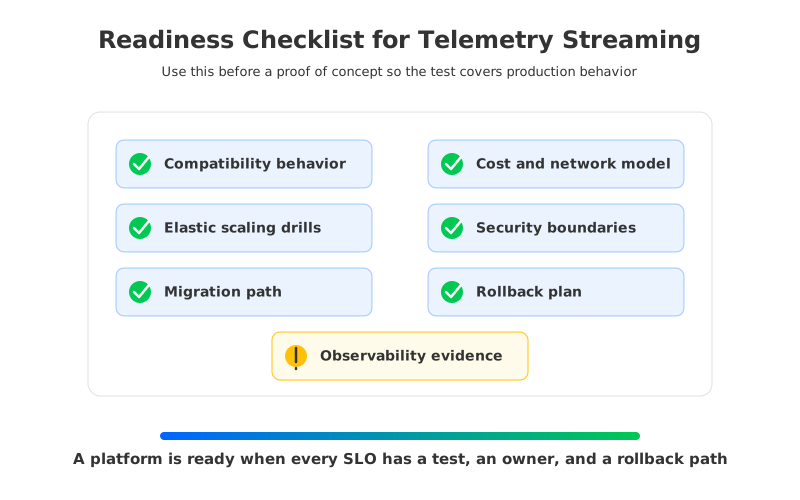
The readiness checklist is simple, but it prevents shallow proofs:
- Compatibility: The exact producers, consumers, Connect plugins, serializers, and security settings used in production have been tested.
- Cost: The estimate includes compute, storage, retention, networking, private connectivity, and observability, using the target cloud region.
- Scaling: Scale-out, scale-in, partition rebalance, and cold-read behavior have been measured under burst and lag conditions.
- Security: Network boundaries, identity, encryption, audit logs, and data residency expectations are mapped to the deployment model.
- Migration: Topic replication, offset continuity, producer switching, consumer switching, and rollback are tested as a runbook.
- Observability: The team has dashboards and alerts for ingest latency, consumer lag, broker health, storage errors, cache hit ratio, and object storage behavior.
If one of these items is missing, the project is not blocked, but the risk has a name. That is already a better place to be than discovering it during a firmware rollout.
5How AutoMQ changes the operating model
After the neutral evaluation, the architectural requirement becomes clearer: a connected vehicle telemetry platform benefits when Kafka compatibility is preserved while broker-local durable storage stops controlling scaling and recovery. AutoMQ fits this category as a Kafka-compatible, cloud-native streaming platform built around Shared Storage architecture. It keeps the Kafka protocol and ecosystem surface while moving durable storage into S3-compatible object storage through its S3Stream storage layer.
The practical change is that AutoMQ Brokers are stateless brokers. They still handle Kafka requests, leadership, caching, and scheduling, but persistent data is not bound to the local disk of one broker. The write path uses WAL (Write-Ahead Log) storage for durable acknowledgment and recovery, then stores data in object storage as the main storage layer. The read path can serve tailing reads from cache and recent data while catch-up reads are fetched from object storage. This is the mechanism behind the operating-model shift: scaling a broker fleet no longer has to be dominated by copying partition data from one local disk set to another.
For vehicle telemetry, that changes the questions an SRE team asks during an incident. Instead of asking how long a failed broker's local replicas will take to rebuild, the team can focus on ownership transfer, leadership, cache warming, and client-visible behavior. Instead of treating retention as a broker disk sizing problem, the platform can reason about object storage capacity and access patterns. Instead of assuming a larger fleet always means a larger data movement plan, the platform can make compute capacity more elastic.
AutoMQ BYOC is relevant for teams that need customer-controlled deployment boundaries in public cloud. In this model, the control plane and data plane run inside the customer's own cloud account and VPC, so telemetry data stays within the customer's environment. AutoMQ Software addresses private data center deployments where the same Kafka-compatible operating model is needed outside public cloud. AutoMQ Open Source provides an Apache 2.0 licensed path for teams that want to evaluate the core architecture with S3 WAL and S3-compatible storage.
Migration risk still deserves its own line in the plan. AutoMQ Kafka Linking is designed for Kafka migration scenarios that need topic replication and consumer progress handling, but the right proof should still test the exact source cluster, authentication mode, topic list, consumer groups, producer switch, and rollback sequence. The architecture helps, but a production telemetry cutover remains a coordination exercise across application teams.
The point is not that every connected vehicle workload should choose the same platform. Shared Storage architecture changes which operational problems are first-order. If your hardest SLOs are tied to broker-local storage, data movement, cross-AZ replication traffic, and fixed capacity planning, a Kafka-compatible shared-storage platform deserves evaluation.
For teams turning a connected vehicle telemetry Kafka design into production, test the SLOs you will be paged for. Then compare the operating model behind each platform. To evaluate AutoMQ with your own workload and deployment boundaries, use the AutoMQ Cloud entry point.
6FAQ
6.1Is Kafka a good fit for connected vehicle telemetry?
Kafka is a strong fit when the telemetry system needs ordered event streams, replayable history, Consumer group processing, and integration with stream processing or data lake pipelines. The platform still needs careful SLO design because vehicle telemetry combines bursty ingest, delayed consumers, sensitive data, and long retention windows.
6.2What is the biggest Kafka architecture risk for vehicle telemetry?
The biggest risk is treating Kafka as only an API choice. In production, the storage model, replication pattern, scaling path, and network design determine whether the system can meet ingest, replay, recovery, and cost SLOs.
6.3Does Tiered Storage solve the retention problem?
Tiered Storage can help with historical retention by moving older segments to remote storage. It does not automatically make brokers stateless, so teams should still test recent-data recovery, leader movement, cold reads, and scaling behavior.
6.4When should a team evaluate AutoMQ?
Evaluate AutoMQ when the team wants Kafka compatibility but is constrained by broker-local storage, cross-AZ replication cost, slow partition reassignment, or fixed capacity planning. The proof should use real clients, real retention targets, and failure drills rather than a small happy-path demo.


