
Table of Contents
Table of Contents
Teams usually search for data quality checks cdc kafka after a familiar CDC pipeline has crossed an uncomfortable line. The connector is no longer feeding one reporting table; it is carrying database changes into search, fraud detection, operational dashboards, feature pipelines, and lakehouse ingestion. At that point, data quality is not a nightly validation task. It is a streaming operations problem with customer impact, incident response, and platform ownership attached to it.
The hard part is that CDC quality failures rarely look like one clean outage. A connector can keep running while a schema change silently drops a field. A consumer group can make progress while one downstream table lags behind. A topic can retain the right events while the quality check that proves ordering, completeness, or deduplication cannot catch up. The useful question is not "do we have checks?" It is "which checks have operational SLOs, and does the Kafka platform give them enough room to run under stress?"
1Why teams search for data quality checks cdc kafka
CDC teams tend to begin with record-level correctness. They check whether primary keys are present, whether deletes are represented consistently, whether source timestamps make sense, and whether schema versions match the downstream contract. Those checks matter, but production CDC fails at the boundaries between systems. The source database has transaction semantics, Kafka has ordered partitions and offsets, Kafka Connect has connector tasks and connector offset storage, and downstream systems have their own retry and idempotency rules.
That is why the search term often hides a larger platform review. The team is not only asking how to validate a Debezium-style stream or a sink connector. They are asking how to keep validation work reliable when topic count grows, retention expands, consumers fall behind, and the platform team is also being asked to reduce cloud cost. Data quality in CDC becomes a service-level objective because it has time, scope, and recovery dimensions.
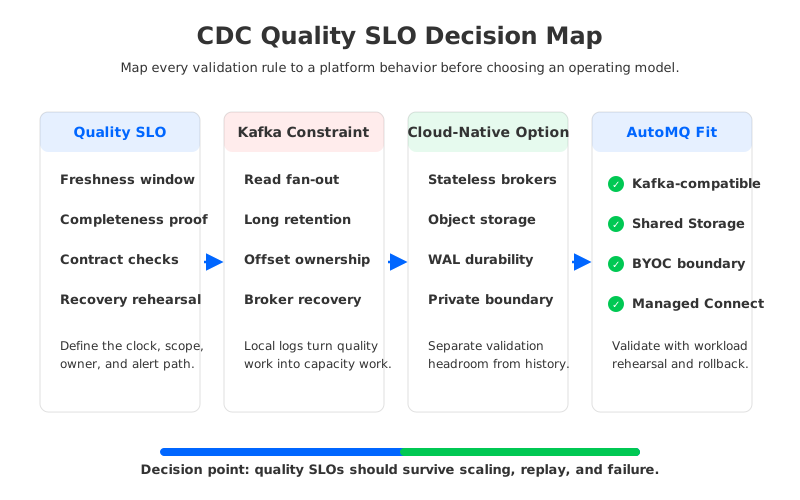
A practical CDC quality program usually separates checks into four SLO classes:
- Freshness checks prove that changes arrive and are validated within an agreed window. They depend on connector task health, consumer lag, fetch performance, and enough headroom for validation consumers.
- Completeness checks compare expected source changes with the records observed in Kafka and downstream sinks. They depend on stable offsets, retention long enough for replay, and deterministic handling of retries.
- Contract checks validate schema, key shape, delete semantics, and required fields. They depend on a clear schema workflow and a way to quarantine bad records without stopping unrelated pipelines.
- Recovery checks prove that replay, backfill, migration, and rollback procedures preserve offsets and data contracts. They depend on how the Kafka platform behaves when brokers fail or capacity changes.
The list looks like application work, but the operational burden quickly lands on the streaming platform. If a freshness SLO is missed, the first dashboard people inspect is usually consumer lag. If a completeness check fails, the next question is whether the missing records are in the topic, in the connector offset state, or stuck behind a slow sink. The quality team can write the rules, but the platform decides whether those rules can run continuously.
2The production constraint behind the problem
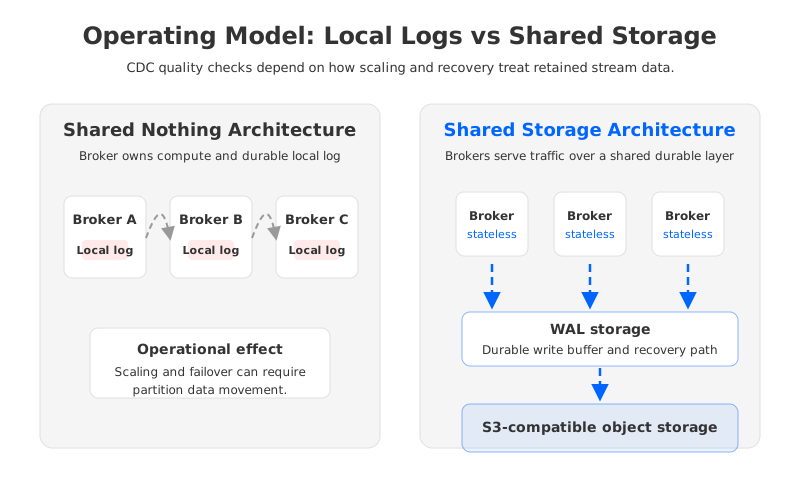
Traditional Apache Kafka uses a Shared Nothing architecture: each broker owns local log storage, and partitions are replicated across brokers for durability. This design is robust and well understood. It also means broker compute, durable storage, partition placement, and replication traffic are coupled. When a CDC estate grows from dozens of topics to hundreds, the coupling shows up in places that quality teams feel directly.
First, quality checks increase read fan-out. A pipeline may already have analytics, serving, and alerting consumers; adding validation consumers creates more fetch load and more lag surfaces. Second, CDC retention is rarely short. Teams keep change streams long enough to support replay, audit, and downstream recovery, which increases the amount of broker-local storage that must be planned. Third, broker failure or scaling events can trigger data movement, leadership changes, and reassignment work at the same time that validation jobs are trying to prove the stream is healthy.
That combination creates a planning trap. Platform teams reserve capacity for peak write throughput, retained history, validation reads, and recovery margin. The quality program then inherits the cost of that reservation. If the team reduces headroom, validation checks become the first work to be delayed during incidents. If the team keeps headroom, the platform may look overprovisioned during normal periods. Neither outcome is a clean engineering decision; it is a trade-off forced by the storage model.
3Architecture options and trade-offs
The neutral way to evaluate a Kafka-compatible platform for CDC quality checks is to start from the SLOs, not the vendor category. A self-managed Kafka cluster can be the right answer when the team has deep operational experience and wants direct control over every broker setting. A managed Kafka service can be the right answer when the priority is reducing control-plane work such as provisioning, patching, and basic monitoring. A cloud-native Kafka-compatible architecture becomes relevant when the harder problem is the coupling between broker-local storage, scaling, retention, and validation headroom.
The table below is a useful first-pass decision map. It avoids treating "managed" as one thing, because managed control-plane work and changed data-plane architecture are different benefits.
| Evaluation area | What CDC quality checks need | Risk in broker-local storage models | What to inspect in a cloud-native option |
|---|---|---|---|
| Compatibility | Existing producers, consumers, connectors, offsets, and topic configs should keep familiar Kafka behavior. | Migration work expands if applications depend on edge-case client behavior or custom operations. | Validate Kafka protocol compatibility, Kafka Connect behavior, ACLs, transactions, and client versions. |
| Elasticity | Validation consumers need temporary headroom during incidents, backfills, and replay. | Scaling can require partition reassignment and data movement, so extra capacity is not always usable immediately. | Check whether compute can scale without moving retained partition data. |
| Cost model | Quality checks add reads, retention, and recovery environments. | Storage, replication, and cross-AZ traffic can grow faster than the validation budget. | Model compute, object storage, WAL storage, requests, networking, and support together. |
| Governance | Data must stay inside approved network, account, and region boundaries. | A managed service may reduce operations while changing data-plane ownership boundaries. | Confirm where the control plane, data plane, logs, metrics, and durable records reside. |
| Recovery | Replays and rollback tests must preserve ordering, offsets, and enough retained history. | Broker failure, scaling, and migration can all compete for disk and network resources. | Test failover, replay, offset continuity, and rollback under load. |
The decision map also gives quality teams a cleaner language for platform discussions. Instead of saying "we need a better CDC platform," they can say "our freshness check needs extra read capacity during source incidents," or "our completeness check needs long retention without making broker replacement expensive." That is a more useful conversation because it names the operational property behind the quality rule.
4Evaluation checklist for platform teams
Before introducing any new platform, run a small but realistic CDC quality rehearsal. Use a source table with inserts, updates, deletes, schema changes, out-of-order downstream processing, and a planned connector restart. Then measure whether the platform can keep the checks within their SLO windows while you change capacity or simulate a broker failure.
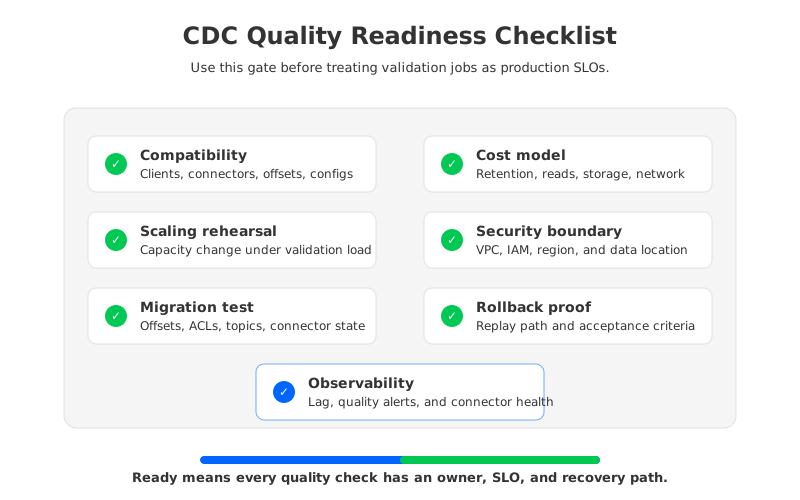
The checklist should cover six questions:
- Can validation consumers read without harming production consumers? Inspect consumer lag, fetch latency, broker CPU, and network saturation while validation jobs run.
- Can the platform retain enough history for quality replay? Retention should be sized around recovery objectives and audit needs, not only the normal sink delay.
- Can connector and consumer offsets be explained during an incident? Kafka offset commits, Kafka Connect offset state, and downstream checkpoints should have a clear ownership model.
- Can bad records be isolated without stopping the whole stream? Dead-letter topics, quarantine paths, and alert routing should be part of the quality design.
- Can capacity change without invalidating the quality signal? Scaling events should not create so much platform noise that freshness or completeness checks become ambiguous.
- Can migration and rollback be tested before the production cutover? A CDC quality program that cannot rehearse rollback is not ready for a platform migration.
This rehearsal often reveals that the data quality logic is less fragile than the operating model around it. Checks written in SQL, stream processing code, or connector transformations can be improved incrementally. Broker storage coupling is harder to work around because it shapes every replay, retention, scaling, and failure-recovery plan.
5How AutoMQ changes the operating model
After the evaluation framework is clear, AutoMQ enters the discussion as a Kafka-compatible cloud-native streaming platform built around a Shared Storage architecture. It keeps Kafka-facing APIs and ecosystem compatibility while moving durable stream data away from broker-local disks and into S3-compatible object storage through S3Stream. Brokers become stateless serving nodes, while WAL storage handles low-latency persistence and recovery buffering.
For CDC quality checks, that architectural change matters in three practical ways. First, validation headroom becomes more compute-oriented. If brokers are not the long-term owners of retained partition data, adding or replacing broker capacity does not require the same large data movement pattern. Second, long retention for replay and audit can be planned around object storage rather than local broker disks. Third, broker recovery and partition reassignment become less entangled with the retained history that quality checks depend on.
AutoMQ BYOC also matters for governance-sensitive CDC workloads. In AutoMQ BYOC, the control plane and data plane run inside the customer's cloud account or VPC boundary, and user data remains in customer-owned infrastructure. That boundary is important when CDC streams contain operational database changes, customer records, or regulated events. The platform team can evaluate managed operations without treating data-plane ownership as an afterthought.
The connector layer is part of the same operating model. AutoMQ's Managed Connector capability is built around Kafka Connect, so teams can run connector tasks from a unified control plane while keeping the runtime in their environment. For CDC programs, that means connector lifecycle, Kafka compatibility, network boundaries, and observability can be reviewed together rather than split across disconnected runbooks.
Migration still deserves discipline. Kafka compatibility reduces application change, but it does not remove the need to test offsets, ACLs, topic configurations, connector state, monitoring, replay windows, and rollback. AutoMQ's Kafka Linking is designed for migration scenarios that need byte-level message synchronization and consumer progress handling in supported cases, but the right proof is still a workload rehearsal. Quality checks should be part of the migration acceptance criteria, not an after-the-fact dashboard.
The same point brings the discussion back to the original search query. Data quality checks in CDC Kafka pipelines are not only validation rules; they are promises about how quickly the platform can detect, explain, and recover from bad change data. If those promises are starting to drive retention, scaling, and migration decisions, treat them as platform SLOs. To evaluate a Kafka-compatible shared-storage operating model in your own cloud boundary, start with the AutoMQ BYOC path.
6FAQ
6.1What are the most important data quality checks for CDC in Kafka?
Start with freshness, completeness, contract, and recovery checks. Freshness tracks whether changes arrive within the SLO window. Completeness proves expected changes appear in Kafka and downstream sinks. Contract checks validate schema, keys, delete handling, and required fields. Recovery checks prove replay, backfill, migration, and rollback behavior.
6.2Should data quality checks run inside Kafka Connect?
Some checks can run in connector transformations or sink-side validation, but platform-level checks usually need independent consumers. Independent validation consumers make it easier to compare source, Kafka, and downstream state without coupling the quality signal to the same task that may be failing.
6.3How does Kafka retention affect CDC quality?
Retention sets the replay window for audits, backfills, and recovery. If retention is shorter than the time needed to detect and repair a bad CDC event, the team may lose the ability to prove completeness from Kafka alone. Long retention should be modeled as part of the quality SLO, not as a storage afterthought.
6.4When should AutoMQ be evaluated for CDC quality workloads?
Evaluate AutoMQ when CDC quality checks are constrained by broker-local storage, long retention, scaling delay, cross-AZ traffic, or governance boundaries. It is most relevant when the team wants Kafka compatibility but needs a different operating model for cloud infrastructure.
7References
- Apache Kafka documentation — Kafka APIs, operations, Kafka Connect, transactions, KRaft, and Tiered Storage.
- Apache Kafka consumer offset tracking — Consumer group offset storage and coordinator behavior.
- AutoMQ architecture overview — Shared Nothing, Tiered Storage, and Shared Storage architecture.
- AutoMQ WAL storage documentation — WAL storage responsibilities and implementation details.
- AutoMQ Managed Connector overview — Managed Kafka Connect service model.


