
Table of Contents
Table of Contents
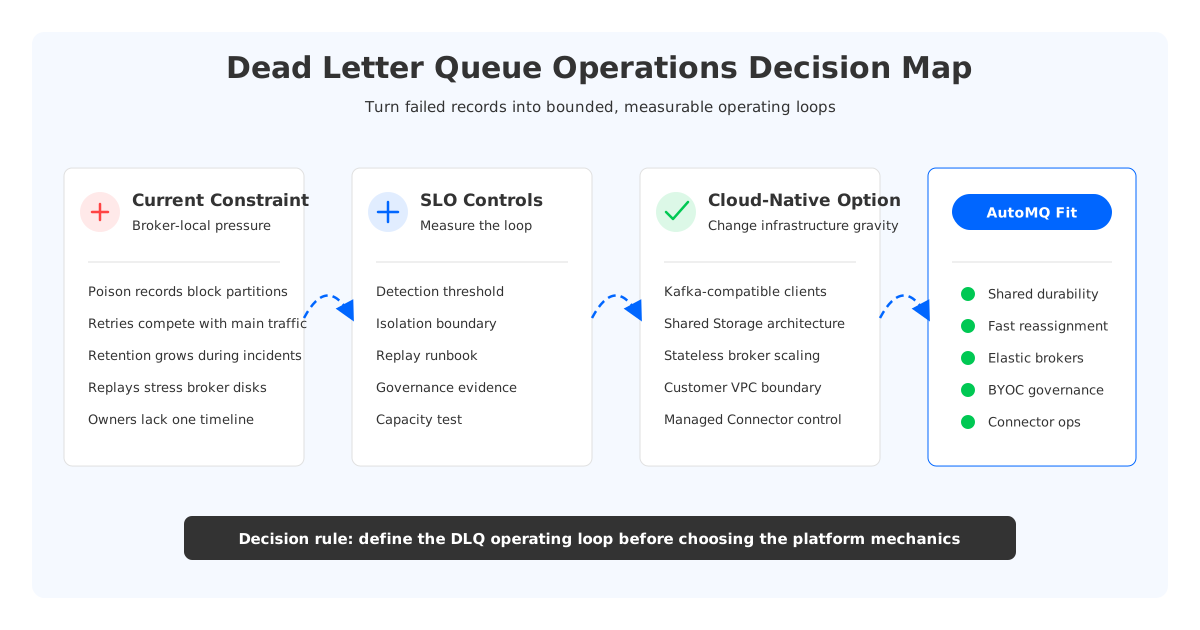
Teams usually search for dead letter queue operations kafka after a production problem has become visible. A connector task is failing on a subset of records, a sink system is rejecting malformed payloads, or a consumer has stopped making progress because a few events cannot be processed safely. The dead letter queue is supposed to protect the main pipeline, but the queue quickly becomes its own production workload with retention, ownership, access control, replay rules, alerting, and cost behavior. If those rules are vague, the DLQ stops being a safety valve and becomes a second incident path.
The useful question is not whether Kafka can hold failed records. It can. Kafka Connect exposes error-tolerance and dead-letter queue settings, consumers can implement retry and quarantine topics, and stream processors can route invalid events away from the main path. The harder question is whether the platform can operate those paths with measurable service-level objectives. A DLQ operation succeeds only when the team can detect the failure, isolate the record, preserve debug context, replay or discard it intentionally, and prove that normal processing stayed inside its error budget.
That changes the architecture discussion. Dead-letter handling is often designed as application logic, but it runs on shared streaming infrastructure. Its behavior depends on topic partitioning, consumer group offsets, Kafka Connect task state, retention, broker capacity, network placement, and team ownership. A good SLO has to cover both layers: what the application promises when a record fails, and what the Kafka-compatible platform promises while that failure path is active.
1Why teams search for dead letter queue operations kafka
The search intent is usually practical, not academic. Engineers are not trying to define a dead letter queue from first principles. They are trying to decide what should happen when a production record cannot be handled without blocking the whole stream. The record may be invalid, late, duplicated, missing a required field, encoded with the wrong schema version, or rejected by a downstream API. Each case looks small by itself. The operational risk appears when the bad-record path begins to compete with the main path for attention and infrastructure.
Kafka makes this tension sharper because offsets are durable progress markers. A consumer group can advance only according to the commit policy chosen by the application. Commit too early, and the failed side effect may be skipped after a restart. Commit too late, and one poison record can hold a partition hostage while lag grows behind it. Kafka Connect adds another layer: workers track connector configuration, task status, offsets, converters, transforms, and optional dead-letter routing. The DLQ is not a garbage bin at the edge of the system. It is a record of where the pipeline's correctness contract was not met.
That contract needs SLOs because "we have a DLQ" says almost nothing about operability. A platform team needs to know how quickly DLQ volume is detected, how long failed records can sit before triage, how much replay can happen without destabilizing the source or sink, and who is allowed to inspect sensitive payloads. These are not dashboard preferences. They are the difference between controlled degradation and a spreading outage.
A workable DLQ SLO starts with a small set of measurable promises:
- Detection: Failed-record volume, connector task errors, consumer lag, and downstream rejection rates must trigger alerts before the main pipeline exhausts its freshness target.
- Isolation: Bad records should move to a bounded quarantine path without blocking healthy records that share the same topic or connector worker.
- Retention: DLQ topics need enough retention for investigation and replay, but not unlimited retention that turns operational errors into unmanaged storage growth.
- Replay: Reprocessing must be tied to offset discipline, sink idempotency, and a rollback plan, not a manual "consume everything again" script.
- Governance: Owners, payload visibility, audit logs, and deletion rules must be explicit because failed records often contain the same sensitive data as successful records.
This is why a DLQ checklist that only names topic configuration is incomplete. Topic configuration matters, but the SLO is about the whole operating loop: detect, isolate, inspect, fix, replay, and close the incident without corrupting downstream state.
2The production constraint behind the problem
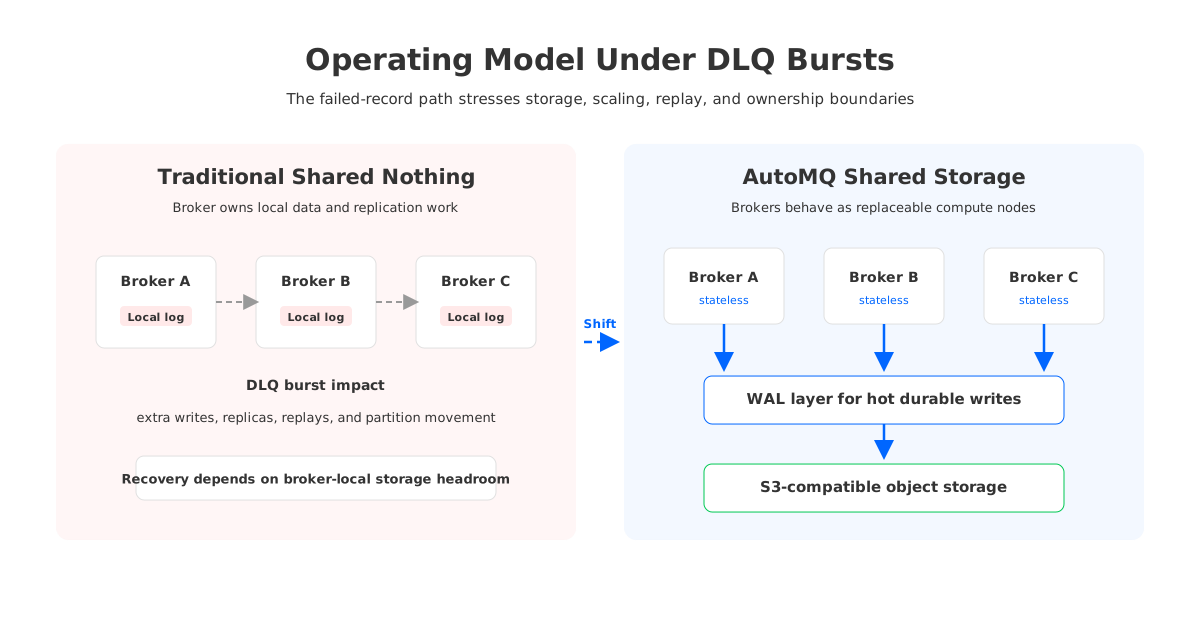
Traditional Apache Kafka is built around a Shared Nothing architecture. Each broker owns local log segments for the partitions assigned to it, and Kafka relies on replication across brokers for durability and availability. That design is proven and widely deployed, but it couples several operational actions to broker-local data. Scaling brokers, reassigning partitions, recovering from disk pressure, and expanding retention can require moving or maintaining a large amount of data across the cluster.
Dead-letter workloads magnify this coupling because they are bursty by nature. A schema deployment may generate a sudden DLQ spike for one connector. A downstream outage may create retries followed by quarantine traffic. A backfill may reveal old records that violate a new contract. The platform must absorb the extra writes, reads, and retention while the main workload keeps running. If capacity planning assumed steady-state traffic, the DLQ path becomes an unplanned stress test.
The stress is not only storage. In a multi-Availability Zone deployment, replication and client placement can turn incident traffic into cross-zone data movement. In a connector-heavy estate, one failure can also cause task restarts, internal-topic writes, offset commits, and observability spikes. The team may respond by overprovisioning brokers so the cluster has enough headroom for rare error bursts. That is understandable, but it means operational risk is paid for every month, even when the DLQ is quiet.
There is a second constraint that does not show up in a broker sizing spreadsheet: ownership. Application teams own validation logic, data integration teams own connector configs, and platform teams own Kafka topics, brokers, quotas, access control, and monitoring. When a DLQ grows, all three teams need evidence from the same timeline. Broker-local storage and slow data movement do not create the bad record, but they can make the recovery window longer.
3Architecture options and trade-offs
There is no single correct DLQ architecture for every Kafka workload. The right design depends on whether failures are rare data-quality exceptions, expected validation outcomes, downstream throttling symptoms, or signs of a broken release. The first choice is where the failure decision lives. Kafka Connect can route connector errors to a DLQ topic when error tolerance is enabled. A custom consumer can route failed records to a retry topic, a quarantine topic, or an incident-specific topic. A stream processor can split valid and invalid records after schema or business-rule validation.
Those options are often mixed in one organization. That is fine, as long as each option has a clear operating model. Connector-level DLQs keep error handling close to connector task state. Application-level DLQs fit domain logic and external side effects. Processor-level quarantine fits common validation, enrichment, or policy enforcement before records reach downstream teams.
The trade-off is that every option creates durable data and operational state. A DLQ topic needs retention, a retry topic needs backoff rules, a connector needs task restart policy, a consumer needs offset discipline, and a replay job needs idempotent writes or a compensation plan. None of these decisions should be hidden inside a single application repository if the pipeline is shared across teams.
The evaluation is easier when the platform team scores the options against the same criteria:
| Criterion | What to evaluate | Why it matters for DLQ SLOs |
|---|---|---|
| Compatibility | Producers, consumers, connectors, serializers, offsets, and tools | DLQ design should not force application rewrites during platform changes. |
| Failure isolation | Per-connector, per-topic, per-tenant, and per-team boundaries | A bad record should not take down unrelated pipelines. |
| Cost behavior | Retention, replay, replication, object storage, and cross-zone traffic | Error bursts create data movement that may not appear in normal workload estimates. |
| Governance | Payload visibility, audit trail, owner mapping, and deletion policy | Failed records can be regulated data, not operational noise. |
| Recovery | Replay window, sink idempotency, offset reset, and rollback | The team needs a tested path from failure to correction. |
| Migration risk | Internal topics, DLQ topics, offsets, connector configs, and runbooks | Moving the cluster without moving the error path creates false confidence. |
The strongest platform designs make the DLQ path boring. Not invisible, and not ignored, but boring in the operational sense: clear alerts, known owners, bounded storage, predictable replay, and a documented rollback path.
4Evaluation checklist for platform teams
Start with the workload, not the tool. A DLQ SLO that works for a low-volume analytics sink may fail for CDC, reverse ETL, fraud detection, or search indexing. The same Kafka topic can serve consumers with very different correctness expectations. The SLO has to be attached to the consumer or connector contract, not only to the source topic.
The platform review should answer these questions before declaring the DLQ path production-ready:
- What counts as a DLQ event? Separate validation failures, serialization errors, downstream rejections, authorization failures, and timeout-driven retries. They need different owners and response times.
- Where is progress committed? Tie offset commits to completed work. For sink workloads, define whether the sink write, DLQ write, or retry scheduling is the completion boundary.
- How much bad-record volume is acceptable? Define rate, absolute count, and percentage-of-traffic thresholds. A low rate can still be severe if records belong to a critical tenant or table.
- Who can read failed payloads? Use Kafka ACLs, identity boundaries, and audit logs so debugging does not bypass data governance.
- How is replay proven safe? Require idempotency keys, target-side deduplication, or a compensation plan before reprocessing DLQ records into production sinks.
- What is the rollback path? Document whether rollback means resetting a consumer group offset, disabling a connector, reverting a schema, or promoting a previous processor version.
- What infrastructure headroom is reserved for failure? Include DLQ writes, retry reads, catch-up consumption, connector restarts, and monitoring traffic in capacity tests.
The last question is where many DLQ programs become infrastructure programs. A team can implement perfect application logic and still miss the SLO if the cluster cannot absorb replay or if partition reassignment takes too long during an incident. DLQ operations are not separate from Kafka operations; they are one of the clearest ways to see whether the platform has enough elasticity and observability.
5How AutoMQ changes the operating model
After the neutral checklist, the infrastructure requirement becomes clearer: keep Kafka semantics stable for clients and connectors, but reduce broker-local data gravity during failure, replay, and scaling. That is where AutoMQ is relevant. AutoMQ is a Kafka-compatible, cloud-native streaming platform that uses a Shared Storage architecture: brokers handle Kafka protocol and compute responsibilities, while durable stream data is stored in S3-compatible object storage through S3Stream and a WAL layer.
For DLQ operations, AutoMQ does not replace application or connector design. The change is below that contract. Stateless brokers reduce the penalty of adding or replacing compute capacity during an error burst. Shared object storage reduces the need to treat each broker disk as the durable center of the pipeline. Seconds-level partition reassignment and Self-Balancing are relevant when replay, catch-up reads, or connector traffic create uneven load.
AutoMQ BYOC also fits the governance side of DLQ operations. In BYOC deployment, the control plane and data plane run inside the customer's cloud account and Virtual Private Cloud, and customer business data stays within that boundary. That matters because failed records may contain sensitive fields, headers, keys, and payload fragments. A team evaluating managed operations should ask where failed records live, who can inspect them, and what network path connector workers use.
Managed Connector support adds another practical layer. A connector platform is easier to operate when task lifecycle, plugin management, worker isolation, and observability are handled through a common control plane. DLQ SLOs still need application-specific rules, but the platform can standardize connector deployment, task status, dead-letter topic naming, access boundaries, and operational visibility.
AutoMQ Linking is relevant when the DLQ program is part of a migration. A production migration has to include ordinary topics, DLQ topics, connector internal topics, consumer group offsets, and rollback behavior. DLQ topics deserve the same migration discipline as business topics because they are often the evidence needed to debug the first week after cutover.
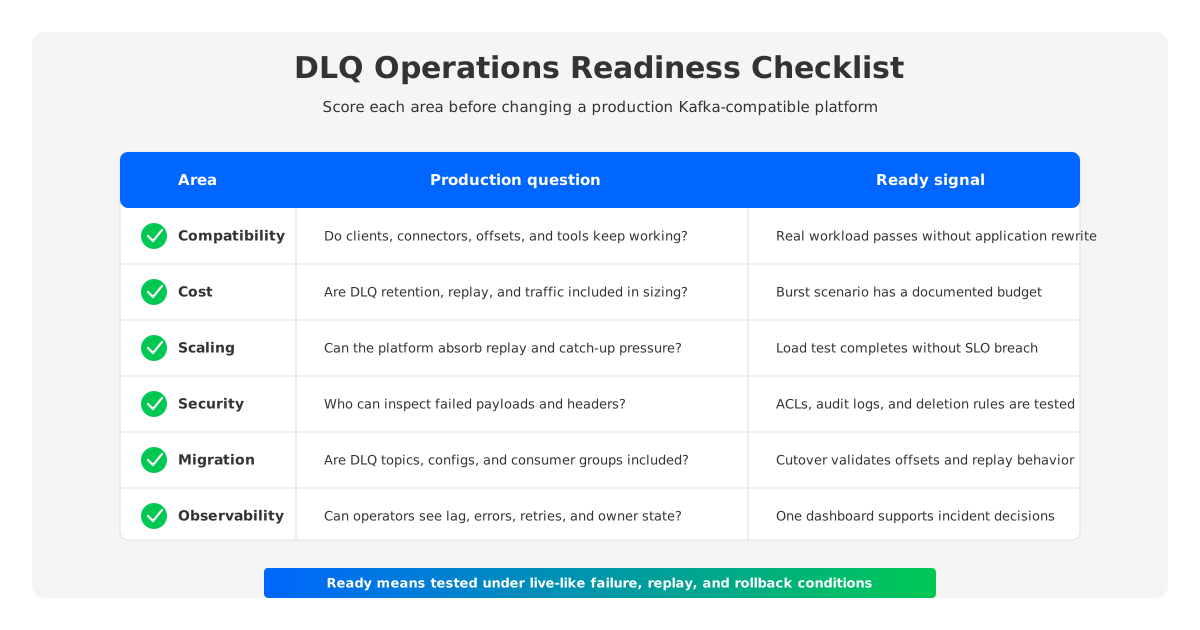
Dead-letter queues exist because production data is messy. The goal is not to make failure disappear; it is to make failure observable, bounded, and recoverable. If your next Kafka review is already circling around DLQ growth, connector errors, replay windows, and broker headroom, run the checklist against one real pipeline. Then compare the operating model of your current cluster with a shared-storage option such as AutoMQ. For a hands-on evaluation in your own cloud environment, start with the AutoMQ trial path: try AutoMQ BYOC.
6FAQ
6.1Is a dead letter queue the same as a retry topic?
No. A retry topic is usually for records that may succeed later, such as records affected by temporary downstream throttling. A dead letter queue is for records that require inspection, correction, discard, or controlled replay. Some teams use both: bounded retries first, then DLQ after the retry policy is exhausted.
6.2Should every Kafka consumer have a DLQ?
Not automatically. A DLQ is useful when the consumer can safely isolate failed records without hiding systemic failure. For workloads with strict ordering or non-idempotent side effects, a DLQ may need stronger controls or a different recovery pattern.
6.3What metrics should be part of a DLQ SLO?
Track failed-record rate, DLQ topic growth, consumer lag, connector task failures, retry attempts, replay duration, sink rejection rate, and time to owner acknowledgment. The exact thresholds should be tied to the workload's freshness and correctness targets.
6.4Does AutoMQ replace DLQ design?
No. AutoMQ changes the Kafka infrastructure operating model through Kafka compatibility, Shared Storage architecture, stateless brokers, and customer-controlled deployment boundaries. Teams still need schema rules, idempotency, replay runbooks, and governance for failed records.


