
Table of Contents
Table of Contents
Teams searching for ev charging events kafka are rarely asking whether Kafka can move messages. The harder question is whether a Kafka-compatible streaming platform can keep charging sessions, payment authorization, station health, pricing updates, and grid signals inside operational service-level objectives when the business moves from pilot scale to city-scale deployment. A missed event can become a driver waiting at a charger, an operator missing a fault signal, or a billing system reconciling a session after the customer has left.
That is why the useful design question is not "Can Kafka ingest EV charging events?" It is "Which SLOs must the event platform protect when the charging network becomes uneven, bursty, multi-tenant, and regulated?" EV charging workloads combine device telemetry, transactional state, fleet operations, and near-real-time analytics. Kafka is a strong fit for that event backbone, but the operating model around Kafka determines whether the platform team spends its time improving charging workflows or moving partitions, reserving broker storage, and explaining lag spikes during traffic surges.
1Why teams search for ev charging events kafka
An EV charging event stream looks simple when it is drawn as charger to broker to application. In production, the stream is a collection of different event classes with different failure tolerance. A connector heartbeat, a meter value update, a start transaction event, and a remote stop command should not be treated as the same operational object. They may share a Kafka topic strategy, but they carry different recovery expectations and business consequences.
The Open Charge Alliance maintains the Open Charge Point Protocol (OCPP), a widely used protocol family for communication between charging stations and central systems. That protocol context matters because it reminds platform teams that the event stream is not only analytics exhaust. Charging infrastructure emits operational facts that applications use to decide whether a station is available, whether a session can start, whether energy delivery should continue, and whether a transaction can be settled.
For platform teams, the first useful move is to translate "event streaming" into explicit SLOs:
- Ingestion freshness: How long can the platform delay charger telemetry before station status, pricing, or fleet dashboards become misleading?
- Transaction continuity: Which start, stop, authorization, and metering events need stronger ordering, idempotency, or replay guarantees?
- Consumer recovery: How quickly must downstream systems catch up after a billing service, fraud model, or operations dashboard falls behind?
- Regional isolation: Which workloads must stay inside a specific cloud region, Virtual Private Cloud (VPC), or customer-controlled account boundary?
- Operational elasticity: How much spare broker, storage, and network capacity must be reserved before holiday travel, fleet depot peaks, or utility demand-response events?
These questions make Kafka architecture concrete. They move the discussion away from a generic event bus and toward measurable operating promises: consumer lag budget, recovery time objective, retention window, availability target, cost envelope, and governance boundary.
2The production constraint behind the problem
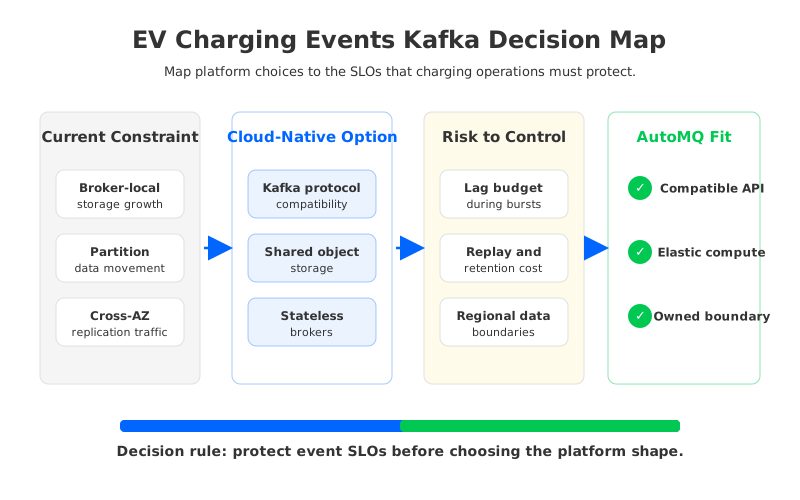
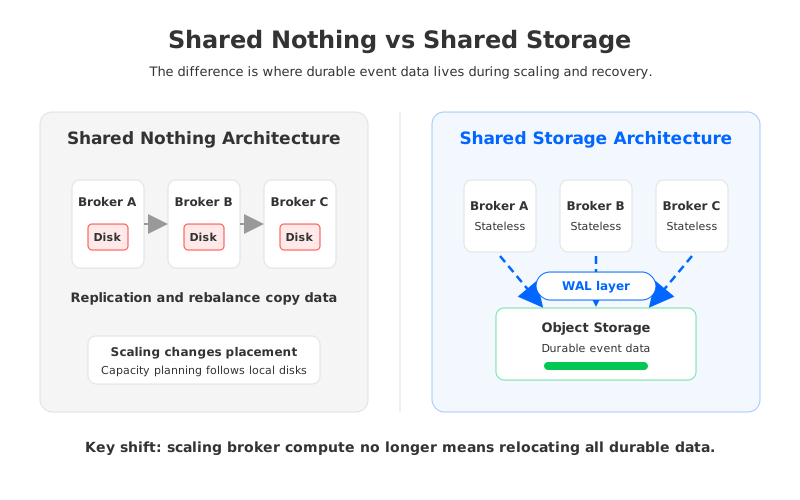
Traditional Kafka uses a Shared Nothing architecture. Each broker owns local storage, partitions are placed on specific brokers, and durability is achieved through replication across brokers. This model works well when capacity grows predictably and when broker-local disks can be treated as the stable center of the system. EV charging networks often violate both assumptions. Station count grows in uneven geography, traffic arrives in local bursts, and retention requirements can differ sharply between telemetry, transactional records, and audit logs.
The pressure shows up in three places. First, broker-local storage turns retention into a capacity planning problem. A team may want to retain raw charging session events for audit or replay, but that decision increases disk requirements on the brokers that host those partitions. Second, partition movement becomes operational work. When a topic grows or a broker becomes hot, rebalancing can mean copying data across machines before the cluster reaches the intended state. Third, multi-AZ replication can increase network traffic because Kafka-level replicas must move records between failure domains.
None of this means Kafka is the wrong abstraction. It means platform teams should separate Kafka protocol semantics from the storage and operations model beneath the protocol. The useful SLO question becomes: if the event contract depends on Kafka clients, consumer groups, offsets, transactions, and Kafka Connect, does the infrastructure also need broker-local persistent storage? In many cloud deployments, that coupling is the part that turns normal charging growth into operational drag.
3Architecture options and trade-offs
There are several reasonable ways to build an EV charging event platform. The right choice depends on which SLO is most expensive to miss. A small charging operator may prioritize operational familiarity over elasticity. A fleet charging network may prioritize catch-up speed because depot events arrive in concentrated windows. A payment-heavy system may care most about ordered transaction processing, idempotent writes, and clean recovery from downstream failure.
| Option | Where it fits | Operational trade-off |
|---|---|---|
| Self-managed Kafka with local disks | Teams with deep Kafka operations experience and stable growth curves | Maximum control, but the team owns broker sizing, storage growth, partition placement, replication traffic, and upgrade discipline. |
| Managed Kafka service | Teams that want less infrastructure ownership while retaining standard Kafka APIs | Reduces some administrative work, but broker capacity, storage tiers, networking, and migration details still need careful evaluation. |
| Kafka plus Tiered Storage | Workloads with large historical retention and hot/cold data separation | Helps with older data, but recent data and broker-local operational behavior remain part of the design. |
| Kafka-compatible Shared Storage architecture | Cloud workloads that need Kafka compatibility with more elastic compute and storage | Changes the operating model by moving durable data to shared object storage and making brokers easier to replace or scale. |
The table is deliberately neutral because "EV charging" is not one workload. A network that mostly reports station telemetry has different needs from a roaming payment network or a fleet depot optimizer. The architecture should be judged against the event classes and SLOs, not against a generic preference for one deployment model.
4Evaluation checklist for platform teams
A practical evaluation should start with the parts that are painful to change later. Kafka client compatibility belongs at the top of that list. Producers and consumers already depend on Kafka concepts such as topics, partitions, offsets, consumer groups, and transactions. Apache Kafka documentation defines these as core client and broker behaviors, so a platform replacement that changes those semantics creates application risk even if it improves infrastructure operations.
The second item is storage independence. EV charging events often have asymmetric retention: recent meter values may be consumed quickly, while transaction and audit records may need longer retention for reconciliation or compliance workflows. If long retention requires proportional broker disk growth, the platform team must keep paying the operational cost of historical data in the hot serving layer.
The third item is failure recovery. A broker failure should not become a long data movement project. A consumer outage should have a predictable catch-up path. A regional incident should have a clear boundary for what data remains available, what consumers can replay, and which systems need manual intervention.
Use this scorecard before comparing products or writing a migration plan:
| Evaluation area | Questions to ask | Good signal |
|---|---|---|
| Compatibility | Can existing Kafka clients, Kafka Connect jobs, stream processors, schemas, and ACL patterns remain intact? | Migration does not require broad application rewrites. |
| Cost model | Are compute, storage, and cross-AZ traffic scaled independently? | Retention growth does not force proportional broker expansion. |
| Elasticity | Can broker capacity change without large partition data movement? | Scaling is an operational action, not a storage migration. |
| Governance | Can data stay in the required VPC, region, account, or private environment? | Deployment boundaries match security and compliance ownership. |
| Recovery | Are offsets, consumer progress, and replay paths testable before cutover? | Rollback and catch-up are part of the design, not an afterthought. |
| Observability | Are lag, throughput, broker health, storage behavior, and connector status visible together? | SREs can diagnose the event path, not only the broker process. |
5How AutoMQ changes the operating model
Only after the evaluation framework is clear does it make sense to discuss a specific architecture. AutoMQ is a Kafka-compatible, cloud-native streaming platform that keeps Kafka protocol semantics while changing the storage layer underneath. Instead of binding durable event data to broker-local disks, AutoMQ uses a Shared Storage architecture backed by S3-compatible object storage, with stateless brokers serving Kafka workloads above that storage layer.
For EV charging events, the important shift is operational rather than cosmetic. Durable data is no longer owned by a particular broker's local disk. Brokers can focus on request handling, partition leadership, caching, and traffic management, while persistent data is stored in shared object storage through AutoMQ's S3Stream layer and WAL (Write-Ahead Log) storage. That changes what scaling and recovery mean: adding or replacing broker capacity no longer has to imply moving the full body of partition data between machines.
This is different from treating object storage only as a cold historical tier. Tiered Storage can be useful when the main problem is old data retention, but it does not fully remove broker-local storage from the hot path. A Shared Storage architecture is a broader operating model change: object storage becomes the durable system of record, and broker instances become more elastic compute nodes in front of it.
The practical benefits map back to the scorecard:
- Compatibility remains the migration anchor. AutoMQ is designed to be Kafka-compatible, so platform teams can evaluate it without starting from a different event API.
- Storage and compute scale on different curves. Long retention for charging sessions and audit replay does not have to grow in lockstep with broker-local disks.
- Broker replacement becomes less dramatic. Stateless brokers reduce the amount of data movement involved in scaling and recovery operations.
- Customer-controlled deployment boundaries remain explicit. AutoMQ BYOC runs in a customer's cloud account, and AutoMQ Software is designed for private environments where the customer operates within their own infrastructure boundary.
- Migration can be staged around Kafka concepts. AutoMQ Kafka Linking is documented for moving topics and consumer progress while preserving Kafka-oriented application behavior.
There are still design choices to make. WAL storage type, cloud region, object storage configuration, connector placement, and observability stack all affect the final SLO. That is the point: the platform conversation moves from "How many brokers and disks do we need to pre-buy?" toward "Which workload classes need which latency, recovery, retention, and governance profile?"
6Readiness checklist
The teams that succeed with EV charging event streaming usually do not begin with a product bake-off. They begin with a written contract between application owners and platform owners. The contract defines what each event class means, how long it can be delayed, how it can be replayed, who owns schema changes, and what happens when a consumer is unhealthy.
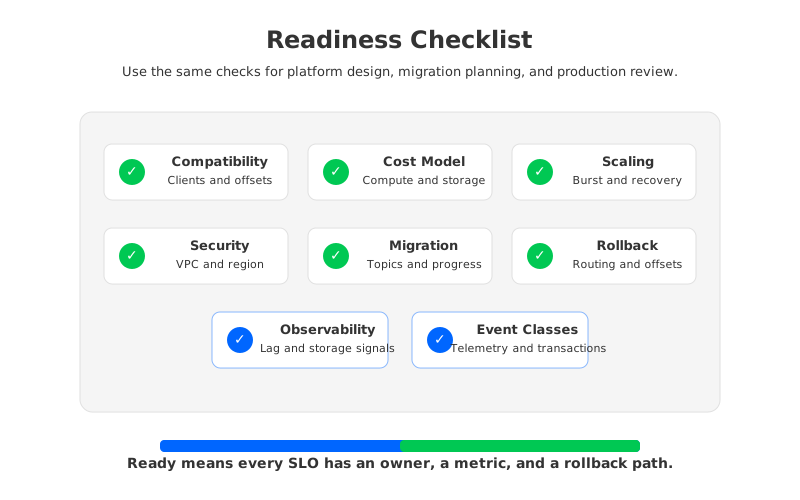
Before production rollout, a platform team should be able to answer these questions without opening a slide deck:
- Which topics carry transactional events, telemetry events, operational commands, and analytical copies?
- Which event classes require strict ordering within a partition, idempotent producers, transactions, or explicit deduplication downstream?
- What is the consumer lag budget for billing, station operations, fleet optimization, and data lake ingestion?
- What retention window is required for replay, audit, and machine learning feature generation?
- Which systems must stay inside a specific cloud account, VPC, region, or private infrastructure boundary?
- What is the rollback path if migration changes producer routing, consumer progress, or connector behavior?
- Which dashboards show charger event freshness, Kafka lag, broker health, storage behavior, and connector status in the same operational view?
If these answers are vague, the platform is not ready, even if the cluster is running. If they are specific, choosing between Kafka deployment models becomes much easier because every architecture can be tested against the same SLO contract.
7FAQ
7.1Is Kafka a good fit for EV charging events?
Kafka is a strong fit when EV charging systems need durable event logs, replay, consumer groups, and integration with multiple downstream services. The key is to model event classes carefully. Telemetry, transaction state, commands, and analytics copies should not all share the same SLO assumptions.
7.2What makes EV charging event streams difficult to operate?
The hard part is uneven pressure. Charging networks can produce local bursts, long retention requirements, multiple consumer speeds, and strict governance boundaries. A platform that works for a small pilot can become difficult to operate when storage growth, broker rebalancing, and cross-AZ traffic grow together.
7.3Do teams need a Kafka-compatible platform rather than a different streaming API?
Many teams already depend on Kafka clients, Kafka Connect, stream processors, and offset-based recovery. A Kafka-compatible platform lets them improve the operating model while keeping the application contract familiar. That is especially useful when charging, billing, operations, and analytics teams already share Kafka-based integrations.
7.4Where does AutoMQ fit in the evaluation?
AutoMQ fits when a team wants Kafka compatibility but does not want broker-local storage to define the scaling and recovery model. Its Shared Storage architecture and stateless brokers are most relevant when retention growth, broker replacement, partition movement, or cloud deployment boundaries are part of the SLO discussion.
7.5What should be tested before migrating EV charging workloads?
Test producer compatibility, consumer group behavior, offset continuity, connector behavior, schema handling, observability, rollback, and catch-up reads under realistic traffic. For charging workloads, include burst scenarios from busy stations or fleet depots, not only average throughput.
The search for ev charging events kafka starts as an implementation question, but production turns it into an SLO question. Once the team can name the event classes, failure modes, and recovery promises, the platform choice becomes more disciplined. To evaluate a Kafka-compatible Shared Storage architecture for your own charging workload, start with AutoMQ BYOC and test it against the checklist above.


