
Table of Contents
Table of Contents
Teams usually search for http api ingestion kafka after the first version works. A service calls an external API, transforms the response, and writes records into Kafka. Then traffic changes. A partner API adds rate limits. A consumer asks for replay. A compliance team asks where tokens are stored. The bridge becomes a production ingestion path, and the question is no longer whether HTTP can feed Kafka. The question is what operational SLOs the platform must protect when the dependency on the other side of the API is outside your control.
HTTP API ingestion is not a connector choice in isolation. It is a boundary between two failure models. HTTP APIs fail with throttling, authentication drift, partial responses, pagination gaps, schema changes, and retry semantics. Kafka absorbs those events into topics, partitions, offsets, consumer groups, retention policies, and replay workflows. A good architecture makes the boundary explicit enough that platform teams can reason about lag, duplicates, backpressure, cost, and recovery without reverse-engineering every producer service.
The practical SLO is not "API to Kafka works." It is closer to this: ingestion accepts recoverable API traffic, preserves required ordering, avoids unbounded retry pressure, gives consumers replayable data, and lets operators scale or recover without turning every spike into a storage migration project.
1Why Teams Search for http api ingestion kafka
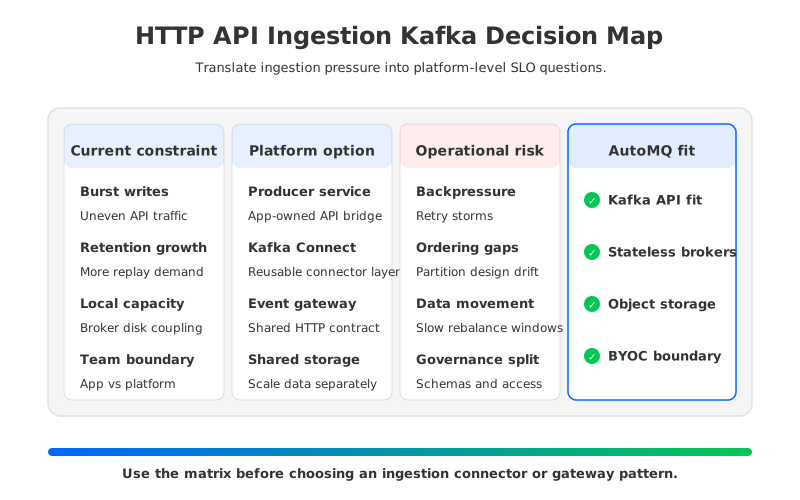
The search intent behind http api ingestion kafka usually falls into three patterns. Some teams need a producer service that calls a few APIs and writes to Kafka. Some need Kafka Connect or a managed connector layer because many teams repeat similar ingestion work. Others need an event gateway that accepts inbound HTTP calls and standardizes authentication, validation, routing, and dead-letter handling before records reach Kafka.
Those patterns are valid, but they are not interchangeable details. A producer service gives application teams control, but it can spread retry logic, token handling, and schema enforcement across repositories. A connector layer gives platform teams a shared surface, but it needs ownership for configuration, task failures, credentials, and versions. An event gateway gives stronger governance, but it becomes a front door with its own availability, rate limiting, and tenant isolation model.
The right decision depends on the SLO you are willing to own:
- Freshness: How far behind the source API can the Kafka topic fall before downstream systems break?
- Completeness: Can the system prove that paginated or incremental API reads did not skip a window?
- Idempotency: Which field becomes the stable record key when the API returns the same object twice?
- Backpressure: Where do requests wait when Kafka is healthy but the source API throttles, or when the API is healthy but Kafka is constrained?
- Replay: How long must the topic retain data so consumers can rebuild state without calling the source API again?
- Ownership: Which team fixes a broken credential, a malformed payload, a connector task failure, or a topic-level capacity problem?
These questions are where production incidents live. HTTP hides operational diversity behind a familiar protocol. Kafka gives you a durable event backbone, but it does not decide how to handle API semantics before the record is produced.
2The Production Constraint Behind the Problem
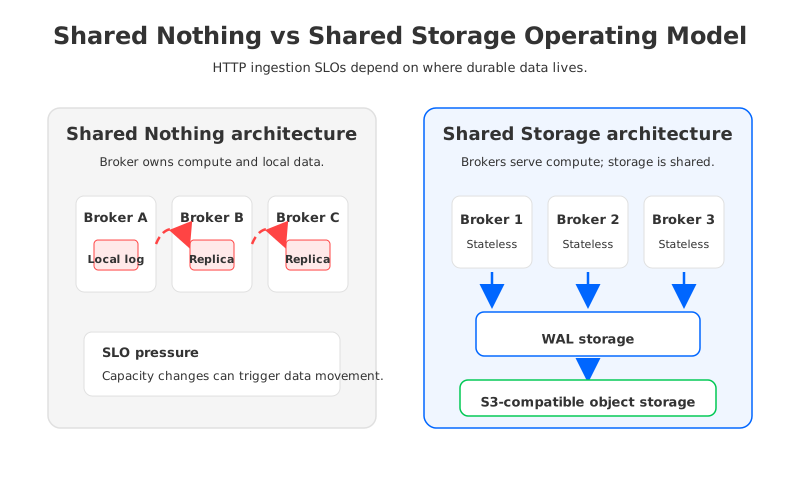
Once HTTP ingestion becomes a shared capability, Kafka storage architecture starts to matter. In traditional Kafka, brokers combine compute and local persistent storage. Each broker manages local logs, partitions are assigned to brokers, and replication keeps followers in sync. This Shared Nothing architecture is proven, but capacity planning is tied to broker-local storage and replica placement.
That coupling matters because HTTP writes are often bursty and externally shaped. A nightly partner sync, outage recovery, token refresh problem, or pagination bug can create a wave of records after quiet traffic. If the cluster has enough broker storage and network headroom, the spike is manageable. If not, operators may need to add brokers, rebalance partitions, increase retention, or throttle ingestion while downstream teams wait.
Kafka gives operators strong primitives: topics, partitions, offsets, consumer groups, idempotent producers, transactions, and KRaft-based metadata management. The operational question is whether the infrastructure beneath those primitives makes ingestion SLOs easier or harder when the workload is not steady.
Tiered Storage can help by moving older log segments to object storage while keeping recent data on broker-local disks. That is useful when replay drives storage growth, but it does not turn brokers into stateless compute nodes. Recent data, broker-local capacity, and operational procedures still matter. For HTTP ingestion, where bursts and replays collide, teams need to separate durable storage growth from compute capacity for accepting, routing, and serving traffic.
3Architecture Options and Trade-Offs
A durable HTTP ingestion platform usually settles into one of four options. The simplest is an application-owned producer service. It is often right when the API is domain-specific, transformation logic is business-heavy, and the owning team can operate the path. The risk is fragmentation: every team invents its own retry policy, dead-letter naming, schema checks, and API checkpointing.
The second option is Kafka Connect, which runs reusable source and sink connectors as a distributed framework. It fits when ingestion should be operated as infrastructure rather than embedded in each application. The trade-off is that task failures, upgrades, secret rotation, offset storage, and scaling policies need platform-grade runbooks.
The third option is an event gateway in front of Kafka. This works when many producers call your platform over HTTP and need consistent authentication, validation, tenant routing, and traffic shaping. The price is another critical-path service. The gateway needs SLOs and must avoid hiding Kafka errors behind generic HTTP responses that make producers retry blindly.
The fourth option is to change the Kafka-compatible platform beneath the ingestion layer. This does not replace producer services, connectors, or gateways. It changes their operating model. If broker compute can scale separately from durable storage, and broker replacement avoids large local data movement, the platform can absorb bursts with different trade-offs.
| Decision area | Producer service | Kafka Connect layer | Event gateway | Shared-storage Kafka-compatible platform |
|---|---|---|---|---|
| Best fit | Domain-specific API logic | Reusable integration operations | Multi-tenant HTTP contracts | Bursty traffic and retention growth |
| Main owner | Application team | Platform or data integration team | Platform team | Platform engineering and SRE |
| Primary risk | Logic fragmentation | Connector task operations | Gateway critical path | Platform migration planning |
| SLO question | Can the app own retries and checkpoints? | Can the platform operate connector failure modes? | Can the gateway expose useful backpressure? | Can compute scale without storage movement? |
The table is not a ranking. Many teams use more than one pattern. A payments API may stay in an application service because business logic is sensitive. A marketing API may move to a connector because freshness is less strict and reuse matters. A partner endpoint may sit behind a gateway because contract enforcement matters more than connector reuse. The platform underneath should be evaluated against SLOs, not diagram preference.
4Evaluation Checklist for Platform Teams
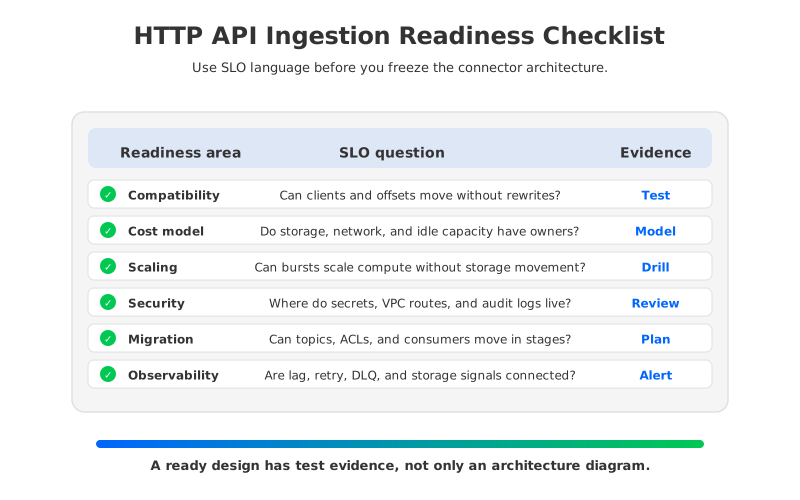
Evaluation should start with compatibility because migration cost can dominate every other benefit. Kafka clients depend on protocol behavior, topic semantics, offsets, consumer group coordination, acknowledgments, transactions, and tooling. A Kafka-compatible platform should preserve client libraries and operating knowledge, while still requiring a controlled test plan for the exact client versions and features in use.
Cost comes next, but model it as a system cost rather than a storage line item. HTTP ingestion creates cost through compute, broker storage, object storage, cross-zone traffic, connector workers, retries, dead-letter retention, monitoring, and operational time. Platform teams should model average write rate, burst rate, retention, consumer fan-out, replay frequency, and recovery objectives.
Scaling deserves a test, not a spreadsheet assumption. Useful tests include a source API recovery burst, connector task restart, consumer lag catch-up, and retention growth scenario. The platform should show behavior during spikes and return to baseline. Watch for hidden work: partition movement, page cache warm-up, storage expansion, task redistribution, and alert noise.
Governance is where integration platforms drift. API credentials need rotation paths. Payload schemas need validation. Sensitive fields need clear boundaries. Dead-letter topics need retention and access policies. Audit logs need to show who changed connector configuration or gateway routing. These controls should be part of the design, not cleanup after the first incident.
Migration and rollback are the final filters. A credible plan includes topic creation, ACLs, schema subjects, connector offsets or source checkpoints, consumer group behavior, parallel-run validation, and rollback that does not corrupt downstream state. The harder the source API is to replay, the more conservative the plan should be.
5How AutoMQ Changes the Operating Model
After neutral evaluation, AutoMQ becomes relevant for a clear architectural reason. AutoMQ is a Kafka-compatible, cloud-native streaming platform that keeps Kafka protocol and ecosystem compatibility while changing storage from broker-local logs to Shared Storage architecture backed by S3-compatible object storage.
In that model, AutoMQ Brokers handle Kafka protocol processing, partition leadership, caching, and scheduling, while durable data is written through S3Stream to WAL (Write-Ahead Log) storage and object storage. Brokers are stateless from the perspective of persistent data ownership. Scaling or replacing broker compute is no longer the same operation as moving large broker-local logs.
That changes the HTTP ingestion conversation. Bursty API traffic can be evaluated as compute pressure and durable storage pressure separately. Retention growth can use object-storage-backed durability instead of pre-provisioning broker-local disks for every replay scenario. Broker failure and capacity events depend less on data movement. SRE runbooks can focus on traffic, leadership, cache behavior, connector health, and source API conditions rather than storage locality.
AutoMQ BYOC also matters for deployment boundaries. In BYOC, the control plane and data plane run in the customer's cloud account or VPC, and customer business data stays there. That boundary matters because API credentials, private routes, topic data, and compliance controls often belong to the same trust zone. A platform that runs inside that boundary reduces security exceptions.
For teams using Kafka Connect, AutoMQ Managed Connector provides managed Kafka Connect in the AutoMQ BYOC environment. The value is not that connectors remove ingestion design work. The value is that connector lifecycle, Kafka-compatible storage, network boundaries, and observability can share one operating model. When a connector fails, the platform team can inspect connector health, Kafka lag, storage behavior, and network placement as one system.
AutoMQ is not a reason to skip ingestion discipline. You still need idempotent record design, schema governance, retry limits, dead-letter policies, and source API checkpointing. The architecture changes what happens when those choices meet production load. Platform teams can design around elastic compute, object-storage-backed durability, and Kafka-compatible APIs instead of over-provisioning every ingestion path.
6A Practical Readiness Scorecard
Before adopting any HTTP ingestion architecture, score the design against seven checks. A "yes" should mean evidence exists in a test, runbook, or reviewed design document.
- Compatibility: The exact Kafka clients, serializers, schema workflows, producer settings, consumer groups, and offset behavior have been tested against the target platform.
- Freshness and lag: The team knows the acceptable lag window for each source API and has alerts that distinguish source throttling from Kafka-side pressure.
- Idempotency: Each record has a stable key or deduplication strategy, and retries cannot create downstream ambiguity.
- Cost ownership: Storage, network, connector workers, retries, dead-letter retention, and operational time have named owners.
- Security boundary: API secrets, private routes, audit logs, and topic permissions live in an approved trust boundary.
- Migration path: Topics, schemas, ACLs, source checkpoints, and consumer groups can move in stages with validation.
- Rollback path: The team can stop the new ingestion path without losing source progress or forcing consumers into inconsistent state.
If the scorecard exposes weak spots, fix those before debating connector brands or instance sizes. HTTP API ingestion fails when teams confuse a working data path with an owned operating model. Kafka gives you the backbone. Platform SLOs decide whether that backbone stays predictable when APIs behave like external systems.
For teams evaluating Kafka-compatible streaming with shared storage, BYOC boundaries, and managed connector operations, the next useful step is to test one real ingestion path. Start with the API that already causes the most support tickets, replay requests, or capacity exceptions. Explore AutoMQ Cloud and BYOC deployment options here: Try AutoMQ.
7FAQ
7.1Is HTTP API ingestion into Kafka better with Kafka Connect or a custom producer?
Use Kafka Connect when the ingestion pattern is reusable and the platform team can own connector operations. Use a custom producer when API logic is domain-specific or tightly coupled to an application workflow. The platform decision should include ownership, retry behavior, checkpointing, schema governance, and rollback.
7.2Why does broker storage architecture matter for HTTP API ingestion?
HTTP API ingestion often creates bursts after source outages, rate-limit windows, or scheduled syncs. In a broker-local model, scaling and retention planning are tied to broker capacity and data placement. Shared Storage architecture separates broker compute from durable storage, changing the operational work during capacity changes and recovery events.
7.3Does Shared Storage architecture replace Kafka retention planning?
No. Retention policy still needs business ownership because it controls replay, compliance, and cost. Shared Storage architecture changes the infrastructure trade-off by placing durable data in object storage, but teams still need clear retention windows, dead-letter retention, and consumer replay expectations.
7.4How should SRE teams measure HTTP API ingestion health?
Measure source API errors, rate-limit responses, retry queues, connector task status, producer errors, Kafka consumer lag, dead-letter volume, topic throughput, and storage signals. Correlation matters. "Lag is high" is less useful than distinguishing source throttling, connector failure, Kafka write pressure, and downstream slowdown.
7.5Can AutoMQ run inside a customer's cloud boundary?
Yes. AutoMQ BYOC is designed so the control plane and data plane run inside the customer's cloud account or VPC, with customer business data staying in that environment. That model is relevant for HTTP API ingestion because credentials, private networking, audit logs, and topic data often need to stay within the same trust boundary.
8References
- Apache Kafka documentation
- Apache Kafka KRaft documentation
- Apache Kafka Tiered Storage documentation
- AutoMQ compatibility with Apache Kafka
- AutoMQ S3Stream Shared Streaming Storage overview
- AutoMQ WAL storage documentation
- AutoMQ Managed Connector documentation
- AutoMQ zero inter-zone traffic documentation


