
Table of Contents
Table of Contents
An AI agent that works in a demo can keep state in memory, call a tool, and return a plausible answer. A production agent has a harder job: it must remember what happened, prove why it acted, retry partial work, coordinate with other agents, and recover after failure without inventing a different history. Teams searching for ai agents durable event logs are usually past the prototype stage. They are asking what event backbone can carry agent work when the workload becomes continuous, multi-tenant, and expensive to replay.
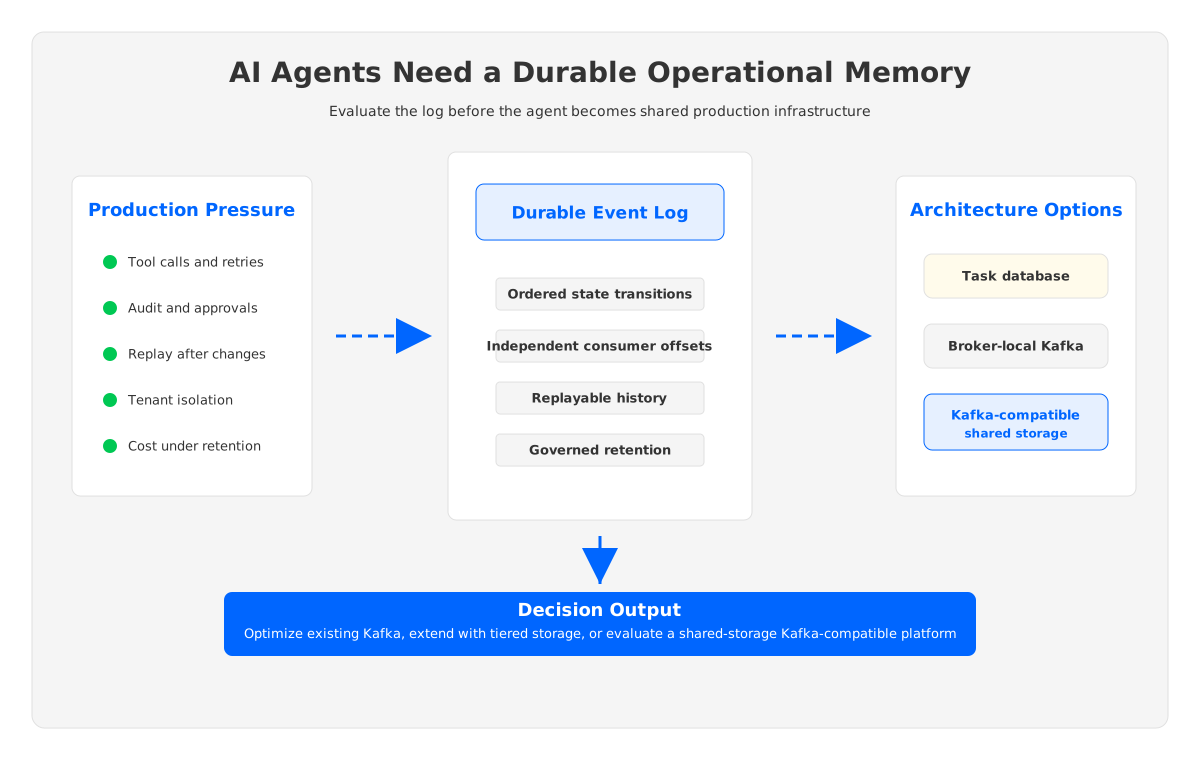
Agentic systems do not behave like normal request-response services. A single user action can become a chain of retrieval, planning, tool invocation, human approval, model output, policy check, and downstream execution. A durable event log gives platform teams one place to anchor that chain: every agent decision becomes an ordered fact that can be consumed, replayed, governed, and joined with operational telemetry.
1Why Durable Event Logs Matter for AI Agents
AI agents multiply the intermediate states a platform has to manage. A human-facing workflow might look like one request, but the system behind it can contain many state transitions: prompt assembled, context retrieved, tool selected, tool call started, tool call completed, model response evaluated, guardrail applied, action committed. If these states live only in service memory or a task database, the platform may know the latest row value but not the exact sequence that led there.
Durable event logs solve that by making the sequence the primary record. Apache Kafka's design gives consumers control over offsets, supports consumer groups, and provides primitives such as idempotent producers and transactions for stronger processing semantics. For agent platforms, those capabilities map naturally to work queues, replay, state reconstruction, and pipelines where results and offsets have to move together.
The pressure grows when agent workflows become shared infrastructure. A platform team may support customer-support agents, software-engineering assistants, risk review bots, and internal data agents on the same event backbone. Their latency, retention, and governance needs differ, but they all need durable ordered facts. The event log becomes less like a pipe and more like the operational memory of the AI platform.
That memory has to satisfy several constraints at once: freshness for action loops, replay after prompt or schema changes, isolation for sensitive tenant data, cost control as retention grows, and visibility into partial work that would otherwise hide inside retry loops.
These are not AI-only concerns. They are the same distributed-systems concerns Kafka teams already know, but agent workloads compress them into a tighter operating window. The retry path is also the audit path, and replay becomes the way a team improves an agent after production incidents.
2The Production Constraints Behind the Search
The first architectural mistake is treating the event log as a generic message queue. A queue asks, "Who should handle this task next?" A durable log asks, "What happened, in what order, and who is allowed to reinterpret it later?" Agents need both, but the durable log is the harder part because it shapes recovery, audit, and future learning.
Kafka's consumer model is useful because a consumer specifies the offset it wants to read from, and consumer groups can store committed offsets so processing resumes after restarts. That matters when an agent workflow has multiple readers: an online coordinator, a safety evaluator, and an analytics job may all read the same topics at different positions.
The second constraint is ordering scope. Agent teams often begin with a single global event stream because it feels easier to reason about, but that becomes a bottleneck. Better designs decide which key owns the order: session ID, task ID, account ID, or resource ID. The choice controls coordination, partition scaling, and replay impact.
The third constraint is retention. Tool-call lifecycle events may be valuable for short-term retry, while approval and policy events may need longer retention. Embeddings, retrieved context, and model prompts may require stricter privacy treatment than operational status events.
The fourth constraint is schema evolution. Tools are added, model providers change, guardrails gain fields, and workflow graphs split into specialized agents. Event schemas need compatibility rules because old runs will be replayed by later processors.
3Architecture Patterns Teams Usually Compare
Platform teams usually compare three patterns before choosing the event backbone for AI agents. The names differ across organizations, but the trade-offs are consistent.
| Pattern | Where It Fits | Main Risk for AI Agents |
|---|---|---|
| Task database plus workers | Early prototypes and low-volume internal automations | History is often overwritten or scattered across tables, logs, and worker state. |
| Traditional Kafka with broker-local storage | Mature event-driven systems with existing Kafka skills and tools | Capacity planning, broker-local disks, replication traffic, and partition movement become operational pressure points. |
| Kafka-compatible shared-storage streaming | Cloud-native platforms that want Kafka semantics with more elastic storage and stateless operations | Teams must evaluate latency, WAL design, compatibility, migration, and deployment boundary carefully. |
Traditional Kafka remains a strong baseline because the ecosystem, protocol, and operational knowledge are deep. The problem is not Kafka's log abstraction. The problem is the shared-nothing operating model that many Kafka deployments inherit. Brokers own local storage, partitions are tied to broker disks, and replication across brokers is part of the durability path. That model can work well, but it becomes harder to operate when retention, replay, and bursty traffic all move at once.
Tiered storage changes part of that equation by moving completed log segments to remote storage, such as object storage. It is valuable for historical data and can reduce pressure on local disks. But the active write path and local log still matter. For agents, where fresh events and replay windows are both important, platform teams should not treat tiered storage and a shared-storage architecture as the same design. They solve related problems at different layers.
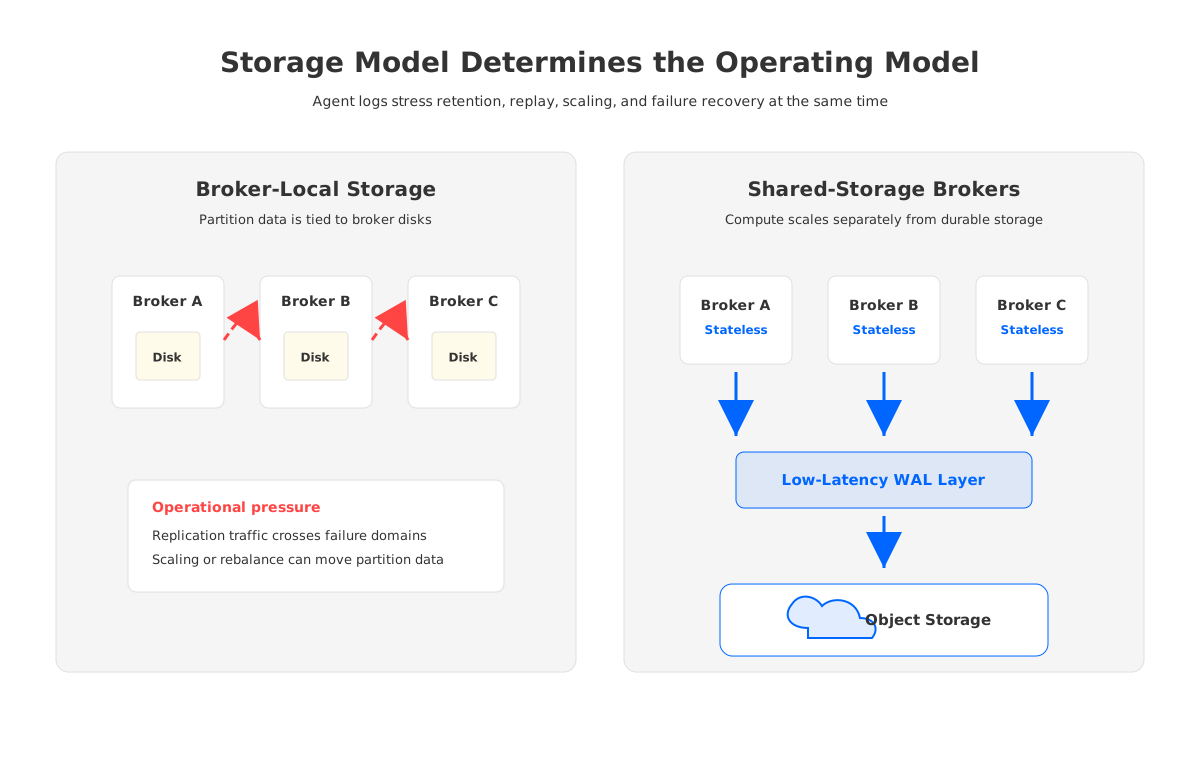
The architecture question is therefore not "Should agents use Kafka?" Many should, especially when the organization already standardizes on Kafka APIs. The better question is what operating model the Kafka-compatible layer should expose as agent traffic grows. If every retention increase requires more broker-local capacity, the event log can become the slowest part of the AI platform to adapt.
4Evaluation Checklist for Platform Teams
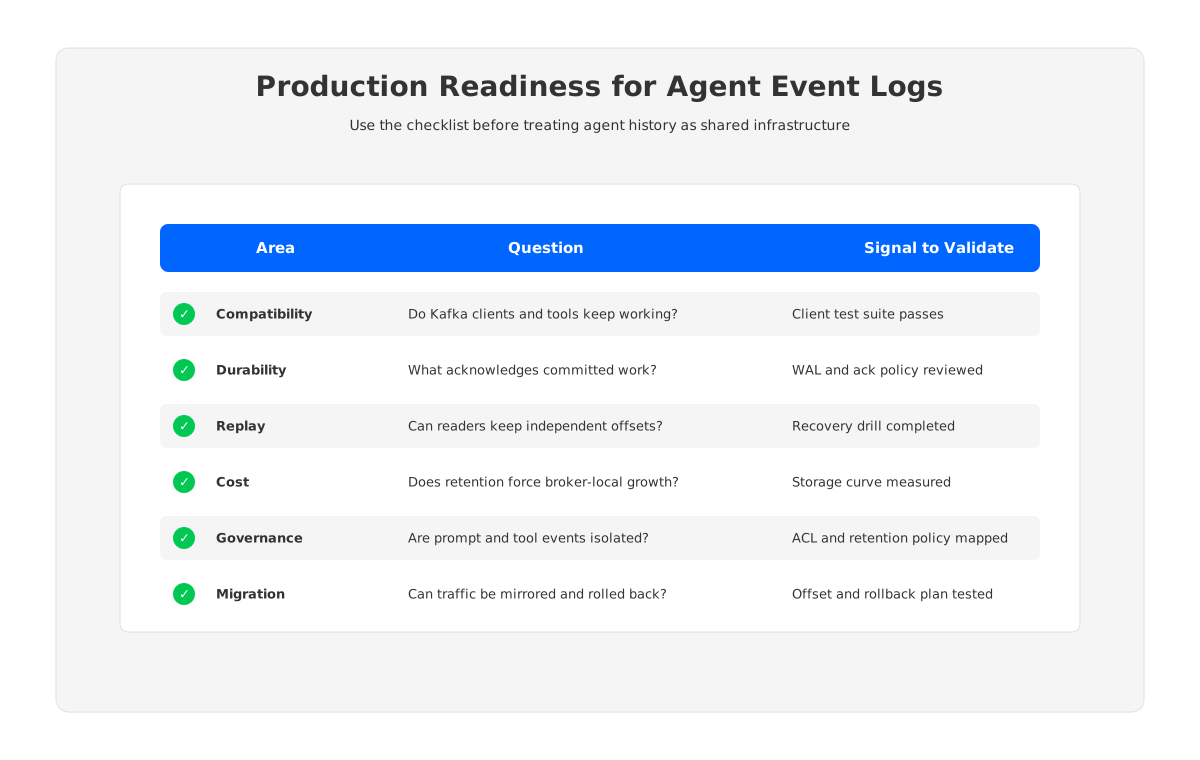
A durable event log for AI agents should be evaluated like production infrastructure, not like an SDK feature. The following checklist is intentionally vendor-neutral. It helps teams separate log semantics from deployment mechanics.
| Area | Question | Why It Matters |
|---|---|---|
| Compatibility | Can existing Kafka producers, consumers, connectors, and governance tools keep working? | Agent platforms often reuse data infrastructure teams already trust. |
| Durability path | What acknowledges a write before work is committed? | Failed tool calls and duplicate actions are easier to reason about when write semantics are explicit. |
| Offset and replay model | Can every agent, evaluator, and analytics job maintain independent progress? | Multiple readers need different recovery and replay behavior. |
| Storage economics | Does longer retention require more broker-local disks, or can colder history scale with object storage? | Agent traces grow quickly because intermediate states become data. |
| Elasticity | What happens during bursts of tool calls, model outputs, or replay? | Agent traffic is often spiky. |
| Governance | Can sensitive prompt, tool, and approval events be isolated, encrypted, audited, and expired? | Agent logs can contain business actions, user data, and policy decisions. |
| Migration and rollback | Can teams test with mirrored traffic, preserve offsets, and roll back without losing visibility? | AI platforms change fast, but the event log should not become a risky cutover point. |
The most important row is usually the durability path. Agent systems contain side effects: ticket updates, purchases, database changes, code changes, emails, and approvals. If the event log acknowledges a transition before it is durable, downstream components may act on a fact that disappears after failure. If it waits for too much coordination, the agent loop can become slow.
Governance deserves the same level of detail. Prompt text, retrieved documents, tool payloads, and model outputs can have different classification levels. A durable log makes these records easier to replay, but also easier to retain longer than intended.
5Where AutoMQ Changes the Operating Model
Once the evaluation focuses on operating model rather than brand names, the shared-storage path becomes worth a serious look. AutoMQ is a Kafka-compatible, cloud-native streaming platform that moves Kafka's storage layer to shared object storage through its S3Stream architecture. Brokers become stateless from an operations perspective, while a WAL layer handles the durable write path before data is persisted to object storage.
That difference matters for AI agents because the painful part is often not producing one more event. It is keeping the platform elastic while the log becomes longer, wider, and more valuable. Broker compute can scale for traffic, while object storage absorbs retained event data. Partition movement no longer has to mean copying large amounts of broker-local data between machines.
AutoMQ's architecture also changes the cost conversation. In a conventional multi-AZ Kafka deployment, replication and client traffic can cross availability-zone boundaries depending on leader placement and consumer location. AutoMQ documents an S3-based design for eliminating inter-zone traffic costs through shared storage and same-AZ routing. The exact savings depend on workload, cloud region, and routing configuration, so a production evaluation should measure traffic patterns rather than copy a benchmark number.
For agent platforms, the deployment boundary matters as much as the storage model. Many teams want managed operations but cannot move sensitive prompts, tool payloads, or regulated event history into a third-party data plane. AutoMQ BYOC keeps the data plane in the customer's cloud account while AutoMQ handles the control-plane experience.
There are still checks to run. Latency-sensitive agents should validate WAL choices against their p99 write path. Teams using compacted topics, transactions, or specific Kafka client versions should test compatibility directly. Migration plans should mirror traffic, compare offsets, verify consumer behavior, and preserve rollback options. Shared storage lowers operating burden; it does not remove engineering discipline.
6A Practical Topic Design for Agent Events
A good first production design is to split agent events by lifecycle rather than by team name. Command topics carry requested work. State topics record transitions. Observation topics capture model outputs, tool responses, evaluator results, and policy decisions, which often need stricter controls. Projection topics hold derived views for dashboards or analytics and can be rebuilt from the durable source events.
The partition key deserves more thought than the topic names. If the key is too broad, one hot customer can throttle unrelated work. If it is too narrow, ordering becomes weak and agents can race each other. Use the smallest identifier that must remain sequential for correctness: task ID, session ID, or resource ID.
7Decision Table: Optimize, Extend, or Re-Platform
Not every AI agent platform needs a storage-architecture change on day one. Some teams should optimize their existing Kafka deployment first. Others should move faster because the event log is already limiting retention, replay, or cost control.
| Situation | Recommended Move |
|---|---|
| Prototype agents with low traffic and no strict replay requirements | Keep the design simple, but write events in a format that can move later. |
| Existing Kafka cluster with stable traffic and short retention | Tune partitioning, schema rules, consumer groups, and observability first. |
| Kafka cluster with growing retention, frequent rebalancing, and cloud cost pressure | Compare tiered storage and Kafka-compatible shared storage. |
| Multi-tenant agent platform with sensitive history and bursty replay | Prioritize compatibility, shared storage, BYOC, governance, and migration testing. |
| Regulated workflows where agent decisions become audit evidence | Treat the event log as a system of record before launch. |
Durable event logs are not a background implementation detail for AI agents. They define how the platform remembers, corrects, proves, and improves its behavior. If your agent roadmap is moving from a handful of automations to shared production infrastructure, start the architecture review with the log: ordering, offsets, replay, durability, retention, governance, and operating model.
To go deeper, start with AutoMQ's shared storage architecture documentation and validate the write path, migration path, and governance controls against one real agent workflow before making a broader platform decision.
8References
- Apache Kafka 4.3 Design: Consumers, delivery semantics, and transactions
- Apache Kafka 4.3 Consumer Offset Tracking
- Apache Kafka 4.3 Tiered Storage
- AutoMQ S3Stream Shared Streaming Storage Overview
- AutoMQ WAL Storage
- AutoMQ Stateless Broker
- AutoMQ Eliminate Inter-Zone Traffics
- Amazon S3 Data Protection and Durability
- Amazon EC2 Regions and Availability Zones
9FAQ
9.1Do AI agents need Kafka, or can they use a task queue?
Some can use a task queue, especially when tasks are short-lived and history is not important. A durable Kafka-compatible log becomes more useful when multiple consumers need independent replay, audit, analytics, and recovery over the same agent-event sequence.
9.2What should be stored in an AI agent event log?
Store state transitions, tool-call lifecycle events, approvals, policy decisions, and references to large artifacts. Treat raw prompts, retrieved documents, and model outputs carefully because they may need stricter retention, redaction, and access controls.
9.3How should teams choose partition keys for agent workflows?
Choose the smallest key that must preserve order for correctness: session ID for conversational continuity, task ID for independent jobs, or resource ID when agents might modify the same object.
9.4Is Kafka tiered storage the same as a shared-storage streaming architecture?
No. Kafka tiered storage moves completed log segments to remote storage while the local broker log remains part of the active storage model. A shared-storage architecture uses object storage as the primary durable substrate and makes brokers stateless from an operating perspective.
9.5Where does AutoMQ fit in an AI agent platform?
AutoMQ fits when teams want Kafka-compatible APIs, durable event logs, elastic cloud operations, shared object storage, and a customer-controlled deployment boundary. It is most relevant when retention, replay, scaling, and cross-AZ traffic become production constraints.


