
Table of Contents
Table of Contents
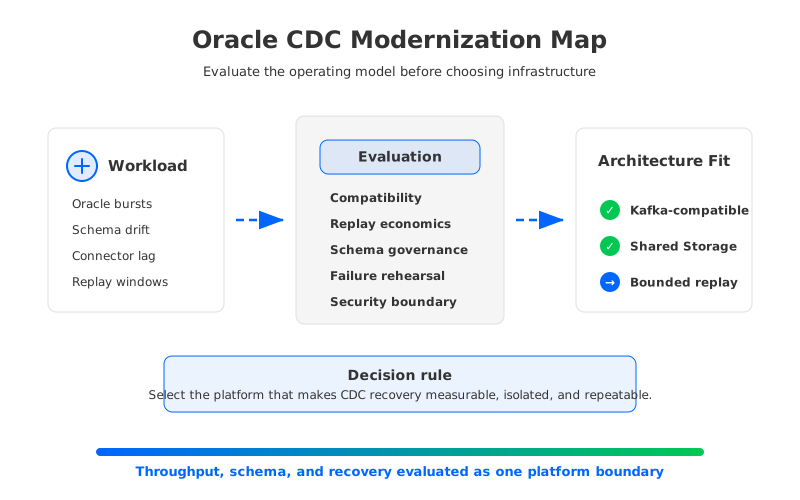
Teams search for oracle cdc kafka modernization when a working replication path starts to feel fragile. The Oracle database is no longer feeding one reporting system. It is feeding fraud models, lakehouse tables, customer-360 views, search indexes, operational caches, and audit pipelines, each with a different tolerance for lag, schema change, and replay. The question is not whether Kafka can carry change events. The question is whether the CDC platform can absorb database pressure, connector pressure, broker pressure, and recovery pressure without turning every incident into a cross-team war room.
Oracle CDC is a high-stakes source because it starts at the system of record. A stalled connector can create application-visible freshness gaps. A schema change can break downstream consumers that assumed a stable envelope. A replay can be necessary for correctness, yet the same replay can overload the Kafka brokers that are still serving live writes and reads. Modernization has to treat throughput, schema drift, and recovery as one operating problem.
1Why teams search for oracle cdc kafka modernization
The search phrase usually appears after a team has already proven the value of CDC. The first pipeline may have been a database-to-Kafka feed for analytics or cache refresh. Then more teams attach consumers, retention increases, and the connector becomes part of production incident management. What looked like integration work becomes a platform boundary.
Oracle adds specific constraints to that boundary. CDC commonly depends on reading database change history through mechanisms such as LogMiner or related capture infrastructure, so the connector is sensitive to database configuration, privileges, archive log availability, and transaction volume. Kafka adds contracts around ordered partitions, consumer group offsets, transactions where used, and storage or fetch limits.
The symptoms tend to look familiar:
- Throughput spikes arrive from the database, not from Kafka producers. End-of-day batch jobs, maintenance windows, and large transactional bursts can push a connector into catch-up mode.
- Schema changes are business events. A column rename, type change, or table split may be valid in Oracle but unsafe for consumers that depend on event shape.
- Recovery is a normal workflow. Teams need to restart from offsets, reprocess a table, rebuild a sink, or correct downstream state without guessing where the source of truth begins.
- Connector ownership is ambiguous. Database administrators, integration engineers, Kafka platform teams, and SREs all own part of the path, but no single dashboard explains the whole failure.
The connector captures change events, but the platform decides how those events are retained, governed, replayed, isolated, and migrated.
2The operational constraint behind connector-heavy platforms
Traditional Kafka deployments use a Shared Nothing architecture. Partition data lives on broker-local disks or attached volumes, leaders serve reads and writes, followers replicate data, and the cluster stores log segments within broker-owned capacity. This makes retained CDC history, broker scaling, and replay-heavy recovery part of the same resource pool.
For Oracle CDC, that coupling matters because the workload is uneven. A connector may run smoothly for weeks, then fall behind because the database emitted a transaction burst or downstream sink maintenance paused consumption. The platform now needs more retention, more fetch capacity, and a clean recovery path at the same time. If every retained byte is tied to broker-local storage, the cluster carries capacity in advance for failure events.
The same coupling appears during infrastructure changes. Replacing brokers, adding capacity, or moving partitions can trigger data movement across the network. When CDC catch-up traffic, replica movement, and live producers compete, the question becomes whether the cluster has enough spare headroom for recovery.
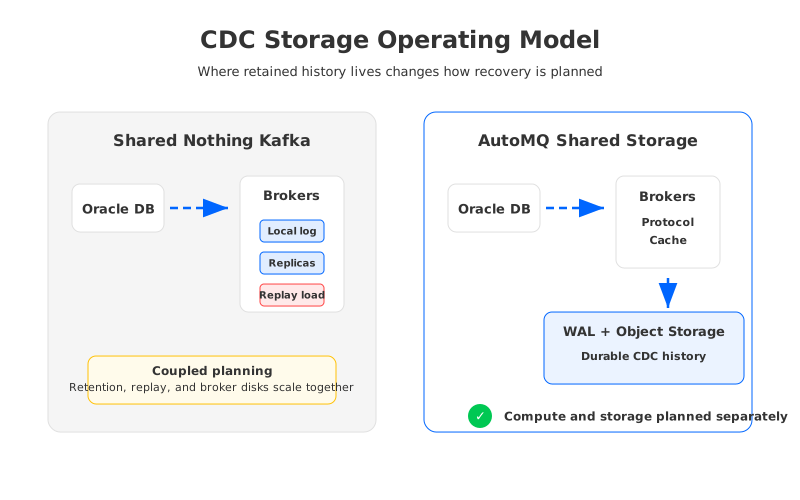
Tiered Storage can reduce local disk pressure by placing older log segments in remote storage. It is useful, but it is not the same as making brokers stateless. Platform teams still need to reason about recent data placement, partition ownership, fetch locality, and broker replacement work. In connector-heavy environments, the critical question is whether storage growth and broker compute must scale together.
3Failure handling, schema, and replay trade-offs
CDC pipelines fail in ways that ordinary application producers do not. A producer service can often retry or emit a corrected event. A CDC connector is replaying the database's transaction history, so a failure can involve source log retention, transaction boundaries, schema metadata, connector state, Kafka offsets, and sink-side idempotency at the same time.
Schema drift is the first trap. Some changes are additive and safe for most consumers. Others change meaning even when the event still serializes correctly. If the platform does not define schema compatibility rules, topic naming conventions, and downstream ownership, the CDC stream becomes a hidden API that changes when the database changes.
Replay is the second trap. Kafka's consumer groups and offsets give teams a powerful mechanism for independent consumption, but replay is not free. A table rebuild, failed sink, or connector restart can create sustained historical reads. In a Shared Nothing cluster, those reads hit brokers that may also be responsible for live CDC ingest, replication, and serving other consumer groups.
The third trap is partial recovery. A connector can resume, a Kafka topic can retain the records, and a sink can still be inconsistent if it committed some changes and failed before others. Readiness depends on the handoff between layers.
| Failure mode | What breaks first | Recovery evidence to collect |
|---|---|---|
| Connector lag after Oracle burst | Source log retention and connector task throughput | Lag trend, archive log window, task restart behavior |
| Schema drift | Consumer compatibility and sink mapping | Schema registry policy, contract tests, rollback plan |
| Broker replacement | Partition movement and catch-up traffic | Broker health, fetch latency, network traffic, reassignment timing |
| Sink rebuild | Historical reads and idempotency | Offset boundary, duplicate handling, table or index validation |
| Region or AZ disruption | Network path and deployment boundary | RPO/RTO target, failover runbook, customer-controlled resources |
The platform is ready when these failures can be rehearsed without special heroics.
4Evaluation checklist for platform teams
The right evaluation starts with compatibility, but it should not stop there. Kafka compatibility means existing producers, consumers, tools, ACL assumptions, topic conventions, and offset behavior can continue to work through a migration. For Oracle CDC, compatibility also includes connector runtime behavior, error handling, schema serialization, and the operational scripts teams use during incidents.
Cost and elasticity need the same proof. CDC retention often grows because teams need replay insurance, not because daily ingest doubled. If replay insurance forces larger broker-local disks and long-lived reservations, rare failure events are shaping the platform cost model.
Governance cannot be postponed until after cutover. The CDC stream exposes database structure to downstream teams, so platform owners need rules for topics, keys, schema evolution, PII handling, access control, lineage, and sink ownership.
Use a scorecard that forces concrete answers:
| Dimension | Review question | Pass signal |
|---|---|---|
| Kafka compatibility | Can existing clients, offsets, and tools keep their contracts? | Representative producers, consumers, and connectors pass staged tests |
| Oracle capture safety | Is source log retention aligned with connector lag and recovery goals? | Lag rehearsal completes inside the source retention window |
| Throughput elasticity | Can bursty CDC catch-up avoid starving live traffic? | Fetch, produce, CPU, and network metrics stay within SLO bounds |
| Schema governance | Are breaking database changes blocked, versioned, or routed? | Contract tests and ownership rules exist before cutover |
| Replay economics | Does long retention force broker-local capacity growth? | Retention model separates durable history from broker sizing |
| Security boundary | Are VPC, IAM, encryption, and data residency requirements explicit? | Deployment runbook maps each control to an owner |
| Rollback | Can producers, connector tasks, and consumers roll back separately? | Offset boundaries and dual-run validation are documented |
A connector demo proves that events can move. A failure rehearsal proves that the team can operate the system when events stop moving correctly.
5How AutoMQ changes the operating model
After the evaluation framework is clear, AutoMQ becomes relevant as a Kafka-compatible streaming platform built around a Shared Storage architecture. It keeps Kafka protocol compatibility while moving persistent stream storage away from broker-local disks and into object storage through S3Stream. Brokers remain responsible for Kafka protocol handling, partition leadership, caching, and request routing, while durability is backed by WAL storage and object storage.
That architectural change is important for Oracle CDC because retained history is part of the recovery plan. If a connector needs to replay after a sink failure, the platform should not have to turn every replay window into broker-local storage growth. Shared Storage changes the planning unit to how compute, cache, WAL, and object storage cooperate under replay.
AutoMQ's stateless broker model also changes broker replacement and scaling work. In a traditional cluster, infrastructure changes can involve partition reassignment and replica movement, which is sensitive during CDC catch-up. With object-storage-backed stream data, broker compute can be adjusted with less dependence on moving durable log data between brokers.
Several AutoMQ capabilities map directly to the checklist:
- Kafka compatibility helps teams preserve client behavior, consumer group expectations, and connector integration patterns while evaluating a storage architecture change.
- Shared Storage architecture separates durable stream data from broker-local disks, which matters when CDC replay windows grow for safety rather than daily throughput.
- WAL storage plus object storage gives the platform a cloud-native durability path without making brokers the long-term storage owner.
- Independent compute and storage scaling helps platform teams plan CDC bursts, replay, and retention without sizing every broker for the largest repair event.
- Zero cross-AZ traffic architecture can change the multi-AZ cloud cost discussion for streaming deployments where replication and fetch traffic are significant.
- Customer-controlled deployment boundaries fit CDC workloads that need clear VPC, IAM, object storage, and regional governance controls.
A team may keep existing Oracle CDC tooling, adopt Kafka Connect-based capture, or standardize on managed connector operations as part of a broader platform. AutoMQ should be evaluated at the Kafka-compatible streaming layer first, then against the connector model that fits the team's database access, security, and ownership boundaries.
6Migration and rollout scorecard
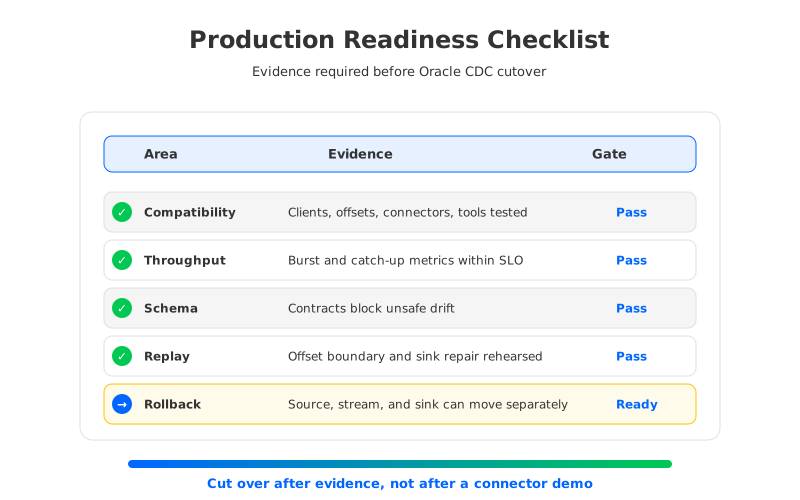
Oracle CDC modernization should move in stages because the source system is too important for a single big-bang cutover. Start with representative tables, including one high-volume table, one schema-sensitive table, and one downstream path that requires replay validation. Mirror or dual-run where possible, compare event counts and sink state, then record offset boundaries.
Cutover should separate four moves: source capture, Kafka-compatible storage, downstream consumption, and sink validation. If all four move at once, a failure has too many possible causes. If each boundary moves with its own rollback point, the platform team can isolate whether the issue is Oracle capture, topic behavior, broker capacity, schema mapping, or sink idempotency.
Observability closes the gap between design and on-call reality. Database log availability, connector task status, Kafka consumer lag, broker fetch pressure, storage growth, schema events, and sink commit health should be visible together. A Kafka-only dashboard misses source-side risk; a connector-only dashboard misses replay cost.
Back at the original search phrase, oracle cdc kafka modernization is not a request for a shinier connector. It is a request for a platform that can keep change data trustworthy when throughput spikes, schema changes, and recovery work arrive together. If your team is evaluating this boundary, use the checklist against your own failure rehearsals, then review AutoMQ's architecture and migration docs or start a technical conversation here: contact AutoMQ.
7References
- Apache Kafka documentation for Kafka Connect concepts, client behavior, consumer groups, offsets, transactions, KRaft, and Tiered Storage.
- Kafka consumer group configuration for consumer group behavior and offset ownership.
- Kafka transactions documentation for transactional producer and consumer semantics.
- Kafka KRaft documentation for metadata quorum operations.
- Kafka Tiered Storage documentation for remote log storage behavior.
- Debezium Oracle connector documentation for Oracle CDC connector behavior and operational considerations.
- Oracle LogMiner documentation for Oracle change log analysis concepts.
- AWS S3 strong consistency documentation for object storage consistency behavior.
- AWS PrivateLink documentation for private connectivity considerations.
- AutoMQ Kafka compatibility documentation for Kafka-compatible client and API expectations.
- AutoMQ Shared Storage architecture documentation for stateless brokers and object-storage-backed stream storage.
- AutoMQ WAL storage documentation for WAL options in the storage architecture.
- AutoMQ migration overview for migration planning.
- AutoMQ zero cross-AZ traffic documentation for cross-AZ traffic architecture.
8FAQ
8.1Is Oracle CDC modernization only a connector replacement?
No. The connector is one part of the path. A serious modernization plan also covers Kafka compatibility, retention, schema governance, replay safety, broker scaling, sink idempotency, security boundaries, and observability across Oracle, Kafka, and downstream systems.
8.2Why does Kafka storage architecture matter for Oracle CDC?
Oracle CDC often needs retained history for recovery and replay. In a Shared Nothing Kafka cluster, that retained history is closely tied to broker-local storage and broker operations. A Shared Storage architecture can reduce the extent to which replay windows and retained history force broker-local capacity growth.
8.3How should teams handle schema drift?
Treat CDC topics as APIs. Define schema compatibility rules, ownership, topic naming, key conventions, and downstream contract tests before cutover. Additive changes may be routine, but changes in meaning, type, or key structure should be reviewed as production changes.
8.4Does Tiered Storage solve CDC replay pressure?
Tiered Storage can help reduce local disk pressure by moving older log segments to remote storage. It does not automatically make brokers stateless or remove the need to evaluate recent data placement, fetch pressure, and broker replacement work. Teams should test replay under failure, not infer readiness from storage tiering alone.
8.5Where does AutoMQ fit in an Oracle CDC architecture?
AutoMQ fits at the Kafka-compatible streaming infrastructure layer. It can work with CDC and connector strategies that publish to Kafka-compatible topics, while its Shared Storage architecture changes how durable stream data, broker elasticity, replay windows, and cross-AZ traffic are planned.


