
Table of Contents
Table of Contents
Teams usually search for topic ownership metadata kafka after Kafka governance has already failed in some small but costly way. A topic exists, producers depend on it, downstream jobs assume its schema, and nobody can say who owns the contract. The answer may be buried in a naming convention, a spreadsheet, a Terraform module, a schema registry subject, or an access request thread.
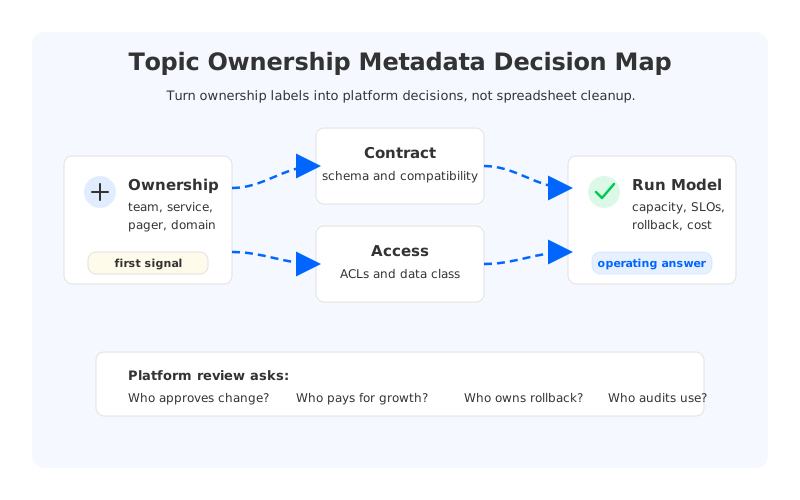
Topic ownership metadata is not a decorative catalog field. It is the smallest unit of accountability for an event contract. A topic owner decides whether a field can be removed, whether a retention change is safe, whether another consumer should receive regulated data, and who joins incidents.
The harder part is that ownership metadata sits across two worlds. Governance teams think in domains, data classes, contracts, and audit trails. Kafka operators think in partitions, ACLs, quotas, retention, replication, consumer groups, and broker capacity. A useful stewardship model connects those worlds.
1Why Teams Search for topic ownership metadata kafka
The search phrase is awkward because the problem is awkward. Kafka stores topic configuration, offsets, group membership, ACLs, and records, but it does not define a universal enterprise model for topic business ownership. Naming conventions help discovery, but they do not answer who can approve a breaking schema change or who pays for extra retention.
That gap appears in familiar production moments:
- A producer team wants to add a field that changes downstream assumptions, and the platform team has to identify every consumer group that may care.
- A security review asks whether a topic contains personal data, but ACLs only show technical principals, not the data owner or approval history.
- A cost review finds a high-retention topic with low read activity, yet nobody knows whether it supports a regulatory replay requirement.
- A migration team needs a cutover owner for each critical topic, but ownership is inferred from service names that are no longer accurate.
These are operational problems with catalog symptoms. If the ownership record cannot influence access review, retention review, schema compatibility, migration planning, and incident routing, it becomes another stale field that people stop trusting.
Kafka makes this visible because a topic is both a technical object and a product boundary. It can represent a public event contract, a private integration, an internal changelog, a CDC stream, or a migration bridge. A metadata model that treats all topics as equal will be too weak for regulated domains and too heavy for ordinary engineering workflows.
2The Governance Pressure Behind Shared Streaming Platforms
Shared Kafka platforms succeed because they reduce duplication. One platform team can provide standard brokers, networking, authentication, monitoring, schema tooling, and operational practices for many application teams. That shared model also concentrates ambiguity. When a topic is not clearly owned, every unclear decision returns to the platform team.
The first pressure is contract evolution. Apache Kafka clients preserve ordering within partitions and coordinate consumers through consumer groups, but they do not decide whether a schema change is semantically safe for a business domain. Schema compatibility rules catch structural problems; they do not know whether customer_status changing meaning breaks a billing job.
The second pressure is access. Kafka ACLs answer whether a principal can read or write. They do not explain why the principal was approved, which data class applies, when access should expire, or whether a consumer is allowed to derive another data product from the stream.
The third pressure is cost. Topic-level decisions such as partition count, retention, replication, and fan-out shape the infrastructure bill. In a broker-local storage architecture, growth in a few topics can drive disk pressure and broker expansion for the whole cluster. Ownership metadata therefore becomes a FinOps signal.
Those pressures explain why a thin metadata catalog rarely solves the problem. A catalog can display the owner, but stewardship requires a control loop: create, review, operate, migrate, and retire. Platform teams need technical evidence from Kafka, governance needs policy evidence, and application teams need a clear change path.
3What Ownership Metadata Should Actually Contain
A useful topic ownership model starts small and becomes more precise where the risk justifies it. Over-modeling every topic makes adoption slow; under-modeling critical topics leaves the platform exposed.
For most production topics, five signals matter:
- Business owner. The domain accountable for the meaning of the event contract, not only the service that currently writes records.
- Technical owner. The on-call team that can change producers, consumers, schemas, infrastructure-as-code, and related deployment settings.
- Data classification. The policy category that drives access approval, encryption expectations, retention review, and audit evidence.
- Contract policy. The schema compatibility mode, versioning convention, deprecation process, and expected notice period for breaking changes.
- Operational policy. The SLO, retention expectation, replay requirement, escalation path, and cost owner.
The distinction between business owner and technical owner is important. A payments domain may own the meaning of an invoice.created event, while a platform integration team owns the connector that publishes it. During review, the business owner protects meaning. During an outage, the technical owner knows what must change.
Metadata also has to survive automation. If topic creation is managed through Terraform, Kubernetes operators, an internal developer portal, or a self-service workflow, ownership fields should be part of the requested artifact. ACL workflows should reference the same owner and data classification fields.
4Contracts, Ownership, Access, and Audit Trade-offs
There is a natural temptation to make ownership metadata the source of truth for every governance decision. That sounds clean, but it can create a brittle system. Topic metadata is excellent for routing decisions and making risk visible; it should not replace the detailed controls that Kafka and adjacent systems already provide.
The practical boundary looks like this:
| Decision area | Kafka-facing control | Ownership signal |
|---|---|---|
| Schema evolution | Schema registry compatibility rules and release workflow | Business owner, contract policy, deprecation window |
| Access control | Kafka ACLs, authentication principals, network boundaries | Data classification, approver, access expiry, consumer purpose |
| Cost management | Partitions, retention, compression, storage placement, quotas | Cost owner, replay requirement, chargeback tag |
| Operations | Consumer lag alerts, broker health, topic metrics, incident routing | Technical owner, SLO, escalation channel |
| Migration | Mirror plan, consumer offset validation, producer cutover | Business criticality, rollback owner, compatibility test status |
The table shows why ownership metadata belongs in the platform workflow rather than in a passive wiki. A schema registry can reject incompatible changes, but it cannot judge business meaning. Kafka ACLs can deny a principal, but they cannot explain whether the approval was legitimate. Monitoring cannot identify the contract owner unless that metadata is wired into alerts or a service catalog.
There is also a privacy angle. Teams sometimes put too much information directly into topic names or labels because they want metadata to be discoverable. That can leak business-sensitive context into tooling, logs, or dashboards. Keep topic names stable and operationally useful, then store richer ownership and classification metadata in a controlled catalog.
Auditability depends on history, not only current values. The owner field matters, but the review trail matters more when an auditor asks why a sensitive topic was made available to another consumer. Topic metadata should point to approval evidence rather than pretending to contain all of it.
5How Traditional Kafka Architecture Adds Operational Friction
Ownership stewardship is already a cross-team problem. Traditional shared-nothing Kafka architecture adds another layer because operational changes often involve broker-local storage. When data lives on broker disks, topic growth and cluster scaling become data movement events with capacity, network, and failure-domain consequences.
That matters during governance work. Suppose a domain owner asks for longer retention because a replay window changed. In a broker-local model, the platform team has to check disk headroom, rebalance pressure, replica placement, and neighboring topics. A business decision about one contract becomes a cluster-level capacity exercise.
Kafka's replication model is robust, but it was designed around brokers that own local log segments. In cloud deployments, that design ties compute and storage sizing together. More storage often means more broker capacity even if CPU and network are not the bottleneck.
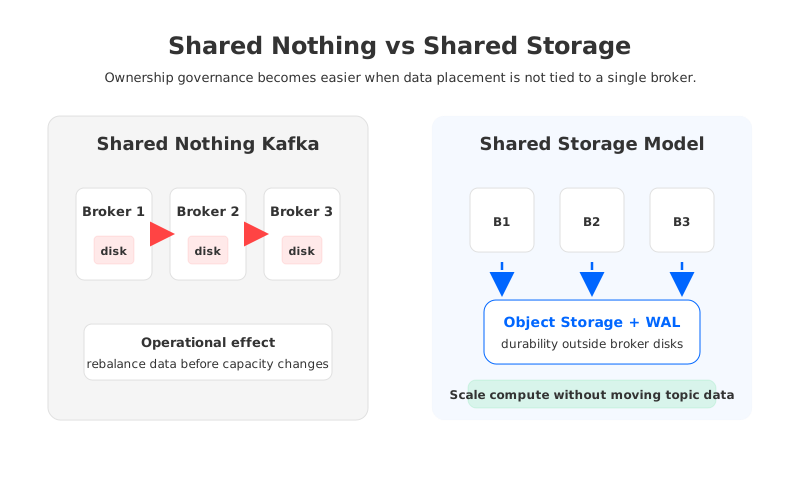
This is where governance and infrastructure architecture meet. If every topic-level stewardship decision can trigger broker-local data motion, the architecture changes the cost of doing governance well.
Tiered storage reduces some pressure by moving older log segments to remote storage. The important distinction is that tiering still keeps brokers responsible for the hot write path and local operational state. A shared storage model goes further by making durable data placement less dependent on broker identity.
6Evaluation Checklist for Platform Teams
Before choosing a catalog tool, schema registry workflow, or streaming platform architecture, platform teams should evaluate the operating model they want ownership metadata to support. Treat topic ownership metadata kafka as a production readiness question.
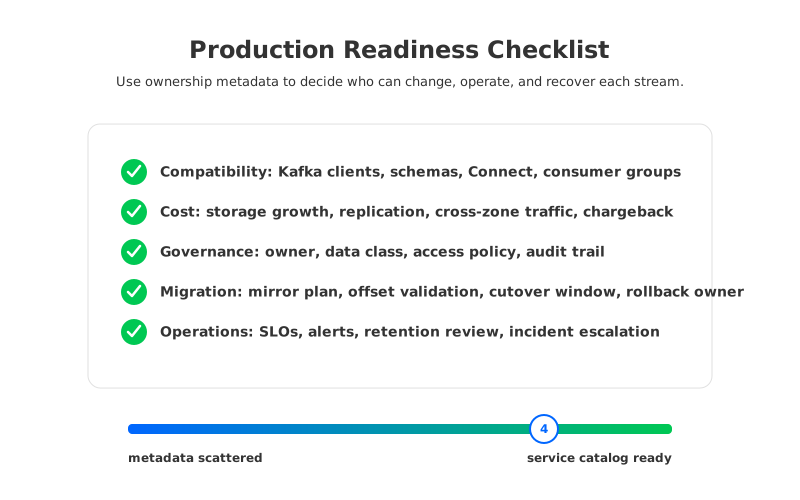
Use these questions in design reviews:
- Compatibility. Can existing producers, consumers, Kafka Connect jobs, and schema tooling continue to work while ownership metadata becomes mandatory?
- Creation workflow. Does every topic request capture business owner, technical owner, data class, contract policy, and retention intent before the topic reaches production?
- Change workflow. Can schema changes, ACL changes, retention changes, and partition changes route to the correct owner without manual detective work?
- Cost workflow. Can the platform attribute storage and traffic growth to a domain, and can the owner explain the business need for retention or fan-out?
- Migration workflow. Can criticality, owner approval, offset validation, and rollback responsibility be tracked per topic during a platform migration?
- Failure workflow. Can alerts route to the team that understands the contract, not only the broker team?
The checklist should be boring by design. Governance that depends on heroic manual review will fail under growth. Developers should request topics through a normal workflow, see visible owners, get automated policy checks, and leave an audit trail for exceptions.
Decision matrices help when teams compare platform options. A managed Kafka service may reduce broker operations but still leave ownership metadata to the customer. A self-managed Kafka platform may provide control but require more automation. A Kafka-compatible shared storage architecture may reduce the operational penalty of topic growth and scaling, but it still needs governance integration around ACLs, schemas, catalogs, and incidents.
Score topic families from 1 to 5 across ownership, contract policy, access evidence, cost accountability, migration readiness, and operational routing. Low scores do not mean the platform is broken; they mean ownership risk is hidden. If a domain scores low on ownership, fix the owner model first. If ownership is strong but retention and scaling remain slow, examine the infrastructure layer.
7How AutoMQ Changes the Operating Model
Once the evaluation framework is clear, AutoMQ becomes relevant as an architectural option rather than a slogan. AutoMQ is a Kafka-compatible cloud-native streaming system that separates broker compute from durable storage by using shared object storage with a write-ahead log design. The key point for ownership stewardship is that many ownership-driven operational changes no longer have to be coupled to broker-local data placement.
In a traditional Kafka cluster, capacity planning often starts with brokers because brokers carry both compute and storage responsibility. In AutoMQ's shared storage architecture, brokers are designed to be more stateless while durable stream data is placed in object storage. That separation lets platform teams scale compute and storage more independently when retention, migration, or traffic requirements change.
This also changes the conversation around cost ownership. If topic metadata identifies the domain that owns retention and replay requirements, the platform can evaluate those requirements against object-storage-backed durability and independent scaling instead of immediately translating them into more broker-local disk.
AutoMQ's Kafka compatibility is equally important. Ownership metadata programs inherit clients, consumer groups, connectors, ACL patterns, schema subjects, and dashboards. A platform that keeps Kafka protocol semantics reduces migration risk because governance improvements can be introduced around familiar Kafka primitives.
Customer-controlled deployment boundaries matter for governance teams as well. In BYOC or private deployment models, the data plane can remain inside the customer's cloud account or controlled environment while the platform team standardizes operations. That boundary can align metadata with cloud accounts, IAM policies, network controls, and audit responsibilities.
Introduce AutoMQ only after the organization knows what it wants from ownership metadata. If the core problem is a missing data catalog, fix the catalog. If the problem is schema review discipline, fix the schema workflow. If the platform also suffers from broker-local storage coupling, slow scaling, cross-zone traffic pressure, and capacity planning friction, a Kafka-compatible shared storage architecture deserves evaluation.
Design the ownership workflow first, then evaluate whether AutoMQ helps execute it with less infrastructure friction. To explore the architecture, start with the AutoMQ overview.
8References
- Apache Kafka documentation: Topic configurations
- Apache Kafka documentation: Consumer configuration and group IDs
- Apache Kafka documentation: Kafka Connect
- Apache Kafka documentation: Semantics
- Apache Kafka wiki: KIP-405: Kafka Tiered Storage
- AWS documentation: Amazon S3 User Guide
- AutoMQ documentation: What is AutoMQ?
- AutoMQ documentation: Architecture overview
- AutoMQ documentation: Table Topic overview
9FAQ
9.1What is topic ownership metadata in Kafka?
Topic ownership metadata identifies who owns a Kafka topic's business meaning, technical operation, access decisions, contract evolution, and cost responsibility. Kafka stores topic configuration and enforces technical controls such as ACLs, but most organizations need metadata that connects topics to domains, data classification, approvals, and incidents.
9.2Should ownership metadata live inside Kafka?
Usually not as the sole source of truth. Kafka topic configuration can carry labels through automation, but stewardship metadata often belongs in a service catalog, developer portal, Terraform workflow, schema governance system, or data catalog. The practical goal is linkage across topics, ACLs, schemas, owners, and audit evidence.
9.3How does topic ownership metadata help with schema governance?
Schema compatibility rules detect structural compatibility, but they cannot decide whether a change is semantically acceptable for a domain. Ownership metadata routes changes to the business and technical owners who understand the contract.
9.4How does this relate to Kafka migration planning?
Migration planning needs per-topic criticality, owner approval, producer cutover responsibility, consumer offset validation, and rollback ownership. If that information is missing, migration teams must reconstruct it manually.
9.5Where does AutoMQ fit in a topic ownership metadata strategy?
AutoMQ fits when governance improvements are constrained by traditional Kafka operational friction. Its Kafka-compatible shared storage architecture separates broker compute from durable storage, reducing the operational penalty of retention growth, scaling, and migration-related parallel running.


