
Table of Contents
Table of Contents
Teams usually search for parquet event archive kafka after the first design has started to strain. The streaming platform is already the system of record for business events, Parquet is already the preferred file format for analytical storage, and the lakehouse team wants fresher data without waiting for another batch window. The awkward part is that Kafka was not supposed to become an unbounded warehouse. It is a log with strong operational semantics, and those semantics become expensive when every archive requirement turns into more broker-local storage, more replica traffic, and more connector recovery work.
The archive itself is not the hard idea. Most data teams can write events into object storage, compact them into Parquet files, and register them in a table format such as Apache Iceberg. The harder question is whether the streaming layer can support that pattern without becoming a storage silo that owns too much history, too much replay load, and too much operational state. If the answer is unclear, the Parquet archive project will look clean on a whiteboard and messy in production.
1Why teams search for parquet event archive kafka
The search phrase is clumsy because the underlying ownership model is clumsy. Application teams think in events, analytics teams think in tables, and platform teams have to keep both sides from accidentally creating a second data warehouse inside Kafka. A fraud detection stream may need low-latency consumers, while the risk analytics team wants the same events as queryable Parquet. A CDC topic may feed operational services, while the lakehouse team wants a durable archive with schema evolution, partition pruning, and table snapshots.
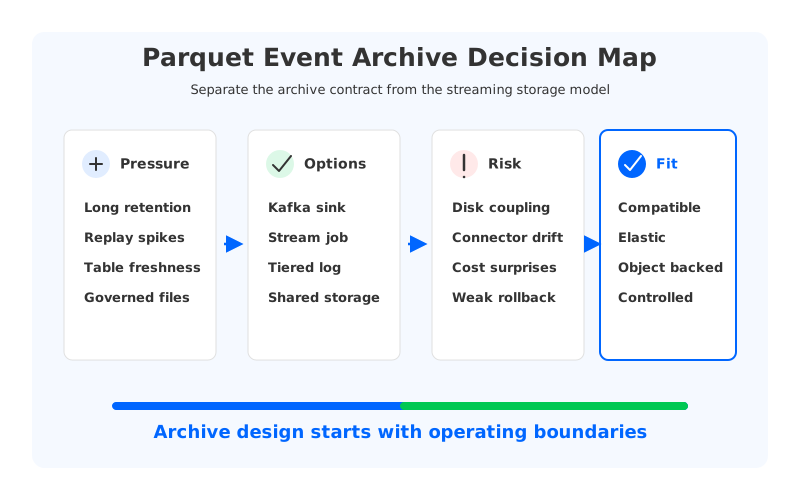
That creates several pressures at once:
- Freshness pressure. Batch export once per day no longer satisfies teams that debug incidents, train features, or run near-real-time reporting from the lakehouse.
- Replay pressure. Backfills, schema corrections, and new consumers need historical events without destabilizing the hot path.
- Governance pressure. Raw events need ownership, access policy, retention rules, and lineage once they leave the message bus.
- Cost pressure. Long Kafka retention, broker disks, inter-zone traffic, connector compute, and object storage requests all appear in different parts of the bill.
The first mistake is treating those pressures as a connector selection problem. Kafka Connect, Flink, Spark Structured Streaming, custom consumers, and managed sink services can all move records toward Parquet. The platform problem sits underneath them: where should durable event history live, how should replay be isolated, and how much state should Kafka brokers own while the archive grows?
2The lakehouse freshness constraint behind the workload
Parquet works well as a columnar file format because analytical engines can skip columns, compress data efficiently, and scan files with predictable layouts. That strength also creates a writer-side constraint. Small, constantly appended files are bad table citizens, while large, perfectly compacted files usually imply latency. A production archive has to choose a file sizing and commit strategy that matches the freshness target, not a generic "stream everything to S3" slogan.
The lakehouse layer adds another contract. Open table formats such as Apache Iceberg track table metadata, snapshots, schema evolution, and partitioning. That means the archive pipeline is not done when bytes land in object storage. It must coordinate file creation, commit visibility, retries, idempotency, and catalog updates so readers see a consistent table rather than a directory full of fragments.
Kafka adds its own semantics to the same path. Consumer groups need offset management, transactions may matter for exactly-once pipelines, and connector tasks need failure handling that does not duplicate or skip records silently. These are good semantics to have. They are also a reminder that a Parquet archive is a boundary between two systems with different ideas of progress: Kafka tracks offsets in an ordered log, while the lakehouse tracks committed files and table snapshots.
3Stream-to-table architecture options
There are four common ways to build the stream-to-table path. None is universally right, and the fastest way to make a poor decision is to rank them only by setup time. The real comparison is how each option handles replay, failure, schema evolution, and the storage model behind the Kafka-compatible API.
| Option | Where it fits | What to validate |
|---|---|---|
| Kafka Connect sink to object storage | Teams already operate Connect and need a straightforward export path | Exactly-once behavior, file sizing, schema registry integration, task recovery, and operational ownership |
| Flink or Spark streaming job | Teams need transformation, enrichment, deduplication, or table-aware commits | Checkpoint recovery, state size, table commit conflicts, and backfill isolation |
| Kafka retention plus periodic batch export | Teams can tolerate less freshness and already have batch governance | Broker storage growth, replay load, export lag, and duplicate export handling |
| Kafka-compatible shared storage with table integration | Teams want Kafka semantics while reducing broker-local storage coupling | Compatibility, WAL behavior, object storage request patterns, and migration risk |
The table hides a subtle point: the export mechanism and the Kafka storage model should be evaluated separately. A Connect sink can be the right export mechanism and still suffer if the upstream cluster is sized around long broker-local retention. A stream processing job can be elegant and still overload the source cluster during a backfill. Conversely, a better Kafka storage model does not remove the need for table governance. It changes the operating envelope in which the archive pipeline runs.
4Why traditional Kafka can become the archive bottleneck
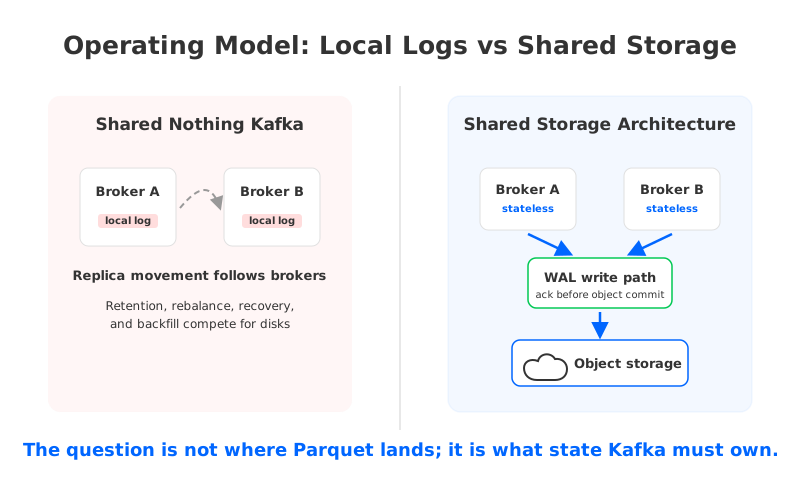
Traditional Kafka follows a Shared Nothing architecture. Each broker owns local log segments for the partitions assigned to it, and replication protects durability by copying data between brokers. This model is proven and familiar, but archive workloads amplify its least elastic parts. Long retention increases local storage requirements. Reassignment moves local data. Broker replacement needs recovery of local state. Backfill consumers compete with hot reads for disk and page cache behavior.
Tiered Storage helps some of this pressure by moving older log data to remote storage. It is valuable when teams need longer retention without keeping every older segment on broker disks. But it does not automatically turn the broker fleet into stateless compute. The operational question remains: how much local state must be protected, moved, warmed, and monitored when the archive grows and replay demand spikes?
Cloud topology makes the same issue more visible. A multi-AZ Kafka deployment provides availability, but replica traffic crosses zones when brokers copy data for durability. Consumers may also cross zones when they read from leaders or replicas outside their local zone. The pricing details depend on the cloud and region, so the responsible move is to model the actual deployment rather than cite a universal number. Still, the pattern is stable: once Kafka becomes the long-term archive source, storage and network costs grow together.
5Evaluation checklist for platform teams
The archive decision should start with the workload contract, then move to platform mechanics. A useful test is to ask whether the platform can survive the worst ordinary day: a schema correction, a replay, a table commit delay, a broker replacement, and a consumer lag spike happening close together. That is not a disaster scenario. It is what happens when a successful data product becomes important enough for many teams to depend on it.
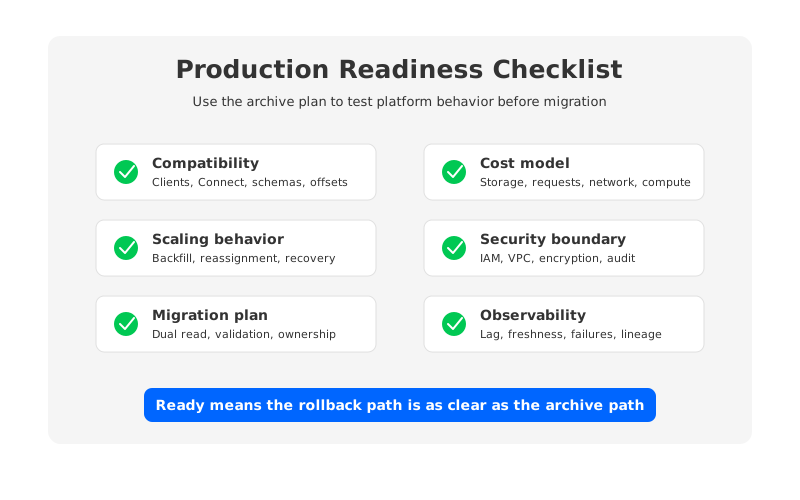
Use this checklist before standardizing on a Parquet archive pattern:
- Kafka compatibility. Confirm the required producer, consumer, admin, transaction, security, schema, and connector behavior. "Kafka-compatible" is not enough; the exact API and operational surface matter.
- Archive commit model. Define how files are sized, when they become visible, how failed commits are retried, and how duplicate files are detected.
- Replay isolation. Test historical reads while hot consumers are running. Backfills should not turn the source cluster into a noisy neighbor for operational consumers.
- Cost model. Include broker compute, broker storage, object storage capacity, object requests, cross-AZ traffic, connector workers, catalog services, and observability.
- Governance boundary. Decide who owns raw topics, curated tables, schemas, retention, access controls, encryption keys, and deletion policy.
- Migration and rollback. Prove how a topic, connector, consumer group, and table can move forward or roll back without losing the ability to explain what happened.
A decision matrix helps because these criteria do not collapse into one metric. The team that optimizes only for the lowest storage price may end up paying through operational risk. The team that optimizes only for connector simplicity may preserve a Kafka layout that cannot absorb archive growth. The right answer is the one whose failure modes the team can operate.
6How AutoMQ changes the operating model
Once the evaluation reaches broker-local storage coupling, AutoMQ becomes relevant as a Kafka-compatible cloud-native streaming platform built around Shared Storage architecture. AutoMQ keeps Kafka protocol and semantic compatibility while replacing the traditional broker-local durability model with S3Stream, WAL storage, and object-storage-backed shared storage. The practical effect is that brokers can focus on Kafka request handling, caching, partition leadership, and scheduling rather than owning durable log data as local disk state.
That distinction matters for Parquet event archives because the platform no longer has to scale storage history and broker compute in lockstep. AutoMQ writes data through a WAL path for persistence, then organizes durable stream data in object storage. When partitions are reassigned or brokers are replaced, the system does not need to copy a large local log archive from one broker to another. The archive pipeline still has to manage table commits and schemas, but the Kafka substrate is less likely to turn long retention into a broker disk project.
AutoMQ also changes the network-cost conversation in multi-AZ deployments. Its documented cross-AZ traffic model uses S3-backed shared storage and zone-aware routing so broker-to-broker replica replication is not the same cost driver it is in a traditional Kafka layout. This does not remove the need to model cloud pricing. It narrows the question to the actual traffic paths that remain: producer and consumer locality, object storage access, connector placement, and table catalog operations.
Table Topic is the most direct AutoMQ feature for teams trying to connect streaming data with lakehouse tables. AutoMQ documentation describes Table Topic as built-in Iceberg integration for flowing streaming data into a data lake for analysis and querying. That does not mean every Parquet archive should skip Flink, Spark, or Kafka Connect. It means the platform team has another option when the desired output contract is an open table rather than another operational consumer.
The cleanest way to evaluate this architecture is to run it against the same checklist used for every option. Start with existing Kafka clients and tools. Validate producer and consumer behavior, offset handling, security controls, connector assumptions, and failure recovery. Then test the archive-specific path: write rate, file visibility, table freshness, replay load, object storage behavior, and rollback. Architecture changes are only valuable when they reduce the work your team actually has to operate.
7Migration scorecard
Before migrating a production archive workload, score the project in three categories. A low score does not mean the architecture is wrong. It means the migration plan is not ready to carry production history.
| Category | Good signal | Risk signal |
|---|---|---|
| Workload clarity | Retention, replay, freshness, and table ownership are written down | The archive is described only as "Kafka to Parquet" |
| Platform readiness | Compatibility, scaling, recovery, and cost tests use production-like topics | Tests cover happy-path writes but not backfills or broker replacement |
| Operating boundary | Topic owners, table owners, and rollback owners are named | Connector failures and bad table commits bounce between teams |
The scorecard forces a useful conversation. Many archive failures are not caused by Parquet, Kafka, or object storage alone. They happen because the team made the archive path visible before the ownership path was visible. A production-ready design says who can change schemas, who can replay data, who can approve retention changes, and who can declare a table snapshot bad.
If your current design is pushing Kafka toward the role of a storage silo, evaluate the substrate before adding another export job. AutoMQ is worth testing when you need Kafka compatibility, object-storage-backed durability, elastic broker operations, customer-controlled deployment boundaries, and a path toward lakehouse integration. The next step is to run a workload-shaped proof of concept through the same migration scorecard, not to accept an architecture diagram as proof. You can start from the verified AutoMQ console path here: explore AutoMQ.
8References
- Apache Kafka documentation
- Apache Kafka Connect documentation
- Apache Kafka message delivery semantics
- Apache Kafka Tiered Storage documentation
- Apache Parquet documentation
- Apache Iceberg documentation
- AWS S3 pricing
- AutoMQ Shared Storage architecture overview
- AutoMQ native Kafka compatibility
- AutoMQ WAL storage
- AutoMQ Table Topic overview
- AutoMQ cross-AZ traffic documentation
9FAQ
9.1Is Kafka a good long-term archive for Parquet workloads?
Kafka can retain data for long periods, and Tiered Storage can extend that model. The key question is whether long-term history should remain a broker-owned operational concern. For many lakehouse workloads, Kafka is better treated as the event contract and replay interface, while object storage and table metadata carry the analytical archive.
9.2Do I need Kafka Connect, Flink, or Spark to write Parquet from Kafka?
Not always, but many teams use one of them. Kafka Connect fits straightforward sink workloads, while Flink and Spark fit transformation-heavy or stateful pipelines. A platform-native table feature can be useful when the desired output is a governed table and the team wants fewer moving parts, but it still needs compatibility, governance, and failure testing.
9.3How does Parquet file sizing affect freshness?
Small files improve freshness but hurt scan efficiency and table maintenance. Larger files improve analytical performance but increase end-to-end latency. The right target depends on the query engine, partitioning strategy, event volume, and whether compaction is handled continuously or in scheduled maintenance.
9.4What should be tested before moving a Kafka archive to AutoMQ?
Test existing clients, consumer groups, security settings, connector assumptions, replay behavior, and table freshness against production-like topics. Then test failure paths: broker replacement, connector restart, table commit failure, object storage throttling, and rollback. The value of Shared Storage architecture is strongest when those tests show less broker-local data movement and clearer scaling behavior.
9.5Does Shared Storage architecture remove lakehouse governance work?
No. It changes the Kafka operating model, but governance still belongs to the data contract. Teams still need schema ownership, access control, retention policy, lineage, table maintenance, and documented recovery procedures.


